

Originally a small fishing village, Sittwe became an important seat of maritime commerce, especially as a port for the export of rice after the British occupation of Arakan, now known as Rakhine State
Credit: DANIEL JULIE from Paris, France · CC BY 2.0 · source

Border Bridge at Moreh between India and Myanmar
Credit: Neilsatyam · CC BY-SA 4.0 · source
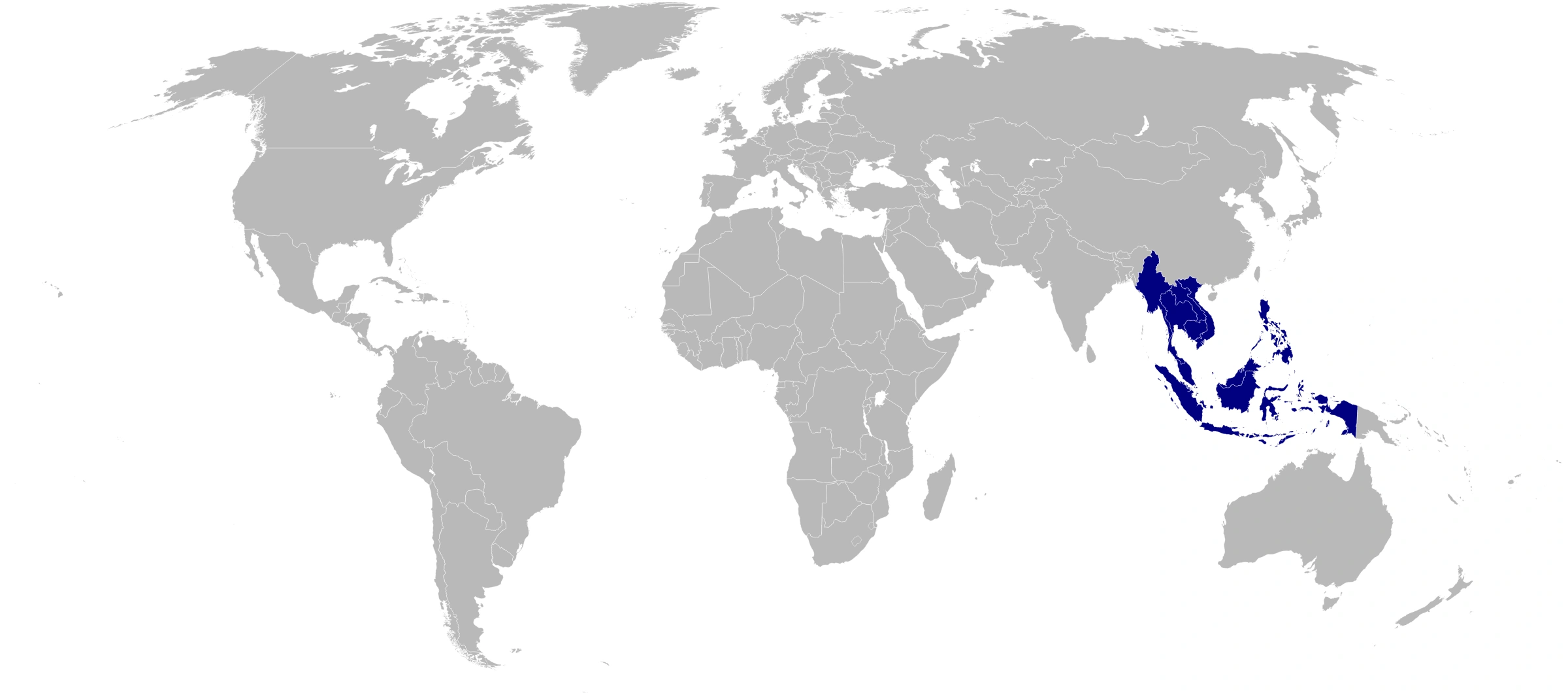
Map study
ASEAN geography as depicted in the source map: compare mainland and maritime Southeast Asia. Verify current membership separately.
- Read the source date and legend; distinguish territory, influence and geographic location.
- Historical boundaries and reference memberships are not live political or operational data.
Credit: Mangwanani · Public domain · sourceConverted to WebP on an opaque white background; proportionally resized without cropping. Original cartography and legend retained.
1. Why Myanmar matters to India
Myanmar occupies the junction of South Asia, Southeast Asia and the Bay of Bengal. For India, it is simultaneously a neighbour, a gateway under the Act East Policy and a security partner affecting the Northeast. Its location links India’s Neighbourhood First approach with ASEAN engagement and the wider Indo-Pacific. Shared Buddhist traditions, historical commercial exchanges and an Indian-origin population provide additional foundations for relations.
The land boundary cuts across communities with close ethnic and familial ties, including Naga and Mizo–Chin populations. Consequently, developments inside Myanmar are not purely external affairs: they influence migration, local livelihoods, ethnic relations and policing within India. Mizoram and Manipur can experience the same regional crisis differently, making consultation with state governments essential.
Myanmar also offers potential access to Southeast Asian markets and alternative transport routes for the Northeast. Its coastline, natural gas resources and proximity to the Andaman and Nicobar Islands add maritime significance. However, geography creates opportunities rather than guaranteed outcomes. Reliable connectivity requires security, customs cooperation, commercially viable logistics and acceptance among communities along project routes.
- Core interests: a secure Northeast, regional connectivity, humanitarian stability and strategic autonomy.
- Diplomatic challenge: pursue these interests without treating support for Myanmar’s people and practical engagement with its authorities as mutually exclusive.
Timeline
1948
Burma became independent; India established diplomatic relations.
2008
India and Myanmar signed the framework agreement for the Kaladan project.
2017
Mass Rohingya displacement from Rakhine State intensified the regional humanitarian crisis.
February–April 2021
The military coup was followed by ASEAN’s adoption of the Five-Point Consensus.
2023
Sittwe port was inaugurated in May; Operation 1027 began in October.
February 2024
India announced plans to fence the border and scrap the Free Movement Regime.
2. Political crisis and India’s diplomatic choices
Myanmar’s armed forces, known as the Tatmadaw, retained substantial political power even during the civilian-led transition. The 2008 Constitution reserved one-quarter of parliamentary seats for the military and protected its institutional influence. On 1 February 2021, the military overthrew the elected government following the National League for Democracy’s victory in the November 2020 election. Protests, repression and armed resistance subsequently expanded into a nationwide conflict.
The conflict involves the military authorities, the opposition National Unity Government, People’s Defence Forces and multiple ethnic armed organisations. These actors have differing objectives and do not form a single cohesive opposition. Operation 1027, launched in October 2023 by the Three Brotherhood Alliance, illustrated the military’s vulnerability and the growing importance of territorial control by non-state actors. India therefore cannot assume that agreements with central authorities alone guarantee access or security.
India has called for cessation of violence, release of political detainees and restoration of the democratic process while maintaining official engagement. This reflects concerns over border security, stranded citizens, connectivity and China’s influence. Yet excessive dependence on military authorities risks weakening India’s credibility among democratic and ethnic constituencies. A balanced approach requires communication with a wider range of stakeholders, without presuming that India can determine Myanmar’s political settlement.
ASEAN’s Five-Point Consensus, adopted in April 2021, calls for an end to violence, constructive dialogue, mediation by a special envoy, humanitarian assistance and an envoy’s visit to meet concerned parties. Its limited implementation demonstrates the difficulty of consensus-based diplomacy when armed actors resist accommodation.
Conflict-sensitive neighbourhood diplomacy
- 1. Map territorial control and humanitarian needs
- 2. Consult northeastern states and affected communities
- 3. Maintain official contact and widen stakeholder communication
- 4. Deliver screened, needs-based assistance and secure viable connectivity segments
- 5. Coordinate regional diplomacy and review measurable outcomes
3. Border security, displacement and humanitarian obligations
The India–Myanmar border traverses difficult terrain and historically supported substantial local movement. Insurgent groups from India’s Northeast have used territory across the border, while trafficking in narcotics, arms and people creates overlapping security challenges. Myanmar’s position within the Golden Triangle makes drug trafficking particularly relevant. Nevertheless, refugees, ordinary border residents and organised criminal networks must not be treated as interchangeable categories.
The Free Movement Regime facilitated limited cross-border travel by eligible border residents without a visa, subject to prescribed conditions. In February 2024, the Union government announced its decision to scrap the regime and fence the border, citing security and demographic concerns. These announcements should not be presented as proof that fencing or uniform replacement arrangements were immediately completed. Physical barriers also raise questions about terrain, cost, divided villages and traditional community ties.
Displacement after the coup brought people, especially from Chin areas, into India’s Northeast. Separately, the Rohingya crisis arose principally from persecution and mass displacement from Rakhine State, particularly in 2017. These are connected humanitarian challenges but have distinct origins and demographic patterns. India is not a party to the 1951 Refugee Convention or its 1967 Protocol and lacks a comprehensive national refugee statute. Constitutional protections available to persons, security legislation and international humanitarian considerations remain relevant.
A workable response combines registration and screening with access to essential assistance, action against trafficking and consultation with receiving states. Return should be assessed against actual safety conditions rather than assumed from diplomatic assurances alone. Humanitarian access should also avoid strengthening coercive actors or excluding vulnerable communities.
| Initiative | Geographical focus | Strategic significance | Principal constraint |
|---|---|---|---|
| Kaladan project | Kolkata–Sittwe–Paletwa–Mizoram | Alternative access to the Northeast | Conflict and incomplete connecting infrastructure |
| Trilateral Highway | Moreh–Myanmar–Mae Sot | Overland integration with Southeast Asia | Construction delays, insecurity and transit arrangements |
| Border trade infrastructure | Moreh–Tamu and Zokhawthar–Rih | Local livelihoods and formal commerce | Disruptions, inadequate logistics and informal trade |
| China–Myanmar Economic Corridor | Yunnan–Myanmar, including Kyaukphyu | Chinese access towards the Indian Ocean | Conflict, implementation risks and local concerns |
4. Connectivity, commerce and the China factor
The Kaladan Multi-Modal Transit Transport Project envisages movement from Kolkata to Sittwe port in Rakhine State, inland water transport to Paletwa in Chin State, and an onward road connection towards Zorinpui in Mizoram. Sittwe port was inaugurated in May 2023. This milestone did not mean that the entire corridor had become operational: incomplete links, difficult terrain and conflict continued to constrain end-to-end connectivity.
The India–Myanmar–Thailand Trilateral Highway aims to connect Moreh in Manipur with Mae Sot in Thailand through Myanmar. Road and bridge works, political instability and insecurity have delayed its potential benefits. Physical construction must be complemented by transit arrangements, predictable customs procedures, vehicle permissions, border infrastructure and insurance. Moreh–Tamu and Zokhawthar–Rih are important border interfaces, but conflict can disrupt formal commerce and redirect trade through informal channels.
China’s influence rests on economic relations, infrastructure, arms supplies and contacts with multiple actors. The China–Myanmar Economic Corridor, including projects around Kyaukphyu, and oil and gas pipelines linking the coast with Yunnan give Beijing access towards the Indian Ocean. Myanmar nevertheless has its own strategic concerns and should not be reduced to a passive Chinese proxy. India’s comparative strengths include proximity, development partnerships, capacity-building and social connections. Delivering dependable projects is more useful than merely announcing alternatives to China.
5. A practical framework for Indian policy
India needs calibrated, multi-channel diplomacy: continued official contact for necessary functions, wider communication with democratic and ethnic stakeholders, and support for an inclusive Myanmar-led political process. Engagement should not imply endorsement of repression. Coordination with ASEAN and Bangladesh can address humanitarian access and displacement, while cooperation with willing development partners can support resilient infrastructure and civilian capacity.
Domestically, Myanmar policy requires cooperative federalism. The Ministry of External Affairs, Ministry of Home Affairs, border forces and northeastern state governments need shared information and clearly assigned responsibilities. Local consultation can improve border regulation, identify legitimate mobility needs and prevent security measures from deepening alienation. Better surveillance, designated crossings and anti-trafficking investigations should complement, rather than be replaced by, fencing.
Success should be measured through outcomes: fewer violent border incidents, safer humanitarian access, functioning project segments, transparent assistance and reliable trade. Project design must incorporate conflict sensitivity, community benefits and contingency routes. India’s long-term interest lies in a peaceful, inclusive and sovereign Myanmar that can cooperate with all neighbours without becoming dependent on any single external power.
Real-world case studies
Sittwe port: infrastructure is not the same as connectivity
The May 2023 inauguration demonstrated tangible progress under Kaladan. However, inland transport and road links remained essential to reaching Mizoram. Conflict around the corridor shows why port completion alone cannot establish commercial viability or reliable access.
Mizoram and displacement from Chin State
Ethnic and kinship connections shaped Mizoram’s reception of people fleeing Myanmar after the 2021 coup. The experience illustrates how national security priorities intersect with local humanitarian commitments, requiring structured Centre–state coordination rather than a uniform response detached from border society.
Previous year questions
No source-linked PYQ is available here yet. Use the practice questions below.
Practice questions
Practice MCQ 1
Which Indian states share a land boundary with Myanmar?
- A. Arunachal Pradesh, Nagaland, Manipur and Mizoram
- B. Assam, Meghalaya, Manipur and Mizoram
- C. Arunachal Pradesh, Assam, Nagaland and Tripura
- D. Nagaland, Manipur, Mizoram and Tripura
Practice MCQ 2
Which sequence correctly represents the envisaged Kaladan transport corridor from India’s eastern coast towards Mizoram?
- A. Kolkata–Yangon–Mandalay–Moreh
- B. Kolkata–Sittwe–Paletwa–Zorinpui
- C. Chennai–Kyaukphyu–Mae Sot–Zorinpui
- D. Kolkata–Chattogram–Tamu–Moreh
Practice MCQ 3
Consider the following statements: 1. Myanmar is the only ASEAN member sharing a land border with India. 2. ASEAN’s Five-Point Consensus provides for humanitarian assistance and dialogue. 3. India is a party to the 1951 Refugee Convention. Which statements are correct?
- A. 1 only
- B. 2 and 3 only
- C. 1 and 2 only
- D. 1, 2 and 3
Mains practice · India’s Myanmar policy must reconcile border security with humanitarian responsibility and regional connectivity. Discuss in the context of Myanmar’s political fragmentation. Answer in 250 words.
- Establish Myanmar’s significance for the Northeast, Act East and the Bay of Bengal.
- Explain why fragmented territorial control limits exclusively government-to-government diplomacy.
- Assess insurgency, trafficking, displacement and cross-border ethnic ties separately.
- Discuss the Free Movement Regime debate and Centre–state coordination.
- Use Kaladan and the Trilateral Highway to distinguish infrastructure creation from operational connectivity.
- Recommend inclusive engagement, humanitarian safeguards, ASEAN coordination and measurable project delivery.
Further reading
- Ministry of External Affairs: India–Myanmar bilateral relations brief and annual reports.
- Ministry of Home Affairs: annual reports and February 2024 announcements on the Myanmar border.
- ASEAN: Chairman’s Statement on the ASEAN Leaders’ Meeting, 24 April 2021.
- Ministry of Ports, Shipping and Waterways: official releases on Sittwe port and the Kaladan project.
- UN OCHA: Myanmar humanitarian updates and response plans.
Preparing for UPSC Civil Services? Get classroom teaching, answer-writing evaluation and mentorship at Pragnya IAS Academy, Ashok Nagar — see why aspirants choose us for IAS coaching in Hyderabad.