

The Union Home Minister, Shri Sushilkumar Shinde inaugurating the Joint Retreat Ceremony of Border Security Force and the Border Guard Bangladesh at Petrapole-Benapole, 24 Parganas (North), West Benga
Credit: Ministry of Home Affairs · GODL-India · source

Da (knife), the beekeepers of the Sundarbans use it to cut beehives. Collected from Satkshira.
Credit: ROCKY · CC BY-SA 4.0 · source
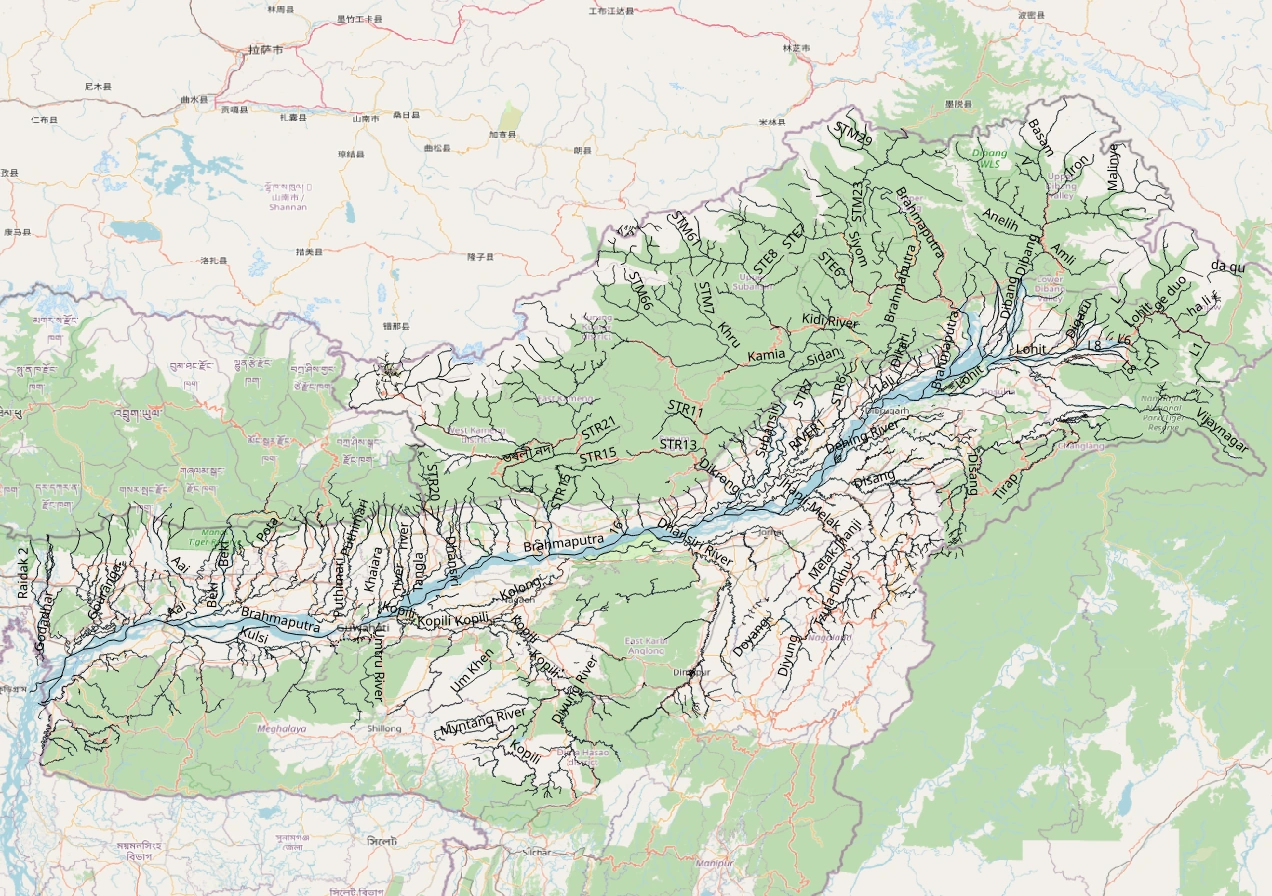
Map study
Brahmaputra basin: trace the transboundary river through Tibet, India and Bangladesh, relating mountain relief and floodplains to flood risk.
- Read the source legend, scale and reference period before comparing regions.
- Connect spatial patterns to the processes discussed in this topic; this map is a study reference, not live operational data.
Credit: Heinz OSM · ODbL · sourceConverted to WebP on an opaque white background; proportionally resized without cropping. Original cartography and legend retained.
1. Strategic importance and historical foundations
Bangladesh occupies a pivotal position between India’s eastern mainland, the Northeast and the Bay of Bengal. Its territory adjoins five Indian states and lies close to the Siliguri Corridor, which connects the Northeast with the rest of India. Cooperation can reduce transport distances, open additional access routes and integrate border regions into regional production networks. Bangladesh is therefore simultaneously a neighbourhood partner, an Act East gateway and an important participant in Bay of Bengal cooperation.
The relationship rests on linguistic, cultural and economic links as well as India’s support for Bangladesh’s Liberation War. In 1971, India received approximately ten million refugees from then East Pakistan and supported Bangladesh’s emergence as an independent state. Recognition on 6 December and the surrender of Pakistani forces in Dhaka on 16 December remain important historical reference points. Subsequent relations fluctuated with changes in Bangladesh’s domestic politics, security policies and perceptions of Indian influence.
Strategic importance should not obscure Bangladesh’s agency. Its governments seek export markets, investment, climate resilience and diversified external partnerships. Effective Indian diplomacy must therefore reconcile India’s security requirements with Bangladesh’s expectations of sovereign equality and tangible economic benefits. Shared history is an asset, but cannot substitute for contemporary public trust.
- Principal regional platforms include BIMSTEC, the BBIN framework, SAARC and the Indian Ocean Rim Association.
- For GS-II, connect Bangladesh with neighbourhood diplomacy, cooperative federalism, regional connectivity and the domestic determinants of foreign policy.
Timeline
1971
India recognised Bangladesh on 6 December; Pakistani forces surrendered in Dhaka on 16 December.
1972–1974
The Joint Rivers Commission was established in 1972, followed by the Land Boundary Agreement in 1974.
1996
The 30-year Ganga Water Sharing Treaty was signed.
2014–2015
The maritime boundary arbitration concluded in 2014; the land boundary settlement was implemented in 2015.
2023
The Friendship Pipeline and Akhaura–Agartala rail link were inaugurated.
August 2024
Sheikh Hasina resigned; an interim government led by Muhammad Yunus took office.
2. Boundary settlement, border management and security
Boundary cooperation provides the strongest evidence that difficult bilateral disputes can be resolved through negotiation. The 1974 Land Boundary Agreement, supplemented by the 2011 Protocol, addressed enclaves, adverse possessions and undemarcated segments. Following India’s constitutional amendment, 111 Indian enclaves in Bangladesh and 51 Bangladeshi enclaves in India were exchanged in 2015. Residents received a citizenship choice, helping end prolonged uncertainty over public services, political representation and legal identity.
The maritime boundary was settled through a 2014 arbitral award under the United Nations Convention on the Law of the Sea. Acceptance of the award reduced uncertainty in the Bay of Bengal and created a clearer basis for fisheries management, offshore resource activity and maritime cooperation. Together, the land and maritime settlements demonstrate the value of legal mechanisms backed by political consent.
Operational challenges nevertheless persist along densely populated, riverine and economically interconnected border areas. These include trafficking, narcotics, cattle smuggling, irregular migration and document fraud. Bangladeshi action against anti-India insurgent networks has significantly benefited security in the Northeast. Cooperation should combine intelligence exchange and coordinated border management with proportionate law enforcement. Border deaths can undermine broader goodwill; livelihood opportunities, lawful crossing arrangements and accountability are therefore security instruments as well as humanitarian concerns.
- Distinguish irregular migration from trafficking, refugee protection and legitimate cross-border mobility.
- Border management requires coordination among the BSF, Border Guard Bangladesh, civil administrations and affected communities.
Turning connectivity infrastructure into shared prosperity
- 1. Identify commercially viable cross-border routes
- 2. Agree on transit, customs and security arrangements
- 3. Complete infrastructure and last-mile links
- 4. Ensure predictable tariffs and reliable operations
- 5. Connect local producers and logistics businesses
- 6. Monitor economic benefits and community impacts
3. Trade, connectivity, energy and development partnership
Bangladesh is one of India’s leading trading partners in South Asia. Bilateral merchandise trade was approximately US$12.9 billion in financial year 2023–24, with Indian exports substantially exceeding imports. India supplies cotton, machinery, petroleum products and other industrial inputs, while Bangladesh’s exports include garments and manufactured goods. The trade imbalance is politically sensitive, but the policy response should emphasise productive investment, improved market access and supply-chain integration rather than treating every deficit as evidence of exploitation.
Connectivity cooperation seeks to restore routes disrupted by Partition and create new multimodal networks. The Protocol on Inland Water Transit and Trade facilitates river transport, while arrangements for Indian cargo through Chattogram and Mongla ports improve potential access to the Northeast. The Akhaura–Agartala cross-border rail link was inaugurated in November 2023. However, infrastructure inauguration must be distinguished from dependable commercial operation: customs procedures, rolling stock, last-mile links and predictable transit rules determine actual benefits.
Energy interdependence includes electricity trade through the Bheramara and Tripura–Comilla interconnections, supply from the Godda power plant and the India–Bangladesh Friendship Pipeline, inaugurated in March 2023 to transport diesel from India to Parbatipur. The Maitree thermal power project at Rampal represents another major joint undertaking. Such projects can strengthen energy security, but pricing, payment sustainability and environmental concerns require transparent management.
India has extended three major sovereign lines of credit amounting to about US$8 billion for infrastructure and other development projects. Delivery matters as much as financial commitments: land acquisition, procurement conditions, project preparation and implementation capacity can delay outcomes. Border haats, scholarships, medical travel and digital links can spread the benefits of cooperation beyond capital-intensive projects.
- A proposed Comprehensive Economic Partnership Agreement should be assessed through market access, investment, services and adjustment costs.
- Bangladesh’s scheduled graduation from least developed country status in 2026 increases the importance of future trade arrangements.
| Instrument or mechanism | Issue | Significance |
|---|---|---|
| Land Boundary Agreement, 1974; Protocol, 2011 | Enclaves and disputed boundary segments | Implemented in 2015 after India’s constitutional amendment |
| Ganga Water Sharing Treaty, 1996 | Dry-season flows at Farakka | Time-bound water-sharing framework with a 30-year duration |
| UNCLOS arbitral award, 2014 | Maritime delimitation | Peaceful settlement through international adjudication |
| BBIN Motor Vehicles Agreement, 2015 | Regional road transport | Implementation requires operational protocols; Bhutan’s non-ratification constrained four-country operation |
| Protocol on Inland Water Transit and Trade | River-based trade and transit | Supports lower-cost regional and Northeast connectivity |
4. River diplomacy, ecology and human security
The sharing of 54 rivers makes water diplomacy a permanent feature of bilateral relations. The 1996 Ganga Water Sharing Treaty governs dry-season sharing at Farakka through an agreed formula and monitoring arrangements. Its 30-year duration makes timely review especially important. The unresolved Teesta issue illustrates the difficulty of allocating limited dry-season flows among competing agricultural, ecological and domestic needs.
Water negotiations also reveal the importance of Indian federalism. The proposed Teesta agreement was not concluded in 2011 amid objections from West Bengal. Although foreign affairs fall within the Union’s domain, implementation and political legitimacy require meaningful engagement with affected states. Technical evidence, reliable flow data and compensation or adaptation measures can help reconcile subnational concerns with national diplomatic objectives.
A basin-oriented approach should supplement allocation negotiations. Priorities include flood forecasting, sediment management, riverbank erosion, pollution control and climate adaptation. Cooperation on the Sundarbans is particularly valuable because cyclones, salinity intrusion, biodiversity loss and livelihood insecurity cross political boundaries. Bangladesh’s hosting of a large Rohingya refugee population in Cox’s Bazar also affects regional stability. India should support humanitarian assistance and conditions for safe, voluntary and dignified return to Myanmar, without conflating refugees with security threats.
- Water cooperation works best when dry-season scarcity and monsoon flood management are treated as connected issues.
- Joint scientific assessments can reduce misinformation, though technical cooperation cannot replace political agreement.
5. Political transition, external competition and India’s policy choices
The August 2024 political upheaval, Sheikh Hasina’s departure and the formation of an interim government under Muhammad Yunus created a major diplomatic challenge. India needed to preserve working relations with Bangladesh’s institutions while addressing border security, continuity of projects and the safety of minorities and other vulnerable communities. The episode underlined the risks of allowing a bilateral relationship to become publicly identified with one leader or party.
China is an important source of infrastructure finance, trade and defence equipment for Bangladesh. India should assess specific strategic implications without assuming that every Chinese project represents an anti-India alignment. Bangladesh also engages Japan, the United States and European partners. Competitive project delivery, transparent finance and regional public goods offer India a more sustainable response than demands for exclusive strategic loyalty.
The way forward is broad-based engagement with government institutions, political stakeholders, businesses, universities and civil society, consistent with non-interference. India should prioritise reliable connectivity, humane border practices, water negotiations, project completion and evidence-based public communication. Bangladesh’s stability cannot be secured through bilateral diplomacy alone, but predictable Indian policy can reduce mistrust. For Mains answers, the central proposition is that strategic reassurance and sovereign equality must reinforce, rather than displace, practical economic cooperation.
- Avoid equating criticism of a particular government with hostility towards the neighbouring country.
- Evaluate new political developments separately from durable geographic, economic and institutional interests.
Real-world case studies
The 2015 enclave exchange: diplomacy with a human dimension
The exchange of 162 enclaves resolved an inherited territorial anomaly that had left many residents with weak access to administration and basic services. Parliamentary consensus and cooperation with affected states enabled implementation. The lesson is that territorial settlements should be judged not only by land exchanged but also by citizenship security, service delivery and rehabilitation.
The 2014 maritime award: managing disagreement through law
An arbitral tribunal constituted under UNCLOS settled the India–Bangladesh maritime boundary dispute. Both countries accepted the outcome, allowing a sensitive sovereignty question to be handled without prolonged confrontation. The case illustrates how international legal processes can support neighbourhood stability when governments demonstrate political restraint.
Previous year questions
No source-linked PYQ is available here yet. Use the practice questions below.
Practice questions
Practice MCQ 1
Which of the following Indian states does not share a land boundary with Bangladesh?
- A. Meghalaya
- B. Mizoram
- C. Manipur
- D. Tripura
Practice MCQ 2
Consider the following statements: 1. The 1996 Ganga Water Sharing Treaty was concluded for 30 years. 2. The Teesta water-sharing agreement was signed in 2011. 3. India and Bangladesh established a Joint Rivers Commission in 1972. Which statements are correct?
- A. 1 and 2 only
- B. 1 and 3 only
- C. 2 and 3 only
- D. 1, 2 and 3
Practice MCQ 3
Consider the following pairs: 1. Constitution (One Hundredth Amendment) Act: India–Bangladesh land boundary settlement. 2. Bheramara: Cross-border electricity cooperation. 3. Chattogram and Mongla: Nepalese inland ports. How many pairs are correctly matched?
- A. Only one
- B. Only two
- C. All three
- D. None
Mains practice · India–Bangladesh relations demonstrate that geographic interdependence does not automatically generate political trust. Examine and suggest measures to build a resilient bilateral partnership. Answer in 250 words.
- Introduce Bangladesh’s importance for the Northeast, Bay of Bengal and Neighbourhood First policy.
- Highlight boundary settlements, counterinsurgency cooperation, energy trade and multimodal connectivity.
- Explain tensions involving water sharing, border deaths, trade imbalance and domestic political perceptions.
- Discuss political transitions and external partnerships without reducing Bangladesh’s choices to India–China rivalry.
- Recommend institutional engagement, state consultation, humane border management and faster project delivery.
- Conclude with sovereign equality, public trust and mutually beneficial interdependence.
Further reading
- Ministry of External Affairs: India–Bangladesh bilateral relations brief and annual reports.
- Department of Commerce: Export Import Data Bank for bilateral merchandise trade.
- Ministry of Jal Shakti: Joint Rivers Commission and the 1996 Ganga Water Sharing Treaty.
- Ministry of Home Affairs: Annual reports on border management.
- Permanent Court of Arbitration: Bay of Bengal Maritime Boundary Arbitration between Bangladesh and India, Award of 7 July 2014.
- NCERT: Contemporary World Politics, chapter on Contemporary South Asia.
Preparing for UPSC Civil Services? Get classroom teaching, answer-writing evaluation and mentorship at Pragnya IAS Academy, Ashok Nagar — see why aspirants choose us for IAS coaching in Hyderabad.