
Map study
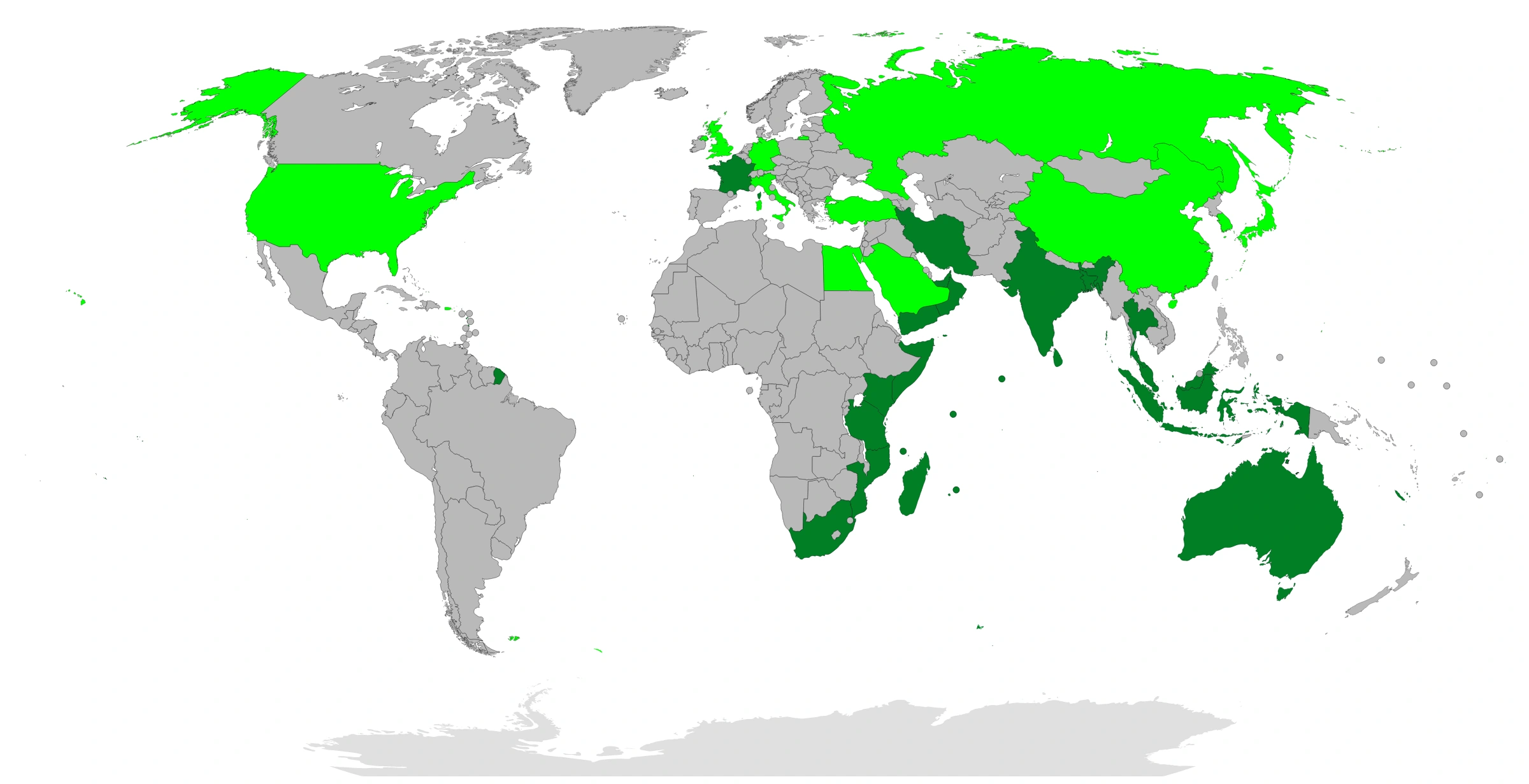
IORA members around the Indian Ocean as shown in the source map. IORA is not QUAD; use this for shared oceanic geographic context only.
- Read the source date and legend; distinguish territory, influence and geographic location.
- Historical boundaries and reference memberships are not live political or operational data.
Credit: Underdwarf58 · CC BY-SA 4.0 · sourceConverted to WebP on an opaque white background; proportionally resized without cropping. Original cartography and legend retained.
Origins, evolution and institutional character
The Quad emerged from practical cooperation rather than a founding treaty. After the December 2004 Indian Ocean tsunami, India, Australia, Japan and the United States formed a core group to coordinate relief. Their complementary naval, airlift and logistical capabilities demonstrated the value of cooperation across the Indian and Pacific Oceans. Japan’s Prime Minister Shinzo Abe subsequently promoted closer cooperation among the four democracies, and officials held an initial quadrilateral meeting in 2007.
The early arrangement lost momentum amid differing strategic priorities and sensitivities about China. Its revival in November 2017 reflected growing concern over maritime coercion, changing regional power balances and vulnerabilities in connectivity and supply chains. Engagement progressed from senior officials to foreign ministers and then leaders. The first virtual leaders’ summit in March 2021 was followed by an in-person summit in Washington in September 2021.
Institutionally, the Quad is an informal, consensus-based minilateral partnership: a small group cooperating within the wider international order. It has no permanent secretariat, founding charter, integrated military command or automatic obligation to defend another member. Leaders’ declarations guide working groups and practical initiatives. This flexibility encourages participation, but implementation depends on national agencies, funding and sustained political attention rather than enforceable supranational decisions.
Timeline
December 2004
The four countries coordinate Indian Ocean tsunami relief through a core group.
2007
The first quadrilateral officials’ meeting is held; the initiative subsequently loses momentum.
November 2017
Quadrilateral consultations resume on the sidelines of ASEAN-related meetings in Manila.
2019
The first Quad foreign ministers’ meeting takes place in New York.
2021
The first virtual leaders’ summit in March and first in-person leaders’ summit in September elevate the partnership.
2022–2024
Cooperation expands through IPMDA, cable resilience initiatives, the Cancer Moonshot and MAITRI.
Strategic rationale and the Indo-Pacific order
The Quad’s central strategic objective is an Indo-Pacific where states can make choices without coercion and maritime access remains governed by international law. Its members support freedom of navigation and overflight, sovereignty, territorial integrity and peaceful settlement of disputes. These principles matter because major energy shipments, commercial sea lanes and submarine communications cables traverse the region. UNCLOS provides the principal legal framework for ocean governance, although the United States has not ratified it.
China is an important contextual driver, but describing the Quad solely as an anti-China coalition is incomplete. Concerns include unilateral changes to the status quo, militarisation of disputed features, economic coercion and opaque infrastructure dependencies. Nevertheless, members retain substantial economic relationships with China and differ in their threat perceptions. India’s continental border concerns, Japan’s East China Sea interests and Australia’s and America’s Pacific priorities do not always converge.
The Quad therefore combines strategic signalling with the provision of regional public goods. Its declarations affirm ASEAN centrality and support the ASEAN Outlook on the Indo-Pacific. This is important because Southeast Asian states generally resist being forced into rival camps. Cooperation with Indian Ocean states and Pacific island countries must similarly respond to local priorities such as climate resilience, fisheries protection and infrastructure, rather than treating them merely as arenas of great-power competition.
How Quad cooperation produces regional public goods
- 1. Identify shared regional needs and strategic vulnerabilities.
- 2. Agree on priorities through leaders and ministerial consultations.
- 3. Allocate contributions across national agencies and partner institutions.
- 4. Deliver finance, technology, training or operational assistance.
- 5. Assess uptake and outcomes with participating regional countries.
Major areas of functional cooperation
Maritime domain awareness is a prominent workstream. Announced at the Tokyo summit in May 2022, the Indo-Pacific Partnership for Maritime Domain Awareness seeks to help regional partners understand activities in their waters using commercially available data and existing information-sharing arrangements. Better awareness can support responses to illegal fishing, trafficking and vessels concealing their activity. At Wilmington in September 2024, leaders announced the Maritime Initiative for Training in the Indo-Pacific, or MAITRI, to help partners use such capabilities.
Health cooperation expanded during the COVID-19 pandemic. The 2021 Quad Vaccine Partnership sought to combine Indian manufacturing, financing from partners and distribution support. Its difficulties illustrated the effects of export restrictions, changing domestic needs and implementation constraints. The 2024 Quad Cancer Moonshot shifted attention towards reducing the burden of cancer in the Indo-Pacific, initially focusing on cervical cancer through prevention, screening and treatment-related cooperation.
Other priorities include critical and emerging technologies, resilient semiconductor supply chains, cybersecurity, clean energy and quality infrastructure. The 2023 Quad Partnership for Cable Connectivity and Resilience addresses the strategic importance of undersea communications networks. The Quad Fellowship supports science, technology, engineering and mathematics education and research links. Infrastructure cooperation emphasises transparency, financial sustainability and capacity building rather than establishing a common development bank.
Humanitarian assistance and disaster relief remains a foundational area. The 2022 Quad Partnership on Humanitarian Assistance and Disaster Relief in the Indo-Pacific provides a framework for coordination. These activities should be distinguished from Malabar, a naval exercise that began as an India–US exercise in 1992. All four Quad members have participated together since 2020, but Malabar is not formally a Quad military exercise.
| Arrangement | Membership | Character and purpose |
|---|---|---|
| Quad | India, Australia, Japan, United States | Informal Indo-Pacific strategic partnership; no collective-defence obligation. |
| AUKUS | Australia, United Kingdom, United States | Security partnership covering conventionally armed, nuclear-powered submarines for Australia and advanced defence capabilities. |
| Malabar | India, United States, Japan and Australia participate together | Naval exercise; not formally a Quad mechanism. |
| ASEAN | Southeast Asian regional grouping | Charter-based regional organisation central to the Indo-Pacific’s diplomatic architecture. |
Significance for India
For India, the Quad strengthens its Act East policy and Indo-Pacific engagement while complementing its Indian Ocean responsibilities. Cooperation with technologically advanced partners improves opportunities for maritime awareness, resilient infrastructure, trusted digital systems and diversified supply chains. It also creates diplomatic space to resist coercion without entering a formal alliance. India’s geographical position, naval capabilities, pharmaceutical industry and development partnerships give it substantial value within the grouping.
The partnership illustrates issue-based alignment rather than abandonment of strategic autonomy. India can cooperate with Quad members while maintaining relations with Russia and participating in BRICS and the Shanghai Cooperation Organisation. However, managing these overlapping relationships requires careful diplomacy. Differences over Russia’s invasion of Ukraine show that agreement on the Indo-Pacific does not imply identical positions on every international dispute.
India must also balance maritime commitments with continental security and domestic development requirements. Its credibility depends on delivering affordable solutions for regional partners, not merely attending summits. Vaccine production, disaster response, digital capacity building and training for maritime agencies offer practical contributions. An inclusive regional approach is especially important for reassuring neighbouring states that India supports their autonomy rather than replacing one dependency with another.
Limitations and the way forward
The Quad faces a persistent gap between ambitious announcements and measurable delivery. Multiple initiatives can create duplication unless responsibilities, financing and implementation schedules are clear. Changes in national leadership, competing crises and different bureaucratic capacities can slow progress. Its informal structure offers adaptability but lacks strong compliance mechanisms. Regional scepticism will increase if security rhetoric overshadows development outcomes or projects appear disconnected from recipient-country needs.
Another limitation is the mismatch between expectations and institutional design. The Quad cannot provide NATO-style collective defence and has no free-trade agreement or common external tariff. It should also be distinguished from AUKUS, the Australia–United Kingdom–United States security partnership focused on advanced defence capabilities. Treating these arrangements as interchangeable obscures their different memberships, purposes and commitments.
A realistic way forward is to prioritise a manageable set of deliverables, publish progress where appropriate and work through existing regional institutions. Maritime information should be usable by civilian agencies, infrastructure should meet local financial and environmental needs, and health programmes should strengthen national systems. For India, the most effective Quad is neither an exclusive containment bloc nor a discussion forum: it is a practical partnership that supports regional capacity and a stable balance of power.
Real-world case studies
The 2004 tsunami: cooperation before institutionalisation
The Indian Ocean tsunami generated an urgent need for coordinated relief across several countries. India, Australia, Japan and the United States combined operational capabilities through a temporary core group before wider UN-led coordination took over. The episode illustrates how crisis-driven cooperation can create habits of partnership without a formal alliance.
Wilmington Cancer Moonshot, 2024
At the Wilmington summit, India committed a US$7.5 million grant for cancer testing, screening and diagnostic support in the Indo-Pacific and support for 40 million HPV vaccine doses through Gavi and Quad-related efforts. These were commitments, not evidence of completed delivery. The initiative demonstrates the Quad’s public-health dimension and the need to distinguish announcements from outcomes.
Previous year questions
UPSC Mains 2020 · GS-II
“Quadrilateral Security Dialogue (Quad)” is transforming itself into a trade bloc from a military alliance, in present times. Discuss.
- Critically examine the premise: the Quad was not a formal military alliance and is not a trade bloc.
- Explain its strategic and maritime-security origins.
- Discuss widening economic, technological, connectivity and supply-chain cooperation.
- Distinguish functional economic cooperation from a preferential trade agreement.
- Conclude that the Quad is an evolving, multidimensional strategic partnership.
Practice questions
Practice MCQ 1
Consider the following statements about the Quad: 1. It has a treaty-based collective-defence obligation. 2. Its first leaders’ summit was held in 2021. 3. All its members have ratified UNCLOS. Which of the statements given above is/are correct?
- A. 1 and 2 only
- B. 2 only
- C. 2 and 3 only
- D. 1, 2 and 3
Practice MCQ 2
The Indo-Pacific Partnership for Maritime Domain Awareness primarily seeks to:
- A. Establish a common naval command for Quad members
- B. Negotiate maritime boundaries on behalf of ASEAN
- C. Improve regional partners’ awareness of activities in their waters
- D. Replace UNCLOS with a regional maritime treaty
Practice MCQ 3
Which of the following pairs is correctly matched?
- A. AUKUS — India, Australia and the United States
- B. Malabar — A collective-defence treaty
- C. Quad Cancer Moonshot — An initiative initially focused on cervical cancer
- D. Quad Fellowship — A common infrastructure lending institution
Mains practice · The Quad’s credibility depends as much on delivering regional public goods as on strategic convergence among its members. Discuss with reference to India’s interests and ASEAN centrality. Answer in 250 words.
- Define the Quad as an informal strategic partnership, not an alliance.
- Explain strategic convergence on maritime access, coercion and a stable Indo-Pacific.
- Use IPMDA, health cooperation, cable resilience and disaster relief as examples.
- Connect India’s interests to strategic autonomy, Act East and capacity building.
- Discuss ASEAN centrality and regional resistance to bloc politics.
- Identify implementation gaps, divergent priorities and resource constraints.
- Recommend locally responsive projects, clear responsibilities and measurable outcomes.
Further reading
- Ministry of External Affairs, India: Quad summit declarations and bilateral relations briefs, mea.gov.in.
- The Wilmington Declaration: Joint Statement from the Leaders of Australia, India, Japan and the United States, 21 September 2024.
- Quad Joint Leaders’ Statement, Tokyo, 24 May 2022.
- ASEAN Outlook on the Indo-Pacific, 2019, asean.org.
- United Nations Division for Ocean Affairs and the Law of the Sea: UNCLOS text and treaty status.
- NCERT, Contemporary World Politics, Class XII.
Preparing for UPSC Civil Services? Get classroom teaching, answer-writing evaluation and mentorship at Pragnya IAS Academy, Ashok Nagar — see why aspirants choose us for IAS coaching in Hyderabad.