

Bangladesh President Shahabuddin in Jakarta for ASEAN Summit 2023
Credit: Setpres of Bureau of Press, Media and Information Presidential Secretariat (Biro Pers, Media, dan Informasi Sekretariat · Public domain · source

Originally a small fishing village, Sittwe became an important seat of maritime commerce, especially as a port for the export of rice after the British occupation of Arakan, now known as Rakhine State
Credit: DANIEL JULIE from Paris, France · CC BY 2.0 · source
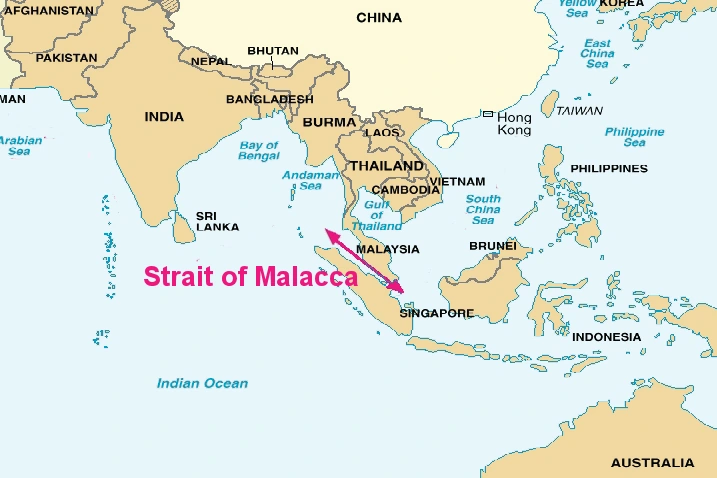
Map study
Strait of Malacca between the Malay Peninsula and Sumatra: trace the Indian Ocean–South China Sea shipping connection and its trade significance.
- Read the source legend and reference date before interpreting the map.
- Use spatial patterns to support topic revision; verify current official boundaries, designations and warnings separately.
Credit: US Department of Defense · Public domain · sourceConverted to WebP on an opaque white background; proportionally resized without cropping. Original cartography and legend retained.
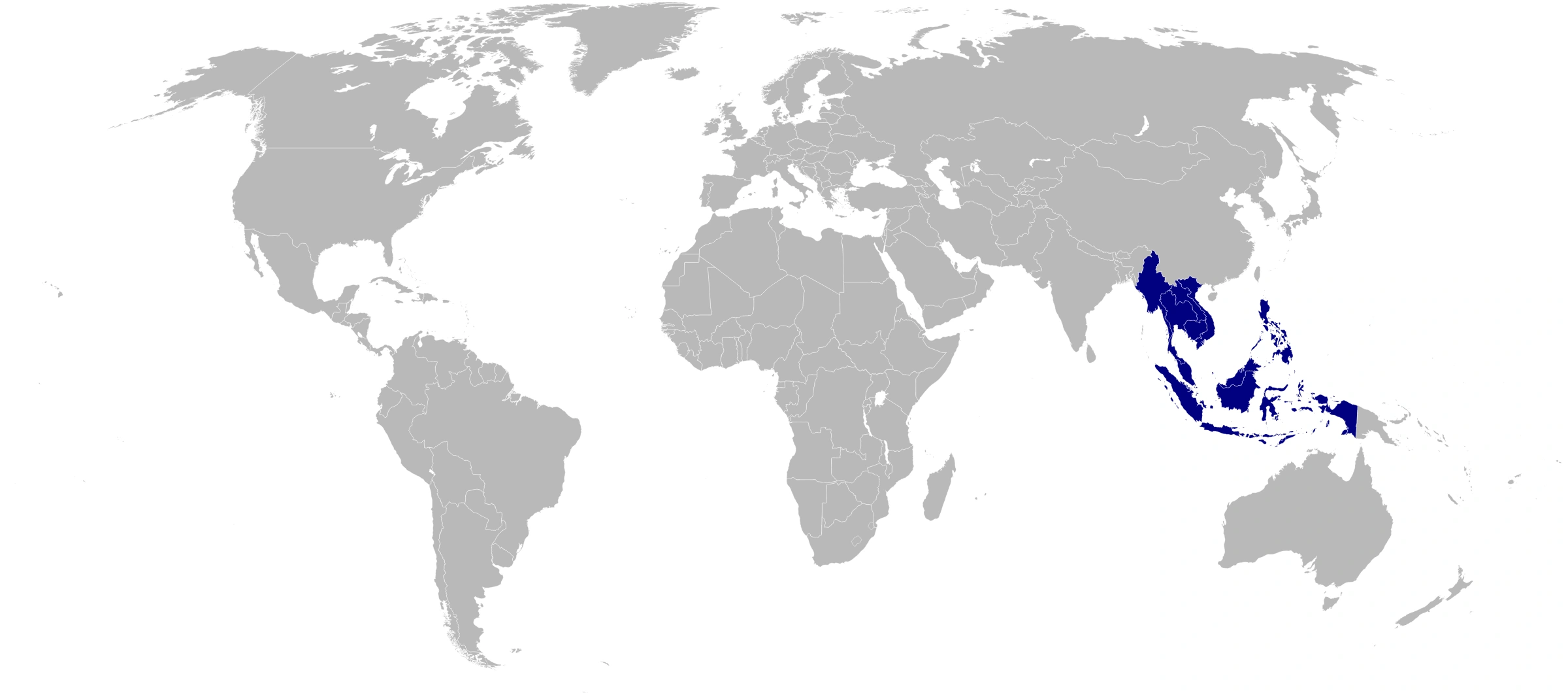
Map study
ASEAN geography as depicted in the source map: compare mainland and maritime Southeast Asia. Verify current membership separately.
- Read the source date and legend; distinguish territory, influence and geographic location.
- Historical boundaries and reference memberships are not live political or operational data.
Credit: Mangwanani · Public domain · sourceConverted to WebP on an opaque white background; proportionally resized without cropping. Original cartography and legend retained.
1. Origins, membership and institutional structure
ASEAN emerged amid Cold War rivalry, regional insurgencies and distrust among neighbouring states. Its founders sought regional stability and economic development without establishing a supranational authority. The Bangkok Declaration emphasised economic growth, social progress, cultural development and regional peace. The organisation subsequently expanded from five founding members to include Brunei Darussalam in 1984, Vietnam in 1995, Laos and Myanmar in 1997, Cambodia in 1999 and Timor-Leste in 2025.
The ASEAN Charter gave the organisation legal personality and formalised its institutions. The ASEAN Summit of heads of state or government is its supreme policy-making body. Foreign ministers constitute the ASEAN Coordinating Council, while three Community Councils oversee the Political-Security, Economic and Socio-Cultural pillars. The Secretary-General and Jakarta-based Secretariat facilitate implementation, but authority remains primarily with member governments.
The ASEAN Way refers to consultation, consensus, informality, respect for sovereignty and non-interference. These norms helped states with different political systems cooperate without surrendering substantial autonomy. However, they can also produce lowest-common-denominator outcomes. ASEAN is therefore not an Asian equivalent of the European Union: it has no common currency, supranational legislature or collective-defence commitment.
- The chairmanship rotates annually among member states.
- The Treaty of Amity and Cooperation, signed in 1976, codifies peaceful dispute settlement and non-interference.
- The ASEAN Community was formally established on 31 December 2015.
Timeline
1967
Bangkok Declaration establishes ASEAN.
1976
Treaty of Amity and Cooperation is signed at the first ASEAN Summit in Bali.
1992
ASEAN Free Trade Area initiative begins; India becomes a sectoral dialogue partner.
2008
ASEAN Charter enters into force.
2015
ASEAN Community is formally established.
2022
India–ASEAN relations are elevated to a Comprehensive Strategic Partnership.
2025
Timor-Leste becomes ASEAN’s eleventh member.
2. Economic integration and ASEAN-led multilateral architecture
ASEAN’s economic importance rests on manufacturing networks, large consumer markets and strategic sea routes linking the Indian and Pacific Oceans. Singapore is a major financial and logistics centre; Vietnam, Thailand, Malaysia and Indonesia occupy important positions in electronics, automobiles, commodities and diversified production networks. Yet development gaps remain substantial, especially between richer members and lower-income mainland economies.
The ASEAN Free Trade Area initiative began in 1992. The ASEAN Trade in Goods Agreement, effective from 2010, consolidated merchandise trade commitments. The ASEAN Economic Community seeks an integrated production base through freer movement of goods, services, investment, skilled labour and capital, subject to national commitments and restrictions. It is neither a complete customs union nor an EU-style single market; non-tariff barriers and regulatory differences remain significant.
ASEAN centrality means that ASEAN should retain a leading role in shaping regional cooperation and convening major powers. The ASEAN Regional Forum addresses political and security dialogue; the East Asia Summit brings leaders together on strategic issues; and the ASEAN Defence Ministers’ Meeting-Plus promotes practical defence cooperation. ASEAN Plus Three links ASEAN with China, Japan and South Korea, including financial cooperation.
The Regional Comprehensive Economic Partnership connects its participating ASEAN economies with China, Japan, South Korea, Australia and New Zealand. Signed in 2020 and first entering into force in 2022, it strengthens trade integration and common rules of origin. India withdrew from negotiations in 2019 because of concerns including import surges, safeguards and the balance of market-access gains. RCEP membership should not be confused with ASEAN membership.
Typical ASEAN cooperation pathway
- 1. Member states identify a shared regional concern
- 2. Officials and sectoral bodies negotiate proposals
- 3. Ministers and leaders build consensus
- 4. National governments implement agreed commitments
- 5. ASEAN bodies monitor progress and facilitate coordination
3. India–ASEAN relations: strategic and developmental significance
India’s Look East Policy developed in the early 1990s alongside economic liberalisation and post-Cold War diplomatic adjustment. Its transformation into the Act East Policy in 2014 emphasised implementation, connectivity and strategic engagement. ASEAN occupies the core of this approach and is an essential partner in India’s vision of an inclusive, rules-based Indo-Pacific.
The ASEAN–India Trade in Goods Agreement was signed in 2009 and entered into force in 2010; agreements covering services and investment followed. Bilateral merchandise trade reached approximately US$122.7 billion in financial year 2023–24, according to Indian official trade data. India nevertheless faces a substantial merchandise deficit. Reviewing the goods agreement involves addressing rules of origin, non-tariff barriers and uneven market access without undermining regional value-chain opportunities.
Connectivity gives the partnership direct relevance to India’s Northeast. The India–Myanmar–Thailand Trilateral Highway aims to connect Moreh in Manipur with Mae Sot in Thailand through Myanmar. The Kaladan Multi-Modal Transit Transport Project links India’s eastern seaboard with Sittwe port and onward connections towards Mizoram. Their full benefits depend on missing infrastructure, border procedures, security and political stability in Myanmar.
Security cooperation includes maritime domain awareness, counterterrorism, disaster relief and defence exchanges. The first ASEAN–India Maritime Exercise was held in 2023. India supports freedom of navigation and peaceful dispute settlement consistent with international law, including UNCLOS. Development partnerships, scholarships, digital cooperation and civilisational links such as Buddhism broaden engagement beyond a purely China-centred strategic calculation.
| Mechanism | Principal function | India’s participation |
|---|---|---|
| ASEAN Regional Forum | Political-security dialogue and confidence-building | Participant since 1996 |
| East Asia Summit | Leaders-led strategic dialogue | Founding participant in 2005 |
| ADMM-Plus | Defence dialogue and practical cooperation | Participant since its inception in 2010 |
| ASEAN Plus Three | Cooperation with China, Japan and South Korea | Not a member |
| RCEP | Trade integration and common commercial rules | Not a party |
4. Major challenges: consensus, Myanmar and strategic rivalry
ASEAN’s diversity is both its strength and its constraint. Members differ in political systems, development levels, threat perceptions and economic dependence on external powers. Consensus preserves unity but can obstruct timely decisions. Non-interference limits pressure on governments facing domestic political or human-rights crises, while the Secretariat has restricted capacity to enforce regional commitments.
Myanmar’s military coup of February 2021 exposed these limitations. ASEAN adopted a Five-Point Consensus in April 2021 calling for an end to violence, constructive dialogue, a special envoy, humanitarian assistance and an envoy visit to meet all parties concerned. Implementation has remained deeply inadequate. Restricting military representatives at selected high-level meetings signalled disapproval, but ASEAN has struggled to secure sustained political progress.
The South China Sea presents a different test. Several ASEAN members have maritime claims overlapping with China’s, while other members prioritise economic ties or avoid confrontation. The 2002 Declaration on the Conduct of Parties provided a diplomatic framework, but negotiations for a Code of Conduct have been protracted. The 2016 arbitral award in the Philippines–China case rejected the legal basis for Chinese historic-rights claims exceeding UNCLOS entitlements; it did not decide sovereignty over land features.
US–China rivalry, minilateral security arrangements and supply-chain restructuring create opportunities for ASEAN while testing its centrality. Climate vulnerability, transboundary haze, Mekong water governance, cybercrime and irregular migration also demand cooperation beyond traditional sovereignty-centred diplomacy.
5. Way forward and Mains analytical framework
ASEAN’s future relevance depends on combining political inclusiveness with credible implementation. Better-resourced institutions, clearer monitoring of commitments and practical cooperation among willing members can improve delivery without requiring EU-style integration. Timor-Leste’s accession also makes capacity-building and narrowing development gaps important institutional priorities.
India should translate summit commitments into completed projects, predictable financing and simpler border procedures. Trade engagement should combine legitimate safeguards with export competitiveness, standards recognition and stronger services links. Maritime capacity-building, resilient supply chains, public-health cooperation and digital public infrastructure offer relatively inclusive areas for partnership.
For a GS-II answer, distinguish ASEAN unity from ASEAN centrality: the former concerns internal cohesion, while the latter concerns its leadership within regional architecture. Supporting centrality does not mean accepting institutional paralysis. A balanced conclusion should recognise ASEAN as an indispensable convenor whose effectiveness depends on cohesion, practical delivery and the willingness of major powers to respect ASEAN-led mechanisms.
Real-world case studies
Cyclone Nargis: cooperation despite sovereignty sensitivities
After Cyclone Nargis struck Myanmar in May 2008, ASEAN helped establish a Tripartite Core Group with Myanmar and the United Nations. It facilitated humanitarian coordination and access, illustrating how trusted regional diplomacy can create operational space when direct external pressure encounters resistance.
ASEAN–India maritime exercise, 2023
The inaugural exercise involved harbour activities in Singapore and a sea phase in the South China Sea. It demonstrated a practical route to improving interoperability and maritime cooperation without converting ASEAN into a military alliance.
Previous year questions
No source-linked PYQ is available here yet. Use the practice questions below.
Practice questions
Practice MCQ 1
With reference to ASEAN, consider the following statements: 1. The ASEAN Charter grants the organisation legal personality. 2. ASEAN maintains a common external tariff applicable to all imports. 3. Its Secretariat is located in Jakarta. Which statements are correct?
- A. 1 and 2 only
- B. 1 and 3 only
- C. 2 and 3 only
- D. 1, 2 and 3
Practice MCQ 2
India participates in which of the following? 1. East Asia Summit 2. ASEAN Plus Three 3. ASEAN Regional Forum 4. ADMM-Plus
- A. 1 and 2 only
- B. 2 and 4 only
- C. 1, 3 and 4 only
- D. 1, 2, 3 and 4
Practice MCQ 3
ASEAN’s Five-Point Consensus adopted in April 2021 primarily concerns which issue?
- A. Resolution of the Myanmar political crisis
- B. Establishment of an ASEAN common currency
- C. Admission of India into RCEP
- D. Final settlement of South China Sea maritime boundaries
Mains practice · ASEAN centrality is indispensable to an inclusive Indo-Pacific, but its credibility depends on internal cohesion and effective delivery. Discuss, highlighting implications for India. Answer in 250 words.
- Define centrality and distinguish it from internal unity.
- Explain ASEAN’s convening role through the EAS, ARF and ADMM-Plus.
- Assess consensus, non-interference, Myanmar and South China Sea divisions.
- Connect ASEAN to India’s Act East Policy, trade and Northeast connectivity.
- Recommend project completion, maritime cooperation and institutional capacity-building.
- Conclude with inclusive regionalism supported by credible implementation.
Further reading
- ASEAN Secretariat: Bangkok Declaration, ASEAN Charter and Treaty of Amity and Cooperation.
- ASEAN Secretariat: ASEAN Outlook on the Indo-Pacific, 2019.
- Ministry of External Affairs, Government of India: ASEAN–India relations briefs and summit statements.
- Department of Commerce, Government of India: ASEAN–India trade agreements and TradeStat database.
- NCERT, Contemporary World Politics: Contemporary Centres of Power.
- Permanent Court of Arbitration: South China Sea Arbitration award and official press materials, 2016.
Preparing for UPSC Civil Services? Get classroom teaching, answer-writing evaluation and mentorship at Pragnya IAS Academy, Ashok Nagar — see why aspirants choose us for IAS coaching in Hyderabad.