
Map study
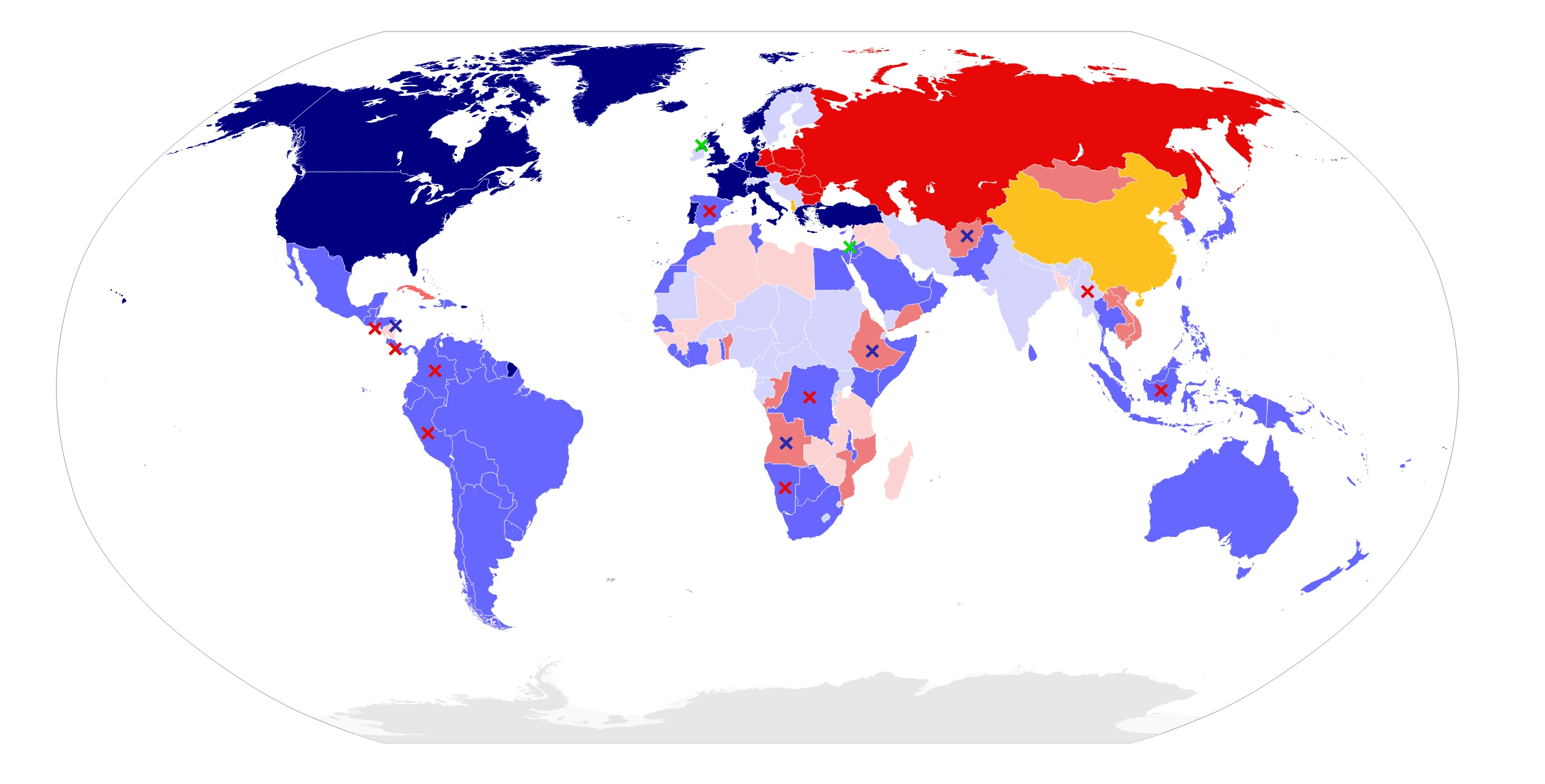
Cold War alliances in 1980: compare blocs and non-aligned regions. This historical map is not current NATO membership or present geopolitical alignments.
- Read the legend and reference date before interpreting regional patterns.
- Relate the map to the article’s topic; verify current administrative boundaries or data separately.
Credit: Chabacano; Sancebau · CC BY-SA 3.0 · sourceConverted to WebP on an opaque white background; proportionally resized without cropping. Original cartography and legend retained.
1. Meaning, strategic rationale and policy framework
Neighbourhood security cooperation comprises arrangements through which adjacent or closely connected states prevent threats, exchange information, coordinate operations and strengthen institutional capacity. For India, geographic proximity creates security interdependence: instability across a border can produce refugee movements, militant activity, disrupted commerce or maritime insecurity. Cooperation is therefore not simply assistance to smaller neighbours; it is an investment in India’s own security and regional development.
Traditional concerns include territorial defence, terrorism, insurgency and the strategic use of ports and infrastructure by external powers. Non-traditional concerns include narcotics, human trafficking, illegal fishing, cybercrime, pandemics and climate-related disasters. These threats frequently overlap: criminal networks may finance armed groups, while disasters can weaken policing and expose communities to exploitation.
Neighbourhood First prioritises relations with nearby countries, while SAGAR links maritime security with shared prosperity. India uses bilateral agreements, capacity-building and regional institutions rather than a single collective-defence framework. Cooperation must respect sovereign equality, consent and non-interference. Its legitimacy depends on whether neighbours perceive India as a reliable provider of public goods rather than a power seeking exclusive strategic control.
- Strategic objective: reduce hostile exploitation of neighbouring territory and safeguard land and sea communications.
- Developmental objective: make connectivity, tourism, energy trade and investment safer.
- Diplomatic objective: build durable institutional trust that can survive changes of government.
2. Land-border cooperation and country-specific priorities
Bangladesh illustrates the importance of linking security cooperation with political trust. Action against anti-India insurgent networks, intelligence exchanges and coordination between the Border Security Force and Border Guard Bangladesh have supported stability. The implementation of the Land Boundary Agreement in 2015 removed enclaves and clarified administration. Nevertheless, border deaths, trafficking, irregular migration and political transitions can strain relations. Effective border management requires proportionate force, joint investigation and accessible legal crossings, not fencing alone.
With Nepal, an open border and dense social ties make community-sensitive policing essential. Bilateral mechanisms address trafficking, counterfeit currency and misuse of travel routes. The Suryakiran military exercise and training links support interoperability. Cooperation should avoid treating legitimate movement as a security threat. With Bhutan, close consultations, training and the 2007 India–Bhutan Friendship Treaty underpin cooperation. Bhutan’s action against insurgent camps in 2003 demonstrated how a neighbour’s sovereign initiative can address shared threats.
Myanmar is important because of insurgent movements, arms trafficking and narcotics flows affecting India’s Northeast. Civil conflict complicates coordination and creates humanitarian pressures in border states. India announced moves in 2024 to fence the border and end the Free Movement Regime; their implementation and local effects require careful distinction from the announcement itself. Security measures must account for cross-border ethnic ties, asylum-related concerns and livelihood dependence.
Pakistan presents a different setting: counterterrorism cooperation remains severely constrained by cross-border terrorism and distrust. The Directors General of Military Operations reaffirmed observance of the ceasefire in February 2021, showing the value of limited risk-reduction mechanisms. With China, military and diplomatic dialogue primarily manages contested boundaries and escalation rather than constituting a broad cooperative security partnership.
- Use joint patrol coordination, liaison meetings and verified intelligence rather than assuming identical interests.
- Separate humanitarian protection and lawful mobility from organised criminal activity.
- Assess each relationship individually; neighbourhood diplomacy cannot follow a uniform security template.
From shared threat to accountable cooperation
- 1. Identify the threat jointly
- 2. Agree on legal authority and consent
- 3. Share verified information securely
- 4. Coordinate agency-level action
- 5. Protect civilians and preserve evidence
- 6. Review outcomes and remedy failures
3. Maritime cooperation and regional institutions
Sri Lanka and Maldives occupy important positions near Indian Ocean shipping routes. Cooperation includes naval and coast guard exercises, hydrographic work, surveillance support, training, search and rescue and humanitarian assistance. Exercises such as SLINEX with Sri Lanka and Dosti involving India, Maldives and Sri Lanka improve practical coordination. Maritime domain awareness combines coastal radar, vessel information and surveillance to identify suspicious activity before it develops into a crisis.
The Colombo Security Conclave provides a focused forum linking maritime neighbours. Its five pillars cover maritime safety and security; countering terrorism and radicalisation; combating trafficking and transnational organised crime; cybersecurity and protection of critical infrastructure and technology; and humanitarian assistance and disaster relief. Bangladesh joined as its fifth member in July 2024, alongside India, Maldives, Mauritius and Sri Lanka.
BIMSTEC connects South and Southeast Asia and offers a platform for counterterrorism, transnational crime and disaster-management cooperation. SAARC’s regional counterterrorism convention dates to 1987, with an additional protocol signed in 2004, but political tensions limit institutional effectiveness. These overlapping platforms are useful when they generate operational results rather than competing declarations.
The Information Fusion Centre–Indian Ocean Region at Gurugram, established in 2018, supports maritime information sharing with partner countries and organisations. Such networks expand situational awareness, but intelligence sharing still requires safeguards covering access, confidentiality and permitted use.
- Maritime priorities: trafficking, illegal activities at sea, search and rescue, oil spills and disaster relief.
- Capacity-building tools: patrol vessels, coastal surveillance, maintenance assistance, training and joint exercises.
- Institutional test: whether shared information leads to timely, lawful and coordinated action.
| Instrument | Primary purpose | Key limitation |
|---|---|---|
| Border-agency coordination | Prevent trafficking and manage incidents | Different enforcement practices and civilian-harm concerns |
| Extradition and mutual legal assistance | Enable prosecution across jurisdictions | Treaty conditions, evidence standards and due process |
| Military and coast guard exercises | Improve readiness and interoperability | Cannot substitute for political trust |
| Maritime information sharing | Identify threats and coordinate responses | Information sensitivity and unequal technical capacity |
| Humanitarian assistance and disaster relief | Save lives and restore essential services | Requires consent, logistics and clear handover arrangements |
4. Instruments, legal safeguards and implementation
Security cooperation operates through defence dialogues, police liaison, extradition treaties, mutual legal assistance arrangements and coordinated border mechanisms. Extradition transfers an accused or convicted person under applicable legal conditions; mutual legal assistance facilitates evidence collection and other judicial processes. Neither should be confused with informal deportation or intelligence exchange. India and Bangladesh signed an extradition treaty in 2013, subsequently amended in 2016.
Joint exercises build familiarity with procedures, while training and equipment support strengthen local institutions. Disaster assistance is especially valuable because it demonstrates immediate benefits to citizens. However, the recipient’s consent, clear mission scope and an agreed exit or handover arrangement remain important. Long-term maintenance and local skills are often more useful than one-time equipment transfers.
Cybercrime and financial crime require cooperation among investigators, financial intelligence units, prosecutors and digital service providers. Shared alerts on fraud or terrorist financing must be supported by legally usable evidence. Data protection, oversight and due process reduce the risk that cooperation enables political repression or indiscriminate surveillance.
- Create standard operating procedures for emergencies, hotlines and evidence preservation.
- Protect victims of trafficking and ensure child-sensitive and gender-sensitive procedures.
- Evaluate outcomes through response times, successful prosecutions and reduced civilian harm, not merely the number of agreements signed.
5. Constraints and the way forward
Power asymmetry generates a persistent dilemma: capabilities that make India a useful partner can also generate fears of domination. Domestic electoral competition may turn security arrangements into symbols of sovereignty. China’s expanding regional presence further complicates choices, but assuming that every neighbour’s external partnership is directed against India can weaken diplomatic engagement.
India also faces coordination problems among central ministries, armed forces, border agencies and state governments. Border states possess local knowledge and bear many costs of disrupted trade, displacement and insecurity. Their participation should strengthen national policy without creating contradictory external commitments. Political instability and weak judicial capacity in partner countries can further interrupt implementation.
A sustainable approach should be consent-based, demand-driven and institution-centred. India should offer transparent agreements, timely project delivery, affordable maintenance and training that increases partners’ autonomy. Functional cooperation on disasters, crime and maritime safety can continue even when political relations are difficult. Security must complement development and people-to-people links rather than crowd them out.
For a GS-II answer, the strongest conclusion is that regional security is co-produced. India cannot secure its borders and surrounding seas through unilateral capability alone. Predictability, lawful procedures and respect for neighbours’ agency convert geographical proximity from a source of vulnerability into a foundation for shared resilience.
- Institutionalise regular reviews and crisis communication insulated from political volatility.
- Consult border communities and state governments on measures affecting mobility and livelihoods.
- Combine strategic vigilance with non-exclusive, benefit-oriented regional partnerships.
Real-world case studies
Bhutan’s Operation All Clear, 2003
In December 2003, Bhutan acted against camps used by Indian insurgent organisations, including ULFA, NDFB and KLO, in southern Bhutan. The operation illustrates how shared threat recognition and Bhutanese sovereign action helped address a cross-border security problem. The wider lesson is that trusted bilateral consultation can be more effective than public pressure.
Operation Neer in Maldives, 2014
Following a fire that disrupted Malé’s principal desalination facility in December 2014, India rapidly supplied drinking water using aircraft and naval vessels. Operation Neer showed that neighbourhood security includes protecting essential civilian services. Rapid assistance generated practical value without requiring a traditional military threat.
Previous year questions
UPSC Mains 2017 · GS-II
China is using its economic relations and positive trade surplus as tools to develop potential military power status in Asia. In the light of this statement, discuss its impact on India as her neighbour.
- Examine the relationship between economic resources, infrastructure and strategic influence.
- Discuss implications for India’s land borders, maritime environment and neighbourhood relationships.
- Distinguish commercial infrastructure from demonstrated military access.
- Suggest credible capacity-building, regional connectivity and diplomatic engagement.
Practice questions
Practice MCQ 1
Consider the following subjects: 1. Maritime safety and security 2. Cybersecurity and protection of critical infrastructure 3. Humanitarian assistance and disaster relief. Which are pillars of cooperation under the Colombo Security Conclave?
- A. 1 only
- B. 1 and 2 only
- C. 2 and 3 only
- D. 1, 2 and 3
Practice MCQ 2
Which statement best distinguishes extradition from mutual legal assistance?
- A. Extradition concerns transfer of persons, while mutual legal assistance supports judicial processes such as obtaining evidence.
- B. Extradition applies only to citizens of the requesting state.
- C. Mutual legal assistance automatically authorises cross-border arrests.
- D. Extradition does not require compliance with domestic law.
Practice MCQ 3
Which of the following pairs is correctly matched?
- A. Suryakiran — India and Sri Lanka
- B. SLINEX — India and Nepal
- C. Operation Neer — Drinking-water assistance to Maldives
- D. Operation All Clear — Indian Ocean anti-piracy mission
Mains practice · Security cooperation in India’s neighbourhood requires strategic capability as well as political legitimacy. Discuss with reference to land-border and maritime cooperation. Suggest measures to make such partnerships sustainable. (250 words)
- Define security interdependence and connect it to Neighbourhood First and SAGAR.
- Use Bangladesh, Nepal and Bhutan for land-border examples.
- Discuss maritime awareness, exercises and the Colombo Security Conclave.
- Explain sovereignty concerns, asymmetry, domestic politics and external competition.
- Recommend consent-based agreements, civilian safeguards, institutional continuity and local capacity-building.
- Conclude that shared benefits and trust make security arrangements durable.
Further reading
- Ministry of External Affairs: Annual Reports and country briefs on India’s neighbours.
- Ministry of External Affairs: India–Bhutan Friendship Treaty, 2007.
- BIMSTEC Secretariat: Security-sector cooperation and the convention on terrorism, transnational organised crime and illicit drug trafficking.
- Ministry of External Affairs: Colombo Security Conclave statements and August 2024 secretariat agreement announcement.
- Indian Navy: Information Fusion Centre–Indian Ocean Region official website.
- NCERT: Contemporary World Politics, chapters on Contemporary South Asia and Security in the Contemporary World.
Preparing for UPSC Civil Services? Get classroom teaching, answer-writing evaluation and mentorship at Pragnya IAS Academy, Ashok Nagar — see why aspirants choose us for IAS coaching in Hyderabad.