

Petrapole-Benapole border ceremony location
Credit: DescriptionPetrapole-Benapole border ceremony location.png This map was created from OpenStreetMap project data, coll · CC BY-SA 4.0 · source

Straddle carrier work at Port of Chittagong.
Credit: Moheen Reeyad · CC BY-SA 4.0 · source
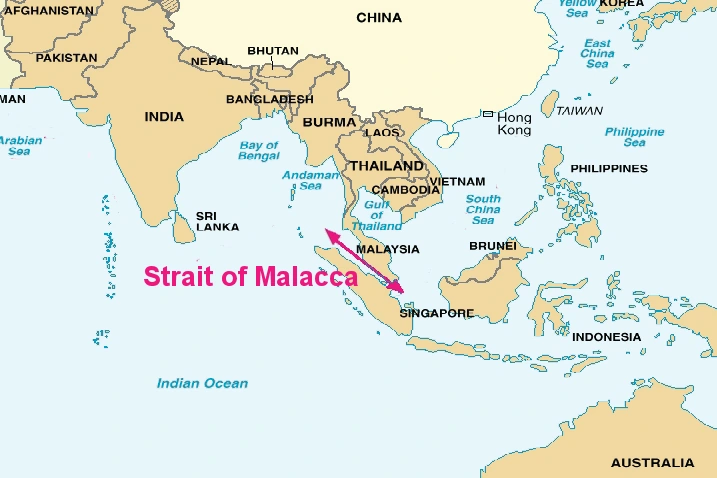
Map study
Strait of Malacca between the Malay Peninsula and Sumatra: trace the Indian Ocean–South China Sea shipping connection and its trade significance.
- Read the source legend and reference date before interpreting the map.
- Use spatial patterns to support topic revision; verify current official boundaries, designations and warnings separately.
Credit: US Department of Defense · Public domain · sourceConverted to WebP on an opaque white background; proportionally resized without cropping. Original cartography and legend retained.
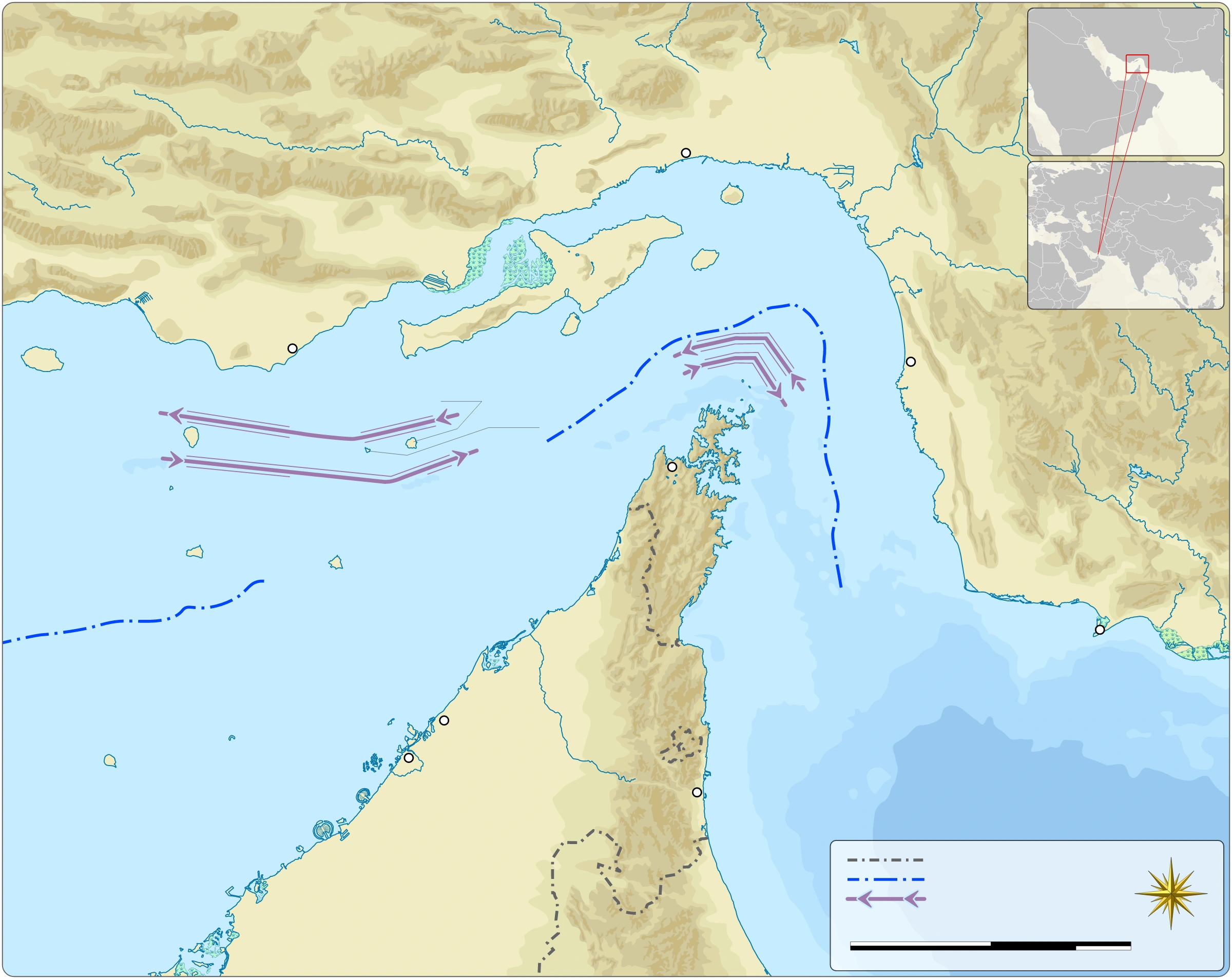
Map study
Strait of Hormuz: locate Iran, Oman and the Persian Gulf–Gulf of Oman connection. Geographic context for energy trade, not a current disruption map.
- Read the source legend and reference date before interpreting the map.
- Use spatial patterns to support topic revision; verify current official boundaries, designations and warnings separately.
Credit: Goran tek-en · CC BY-SA 4.0 · sourceConverted to WebP on an opaque white background; proportionally resized without cropping. Original cartography and legend retained.
1. Strategic significance and institutional architecture
Neighbourhood trade diplomacy concerns the rules, infrastructure and political relationships governing exchanges of goods, services and electricity across borders. For India, its immediate South Asian neighbours are the principal focus, while Myanmar connects the neighbourhood with ASEAN and the Act East policy. China is also a major neighbouring trading partner, but its scale, strategic competition and different institutional relationship require distinct treatment.
Trade creates markets for Indian firms, supports border livelihoods and provides neighbours with access to a large nearby economy. It can reduce the cost of essential supplies, enable regional value chains and improve connectivity for landlocked Nepal and Bhutan. For India’s Northeast, neighbouring ports and transit corridors can overcome geographical isolation and stimulate local production.
The South Asian Free Trade Area, or SAFTA, provides a regional framework for tariff preferences in goods. Its effectiveness is limited by sensitive lists, rules-of-origin requirements, non-tariff barriers and political restrictions. Bilateral arrangements often deliver more: India has free trade agreements with Sri Lanka and Bhutan, preferential arrangements with Nepal, and trade and transit instruments with Bangladesh. Preferences do not eliminate every tariff or regulatory requirement.
- Neighbourhood First supplies the political framework; Act East and BIMSTEC connect eastern neighbours with wider regional markets.
- SAFTA covers goods; the SAARC Agreement on Trade in Services was signed separately in 2010.
- WTO obligations provide the multilateral baseline, while permitted regional preferences offer additional market access.
Timeline
2000
The India–Sri Lanka Free Trade Agreement becomes operational.
2004–2006
SAFTA is signed in 2004 and enters into force in 2006.
2015
Bangladesh, Bhutan, India and Nepal sign the Motor Vehicles Agreement.
2019
Political tensions trigger major restrictions on India–Pakistan trade.
2024
Nepal–Bangladesh electricity trade through India’s grid is inaugurated.
2. Country-specific patterns and diplomatic priorities
Bangladesh is central to India’s eastern connectivity. Trade includes textiles, agricultural products, machinery and intermediate inputs. Bangladesh benefits from Indian inputs and a large consumer market, while India gains access to a growing economy and connectivity opportunities for the Northeast. Under bilateral arrangements, designated Indian cargo can use Chattogram and Mongla ports. Changes in Bangladesh’s domestic politics make commercial predictability and sustained institutional engagement especially important.
Nepal’s open border and close economic links coexist with dependence on Indian transit routes and sensitivity about sovereignty. The bilateral Treaty of Trade and Treaty of Transit address different needs: market access and movement through Indian territory. Bhutan’s relationship with India combines free trade, transit and hydropower cooperation. Electricity exports generate revenue, but diversification remains important for resilience and employment.
The India–Sri Lanka Free Trade Agreement has operated since March 2000. Its experience highlights both the benefits of preferential access and disputes concerning quotas, standards and rules of origin. Maldives depends substantially on imported essentials, making dependable supplies and shipping links diplomatically important. Myanmar offers access to Southeast Asia, but conflict and border insecurity disrupt formal commerce.
Trade with Pakistan has been severely restricted since 2019: India withdrew most-favoured-nation treatment after the Pulwama attack, while Pakistan subsequently suspended bilateral trade, subject to limited exceptions. Afghanistan illustrates the difficulties of commerce without dependable direct overland access. Chabahar offers an alternative route through Iran, but commercial viability, security and sanctions-related uncertainty remain constraints. India’s large merchandise deficit with China raises separate concerns over concentrated dependence on critical inputs.
From diplomatic agreement to regional production networks
- 1. Agree on market-access and transit rules
- 2. Build border, transport and grid infrastructure
- 3. Coordinate customs, standards and digital documentation
- 4. Enable reliable movement of goods and electricity
- 5. Develop cross-border investment and supplier networks
- 6. Monitor shared benefits and resolve disputes
3. Connectivity, energy and trade facilitation
Market access is meaningful only when goods can cross borders efficiently. Integrated Check Posts, developed through the Land Ports Authority of India, bring customs, immigration and associated services together. Petrapole–Benapole on the Bangladesh border and Raxaul–Birgunj on the Nepal border are important gateways. Their performance depends on approach roads, parking, warehousing, testing facilities and coordinated operating hours on both sides.
The Bangladesh–Bhutan–India–Nepal Motor Vehicles Agreement, signed in June 2015, seeks to facilitate cross-border movement of passenger, personal and cargo vehicles. Bhutan has not ratified it, and full implementation across all four countries remains incomplete. Operational protocols, insurance, customs guarantees and environmental safeguards matter as much as signing the agreement.
Rail links, coastal shipping and the India–Bangladesh Protocol on Inland Water Transit and Trade diversify transport options. Digital customs, advance processing, electronic certificates of origin and risk-based inspection can reduce delays without weakening enforcement. Mutual recognition of testing results requires credible accreditation and regulatory confidence, not simply political declarations.
Electricity trade adds a growing regional dimension. India imports hydropower from Bhutan and Nepal and supplies electricity to Bangladesh. In November 2024, the first trilateral power transaction from Nepal to Bangladesh through India’s grid was inaugurated, covering 40 MW. Such arrangements turn India’s geographical position into a platform for shared energy security.
| Instrument | Primary purpose | Important limitation |
|---|---|---|
| SAFTA | Preferential tariffs for regional goods trade | Sensitive lists and political restrictions limit coverage |
| Bilateral trade agreements | Country-specific market access | Rules of origin and product exclusions still apply |
| Transit agreements | Movement through another country to reach markets or ports | Transit permission is not equivalent to unrestricted import access |
| BBIN Motor Vehicles Agreement | Facilitate cross-border vehicle movement | Ratification and operational implementation remain incomplete |
| Cross-border electricity arrangements | Exchange power using interconnected grids | Require transmission access, approvals and commercial agreements |
4. Why regional trade remains below potential
Political mistrust is the foremost obstacle. India–Pakistan tensions have weakened SAARC cooperation, while smaller neighbours may interpret dependence on India as a source of vulnerability. Border disruptions or uncertainty over essential supplies can therefore produce diplomatic costs beyond their immediate commercial impact. Economic interdependence can encourage cooperation, but it does not automatically resolve territorial or security disputes.
Trade costs remain high because of limited transport integration, repeated transshipment, inconsistent documentation and insufficient border infrastructure. Sanitary and phytosanitary measures and technical standards are legitimate protections when evidence-based and transparent; opaque testing procedures or discriminatory application can turn them into barriers. Informal trade also grows where formal channels are costly or inaccessible.
Structural asymmetry compounds these difficulties. India’s neighbours often have narrow export baskets, small industrial bases and difficulties meeting standards at scale. Persistent bilateral deficits can generate resentment, although a deficit alone does not establish unfair trade. Import restrictions may protect particular producers but raise costs for consumers and downstream industries.
Domestic instability, foreign-exchange shortages and climate hazards can interrupt regional supply chains. The pandemic demonstrated the importance of keeping essential trade functioning. Agricultural export restrictions and sudden regulatory changes may help address domestic shortages, but they can undermine confidence among dependent neighbours unless accompanied by consultation and predictable arrangements.
5. A practical agenda for trade diplomacy
India should frame regional integration as shared prosperity rather than simply a search for export markets. Supporting neighbours’ productive capacity through standards laboratories, supplier development, logistics and investment would expand their exports and strengthen political support for openness. Regional value chains in garments, food processing, pharmaceuticals and clean energy offer practical entry points.
Implementation should take priority over repeated announcements. Time-bound border upgrades, interoperable customs systems, coordinated inspections and transparent grievance mechanisms can deliver visible benefits. State governments, border communities, small firms and women traders should participate in policy design because they experience the costs of inefficient crossings directly.
Predictable essential-supply arrangements, subject to domestic availability and clearly stated rules, would improve India’s credibility. Wider electricity trading, diversified transit routes and climate-resilient infrastructure can spread gains across countries. Subregional cooperation should complement, rather than formally replace, wider South Asian institutions.
Success should be measured through border-clearance times, logistics costs, export diversification, reliability of energy supply and benefits to local communities, not merely aggregate trade value. The guiding principle is asymmetric responsibility with reciprocal gains: India can shoulder greater facilitation costs while seeking transparent rules, commercial sustainability and legitimate security safeguards.
Real-world case studies
Nepal–Bangladesh power trade through India
The 40 MW transaction inaugurated in November 2024 illustrates cooperation beyond bilateral exchange. Nepal gains an additional market, Bangladesh diversifies supply, and India provides the transmission bridge. Its initial scale is modest, but it demonstrates how regional infrastructure and coordinated regulation can overcome the absence of a direct border.
India–Bangladesh border haats
Border haats, including the Kalaichar–Baliamari haat inaugurated in 2011, created regulated spaces for small-scale local commerce. They demonstrate that trade diplomacy can directly support remote communities and interpersonal trust. Their functioning remains dependent on bilateral coordination and security conditions; they complement rather than substitute for major commercial gateways.
Previous year questions
UPSC Mains 2017 · GS-II
Poor India–Pakistan relations and mistrust among SAARC members have prevented SAARC from realising its full potential. Explain with suitable examples.
- Connect political mistrust with restrictions on trade, transit and institutional cooperation.
- Discuss SAFTA’s limited outcomes and weak regional connectivity.
- Use India–Pakistan tensions and the stalled summit process as examples.
- Assess bilateral and subregional cooperation without treating it as a complete replacement for SAARC.
Practice questions
Practice MCQ 1
Consider the following statements: 1. SAFTA provides a regional framework for preferential trade in goods. 2. A transit agreement necessarily grants duty-free access for all goods to the transit country’s domestic market. Which is correct?
- A. 1 only
- B. 2 only
- C. Both 1 and 2
- D. Neither 1 nor 2
Practice MCQ 2
Which country signed the BBIN Motor Vehicles Agreement in 2015 but has not ratified it?
- A. Bangladesh
- B. Bhutan
- C. India
- D. Nepal
Practice MCQ 3
The Nepal–Bangladesh electricity transaction inaugurated in November 2024 depends on transmission through which country?
- A. China
- B. Bhutan
- C. India
- D. Myanmar
Mains practice · Trade diplomacy in India’s neighbourhood requires predictable connectivity and shared gains more than tariff concessions alone. Discuss. Suggest measures to realise the region’s economic potential. Answer in 250 words.
- Introduce the gap between geographical proximity and low regional integration.
- Explain SAFTA, bilateral preferences and the limits of tariff reduction.
- Analyse political mistrust, logistics costs, standards and economic asymmetry.
- Use Bangladesh port access, Nepalese transit and trilateral electricity trade as examples.
- Recommend customs coordination, reliable essential supplies, productive investment and local participation.
- Conclude with measurable outcomes and mutual confidence.
Further reading
- Ministry of External Affairs: annual reports and bilateral country briefs, mea.gov.in.
- Department of Commerce: trade agreements and TradeStat database, commerce.gov.in.
- SAARC Secretariat: Agreement on South Asian Free Trade Area, saarc-sec.org.
- World Bank: A Glass Half Full: The Promise of Regional Trade in South Asia, 2018.
- Land Ports Authority of India: annual reports and land-port profiles, lpai.gov.in.
- Central Electricity Authority: cross-border electricity trade guidelines and procedures, cea.nic.in.
Preparing for UPSC Civil Services? Get classroom teaching, answer-writing evaluation and mentorship at Pragnya IAS Academy, Ashok Nagar — see why aspirants choose us for IAS coaching in Hyderabad.