

Electronic voting machine
Credit: Shagil Kannur · CC BY-SA 4.0 · source

The Dy. CEO, Election Commission of India (ECI), Dr. Alok Shukla explaining about the newly launched Voter Verifiable Paper Audit Trail (VVPAT) system, as a pilot project for the New Delhi constituenc
Credit: Election Commission of India · GODL-India · source
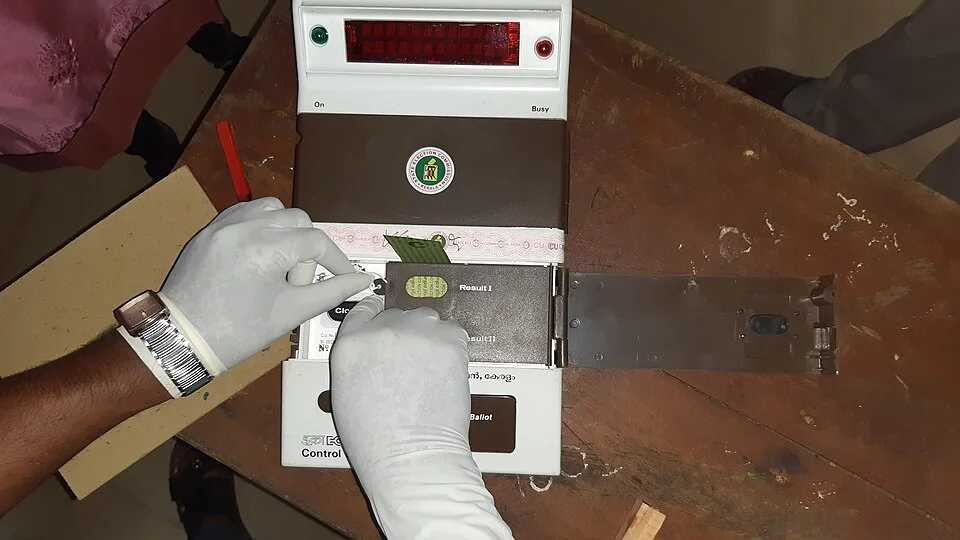
EVM control unit, as identified by the supplied file title; illustrative of electoral equipment.
Credit: Shagil Kannur · CC BY-SA 4.0 · sourceResized and converted to WebP; uncropped.
1. Meaning, components and operation
An Electronic Voting Machine records votes electronically instead of requiring voters to mark paper ballots. In the ECI system, the Ballot Unit is placed inside the voting compartment, while the Control Unit remains with the polling officer. The officer enables a vote, after which the elector presses the button against a candidate’s name and symbol, or NOTA. The machine then locks against another vote until enabled again.
The Voter Verifiable Paper Audit Trail, or VVPAT, adds a visible paper record. It briefly displays a printed slip containing the selected candidate’s serial number, name and symbol behind a transparent window, ordinarily for about seven seconds. The slip then falls into a sealed compartment. Voters cannot take it away: retaining the slip within the system protects ballot secrecy and prevents its use as proof of a purchased vote.
ECI EVMs are battery-operated, standalone machines, not internet voting devices. They do not require mains electricity or connect to the internet, Wi-Fi or Bluetooth. This reduces exposure to remote cyberattacks, but does not eliminate the need for secure manufacture, handling, storage and independent verification. Claims about networked voting systems abroad should therefore not automatically be applied to Indian EVMs.
- Ballot Unit: voter-facing panel displaying candidates and voting buttons.
- Control Unit: enables polling and stores electronically recorded votes.
- VVPAT: creates a voter-visible paper record available for prescribed verification.
Timeline
1982
EVMs were first used experimentally in selected polling stations of Kerala’s Parur Assembly constituency.
1984
A.C. Jose judgment clarified that ECI directions cannot override existing election law.
1989
Section 61A, inserted through the 1988 amendment, came into force.
2004
All Lok Sabha constituencies used EVMs.
2013–2019
Court-directed VVPAT introduction progressed to universal coverage in the 2019 Lok Sabha election.
2024
The Supreme Court rejected universal slip counting and prescribed additional preservation and technical-verification safeguards.
2. Constitutional and statutory framework
Article 324 provides the institutional foundation for ECI supervision, while Article 326 establishes adult suffrage for Lok Sabha and State Legislative Assembly elections. Article 327 empowers Parliament to legislate on these elections. Neither Article 324 nor Article 326 itself prescribes electronic voting: the detailed authority comes from election legislation and rules.
In A.C. Jose v. Sivan Pillai, 1984, the Supreme Court considered electronic voting introduced in part of a Kerala Assembly constituency without supporting statutory rules. It held that the Commission could supplement the law where necessary, but could not override an existing statutory framework. Parliament subsequently inserted Section 61A into the Representation of the People Act, 1951 through the 1988 amendment, effective in 1989, enabling voting machines in constituencies specified by the ECI.
The Conduct of Elections Rules, 1961 regulate machine-based polling and counting. Rule 49MA provides a procedure when an elector alleges that the VVPAT printed an incorrect choice. Rule 56D allows an application for counting VVPAT slips, subject to the Returning Officer’s reasoned decision. Where such a paper count differs from the corresponding electronic count, the result sheet is amended according to the paper-slip count.
Local-body elections require a separate institutional distinction. Under Articles 243K and 243ZA, State Election Commissions supervise panchayat and municipal elections respectively. Their equipment and procedures should not automatically be treated as identical to those prescribed by the ECI for parliamentary and Assembly elections.
EVM election cycle
- 1. First-level checking and randomised allocation
- 2. Candidate-setting, testing and sealing
- 3. Polling-day mock poll and clearance of mock data
- 4. Voting with VVPAT display
- 5. Sealing, transport and strong-room custody
- 6. Electronic counting and prescribed VVPAT verification
3. Safeguards throughout the election cycle
EVM credibility rests on a combination of technical design, administrative controls and scrutiny by political participants. Before deployment, machines undergo first-level checking by authorised engineers, with recognised political parties invited to observe. Randomisation determines allocation to constituencies and subsequently polling stations, making advance identification of a particular machine’s destination more difficult.
Candidate-setting, sealing and mock polls provide additional checkpoints. On polling day, a mock poll is conducted before actual voting in the presence of available polling agents. Its electronic results are checked against the corresponding VVPAT slips. Mock-poll data must then be cleared and those slips removed and handled according to instructions before actual polling starts.
After polling, machines are sealed and transported under prescribed security arrangements. Polled machines are kept in secured strong rooms with access controls, surveillance and opportunities for candidate representatives to observe arrangements. Polling agents receive the account of votes recorded in Form 17C, which supports comparison with the vote totals produced during counting.
These measures create a chain of custody: each transfer and procedural checkpoint should be documented and open to authorised scrutiny. A broken seal, unrecorded movement or failure to clear mock-poll data is not automatically evidence of a manipulated election, but each requires examination and remedial action under the applicable rules.
| Instrument or procedure | Purpose | Important distinction |
|---|---|---|
| EVM | Electronically records and counts votes | Not an internet voting system |
| VVPAT | Provides a visible paper record | No take-home receipt |
| Mandatory VVPAT count | Checks paper slips against electronic totals | Five polling stations per Assembly constituency or parliamentary Assembly segment |
| Form 17C | Documents the account of votes recorded | Not a record of individual voter choices |
| 2024 technical-verification direction | Enables specified memory or microcontroller checks | Separate from VVPAT-slip counting |
4. VVPAT verification and judicial scrutiny
In Subramanian Swamy v. Election Commission of India, 2013, the Supreme Court recognised the paper trail as an indispensable requirement of free and fair elections and directed phased introduction of VVPATs. The judgment linked voter confidence to an ability to verify that the recorded choice corresponded to the vote cast.
In N. Chandrababu Naidu v. Union of India, 2019, the Court increased mandatory VVPAT verification from one to five randomly selected polling stations per Assembly constituency or per Assembly segment of a parliamentary constituency. This is five polling stations, not five per cent of polling stations. The provision does not mean that every VVPAT slip in a constituency is routinely counted.
In Association for Democratic Reforms v. Election Commission of India, decided on 26 April 2024, the Supreme Court declined to order a return to paper ballots or universal VVPAT-slip counting. It directed that Symbol Loading Units be sealed and secured for at least 45 days after declaration of results. It also provided for manufacturer-engineer verification of the burnt memory or microcontroller in five per cent of EVMs per Assembly constituency or segment, on a timely written request from candidates finishing second or third.
Under the 2024 directions, such a request must be made within seven days of result declaration. The requesting candidate bears the verification expense, refundable if tampering is found. This technical-verification mechanism is distinct from routine counting of VVPAT slips; aspirants should not merge the two procedures.
5. Benefits, limitations and reform priorities
EVMs enable faster counting, reduce dependence on printed ballot papers and eliminate invalid votes caused by ambiguous marking of ordinary paper ballots. Battery operation supports deployment in areas with unreliable electricity. Nevertheless, machine reliability and election integrity are different questions: voter intimidation, inducements, impersonation and misuse of campaign resources cannot be resolved by voting technology alone.
The central debate concerns verifiability and public confidence, not merely counting speed. Malfunction does not necessarily establish tampering, while a standalone design does not remove every possible physical or insider risk. Meaningful safeguards require transparent procedures, trained staff, secure custody and credible investigation of complaints.
Reform discussions should examine statistically justified audit design, clear mismatch-resolution procedures, timely publication of verification outcomes and accessible voter education. Risk-limiting audits are a proposed statistical approach that can expand checking when evidence warrants; they should not be confused with India’s existing fixed-number VVPAT verification rule. The objective is an electoral system that is efficient, secret, inclusive and demonstrably trustworthy.
EVM Control Unit: Recording Votes and Safeguarding the Poll
The supplied metadata identifies an Electronic Voting Machine control unit, making it directly relevant to the equipment used in Indian elections. In an Indian EVM arrangement, the control unit remains with the polling officer, while the ballot unit enables the voter to select a candidate. The officer authorises a vote through the control unit; the voter then records the choice on the ballot unit. The control unit stores recorded votes and provides the result through a controlled counting procedure. It should not be confused with the Voter Verifiable Paper Audit Trail, which provides a paper-based verification mechanism.
Constitutionally, Article 324 places supervision, direction and control of parliamentary and state legislature elections with the Election Commission of India. Section 61A of the Representation of the People Act, 1951 provides statutory authority for voting machines. Technical design alone does not establish electoral credibility: first-level checks, mock polls, sealing, custody arrangements and candidate-agent participation also matter. The metadata does not establish this device’s model, deployment history, certification or performance, and cannot independently prove security or reliability.
- Functional distinction: the ballot unit accepts the voter’s selection; the control unit records votes; VVPAT supplies a verifiable paper trail.
- Security distinction: standalone operation is a technical feature; access controls, documented custody and scrutiny are procedural safeguards.
- Jurisdiction distinction: local-body elections fall under State Election Commissions; do not automatically assume identical equipment or procedures across jurisdictions.
Real-world case studies
Parur: technology needs legal authority
The 1982 experimental use of EVMs in Kerala led to the A.C. Jose litigation. The episode illustrates that administrative innovation must remain within election law; technological advantages do not substitute for statutory authorisation.
2019: verification becomes a nationwide feature
Universal VVPAT deployment in the Lok Sabha election coincided with the Supreme Court’s increase in mandatory sampling to five polling stations per Assembly constituency or segment. The change institutionalised paper verification without requiring a complete paper recount.
Previous year questions
No source-linked PYQ is available here yet. Use the practice questions below.
Practice questions
Practice MCQ 1
Which provision specifically authorises the use of voting machines in elections governed by the Representation of the People Act, 1951?
- A. Article 326
- B. Section 61A of the Representation of the People Act, 1951
- C. Article 243K
- D. The Tenth Schedule
Practice MCQ 2
Consider the following statements: 1. A voter may retain the VVPAT slip. 2. ECI EVMs require internet connectivity. 3. Mandatory VVPAT verification covers five randomly selected polling stations per Assembly constituency or parliamentary Assembly segment. Which statements are correct?
- A. 1 only
- B. 2 and 3 only
- C. 3 only
- D. 1 and 3 only
Practice MCQ 3
The principle established in A.C. Jose v. Sivan Pillai is best expressed by which statement?
- A. Article 324 permits the ECI to override election statutes.
- B. Electronic voting is unconstitutional in every circumstance.
- C. ECI directions may supplement but cannot override existing election law.
- D. State Election Commissions conduct Lok Sabha elections.
Mains practice · Electoral credibility requires both technological reliability and publicly verifiable procedures. Discuss with reference to India’s EVM–VVPAT system. Answer in 250 words.
- Introduce Article 324 and Section 61A.
- Explain standalone design and the VVPAT paper record.
- Evaluate randomisation, mock polls, Form 17C and strong-room custody.
- Refer to the 2013, 2019 and 2024 Supreme Court decisions.
- Distinguish malfunction, tampering allegations and wider electoral malpractice.
- Recommend transparent verification, effective complaint resolution and statistically informed audit discussion.
Further reading
- Constitution of India: Articles 324–329, 243K and 243ZA.
- Representation of the People Act, 1951: Section 61A.
- Conduct of Elections Rules, 1961: Rules 49MA and 56D.
- Election Commission of India: EVM and VVPAT FAQs, manuals and instructions.
- Supreme Court of India: Association for Democratic Reforms v. Election Commission of India, judgment dated 26 April 2024.
- https://commons.wikimedia.org/wiki/File:Contr_Unit_of_Electronic_Voting_Machine_2.jpg
Preparing for UPSC Civil Services? Get classroom teaching, answer-writing evaluation and mentorship at Pragnya IAS Academy, Ashok Nagar — see why aspirants choose us for IAS coaching in Hyderabad.