
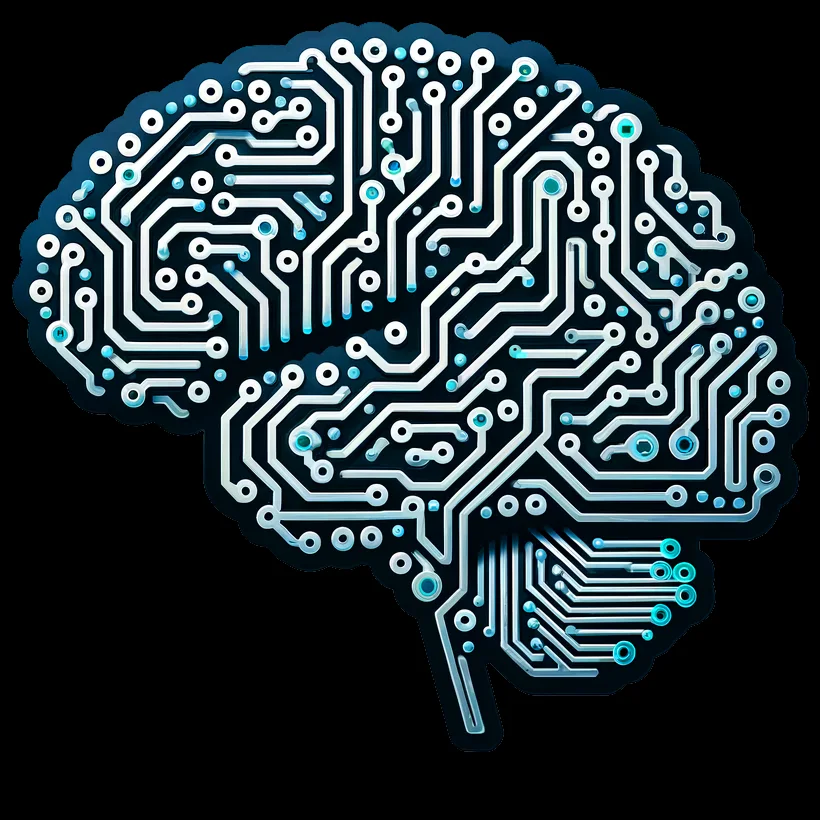
AI-generated conceptual illustration of artificial intelligence, described as a brain made from printed circuit boards.
Credit: JPxG · Public domain · sourceResized and converted to WebP; uncropped.
1. Meaning, scope and foundations
Artificial intelligence is a field concerned with building systems capable of perception, language processing, learning, reasoning and decision-making. Unlike a conventional program that follows explicitly specified instructions for every operation, a learning-based AI system develops patterns from examples. However, AI also includes rule-based approaches: early expert systems used knowledge bases and inference rules rather than learning mainly from large datasets.
The expression artificial intelligence was introduced in the 1955 proposal for the Dartmouth research project, held in 1956. Subsequent development involved alternating periods of enthusiasm and reduced funding, sometimes called AI winters. Recent advances reflect the availability of large datasets, improved algorithms, powerful processors and cloud infrastructure rather than the emergence of a single invention.
Existing systems are generally classified as narrow AI because they operate within bounded tasks or capabilities, even when their range is broad. Artificial general intelligence refers to a proposed system with broadly general, human-level intellectual capabilities; its definition and evaluation remain contested. There is no universally accepted demonstration of AGI. Artificial superintelligence is a hypothetical capability beyond human intelligence.
- Automation executes a process with reduced human intervention; it need not involve AI.
- Robotics concerns physical machines, sensors and actuators. A robot may use AI, but software-only AI is not a robot.
- The Internet of Things connects physical devices for sensing and communication; AI can analyse the resulting data.
- The Turing Test evaluates conversational behaviour under specified conditions; it does not establish consciousness or universal intelligence.
Timeline
1956
The Dartmouth summer research project helped establish AI as a distinct research field.
2017
Publication of Attention Is All You Need introduced the transformer architecture.
2018
NITI Aayog released India’s National Strategy for Artificial Intelligence.
2021
UNESCO adopted its Recommendation on the Ethics of Artificial Intelligence.
2024
India approved the IndiaAI Mission; the EU AI Act entered into force with phased application.
2. How machines learn
Machine learning trains a model to identify useful patterns in data. In supervised learning, training examples contain target labels, such as images marked as diseased or healthy. Classification predicts categories, whereas regression predicts numerical values. Unsupervised learning identifies structures without supplied target labels, including customer clusters or patterns in high-dimensional data.
Reinforcement learning uses interactions with an environment and a reward signal to improve a policy for selecting actions. It is relevant to game-playing, robotics and resource allocation. Self-supervised learning derives training targets from the data itself, such as predicting missing portions of a sentence. It is important in training modern foundation models and should not be confused with a system independently verifying truth.
Deep learning uses neural networks with multiple processing layers to learn representations. Training adjusts model parameters to reduce an objective or loss function; inference applies a trained model to new inputs. Training, validation and test datasets serve different purposes. Overfitting occurs when a model captures training-specific details but performs poorly on new data; data leakage can make reported performance misleadingly high.
- Natural language processing handles language tasks such as translation, summarisation and speech-related applications.
- Computer vision analyses images and videos for tasks including object detection and medical image interpretation.
- Accuracy alone can be misleading for rare events; precision and recall help assess false alarms and missed cases.
- Performance may deteriorate after deployment when real-world data changes, a problem known as distribution shift.
Responsible AI deployment cycle
- 1. Define the problem and assess whether AI is necessary
- 2. Collect lawful, relevant and representative data
- 3. Train and validate the model
- 4. Test accuracy, safety, bias and security
- 5. Deploy with appropriate oversight and user disclosure
- 6. Monitor performance, provide redress and update or withdraw
3. Generative AI and enabling infrastructure
Generative AI creates text, images, audio, video or code from learned patterns. A foundation model is trained on broad data and can be adapted to multiple downstream tasks. Large language models process tokens, which may represent words, word fragments or other units. Transformer architectures use attention mechanisms to capture relationships within inputs; the influential transformer paper was published in 2017.
Many language models generate output by repeatedly predicting the next token. Fine-tuning adapts a model through further training, while prompting provides instructions or context without necessarily changing its parameters. Retrieval-augmented generation retrieves information from external sources and supplies it as context. Retrieval can improve relevance and traceability but cannot guarantee that every generated statement is correct.
Multimodal models process more than one type of input or output, such as text and images. AI agents combine models with tools and workflows to perform multi-step tasks, potentially creating additional security and oversight risks. A hallucination is a plausible but unsupported or incorrect output; it is not proof of intentional deception or human-like understanding.
AI infrastructure includes datasets, data centres, high-bandwidth networks and specialised processors. Graphics processing units are valuable because they perform many computations in parallel; other accelerators include tensor processing units and neural processing units. Edge AI runs models on or near devices, reducing dependence on remote servers. It may improve latency and privacy, but is constrained by local memory, power and computing capacity.
- Cloud computing is an enabling platform, not a synonym for AI.
- Blockchain and quantum computing are not prerequisites for AI.
- Open model weights do not necessarily imply open training data, fully open-source software or unrestricted licensing.
| Approach | Training signal | Illustrative task |
|---|---|---|
| Supervised learning | Examples with target labels | Classifying labelled crop-disease images |
| Unsupervised learning | Patterns without supplied target labels | Grouping similar documents |
| Self-supervised learning | Targets derived from the data itself | Predicting masked text |
| Reinforcement learning | Rewards from interaction | Learning a robot-control policy |
4. Applications and limitations in development
In healthcare, AI supports screening, image interpretation, clinical documentation and drug discovery. A prediction is not automatically a medical diagnosis: clinical validation, representative data and professional accountability remain essential. In agriculture, satellite imagery, weather information and field data can support pest detection, irrigation advice and yield estimation. Smallholder benefits depend on local-language access, reliable ground data and affordable delivery.
Public-sector applications include flood forecasting, administrative document processing, translation and identification of service-delivery gaps. Industry uses AI for predictive maintenance, logistics and quality inspection. Financial institutions employ it for fraud detection and risk assessment. In education, adaptive learning can offer personalised support, but inaccurate explanations, profiling and unequal device access require safeguards.
AI can improve productivity while changing the composition of employment. Tasks within occupations may be automated, supplemented or redesigned; this does not imply that entire occupations disappear uniformly. India’s multilingual population creates opportunities for language technologies, but low-resource languages often have limited digitised training material. Accessibility tools such as speech recognition and image descriptions can assist persons with disabilities.
- High benchmark performance does not automatically establish suitability for a hospital, farm or government department.
- Correlations learned from historical data do not by themselves demonstrate causation.
- Training and serving models consume electricity and may require water for data-centre cooling; impacts vary by model, location and energy mix.
5. Risks, governance and India’s policy framework
AI risks include discriminatory outcomes, privacy violations, cybersecurity misuse, copyright disputes and concentration of technological power. Biased data, unsuitable labels or inappropriate deployment can disadvantage particular groups. Deepfakes are synthetic or manipulated media that can impersonate people, facilitate fraud and undermine trust. Synthetic media also has legitimate uses, so assessment must consider consent, disclosure and context.
Responsible AI requires safety, reliability, fairness, transparency, privacy and accountability. Practical measures include data-quality checks, independent evaluation, adversarial testing, access controls, incident reporting and meaningful human oversight. Explainability concerns understanding an output or mechanism; transparency additionally covers disclosure about system design, limitations and use. Neither alone guarantees fairness. Human review is effective only when reviewers have time, expertise and authority to intervene.
NITI Aayog’s National Strategy for Artificial Intelligence, released in June 2018, advanced the AI for All approach. It prioritised healthcare, agriculture, education, smart cities and infrastructure, and smart mobility and transportation. NITI Aayog subsequently published Responsible AI for All documents in 2021. These policy documents should not be confused with binding legislation.
The IndiaAI Mission, implemented through the IndiaAI Independent Business Division under Digital India Corporation, seeks to strengthen computing access, datasets, indigenous capabilities, skills, applications, startup financing and safe AI. Its approved design envisaged a scalable ecosystem of 10,000 or more GPUs through public-private partnership. BHASHINI, the National Language Translation Mission, supports digital language services and access across Indian languages.
India’s Digital Personal Data Protection Act, 2023 provides a framework for processing digital personal data, subject to its provisions and implementation notifications. Internationally, UNESCO adopted its Recommendation on the Ethics of Artificial Intelligence in 2021. The European Union’s AI Act entered into force in August 2024, with phased application and a risk-based framework. India is also a participant in the Global Partnership on Artificial Intelligence.
- IndiaAI pillars: Compute Capacity; Innovation Centre; Datasets Platform; Application Development Initiative; FutureSkills; Startup Financing; Safe and Trusted AI.
- For public procurement, specify the problem, evaluate alternatives, test local performance and provide grievance-redress mechanisms.
- Do not equate voluntary ethical principles, policy strategies and legally enforceable obligations.
Artificial intelligence: interpreting the brain–computer metaphor
The supplied metadata describes a symbolic AI illustration generated using DALL-E 3. Its brain–circuit-board concept is useful for introducing artificial intelligence, but it is a metaphor, not a technical model. AI systems use computational methods to infer outputs from inputs; they need not reproduce human thinking or possess consciousness. Artificial neural networks are mathematically defined architectures loosely inspired by biological networks, not digital replicas of the human brain.
The image’s documented generation also illustrates generative AI: a system produces content in response to a prompt rather than merely assigning a label or forecasting a value. This demonstrates a stated application, not evidence of the system’s accuracy, reasoning ability or general intelligence. In India, potential uses include local-language assistance, agricultural advisories and public-service delivery. Their value depends on representative data, reliable infrastructure, domain-specific evaluation and human oversight. The IndiaAI Mission provides a relevant policy context through its focus on computing capacity, datasets, skills and responsible AI; an illustrative icon cannot establish progress or effectiveness in these areas.
- Distinguish the hierarchy: AI is the broader field; machine learning is a major approach within it, and deep learning uses multilayer neural networks.
- Separate software from infrastructure: models and algorithms perform inference, while processors and data centres supply computation; a circuit-board motif does not explain model architecture.
- For governance answers, connect risks to safeguards: inaccurate outputs require verification, discriminatory outcomes require bias testing, and sensitive-data use requires privacy protection and accountability.
Real-world case studies
AI-supported tuberculosis screening in India
Qure.ai’s qXR, developed by an Indian company, analyses chest X-rays and has been used in tuberculosis screening programmes. Such computer-aided detection can help prioritise people for further testing where radiology capacity is limited. It does not establish bacteriological confirmation: diagnostic pathways and appropriate confirmatory tests remain necessary.
AlphaFold and protein structure prediction
DeepMind’s AlphaFold demonstrated major advances in predicting protein structures. The AlphaFold Protein Structure Database, developed with EMBL-EBI, made over 200 million predictions available in 2022. These predictions support biological research but do not automatically establish protein function, molecular interactions or the safety and efficacy of a medicine.
Previous year questions
UPSC Prelims 2020
With the present state of development, Artificial Intelligence can effectively do which of the following? 1. Bring down electricity consumption in industrial units. 2. Create meaningful short stories and songs. 3. Disease diagnosis. 4. Text-to-speech conversion. 5. Wireless transmission of electrical energy. Select the correct answer.
- A. 1, 2, 3 and 5 only
- B. 1, 3 and 4 only
- C. 2, 4 and 5 only
- D. 1, 2, 3 and 4 only
Practice questions
Practice MCQ 1
Consider the following statements: 1. Deep learning is a subset of machine learning. 2. All robotic systems necessarily use machine learning. 3. Self-supervised learning can derive training targets from the input data itself. Which statements are correct?
- A. 1 and 2 only
- B. 1 and 3 only
- C. 2 and 3 only
- D. 1, 2 and 3
Practice MCQ 2
With reference to generative AI, consider the following statements: 1. Retrieval-augmented generation can supply external documents as context to a language model. 2. A fluent response necessarily indicates factual correctness. 3. Inference necessarily updates a model’s parameters. Which statements are correct?
- A. 1 only
- B. 1 and 2 only
- C. 2 and 3 only
- D. 1, 2 and 3
Practice MCQ 3
Which of the following are pillars of the IndiaAI Mission? 1. IndiaAI Compute Capacity. 2. IndiaAI FutureSkills. 3. Safe and Trusted AI. Select the correct answer.
- A. 1 and 2 only
- B. 2 and 3 only
- C. 1 and 3 only
- D. 1, 2 and 3
Mains practice · Artificial intelligence can strengthen public-service delivery, but adoption without institutional safeguards can deepen exclusion. Discuss with reference to India. Suggest a responsible deployment framework. Answer in 250 words.
- Explain applications in health screening, agriculture, translation and administrative assistance.
- Identify risks from unrepresentative data, privacy violations, automation bias and unequal digital access.
- Link the IndiaAI Mission and BHASHINI to capacity-building and inclusion.
- Recommend lawful data use, local validation, accessibility, independent audits and meaningful human review.
- Provide grievance redress, non-digital alternatives and continuous monitoring.
- Conclude that public value and accountability, rather than technological novelty, should guide adoption.
Further reading
- NITI Aayog: National Strategy for Artificial Intelligence, 2018.
- NITI Aayog: Responsible AI for All, Parts 1 and 2, 2021.
- Press Information Bureau: Cabinet approval of the IndiaAI Mission, 7 March 2024.
- IndiaAI official portal: indiaai.gov.in.
- BHASHINI official portal: bhashini.gov.in.
- UNESCO: Recommendation on the Ethics of Artificial Intelligence, 2021.
- India Code: Digital Personal Data Protection Act, 2023.
- Stuart Russell and Peter Norvig: Artificial Intelligence: A Modern Approach.
- https://commons.wikimedia.org/wiki/File:Dall-e_3_(jan_%2724)_artificial_intelligence_icon.png
Preparing for UPSC Civil Services? Get classroom teaching, answer-writing evaluation and mentorship at Pragnya IAS Academy, Ashok Nagar — see why aspirants choose us for IAS coaching in Hyderabad.