
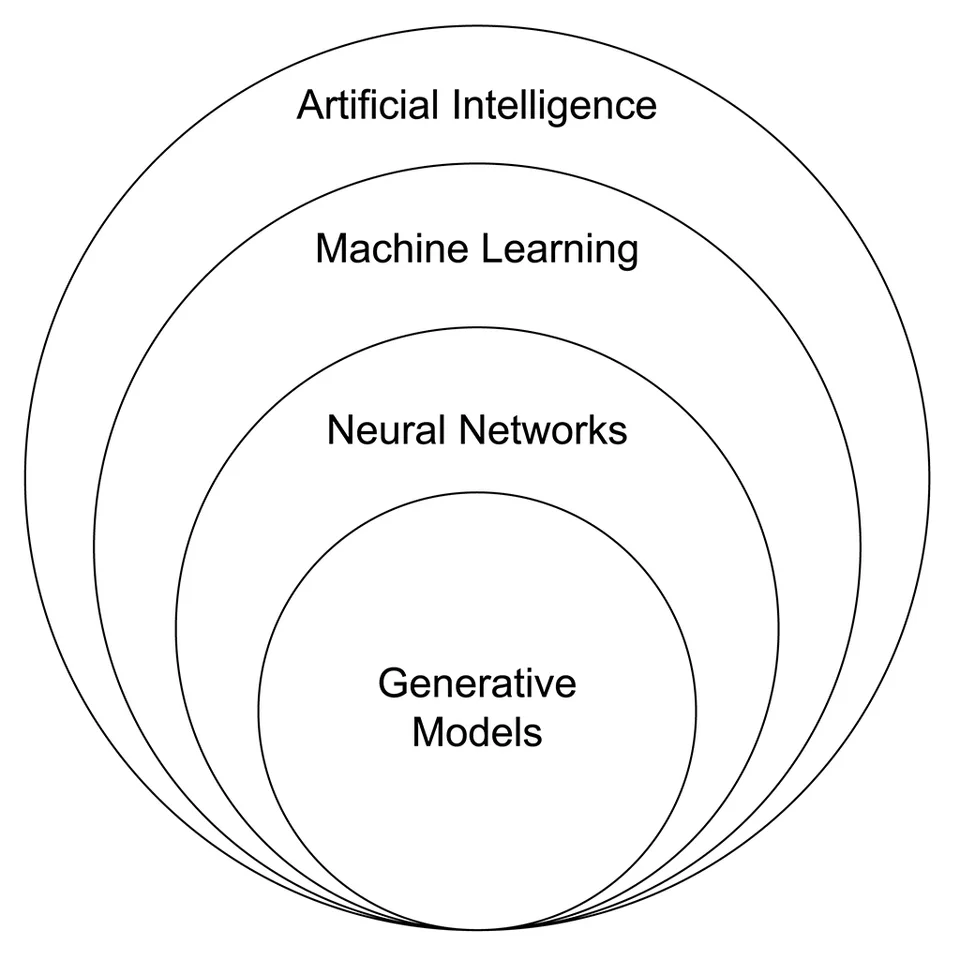
Conceptual diagram relating artificial intelligence to generative models.
Credit: The Original Benny C · CC BY-SA 4.0 · sourceResized and converted to WebP; uncropped.
1. Meaning and essential distinctions
Generative artificial intelligence is a class of AI systems capable of producing new content resembling patterns learned from training data. Outputs include essays, computer code, images, speech, music, videos and candidate molecular structures. Unlike traditional rule-based software, these systems learn statistical relationships through training. The output is generated in response to an input, commonly called a prompt, which may contain instructions, examples, documents or images.
Artificial intelligence is the broad field of building systems that perform tasks associated with human intelligence. Machine learning is a subset in which systems learn from data, while deep learning uses multilayer neural networks. Much contemporary generative AI is based on deep learning. However, AI also includes non-generative applications such as credit-risk prediction, object detection and route optimisation.
A large language model, or LLM, is trained to process and generate language. A multimodal model handles more than one modality, such as text and images. A foundation model is trained on broad data and can be adapted to multiple tasks. Artificial general intelligence refers to a proposed broadly capable form of machine intelligence; generative ability alone does not establish general intelligence, consciousness or human-like understanding.
- Generative task: draft a description of a satellite image.
- Discriminative task: classify the image as forest or non-forest.
- Predictive task: estimate the probability of forest loss.
2. How generative models work
Training adjusts a model’s numerical parameters to reduce errors against a learning objective. Language-model training commonly uses self-supervision: the data itself supplies targets, such as the next token in a passage. Tokens may be words, word fragments or characters. During inference, the trained model processes a prompt and generates output. Training and inference both require computing resources, but only training necessarily changes the model’s parameters.
Transformers, introduced in 2017, use attention mechanisms to capture relationships among tokens. Many LLMs generate text autoregressively, predicting one token after another. Their context window limits the material they can process in a single interaction. A temperature setting influences sampling randomness: lower values generally make output more predictable, but do not guarantee correctness.
Other important architectures include generative adversarial networks, or GANs, in which a generator and discriminator compete during training. Diffusion models learn to reverse a progressive noising process and are widely used for image generation. Variational autoencoders learn probabilistic latent representations from which new samples can be generated. These architectures are not interchangeable, and modern systems may combine techniques.
- Fine-tuning further trains a model on selected data for a task or domain.
- Instruction tuning and reinforcement learning from human feedback can improve instruction-following and alignment with preferred behaviour.
- Retrieval-augmented generation, or RAG, retrieves external documents and supplies them as context. It does not inherently update model weights.
- Prompt engineering changes instructions or context without necessarily retraining the model.
Simplified generative-AI development cycle
- 1. Collect and govern relevant data
- 2. Clean, filter and prepare training data
- 3. Train a model by adjusting parameters
- 4. Adapt and evaluate for intended tasks
- 5. Generate outputs during inference
- 6. Monitor failures and improve safeguards
3. Applications and enabling infrastructure
In education, generative AI can create practice questions, translate lessons and provide explanations adapted to different learning levels. In public administration, it can assist with document summarisation, multilingual citizen communication and searching departmental records. Such applications need authoritative source material, accessibility testing and escalation to accountable officials, particularly where welfare entitlements or legal rights are involved.
Healthcare applications include drafting clinical notes, assisting medical-image interpretation and proposing molecules for drug discovery. Generated molecules remain candidates requiring laboratory validation, toxicity assessment and clinical trials. In agriculture, locally adapted assistants can communicate crop advisories, but recommendations must reflect location, season and verified agronomic knowledge. Software development, design and scientific research are other major application areas.
The enabling infrastructure includes training data, GPUs and other AI accelerators, high-bandwidth networking, reliable electricity and data centres. Cloud computing improves access to powerful systems, while smaller models can run closer to users on edge devices. Quantisation reduces numerical precision to lower memory and computational requirements, sometimes at a performance cost. Environmental impacts depend on model size, usage, hardware efficiency, electricity sources and cooling arrangements.
- Indian priorities include regional-language coverage, affordable access and representation of low-resource languages.
- Synthetic data can supplement datasets, but is not automatically unbiased, accurate or privacy-preserving.
| Concept | Main function | Important qualification |
|---|---|---|
| Pre-training | Learns broad patterns from data | Does not guarantee factual reliability |
| Fine-tuning | Adapts model parameters through further training | Different from merely changing a prompt |
| RAG | Retrieves information to support generation | Usually leaves model weights unchanged |
| Inference | Uses a trained model to produce output | Still requires computational resources |
| AI agent | Uses models and tools to pursue tasks | Requires permission controls and oversight |
4. Limitations and societal risks
A hallucination is an incorrect or unsupported output presented as plausible information. It arises because generating statistically likely content is not equivalent to verifying truth. A model may fabricate references, misstate laws or make arithmetic errors. RAG, external tools and expert review can reduce such failures, but retrieved material may itself be unreliable and the model may misinterpret it.
Bias in training data can reproduce stereotypes or create unequal performance across languages and social groups. Privacy risks arise from collection of personal information, memorisation of training examples and disclosure through prompts. Copyright questions concern both training material and generated outputs; legal treatment varies across jurisdictions. Open-weight availability does not automatically confer unrestricted rights over training data or satisfy every definition of open-source software.
Deepfakes can impersonate people through synthetic audio or video, facilitating fraud and misinformation. Models can also be manipulated through prompt injection, including instructions hidden in retrieved documents. AI agents that invoke tools or execute workflows introduce additional risks if granted excessive permissions. Employment effects may involve task transformation and displacement, making reskilling important. High-stakes decisions require human accountability rather than uncritical acceptance of automated recommendations.
- Watermarking and provenance records can support authenticity checks, but are not foolproof.
- Fluency, model size and benchmark scores are not substitutes for domain-specific testing.
5. Indian policy and international governance
The Union Cabinet approved the IndiaAI Mission on 7 March 2024. Its seven pillars cover compute capacity, an innovation centre, datasets, application development, future skills, startup financing, and safe and trusted AI. The mission is implemented through the IndiaAI Independent Business Division under Digital India Corporation, within the Ministry of Electronics and Information Technology. Its objectives include broadening access to AI infrastructure and strengthening indigenous capabilities.
NITI Aayog’s National Strategy for Artificial Intelligence, published in 2018, advanced an AI for All approach. Its responsible-AI work emphasises safety, equality, inclusion, privacy, transparency and accountability. Relevant legal frameworks include the Information Technology Act, 2000, the Copyright Act, 1957, and the Digital Personal Data Protection Act, 2023. Applicability depends on the activity, statutory scope and commencement of relevant provisions; IndiaAI Mission is not itself an AI regulation.
Internationally, UNESCO adopted its Recommendation on the Ethics of Artificial Intelligence in 2021. The European Union’s AI Act entered into force in August 2024 with phased application, combining risk-based obligations with rules for general-purpose AI models. For India, an appropriate approach balances innovation with safeguards: representative datasets, security testing, independent evaluation, grievance redress and meaningful human oversight. Regulation should distinguish a low-risk creative assistant from systems affecting health, employment or access to essential services.
Generative AI within the broader AI landscape
The supplied metadata describes a Venn diagram relating artificial intelligence to generative models, making it directly relevant to this microtopic. AI is the broad field of building systems that perform tasks associated with intelligence; machine learning develops capabilities through learning from data. Generative models learn statistical patterns that enable them to produce new samples, such as text or images. Most prominent contemporary generative AI systems use deep learning, but generative modelling is not confined to deep neural networks.
A subset diagram is a conceptual aid, not proof of a rigid technological hierarchy. Generative and predictive functions can coexist in one system: a language model commonly generates text by repeatedly predicting the next token. This does not establish factual accuracy, human-like understanding or artificial general intelligence. Since only metadata is available, the diagram’s precise labels and nesting cannot be verified here.
For India, applications include multilingual public-service assistance, educational resources and administrative drafting. Deployment requires attention to uneven language representation, personal-data protection, copyright and accountability. Retrieval from trusted sources can improve grounding, but neither retrieval nor fluent output guarantees correctness. Consequential uses need proportionate safeguards, human review and clear responsibility for errors.
- Prelims distinction: generative AI creates content; a search engine primarily retrieves information, though products may combine both functions.
- Evidence limit: plausible generated statements require independent verification, especially in legal, scientific and policy contexts.
- Mains approach: assess productivity and inclusion alongside misinformation, bias, labour impacts and institutional oversight.
Real-world case studies
Jugalbandi: multilingual access to information
Launched in India in 2023, Jugalbandi combined conversational AI with Indian-language capabilities to help users access information about government schemes through a messaging interface. It illustrates how generative systems can simplify complex information. Accurate retrieval, current eligibility rules and human support remain essential.
Mata v. Avianca: fabricated legal citations
In 2023, a United States federal court sanctioned lawyers after a filing included non-existent judicial decisions generated by ChatGPT. The case demonstrates that plausible citations are not evidence and that professionals remain responsible for independently verifying AI-assisted work.
Previous year questions
No source-linked PYQ is available here yet. Use the practice questions below.
Practice questions
Practice MCQ 1
Consider the following statements: 1. Retrieval-augmented generation necessarily updates model parameters. 2. Fine-tuning involves further training of a model. 3. Inference can occur without changing model parameters. Which statements are correct?
- A. 1 and 2 only
- B. 2 and 3 only
- C. 1 and 3 only
- D. 1, 2 and 3
Practice MCQ 2
Which one of the following best describes a diffusion model used for image generation?
- A. A model that only retrieves identical images from a database
- B. A model that learns to reverse a progressive noising process
- C. A model that requires a competing discriminator in every implementation
- D. A model that generates images without training data or learned parameters
Practice MCQ 3
Consider the following statements about generative AI: 1. Synthetic datasets are inherently free from personal information. 2. Watermarking guarantees detection of every AI-generated image. 3. Fluent language generation does not establish factual accuracy. Which statements are correct?
- A. 1 only
- B. 1 and 2 only
- C. 3 only
- D. 2 and 3 only
Mains practice · Generative AI can improve access to public services, but may also magnify exclusion and misinformation. Discuss safeguards for its responsible deployment in India. Answer in 250 words.
- Explain multilingual assistance, document processing and service discovery.
- Identify hallucinations, biased language performance, privacy risks and digital exclusion.
- Use verified departmental sources with citations and update mechanisms.
- Require domain testing, security controls and data minimisation.
- Retain human review, offline alternatives and accessible grievance redress.
- Link capacity building to IndiaAI Mission and responsible-AI principles.
Further reading
- MeitY and IndiaAI: official IndiaAI Mission documents, indiaai.gov.in.
- Press Information Bureau: Cabinet approval of IndiaAI Mission, 7 March 2024.
- NITI Aayog: National Strategy for Artificial Intelligence, 2018; Responsible AI for All approach documents.
- UNESCO: Recommendation on the Ethics of Artificial Intelligence, 2021.
- NIST: Artificial Intelligence Risk Management Framework and Generative Artificial Intelligence Profile.
- European Commission: official AI Act explanatory material.
- https://commons.wikimedia.org/wiki/File:AI_relation_to_Generative_Models_subset,_venn_diagram.png
Preparing for UPSC Civil Services? Get classroom teaching, answer-writing evaluation and mentorship at Pragnya IAS Academy, Ashok Nagar — see why aspirants choose us for IAS coaching in Hyderabad.