
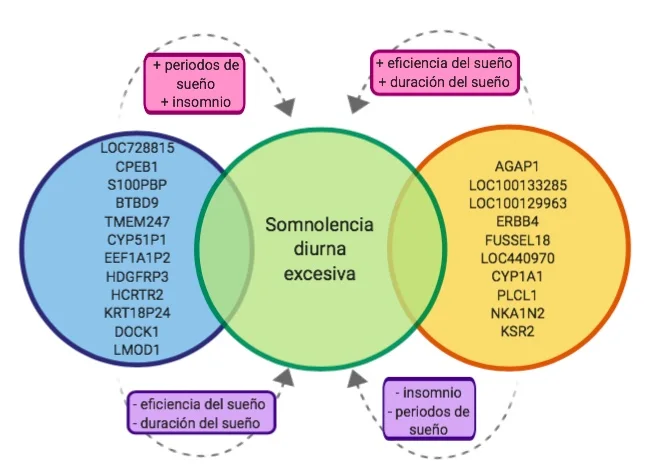
Illustrative grouping of genes associated with daytime sleepiness by sleep propensity and sleep fragmentation.
Credit: Emmb1612 · CC BY-SA 4.0 · sourceResized and converted to WebP; uncropped.
1. Genes, DNA and chromosomes
Genes are segments of genetic material that contribute to biological function through their products. In cellular organisms, genes are made of DNA. Some viruses have RNA genomes and therefore RNA-based genes. A gene need not encode a protein: ribosomal RNA and transfer RNA are functional gene products involved in protein synthesis.
DNA usually forms a double helix with two antiparallel strands. Each nucleotide contains a sugar, phosphate group and nitrogenous base. Adenine pairs with thymine, while guanine pairs with cytosine. The sequence of bases stores biological information. In eukaryotic cells, DNA associates with proteins, especially histones, to form chromatin, which is organised into chromosomes.
The genome is the complete genetic material of an organism or cell. A gene occupies a particular location, called a locus; alternative versions of a gene are called alleles. Homologous chromosomes carry corresponding loci, although their alleles may differ. Genotype refers to genetic constitution, while phenotype refers to observable or measurable characteristics.
Human nuclear DNA is inherited from both parents. Mitochondrial DNA is ordinarily inherited maternally. Plants additionally possess chloroplast genomes. These organellar genomes illustrate why genetic information is not restricted to the nucleus.
- Homozygous: possessing identical alleles at a locus; heterozygous: possessing different alleles.
- Chromosome number does not reliably indicate an organism’s complexity.
- Mature human red blood cells lack nuclei and mitochondria; the usual chromosome count does not apply to them.
Timeline
1866
Gregor Mendel published his experiments on plant hybridisation.
1953
Watson and Crick proposed the DNA double-helix model, drawing on evidence including the X-ray diffraction work of Rosalind Franklin and Maurice Wilkins.
2003
The Human Genome Project was declared complete.
2012
Programmable RNA-guided DNA cleavage using CRISPR-Cas9 was demonstrated.
January 2025
GenomeIndia data covering 10,000 sequenced individuals were dedicated to the nation.
2. Gene expression and its regulation
Gene expression is the use of genetic information to produce a functional product. For protein-coding genes, transcription copies DNA information into RNA, and translation uses messenger RNA to assemble a polypeptide at a ribosome. Transfer RNA brings amino acids, while ribosomal RNA forms a major structural and catalytic component of ribosomes.
The genetic code consists of three-base units called codons in messenger RNA. There are 64 codons: 61 specify amino acids and three normally signal termination. AUG generally serves as the start codon and codes for methionine. The code is degenerate, meaning that more than one codon can specify the same amino acid, and nearly universal, with limited exceptions.
In eukaryotes, many genes contain exons interrupted by introns. During RNA processing, introns are removed and exons joined. Alternative splicing can generate different RNA transcripts from one gene, increasing the diversity of protein products. Thus, one gene does not necessarily correspond to one protein.
Regulatory DNA sequences and transcription factors influence where, when and how strongly genes are expressed. Epigenetic mechanisms, including DNA methylation and histone modification, can alter gene activity without changing the underlying DNA sequence. They help explain how cells with broadly similar genomes develop specialised functions.
- The usual information pathway is DNA to RNA to protein; reverse transcription transfers information from RNA to DNA.
- Non-coding DNA is not automatically useless: some regions regulate genes or produce functional RNAs.
Expression of a typical eukaryotic protein-coding gene
- 1. Regulatory signals activate transcription
- 2. DNA is transcribed into precursor messenger RNA
- 3. RNA processing includes splicing, capping and polyadenylation
- 4. Mature messenger RNA reaches the cytoplasm
- 5. Ribosomes translate codons into a polypeptide
- 6. Folding and modification produce a functional protein
3. Inheritance, variation and genetic disorders
Mendel’s experiments with pea plants established principles of inheritance. The law of segregation states that the two alleles at a locus separate during gamete formation. Independent assortment generally applies to genes on different chromosomes or sufficiently far apart on the same chromosome. Closely linked genes tend to be inherited together, although crossing over can separate them.
Dominant and recessive describe relationships between alleles, not their frequency, usefulness or strength. Incomplete dominance produces an intermediate heterozygous phenotype, while codominance allows both alleles to be expressed. The human ABO blood group system illustrates multiple alleles and codominance: the A and B alleles are codominant.
Many characteristics, including height, are polygenic and influenced by environmental conditions. Pleiotropy occurs when one gene affects multiple traits. Mutations are changes in genetic sequence and may be harmful, neutral or beneficial depending on context. Germline mutations can be inherited, whereas somatic mutations are generally not transmitted to offspring.
Sickle-cell disease involves a variant in HBB, which encodes the beta-globin component of haemoglobin. Haemophilia A and B commonly follow X-linked recessive inheritance. Down syndrome, usually caused by an extra chromosome 21, is a chromosomal condition rather than a single-gene disorder. Cancer commonly involves accumulated changes affecting cell growth, DNA repair and cell death.
- Having a disease-associated allele does not always mean disease will develop; penetrance and environmental influences matter.
- Genetic disease and inherited disease are not identical: some genetic changes arise newly in an individual.
| Term | Meaning | Example |
|---|---|---|
| Gene | DNA sequence expressed as a functional RNA or protein | HBB |
| Allele | Alternative version at a genetic locus | Sickle-cell-associated HBB allele |
| Chromosome | Organised DNA–protein structure carrying many genes | Human chromosome 21 |
| Genome | Complete genetic material | Human nuclear and mitochondrial genomes |
| Genetic code | Correspondence between RNA codons and amino acids or stop signals | AUG specifies methionine |
4. Genes in biotechnology and medicine
Genome sequencing determines the order of DNA bases; it does not itself change genes. Polymerase chain reaction amplifies selected DNA sequences, enabling applications in diagnostics, research and forensics. DNA profiling compares variable genetic markers to assess identity or biological relationships rather than routinely sequencing an entire genome.
Recombinant DNA technology combines DNA sequences and introduces them into suitable host cells. Engineered microorganisms can manufacture human insulin. Bt cotton contains bacterial genes that enable production of proteins toxic to particular insect pests. Such resistance is target-specific and does not make the crop immune to all pests.
Gene editing makes targeted alterations in genetic material. In CRISPR-Cas9 systems, a guide RNA directs the Cas9 nuclease to a matching DNA region near a suitable recognition motif. Cellular repair after cutting can disrupt a gene or, under appropriate conditions, introduce a planned change. Delivery difficulties, off-target changes and unintended on-target effects remain important concerns.
Gene therapy seeks to treat disease by adding, modifying or regulating genetic material. Ex vivo therapy modifies cells outside the body before returning them; in vivo therapy delivers treatment directly into the body. Pharmacogenomics studies how genetic variation affects responses to medicines, supporting more individualised drug selection and dosing.
- Sequencing reads genetic information; editing changes it; gene therapy is a therapeutic application.
- Not all genetically modified organisms are transgenic: some modifications do not introduce genes from another species.
5. Indian initiatives, regulation and ethical issues
The Human Genome Project, completed in 2003, produced a foundational human reference sequence. References are not identical to every person’s genome, and later projects have improved completeness and representation. India’s genetic diversity makes population-relevant genomic datasets important for interpreting variants and understanding disease risks.
The Department of Biotechnology’s GenomeIndia project sequenced genomes from 10,000 individuals representing diverse Indian populations. Its genome data were dedicated to the nation in January 2025. The Indian Biological Data Centre at Faridabad provides infrastructure for biological data storage and access. Such resources can strengthen research but do not automatically establish the clinical significance of every detected variant.
India’s genetically engineered organism framework includes the 1989 Rules under the Environment (Protection) Act, 1986. The Review Committee on Genetic Manipulation operates under the Department of Biotechnology, while the Genetic Engineering Appraisal Committee functions under the environment ministry. Responsibilities differ according to the activity and regulatory stage.
The ICMR–DBT National Guidelines for Gene Therapy Product Development and Clinical Trials, 2019, address safety and ethical requirements. Key concerns include informed consent, genetic privacy, re-identification risks, discrimination and equitable access. Somatic interventions primarily affect the treated individual; heritable germline changes could affect future generations, raising substantially greater ethical and safety concerns.
- Genetic counselling should explain uncertainty and reproductive options without coercion or stigmatisation.
- Population-level genetic findings should not be treated as rigid biological definitions of caste, ethnicity or social identity.
Genes, Complex Traits and Association Evidence
The supplied metadata describes genes associated with excessive daytime sleepiness, grouped into biological subtypes linked to sleep propensity and sleep fragmentation. This illustrates how different biological mechanisms can contribute to a similar observable trait, or phenotype. A gene is not necessarily a deterministic instruction for one characteristic: complex traits commonly reflect contributions from multiple genes, their regulation and environmental influences. Daytime sleepiness therefore provides a useful example of why a simple “one gene–one trait” model is often inadequate.
An association between a genetic variant and a trait does not, by itself, establish that the variant causes the trait. An associated variant may merely track a nearby causal change; identifying the relevant gene and mechanism requires further evidence. The metadata does not establish the study population, methods or strength of association, so it cannot support clinical predictions or conclusions specific to India. For Indian public health and genomics, the broader lesson is that findings require validation in appropriate populations. Genetic information may help investigate disease susceptibility, but interpretation must also consider clinical history, lifestyle and environmental exposures, alongside consent and privacy.
- Gene versus variant: a gene is a functional DNA unit; variants are sequence differences that may alter function, regulation or neither.
- Polygenic versus Mendelian: many small genetic contributions differ from inheritance primarily driven by a single gene.
- Association versus diagnosis: a research link does not establish causation, justify a screening test or identify a treatment target.
Real-world case studies
CRISPR-based treatment for sickle-cell disease
In 2023, the United Kingdom and United States approved Casgevy for specified patients with sickle-cell disease. The treatment edits a regulatory region affecting BCL11A in the patient’s blood stem cells, increasing fetal haemoglobin production. It does not directly repair the sickle-cell HBB variant and is a somatic, ex vivo intervention.
India’s sickle-cell mission
Launched in July 2023, the National Sickle Cell Anaemia Elimination Mission aims to eliminate sickle-cell disease as a public health problem by 2047. Screening, counselling and care are central components, particularly in affected tribal populations. Carrier identification must support informed choices rather than discrimination.
Previous year questions
UPSC Prelims 2019
What is Cas9 protein, which is often mentioned in the news?
- A. A molecular scissors used in targeted gene editing
- B. A biosensor used for accurately detecting pathogens in patients
- C. A gene that makes plants pest-resistant
- D. A herbicidal substance synthesised in genetically modified crops
Practice questions
Practice MCQ 1
Consider the following statements: 1. Every gene encodes a protein. 2. Some human genes are located in mitochondria. 3. Alternative splicing can generate multiple RNA transcripts from one gene. Which statements are correct?
- A. 1 and 2 only
- B. 2 and 3 only
- C. 1 and 3 only
- D. 1, 2 and 3
Practice MCQ 2
Which of the following best describes an epigenetic change?
- A. Replacement of a DNA base by another base
- B. Addition of an entire chromosome
- C. Alteration of gene activity through DNA methylation without changing the base sequence
- D. Removal of a DNA segment using Cas9
Practice MCQ 3
Consider the following pairs: 1. Genome sequencing — Determining DNA base order 2. PCR — Amplifying selected DNA sequences 3. Ex vivo gene therapy — Modifying cells directly inside the patient’s body. How many pairs are correctly matched?
- A. Only one
- B. Only two
- C. All three
- D. None
Mains practice · Distinguish genome sequencing from gene editing. Discuss their potential for Indian public health and the safeguards required for responsible application. Answer in 250 words.
- Define sequencing as reading DNA and editing as targeted modification.
- Discuss rare-disease diagnosis, variant interpretation, pharmacogenomics and targeted therapies.
- Use GenomeIndia and sickle-cell interventions as examples.
- Explain limitations involving population representation, uncertain variants, delivery and unintended editing.
- Address consent, privacy, genetic counselling, affordability and discrimination.
- Differentiate somatic treatment from heritable germline modification and stress rigorous oversight.
Further reading
- NCERT Biology, Class XII: Principles of Inheritance and Variation; Molecular Basis of Inheritance; Biotechnology: Principles and Processes.
- Department of Biotechnology: GenomeIndia project information.
- ICMR–DBT: National Guidelines for Gene Therapy Product Development and Clinical Trials, 2019.
- Ministry of Environment, Forest and Climate Change: Genetic Engineering Appraisal Committee and Rules, 1989.
- National Human Genome Research Institute: Talking Glossary of Genomic and Genetic Terms.
- Ministry of Health and Family Welfare: National Sickle Cell Anaemia Elimination Mission.
- https://commons.wikimedia.org/wiki/File:Genes_asociados_a_la_somnolencia_diurna_excesiva_se_agrupan_en_subtipos_biol%C3%B3gicos.jpg
Preparing for UPSC Civil Services? Get classroom teaching, answer-writing evaluation and mentorship at Pragnya IAS Academy, Ashok Nagar — see why aspirants choose us for IAS coaching in Hyderabad.