
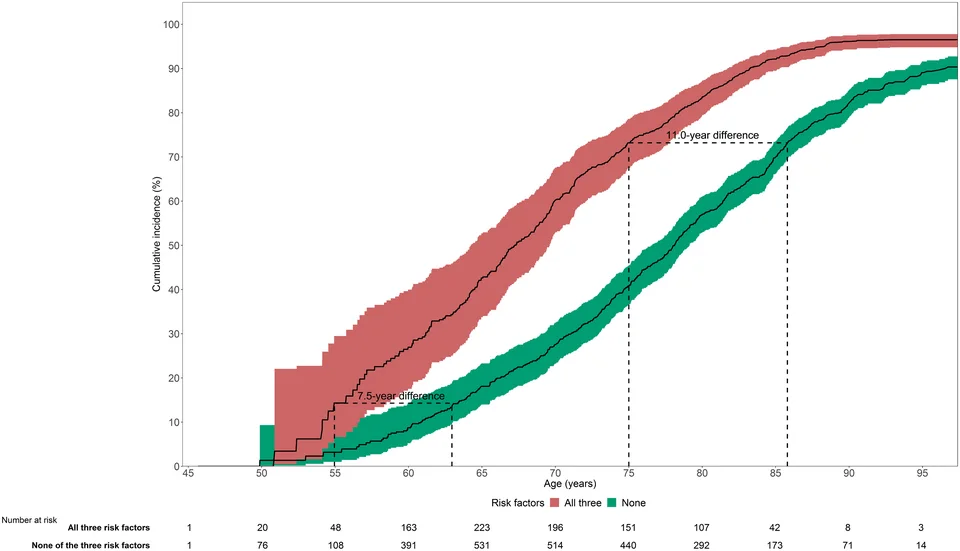
Study-based graph comparing cumulative NCD incidence across baseline risk-factor groups.
Credit: Citation: Licher S, Heshmatollah A, van der Willik KD, Stricker BHC, Ruiter R, de Roos EW, et al. (2019) Lifetime risk and multimorbidity of non-communicable diseases and disease-free life expectancy in the general population: A population-based coho · CC BY 4.0 · sourceResized and converted to WebP; uncropped.
1. Meaning, classification and India’s disease burden
Non-communicable diseases, or NCDs, generally develop through interactions among genetic, physiological, environmental and behavioural factors. Many persist for years and require continuing care rather than a single curative intervention. The four principal groups emphasised in public-health programmes are cardiovascular diseases, cancers, diabetes and chronic respiratory diseases. The wider category includes conditions such as chronic kidney disease, osteoporosis and several neurological disorders.
NCDs are not confined to older people or wealthy societies. Genetic susceptibility, childhood exposures, air pollution, unhealthy food environments and unequal access to healthcare can produce disease at younger ages. Poverty increases exposure and delays diagnosis; prolonged treatment and loss of earnings can, in turn, deepen poverty.
India faces a double burden: infectious diseases and undernutrition coexist with increasing NCDs. The India State-Level Disease Burden Initiative estimated that NCDs accounted for 61.8% of deaths in 2016, compared with 37.9% in 1990. These are historical estimates, not current annual figures. Population ageing, urbanisation and changing exposures contribute to this epidemiological transition.
- Incidence measures new cases over a specified period; prevalence measures existing cases in a population.
- Disability-adjusted life years, or DALYs, combine years of life lost through premature death and years lived with disability.
- Comorbidity means the coexistence of diseases, such as diabetes and hypertension.
2. Biological mechanisms of major NCDs
Cardiovascular diseases affect the heart and blood vessels. In atherosclerosis, lipid-rich plaques accumulate within arterial walls. Plaque rupture can trigger a blood clot, obstructing blood supply and causing myocardial infarction or ischaemic stroke. A haemorrhagic stroke instead results from bleeding within or around the brain. Hypertension is often symptomless but progressively damages vessels and organs; it is both a disease and a major risk factor.
Diabetes mellitus involves persistently elevated blood glucose. Insulin, secreted by pancreatic beta cells, helps regulate glucose uptake and metabolism. Type 1 diabetes usually results from autoimmune destruction of beta cells and requires insulin treatment. Type 2 involves insulin resistance and progressive impairment of insulin secretion. Gestational diabetes is diagnosed during pregnancy and raises subsequent type 2 diabetes risk. Long-term complications include retinopathy, kidney damage, neuropathy and cardiovascular disease.
Cancer results from accumulated genetic and epigenetic changes that disrupt normal control of cell growth and survival. Malignant tumours invade nearby tissues and may metastasise to distant sites; benign tumours do not metastasise. Not all cancers form solid tumours: leukaemias affect blood-forming tissues. Carcinogens include tobacco smoke, ultraviolet radiation, asbestos and certain infections.
Chronic obstructive pulmonary disease, or COPD, causes persistent airflow obstruction and is associated with tobacco, household smoke and occupational exposures. Asthma involves airway inflammation and variable airflow limitation. Neither is an infectious disease, although respiratory infections can trigger worsening symptoms.
- Type 2 diabetes can occur in non-obese individuals; obesity increases risk but is not essential for diagnosis.
- A heart attack interrupts blood flow to heart muscle; cardiac arrest is the sudden loss of effective cardiac pumping.
Continuum of NCD care
- 1. Reduce population-level risk exposures
- 2. Assess individual risk and conduct appropriate screening
- 3. Confirm diagnosis and assess complications
- 4. Provide treatment, counselling and referral
- 5. Monitor control, adherence and rehabilitation needs
3. Risk factors and the infection–NCD connection
Major modifiable behavioural risks are tobacco use, unhealthy diets, physical inactivity and harmful alcohol use. High sodium intake contributes to raised blood pressure; industrial trans fats increase cardiovascular risk. Diets rich in minimally processed foods, vegetables, fruits, pulses and whole grains support prevention. Non-modifiable factors include age, inherited susceptibility and family history, but genetic predisposition does not make disease inevitable.
Metabolic risks include raised blood pressure, hyperglycaemia, abnormal blood lipids and excess adiposity. Body mass index is a useful population-level measure but does not directly measure fat distribution. Abdominal fat is particularly relevant to cardiometabolic risk, including among South Asian populations. Air pollution is also a major NCD risk, contributing to cardiovascular disease, chronic respiratory disease and lung cancer.
The distinction between infectious and non-communicable disease requires care. Persistent infection with high-risk human papillomavirus types can cause cervical cancer; hepatitis B and C can cause liver cancer; Helicobacter pylori increases stomach cancer risk. The infectious agent may spread between people, but the resulting cancer is generally not contagious. Vaccination against HPV and hepatitis B therefore prevents some cancers.
- Smokeless tobacco is carcinogenic; absence of smoke does not imply safety.
- Antibiotics do not treat diabetes, hypertension or cancer, although they may treat associated bacterial infections.
| Disease group | Central feature | Important preventive approach |
|---|---|---|
| Cardiovascular diseases | Heart or vascular dysfunction; atherosclerosis is a major mechanism | Control blood pressure, tobacco exposure and lipid-related risk |
| Type 2 diabetes | Insulin resistance with progressive beta-cell dysfunction | Physical activity, healthy diet and appropriate weight management |
| Cancer | Uncontrolled abnormal cell growth with potential invasion | Tobacco control, selected vaccines and evidence-based screening |
| Chronic respiratory diseases | Persistent or variable airflow limitation | Reduce tobacco smoke, air pollution and occupational exposures |
4. Prevention, screening and continuing care
Primordial prevention stops risk-promoting conditions from emerging, for example through walkable neighbourhoods and healthy school food policies. Primary prevention reduces disease onset through measures such as tobacco cessation and vaccination. Secondary prevention identifies disease early and initiates treatment. Tertiary prevention limits complications and disability through rehabilitation and sustained disease management.
Screening tests apparently healthy people to identify those who may have disease or increased risk. A positive screening result usually requires diagnostic evaluation; it is not automatically a confirmed diagnosis. Useful programmes need reliable tests, accessible confirmation and effective treatment. False-positive results, false reassurance and overdiagnosis are possible harms, so indiscriminate testing is not equivalent to prevention.
NCD control requires long-term follow-up, affordable medicines and management of multiple risks together. Blood-pressure control, lipid management and tobacco cessation can substantially reduce cardiovascular events. Diabetes care includes eye, kidney and foot assessment. Cancer care combines appropriate surgery, radiotherapy or systemic treatment with supportive care. Palliative care relieves suffering and can begin alongside disease-directed treatment.
- WHO recommends adults undertake 150–300 minutes of moderate-intensity aerobic activity weekly, or an equivalent amount of vigorous activity.
- WHO recommends adults consume less than 5 grams of salt per day, approximately 2 grams of sodium.
5. India’s policy and programme framework
The National Programme for Prevention and Control of Non-Communicable Diseases, or NP-NCD, builds on the earlier NPCDCS programme launched in 2010. It supports health promotion, screening, diagnosis, treatment and referral. Population-based screening covers hypertension, diabetes and oral cancer among adults aged 30 years and above, with breast and cervical cancer screening for eligible women. Ayushman Arogya Mandirs provide an important primary-care platform.
The National Health Policy 2017 adopted the objective of reducing premature mortality from cardiovascular diseases, cancer, diabetes and chronic respiratory diseases by 25% by 2025. This was a policy target, not a statement of achievement. Programme success depends on treatment continuity and disease control, not merely the number of people screened.
The Cigarettes and Other Tobacco Products Act, 2003, or COTPA, regulates tobacco-related advertising, sales and smoking in public places. The Prohibition of Electronic Cigarettes Act, 2019, prohibits specified activities including their production, import and sale. FSSAI limited industrial trans fatty acids in oils, fats and relevant foods to 2% by mass of total oils and fats from January 2022. Clean-air action, safer workplaces and active transport complement clinical services.
- NCD prevention requires coordination across health, education, food regulation, urban planning, taxation and environmental governance.
- Digital records can support follow-up, but require privacy safeguards and alternatives for digitally excluded patients.
Risk-factor burden and the timing of NCD onset
Non-communicable diseases (NCDs) arise through interactions among behavioural, metabolic, environmental and genetic influences. The supplied metadata describes a graph relating baseline risk-factor burden to cumulative incidence of NCDs. Participants with all three studied risk factors reached comparable cumulative incidence at younger ages than those with none. This illustrates how clustering of risks can be associated with earlier disease onset, rather than merely a higher burden late in life.
Interpretation requires caution. Cumulative incidence concerns new disease occurrence over a specified period among an initially at-risk population; it is not prevalence, which counts existing cases. The metadata does not identify the three risk factors, study population or precise NCD outcome definition. Therefore, the reported average nine-year difference should not be treated as a universal prediction, an Indian estimate or proof of causation. Baseline risk categories also need not capture subsequent changes in behaviour or exposure.
For India, the conceptual lesson is to combine population-wide prevention with early detection and sustained care. Tobacco control, healthier diets, physical activity and reduced harmful alcohol use address major modifiable risks. Screening for hypertension and diabetes can identify people needing further assessment, but screening alone does not prevent complications: confirmation, affordable treatment and follow-up are essential.
- Risk factors increase probability; their presence does not guarantee disease, and their absence does not eliminate risk.
- Non-communicable does not mean non-infectious in origin: some cancers have infection-related causes.
- For Mains, connect individual prevention with cleaner environments, accessible primary care and continuity of treatment.
Real-world case studies
India Hypertension Control Initiative
Launched in 2017, this collaborative initiative uses standard treatment protocols, reliable medicine supply, team-based care and patient monitoring. It illustrates why detecting high blood pressure must be followed by accessible, sustained treatment.
North Karelia, Finland
Beginning in 1972, the North Karelia Project combined community mobilisation, dietary change, tobacco reduction and better hypertension care. Subsequent cardiovascular mortality reductions illustrate the value of population-wide prevention alongside clinical treatment.
Previous year questions
No source-linked PYQ is available here yet. Use the practice questions below.
Practice questions
Practice MCQ 1
Which of the following infections are associated with increased risk of cancer? 1. Human papillomavirus 2. Hepatitis B virus 3. Helicobacter pylori
- A. 1 and 2 only
- B. 2 and 3 only
- C. 1 and 3 only
- D. 1, 2 and 3
Practice MCQ 2
Consider the following statements: 1. Type 1 diabetes usually involves autoimmune destruction of pancreatic beta cells. 2. Type 2 diabetes occurs only in obese individuals. 3. Insulin is secreted by pancreatic alpha cells. Which is/are correct?
- A. 1 only
- B. 1 and 2 only
- C. 2 and 3 only
- D. 1, 2 and 3
Practice MCQ 3
Screening apparently healthy adults for hypertension, followed by diagnostic confirmation and treatment, is primarily an example of:
- A. Primordial prevention
- B. Primary prevention
- C. Secondary prevention
- D. Tertiary prevention
Mains practice · India’s non-communicable disease burden cannot be addressed through hospital expansion alone. Discuss the role of primary healthcare and multisectoral prevention. (150 words)
- Introduce the epidemiological transition and continuing double burden.
- Explain screening linked to confirmation, affordable medicines and longitudinal care.
- Discuss tobacco regulation, healthy food environments, clean air and active transport.
- Address financial barriers, rural access and unequal risk exposure.
- Conclude with measurable disease-control outcomes rather than screening counts alone.
Further reading
- WHO: Noncommunicable diseases fact sheet and updated NCD Best Buys.
- Ministry of Health and Family Welfare: NP-NCD operational guidelines.
- ICMR, PHFI and IHME: India: Health of the Nation’s States, 2017.
- NCERT Biology, Class XI: Chemical Coordination and Integration; Class XII: Human Health and Disease.
- FSSAI: Eat Right India and trans-fat elimination resources.
- https://commons.wikimedia.org/wiki/File:Non-communicable_disease_risk_factors_graph.png
Preparing for UPSC Civil Services? Get classroom teaching, answer-writing evaluation and mentorship at Pragnya IAS Academy, Ashok Nagar — see why aspirants choose us for IAS coaching in Hyderabad.