
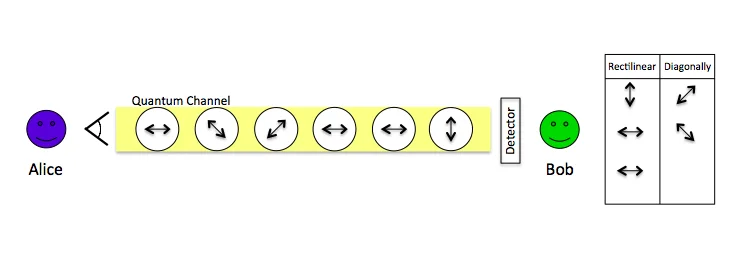
Illustrative quantum coin-flipping protocol using photon transmission between Alice and Bob.
Credit: Cku04 · CC BY-SA 4.0 · sourceResized and converted to WebP; uncropped.
1. Meaning and scientific foundations
Quantum communication is the transfer of quantum states or the use of quantum phenomena to support communication tasks. Unlike conventional communication, where information is represented by classical bits, quantum systems use qubits. A qubit can exist in a superposition of two basis states, although measurement produces a definite outcome. Photons are especially suitable carriers because they travel rapidly, interact relatively weakly with their surroundings, and can be encoded through properties such as polarisation, phase or time of arrival.
Three principles are central. First, attempts to distinguish non-orthogonal quantum states cannot always succeed and can introduce detectable disturbance. Second, the no-cloning theorem states that an arbitrary unknown quantum state cannot be copied perfectly. It does not mean that every known quantum state is impossible to reproduce. Third, entanglement creates correlations between joint quantum systems that cannot be fully explained by classical shared variables.
Entanglement does not enable instantaneous messaging. The no-signalling principle prevents either participant from controlling local measurement results to send a usable message faster than light. Quantum teleportation transfers an unknown quantum state using previously shared entanglement and classical communication. It does not transport matter, create a perfect additional copy of the original state, or eliminate the need for an ordinary communication channel.
- Quantum channel: carries quantum systems, often photons through optical fibre or free space.
- Classical channel: carries ordinary information needed for coordination, authentication and error processing.
- Quantum network: connects devices capable of generating, transmitting, storing or processing quantum states.
Timeline
1984
Bennett and Brassard proposed the BB84 quantum key distribution protocol.
1991
Artur Ekert proposed an entanglement-based approach to quantum cryptography.
2016
China launched Micius, a satellite dedicated to quantum science experiments.
2021–2022
ISRO demonstrated 300-metre free-space QKD; DRDO and IIT Delhi subsequently announced QKD over more than 100 kilometres of fibre.
2023
India approved the National Quantum Mission.
2024
India announced four thematic quantum hubs; NIST finalised its first three principal post-quantum cryptography standards.
2. Quantum key distribution and its security
Quantum key distribution, or QKD, enables two legitimate users, conventionally called Alice and Bob, to establish shared secret key material. The BB84 protocol, proposed by Charles Bennett and Gilles Brassard in 1984, uses quantum states prepared and measured in different bases. After transmission, the users publicly compare their basis choices, retain appropriate results, and test a sample for errors. They do not publicly reveal the entire retained key.
A sufficiently high error rate can indicate eavesdropping, excessive noise or faulty equipment. If the observed statistics satisfy the protocol’s security conditions, the users perform error correction and privacy amplification. Error correction reconciles differences between their records; privacy amplification reduces any information potentially available to an adversary. If the conditions are not met, the protocol aborts rather than guaranteeing a usable key.
An authenticated classical channel is indispensable. Without authentication, an attacker could impersonate each legitimate user to the other in a man-in-the-middle attack. Authentication can rely on an initially shared secret or suitable public-key mechanisms. Therefore, QKD does not establish identity from nothing. The resulting keys can support conventional encryption, such as AES, or a one-time pad when its strict conditions are met.
Claims that quantum communication is absolutely unhackable are misleading. Security proofs apply under specified assumptions, while real equipment may have imperfect photon sources, detector vulnerabilities and information leakage through side channels. Attacks on endpoints, software or key storage remain possible. Measurement-device-independent QKD addresses detector-side vulnerabilities under its protocol assumptions, but it does not remove every practical risk. QKD also cannot prevent an adversary from disrupting or blocking the channel.
Simplified BB84 key establishment
- 1. Establish an authenticated classical channel.
- 2. Prepare and transmit randomly selected quantum states.
- 3. Measure received states using randomly selected bases.
- 4. Compare basis choices and retain compatible results.
- 5. Estimate errors and abort if security conditions fail.
- 6. Perform error correction and privacy amplification to obtain shared secret keys.
3. Transmission technologies and the quantum internet
Optical-fibre QKD is useful for metropolitan and selected intercity links because it can draw on existing telecommunications infrastructure. Its main limitation is photon loss, which increases with distance and lowers achievable secret-key rates. Classical optical amplifiers cannot simply boost an unknown quantum signal while preserving its state: amplification introduces noise, and perfect copying is forbidden. Specialised equipment, careful calibration and network integration are therefore necessary.
Free-space communication sends photons through the atmosphere or between ground stations and satellites. Satellite links can bridge large separations because much of the transmission path lies in near-vacuum. However, clouds, atmospheric turbulence, background light, precise pointing and limited satellite visibility affect performance. An operational network may consequently combine satellite links, fibre connections and secure ground facilities rather than depend on a single transmission method.
Trusted-node networks extend coverage by joining shorter secure links, but intermediate nodes must be protected because they can access key material. Quantum repeaters aim to overcome distance limitations through entanglement distribution, quantum memories and entanglement swapping rather than ordinary amplification. Large-scale repeater networks remain a major research and engineering challenge.
A future quantum internet would connect quantum processors, memories and sensors. Potential uses include distributed quantum computing, secure communication and networked sensing. It is not simply a faster version of today’s internet, nor does it imply that routine web traffic must become quantum. Early systems are likely to coexist with classical networks, which remain necessary for control, synchronisation and communication of measurement results.
| Technology | Main purpose | Essential distinction |
|---|---|---|
| Quantum key distribution | Establish shared secret keys | Requires a quantum channel and authenticated classical communication |
| Post-quantum cryptography | Quantum-resistant cryptographic functions | Runs on conventional computers and communication networks |
| Quantum teleportation | Transfer an unknown quantum state | Requires shared entanglement and classical communication |
| Trusted-node network | Connect multiple shorter QKD links | Intermediate nodes must be trusted and physically secured |
| Quantum repeater network | Extend entanglement distribution | Uses quantum operations rather than conventional signal amplification |
4. India’s programmes and strategic relevance
The Union Cabinet approved the National Quantum Mission on 19 April 2023, with a total outlay of ₹6,003.65 crore for the period 2023–24 to 2030–31. Implemented by the Department of Science and Technology, it covers quantum computing, quantum communication, quantum sensing and metrology, and quantum materials and devices. Its computing goal includes developing intermediate-scale quantum computers with 50–1,000 physical qubits over eight years; this should not be confused with a communication-distance target.
Communication objectives include satellite-based secure quantum communication between ground stations over a range of 2,000 kilometres within India, long-distance secure quantum communication with other countries, intercity QKD over 2,000 kilometres, and multi-node quantum networks with quantum memories. These are mission targets, not a statement that all capabilities are already operational. Four thematic hubs were announced in 2024, including the quantum communication hub at IIT Madras.
Indian demonstrations illustrate progress at different scales. In March 2021, ISRO demonstrated free-space QKD over 300 metres at the Space Applications Centre, Ahmedabad. In February 2022, DRDO and IIT Delhi announced a QKD demonstration over more than 100 kilometres of optical fibre between Prayagraj and Vindhyachal in Uttar Pradesh. Such results establish experimental capability, but do not automatically demonstrate a nationwide, continuously available service.
Strategic applications include diplomatic communication, defence networks and selected links in critical infrastructure. Indigenous photon sources, single-photon detectors, photonic devices, control electronics and testing capabilities matter for technological autonomy. Policy priorities also include skilled personnel, interoperability, independent security evaluation and realistic procurement standards. Public investment should distinguish experimental milestones from deployable systems and assess security benefits against cost, reliability and operational constraints.
5. Quantum communication versus post-quantum cryptography
Quantum communication must be understood alongside the threat posed by quantum computing. A sufficiently powerful, fault-tolerant quantum computer running Shor’s algorithm could undermine widely used public-key systems such as RSA and elliptic-curve cryptography. This does not mean that present experimental quantum computers can routinely break modern encryption. Nevertheless, attackers may collect encrypted information today for possible future decryption, creating a concern for data that must remain confidential for decades.
Post-quantum cryptography, or PQC, addresses this threat through mathematical algorithms designed to resist both classical and quantum attacks while running on conventional hardware. In August 2024, the US National Institute of Standards and Technology finalised its first three principal PQC standards: ML-KEM for key establishment, and ML-DSA and SLH-DSA for digital signatures. PQC generally supports wider deployment through software and system upgrades, although migration still requires testing and inventory management.
QKD and PQC are complementary rather than interchangeable. QKD needs specialised quantum links and primarily addresses key establishment; PQC can support key establishment and digital signatures across ordinary networks. Neither protects a compromised endpoint by itself. For India, a balanced approach combines quantum-network research, selective QKD deployment, cryptographic agility and migration towards standardised post-quantum algorithms.
- Prelims trap: quantum teleportation transfers a state, not a person or physical object.
- Prelims trap: interception may cause detectable statistical disturbance, but ordinary noise can also create errors.
- Prelims trap: quantum-secure communication may refer to QKD or to classical post-quantum methods; identify the underlying technology.
Quantum Coin Flipping: Communication Beyond Key Distribution
The supplied metadata describes a quantum coin-flipping protocol in which Alice chooses a preparation basis and a sequence of qubits, sends photons to Bob through a quantum channel, and Bob measures them before making a basis guess. Quantum coin flipping aims to let mutually distrustful parties agree on a random outcome while limiting either party’s ability to bias it. It is therefore directly relevant to quantum communication, but it is not the same task as quantum key distribution (QKD), which establishes shared secret keys.
Its conceptual foundations include measurement in different bases and the no-cloning theorem: an arbitrary unknown quantum state cannot be copied perfectly. These properties constrain information extraction, but do not automatically make a protocol cheat-proof. The metadata outlines only part of a procedure; it does not establish its security proof, cheating bounds, or practical robustness. For India, this is an illustrative protocol, not evidence of an Indian deployment. It helps contextualise the National Quantum Mission’s quantum-communication objectives while distinguishing research protocols from operational secure networks.
- Task distinction: QKD creates secret key material; coin flipping seeks a jointly accepted random outcome despite possible dishonesty by a participant.
- Security distinction: strong and weak coin flipping have different adversarial goals. Perfectly unbiased strong quantum coin flipping is impossible in the standard model.
- Deployment distinction: photon loss, detector imperfections and implementation flaws affect practical security; quantum channels do not eliminate the need for appropriate classical communication and authentication.
Real-world case studies
Micius: satellite-based quantum experiments
China’s Micius satellite, launched in 2016, enabled landmark demonstrations of satellite QKD and entanglement distribution between ground stations separated by about 1,200 kilometres. It showed the value of space links for overcoming terrestrial distance constraints. Different experiments used different security architectures; a satellite acting as a trusted relay is not equivalent to an end-to-end untrusted-relay network.
Prayagraj–Vindhyachal fibre demonstration
In February 2022, DRDO and IIT Delhi announced QKD over more than 100 kilometres using commercial-grade optical fibre between Prayagraj and Vindhyachal. The demonstration highlighted indigenous development and compatibility with fibre infrastructure. Scaling such achievements requires secure key management, device testing, reliable operation and integration with the applications that consume the keys.
Previous year questions
No source-linked PYQ is available here yet. Use the practice questions below.
Practice questions
Practice MCQ 1
With reference to quantum key distribution, consider the following statements: 1. It requires authentication of the classical communication channel. 2. It necessarily transmits the entire user message as quantum states. 3. An excessive error rate may require the protocol to abort. Which of the statements given above are correct?
- A. 1 and 2 only
- B. 1 and 3 only
- C. 2 and 3 only
- D. 1, 2 and 3
Practice MCQ 2
Which one of the following correctly describes quantum teleportation?
- A. Transport of matter without traversing the intervening space
- B. Perfect copying of any unknown quantum state
- C. Transfer of a quantum state using shared entanglement and classical communication
- D. Transmission of a controllable message faster than light
Practice MCQ 3
Consider the following statements: 1. Post-quantum cryptography can operate on conventional computers. 2. Ordinary optical amplifiers can faithfully amplify arbitrary unknown quantum states for long-distance QKD. 3. India’s National Quantum Mission includes quantum communication and quantum sensing. Which of the statements given above are correct?
- A. 1 only
- B. 2 only
- C. 1 and 3 only
- D. 1, 2 and 3
Mains practice · Quantum communication offers strategic opportunities but is not a complete solution to cybersecurity. Discuss in the context of India’s National Quantum Mission. Suggest a balanced technology-adoption strategy. (250 words)
- Explain QKD, entanglement and the distinction between key establishment and message encryption.
- Mention the mission’s outlay, duration and communication objectives.
- Discuss diplomatic, defence and critical-infrastructure applications alongside indigenous technology development.
- Examine photon loss, trusted nodes, implementation vulnerabilities, endpoint security and costs.
- Distinguish QKD from post-quantum cryptography and explain their complementary roles.
- Recommend selective pilots, independent certification, cryptographic inventories, PQC migration, skills and interoperability.
Further reading
- Department of Science and Technology: National Quantum Mission objectives and thematic hubs, dst.gov.in.
- Press Information Bureau: Cabinet approval of the National Quantum Mission, 19 April 2023.
- ISRO: Demonstration of free-space quantum communication over 300 metres, March 2021, isro.gov.in.
- Press Information Bureau: DRDO and IIT Delhi demonstration of quantum key distribution over 100 kilometres, 23 February 2022.
- NIST: Post-Quantum Cryptography programme and standards FIPS 203, FIPS 204 and FIPS 205, nist.gov.
- Michael A. Nielsen and Isaac L. Chuang: Quantum Computation and Quantum Information.
- https://commons.wikimedia.org/wiki/File:Quantum_Coin_Flipping_Protocol.png
Preparing for UPSC Civil Services? Get classroom teaching, answer-writing evaluation and mentorship at Pragnya IAS Academy, Ashok Nagar — see why aspirants choose us for IAS coaching in Hyderabad.