
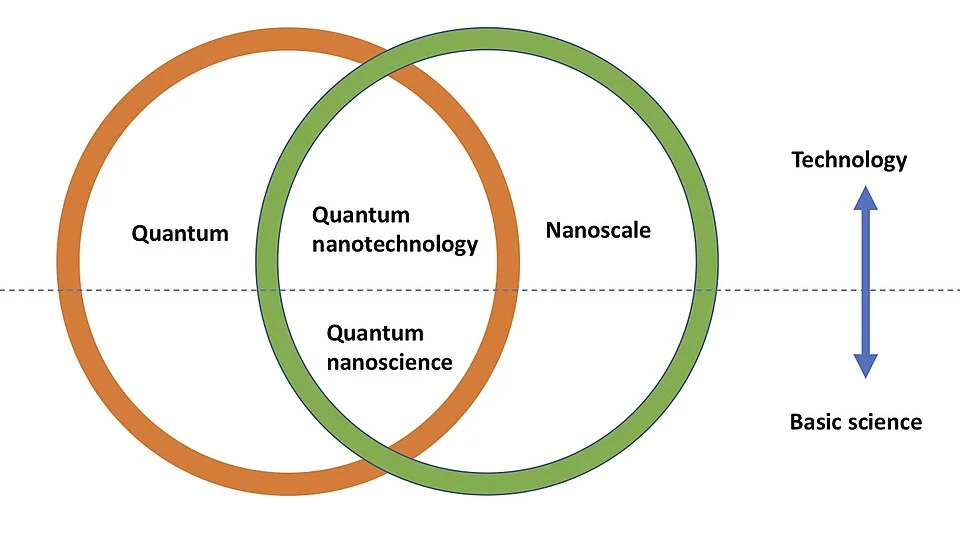
Illustrative overview of technology applications of quantum nanoscience.
Credit: Rickinasia · CC BY-SA 4.0 · sourceResized and converted to WebP; uncropped.
1. Scientific foundations and technological scope
Quantum technology involves deliberately preparing, controlling and measuring quantum states to perform useful tasks. Classical information is encoded in bits that take values of zero or one. A qubit can exist in a superposition of these basis states, with probability amplitudes determining measurement outcomes. Measurement does not reveal every component of a superposition: it yields an outcome according to quantum probabilities. Thus, quantum computing is not simply a machine reading all possible answers simultaneously.
Entanglement creates correlations between quantum systems that cannot generally be explained by independent classical states. Quantum interference allows algorithms to reinforce useful outcomes and suppress others. These properties can provide advantages for particular computational problems. However, entanglement cannot transmit usable information faster than light.
Decoherence occurs when unwanted interaction with the environment damages quantum states. Noise, imperfect control and measurement errors make reliable operations difficult. Quantum engineering therefore requires precise control, isolation and error management. Depending on the platform, this may involve cryogenic refrigeration, ultra-high vacuum, lasers, microwave electronics or advanced photonics.
- Quantum computing: processing information using controlled qubits and quantum operations.
- Quantum communication: distributing quantum states or establishing cryptographic keys using quantum properties.
- Quantum sensing and metrology: exploiting quantum effects to measure time, gravity, magnetic fields and other quantities with high precision.
- Quantum materials and devices: developing enabling systems such as single-photon sources, detectors and superconducting circuits.
Timeline
1994
Peter Shor developed a quantum algorithm for efficient integer factorisation, establishing a major long-term challenge to public-key cryptography.
2016
China launched the Micius satellite for quantum science and communication experiments.
2023
India approved the National Quantum Mission.
2024
NIST finalised its first three principal post-quantum cryptography standards.
2. Applications, opportunities and technological limits
Quantum computing could assist the simulation of molecules and materials, where classical calculation becomes difficult as quantum complexity grows. Potential applications include catalyst design, battery chemistry and pharmaceutical research. Certain mathematical problems also admit major theoretical speed-ups. Nevertheless, an advantage demonstrated on a specially designed benchmark does not establish commercially useful superiority across tasks.
Current processors remain constrained by noise and limited circuit depth. Fault-tolerant computation requires quantum error correction, which encodes a logical qubit across multiple physical qubits. Physical-qubit counts alone are therefore poor indicators of capability: error rates, connectivity, coherence times and logical performance also matter. Superconducting circuits, trapped ions, neutral atoms, photons and semiconductor spins represent competing hardware approaches.
Quantum sensing may deliver useful applications sooner than large-scale fault-tolerant computing. Atomic clocks support precise timing; quantum gravimeters can help investigate underground structures and groundwater; sensitive magnetometers have applications in medicine and geophysical exploration. Quantum inertial sensors could support navigation where satellite signals are unavailable, although field reliability and cost remain significant constraints.
Quantum key distribution, or QKD, allows communicating parties to establish keys while detecting certain forms of interception under specified assumptions. It requires an authenticated classical channel and does not automatically secure compromised endpoints. Fibre attenuation, detector vulnerabilities and the difficulty of long-distance quantum networking limit deployment. Satellite links offer another route, but require substantial space and ground infrastructure.
- Near-term assessment should prioritise measurable improvements over existing methods, rather than the quantum label.
- Claims about quantum solutions for optimisation or artificial intelligence require problem-specific evidence; general practical superiority is not established.
Preparing critical infrastructure for quantum-related cryptographic risk
- 1. Identify sensitive data and required confidentiality periods
- 2. Inventory cryptographic algorithms, certificates and dependencies
- 3. Prioritise exposed and high-consequence systems
- 4. Test standardised post-quantum solutions and interoperability
- 5. Migrate with crypto-agility and implementation safeguards
- 6. Audit continuously and update as standards evolve
3. India’s National Quantum Mission and innovation ecosystem
The National Quantum Mission seeks to establish India as a significant participant in quantum research and industrial development. Approved in April 2023, it provides ₹6,003.65 crore over 2023–24 to 2030–31. Its computing objective includes developing intermediate-scale systems with 50–1,000 physical qubits over eight years using platforms such as superconducting and photonic technologies. This target should not be confused with 1,000 error-corrected logical qubits.
Communication objectives include satellite-based secure quantum communication between ground stations over a range of 2,000 km within India, long-distance links with other countries, inter-city QKD over 2,000 km and multi-node quantum networks. These are mission goals, not a statement that all such systems are already operational. Other priorities include high-sensitivity magnetometers, precision atomic clocks, quantum materials and components such as single-photon sources and detectors.
Four thematic hubs anchor the mission: quantum computing at the Indian Institute of Science, Bengaluru; quantum communication at IIT Madras in association with the Centre for Development of Telematics; quantum sensing and metrology at IIT Bombay; and quantum materials and devices at IIT Delhi. The hub structure aims to connect academic research, national laboratories, start-ups and industry rather than confining development to isolated projects.
India’s opportunity extends beyond building complete quantum computers. Domestic capabilities in control electronics, lasers, cryogenics, fabrication, packaging, testing and software can create valuable industrial niches. Cloud access to processors and shared research facilities can widen participation, but access must be accompanied by experimental training and rigorous benchmarking.
- Scientific autonomy requires dependable access to components, fabrication and technical know-how, alongside international collaboration.
- Mission evaluation should track reproducible results, component reliability, trained personnel, industrial adoption and intellectual property, not announcements alone.
| Capability | Main purpose | Important limitation |
|---|---|---|
| Quantum computing | Specialised computation and quantum simulation | Noise and error-correction overhead constrain useful scale |
| Quantum key distribution | Establish cryptographic keys through quantum communication | Needs authentication and specialised infrastructure; endpoints remain vulnerable |
| Post-quantum cryptography | Protect conventional digital systems against known quantum attacks | Requires careful migration and secure implementation |
| Quantum sensing | Precision measurement of physical quantities | Field robustness, calibration and cost affect adoption |
4. Cybersecurity, strategic competition and societal implications
A sufficiently capable fault-tolerant quantum computer running Shor’s algorithm could compromise widely used public-key systems based on integer factorisation or discrete logarithms, including RSA and elliptic-curve cryptography. Such a cryptographically relevant machine is not known to exist today. However, adversaries may collect encrypted information now for decryption later, creating a present risk for data requiring long-term confidentiality.
Post-quantum cryptography, or PQC, uses algorithms designed to withstand known classical and quantum attacks while running on conventional systems. Unlike QKD, it does not require quantum communication hardware. In August 2024, the US National Institute of Standards and Technology finalised its first three principal PQC standards: FIPS 203 for ML-KEM key establishment and FIPS 204 and 205 for ML-DSA and SLH-DSA digital signatures.
India should inventory cryptographic dependencies across defence, banking, telecommunications, government services and critical infrastructure. Migration requires testing interoperability, updating certificates and protocols, securing implementations and providing crypto-agility: the ability to replace algorithms without rebuilding entire systems. QKD may complement such measures in selected high-value links, but cannot substitute for comprehensive cybersecurity.
Strategic competition can restrict access to advanced equipment and expertise. At the same time, excessive secrecy may weaken basic research and international standards cooperation. Public policy must balance security with openness, ensure responsible procurement and prevent overstated promises from diverting resources away from proven technologies.
- Privacy and security planning should reflect the lifespan of sensitive data, rather than waiting for a precise forecast of quantum-computer arrival.
- Social benefits depend on affordable access, interdisciplinary skills and applications addressing public needs rather than prestige alone.
5. Implementation priorities and a balanced way forward
A practical strategy should pursue two parallel tracks: long-horizon research towards fault-tolerant systems and nearer-term deployment of sensing, enabling components and quantum-safe cryptography. Public funding should support multiple promising hardware approaches while using stage-wise technical reviews to prevent indefinite support for uncompetitive designs.
Shared fabrication and testing facilities can reduce the entry barrier for universities and start-ups. Training should combine physics with electronics, materials science, computer science and engineering. Technician development is particularly important because operating complex equipment requires skills beyond theoretical knowledge.
Government procurement should begin with clearly defined problems, independent validation and comparison against the best classical alternatives. Standards, calibrated measurement and cybersecurity certification can help distinguish genuine advances from marketing claims. Public-sector pilots should publish non-sensitive findings, including failures, to improve collective learning.
For GS-III, quantum technology illustrates the relationship between frontier science, indigenisation, cybersecurity and inclusive development. The appropriate conclusion is neither technological pessimism nor inevitability: India needs sustained research, trustworthy evaluation, resilient supply chains and applications justified by demonstrable public value.
Quantum technology: applications and practical limits
The supplied metadata identifies an overview of quantum nanoscience applications, making it relevant to quantum technology without establishing which devices or processes the image depicts. Quantum technologies exploit phenomena such as superposition, entanglement and quantum-state sensitivity. Quantum computing manipulates qubits to tackle selected computational problems; quantum communication uses quantum states in information-transfer protocols; quantum sensing exploits measurable quantum effects for precision measurement. Nanoscience supports the fabrication and control of some quantum systems, but not every nanoscale technology is a quantum technology.
For India, the National Quantum Mission seeks to strengthen capabilities across computing, communication, sensing and metrology, and quantum materials and devices. Potential applications include studying molecules and materials, securing selected communication links, and improving measurements relevant to navigation and geophysics. These possibilities should not be confused with universally available commercial advantages. Decoherence, operational noise, fabrication challenges and demanding control requirements constrain performance. The image metadata alone provides no evidence about technological readiness, Indian deployment or demonstrated quantum advantage.
- Superposition does not mean a quantum computer can simply read every possible answer simultaneously. Useful speed-ups depend on algorithms, interference and the problem being solved.
- Quantum key distribution concerns establishing keys with detectable eavesdropping under specified assumptions; it does not make endpoints, authentication or an entire network automatically secure.
- Post-quantum cryptography uses classical algorithms designed to resist quantum attacks. Distinguish it from quantum communication when assessing India’s cybersecurity preparedness and migration needs.
Real-world case studies
ISRO’s free-space quantum communication demonstration
In March 2021, ISRO demonstrated free-space quantum communication over 300 metres at the Space Applications Centre, Ahmedabad, including live videoconferencing using quantum-key-encrypted signals. The experiment illustrated indigenous capabilities in optical systems and quantum communication. It was a technology demonstration, not an operational nationwide quantum network.
Micius and satellite-based quantum links
Experiments using China’s Micius satellite demonstrated satellite-based entanglement distribution and quantum key distribution over long distances. They showed how space links can address some limitations of terrestrial optical-fibre transmission. Nevertheless, operational security depends on the particular protocol, trust architecture and ground equipment; a satellite link does not by itself guarantee end-to-end security.
Previous year questions
No source-linked PYQ is available here yet. Use the practice questions below.
Practice questions
Practice MCQ 1
With reference to quantum technologies, consider the following statements: 1. Quantum entanglement allows usable information to be transmitted faster than light. 2. Measuring a qubit generally does not reveal all the information represented by its probability amplitudes. 3. Quantum error correction can encode a logical qubit across several physical qubits. Which statements are correct?
- A. 1 and 2 only
- B. 2 and 3 only
- C. 1 and 3 only
- D. 1, 2 and 3
Practice MCQ 2
Which statement correctly distinguishes post-quantum cryptography from quantum key distribution?
- A. Both necessarily require quantum computers at communicating endpoints.
- B. Post-quantum cryptography runs on conventional systems, whereas QKD uses quantum communication to establish keys.
- C. QKD eliminates the need for an authenticated classical channel.
- D. Post-quantum cryptography protects only satellite communication.
Practice MCQ 3
Consider the following domains: 1. Quantum computing 2. Quantum communication 3. Quantum sensing and metrology 4. Quantum materials and devices. How many are thematic domains of India’s National Quantum Mission?
- A. Only one
- B. Only two
- C. Only three
- D. All four
Mains practice · Quantum technology offers strategic opportunities but also creates new vulnerabilities. Discuss how India can translate the National Quantum Mission into secure and socially useful capabilities. Answer in 250 words.
- Introduce quantum computing, communication and sensing without claiming universal computational superiority.
- Explain applications in materials, healthcare, precision measurement and national security.
- Mention the mission’s outlay, duration and four thematic domains.
- Analyse decoherence, error correction, component dependence and skill shortages.
- Distinguish QKD from PQC and explain the harvest-now-decrypt-later threat.
- Recommend shared infrastructure, verified pilots, cryptographic migration and outcome-based evaluation.
Further reading
- Department of Science and Technology: National Quantum Mission, official objectives and thematic hub information.
- Press Information Bureau: Cabinet approval of the National Quantum Mission, 19 April 2023.
- ISRO: Demonstration of free-space quantum communication, March 2021.
- NIST: Post-Quantum Cryptography project and FIPS 203, 204 and 205.
- NCERT Class XII Physics: Dual Nature of Radiation and Matter; Atoms.
- Michael A. Nielsen and Isaac L. Chuang: Quantum Computation and Quantum Information.
- https://commons.wikimedia.org/wiki/File:Technology_applications_of_quantum_nanoscience.jpg
Preparing for UPSC Civil Services? Get classroom teaching, answer-writing evaluation and mentorship at Pragnya IAS Academy, Ashok Nagar — see why aspirants choose us for IAS coaching in Hyderabad.