
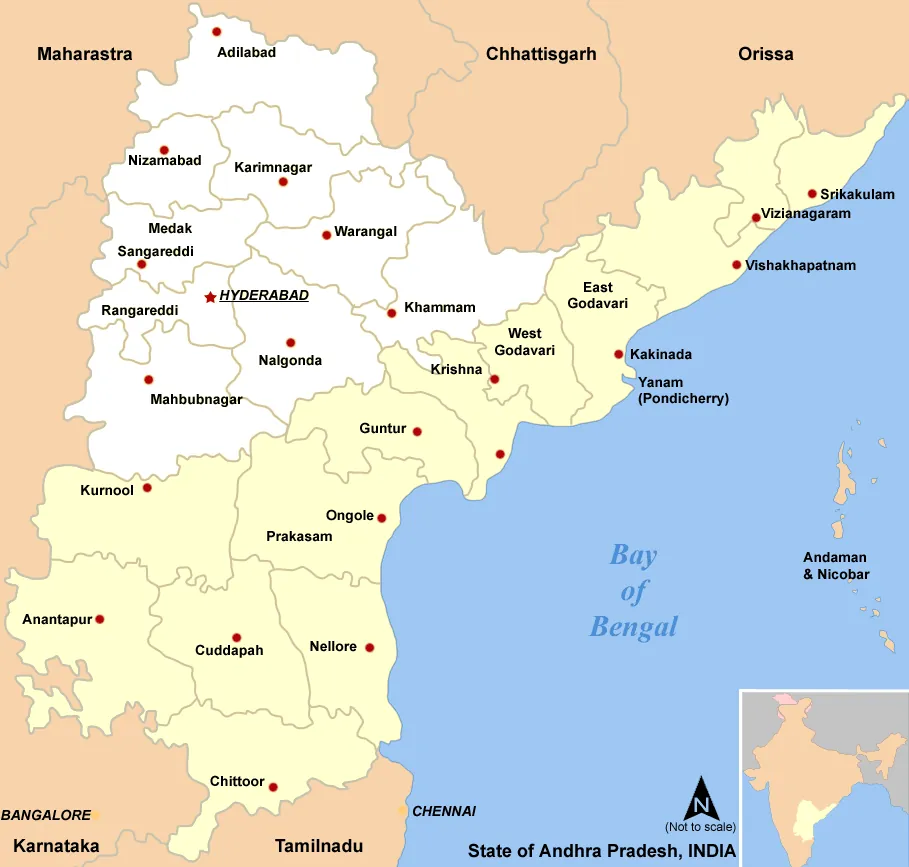
Map of the two states created in 2014, the end-point of the final movement.
Credit: No machine-readable author provided. Bmaganti~commonswiki assumed (based on copyright clai · CC BY-SA 3.0 · source
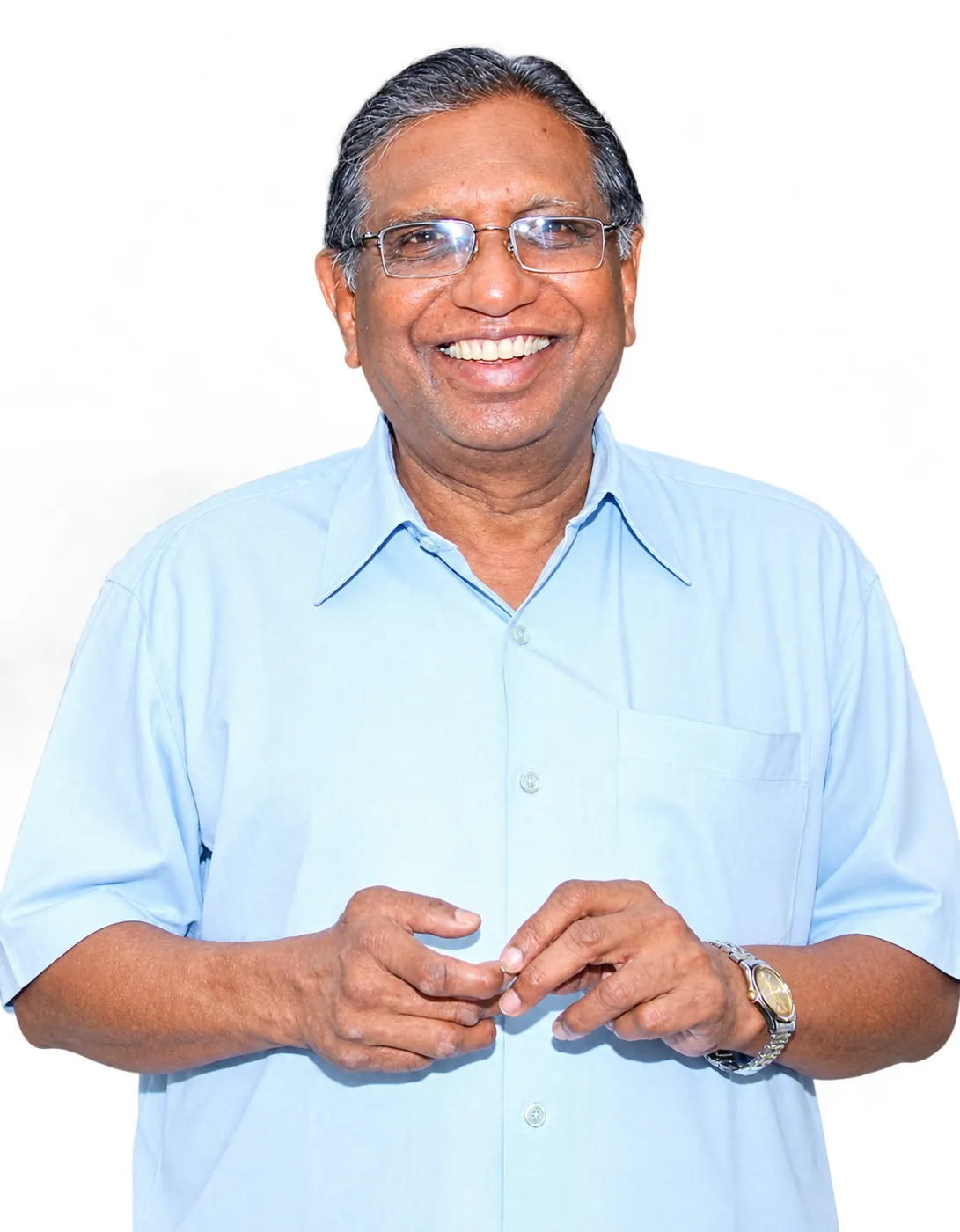
Economist and ideologue of the statehood movement.
Credit: Kavali Chandrakanth KCK · CC0 · source
Poet whose public voice kept the regional question alive.
Credit: User:Lipika2005 · CC BY-SA 4.0 · source
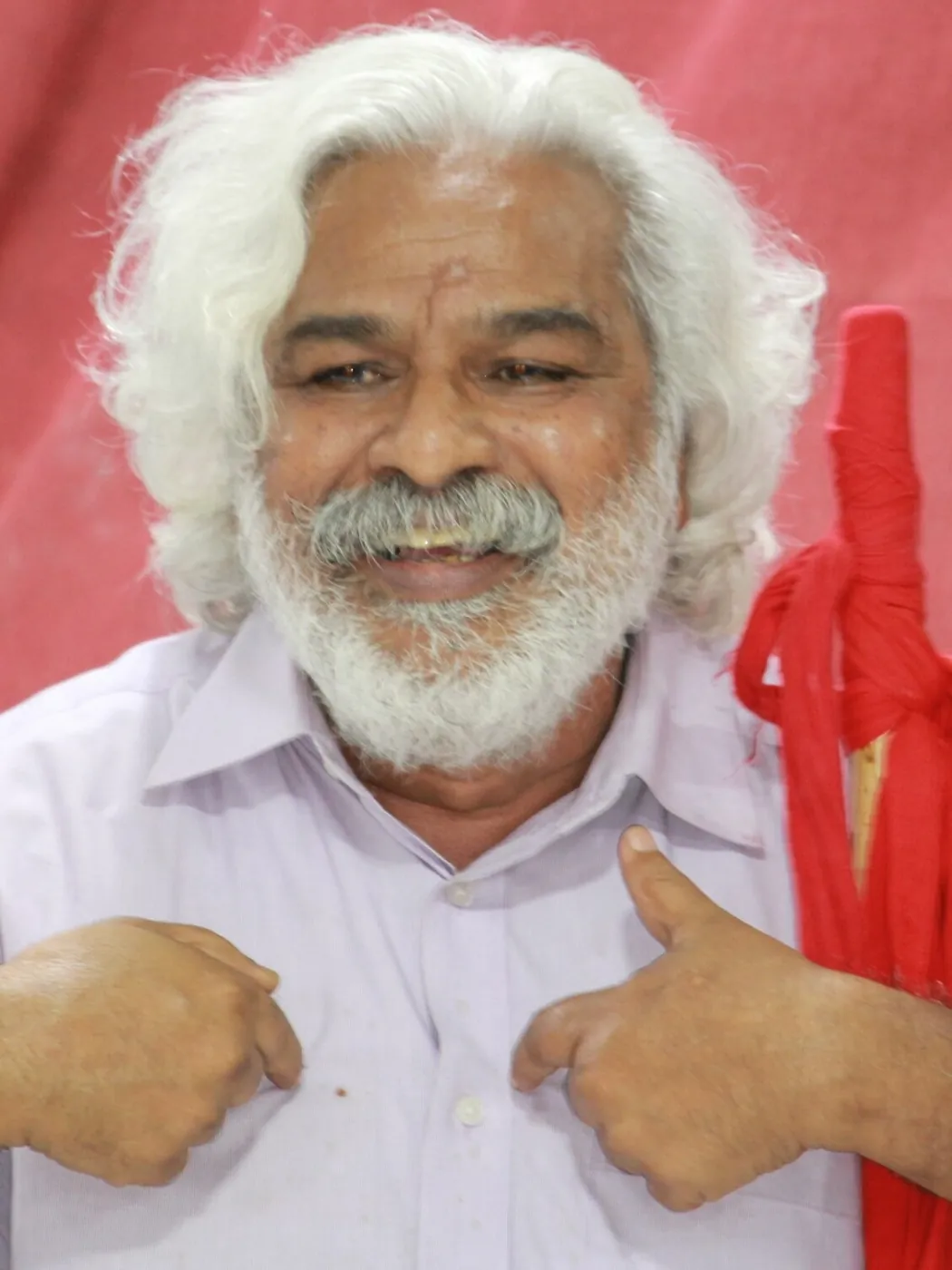
Balladeer whose songs carried the movement to villages.
Credit: Batthini Vinay Kumar Goud · CC BY-SA 4.0 · source
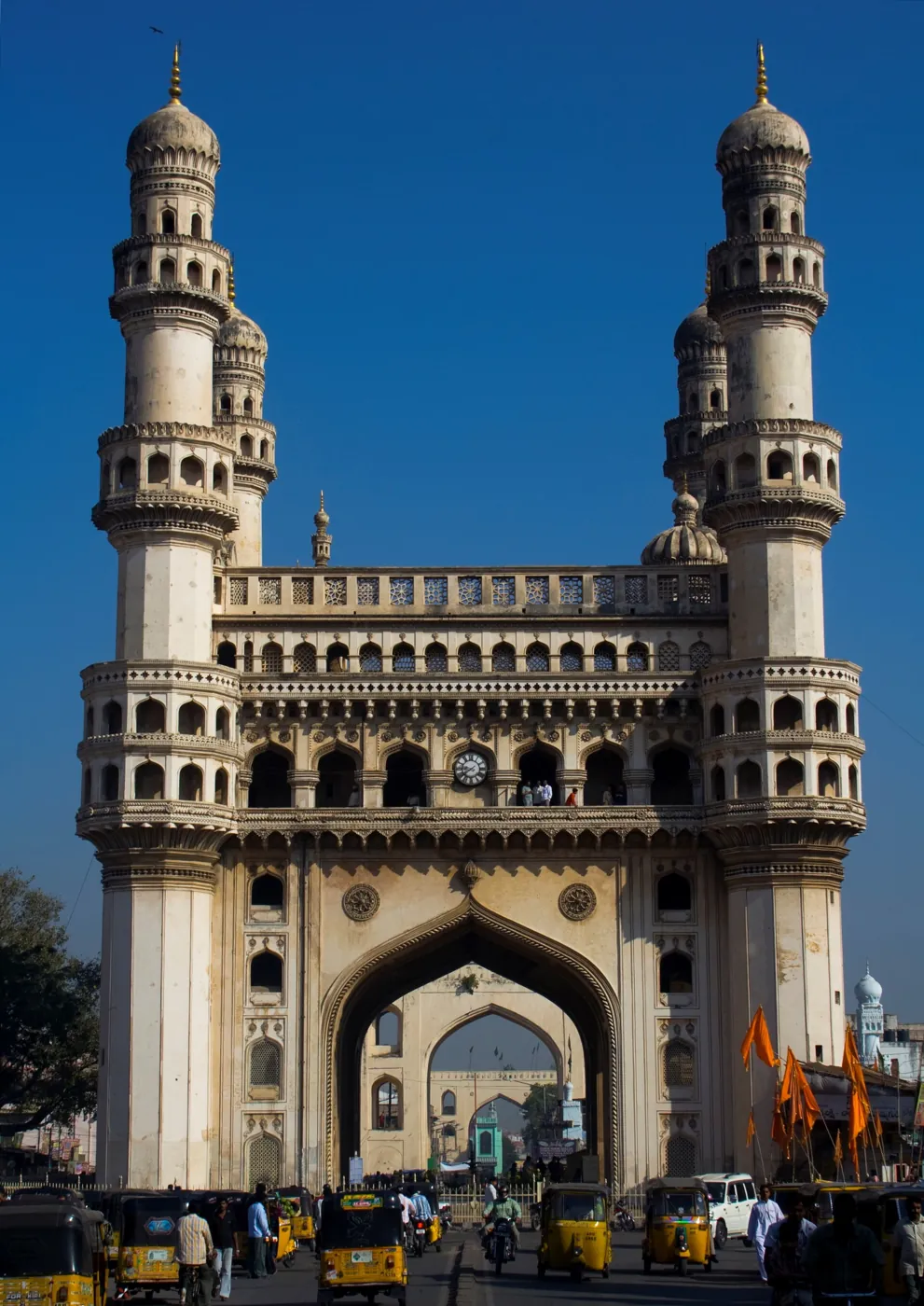
Hyderabad was the base of most early Telangana forums and trusts.
Credit: DidierTais · CC BY-SA 3.0 · source
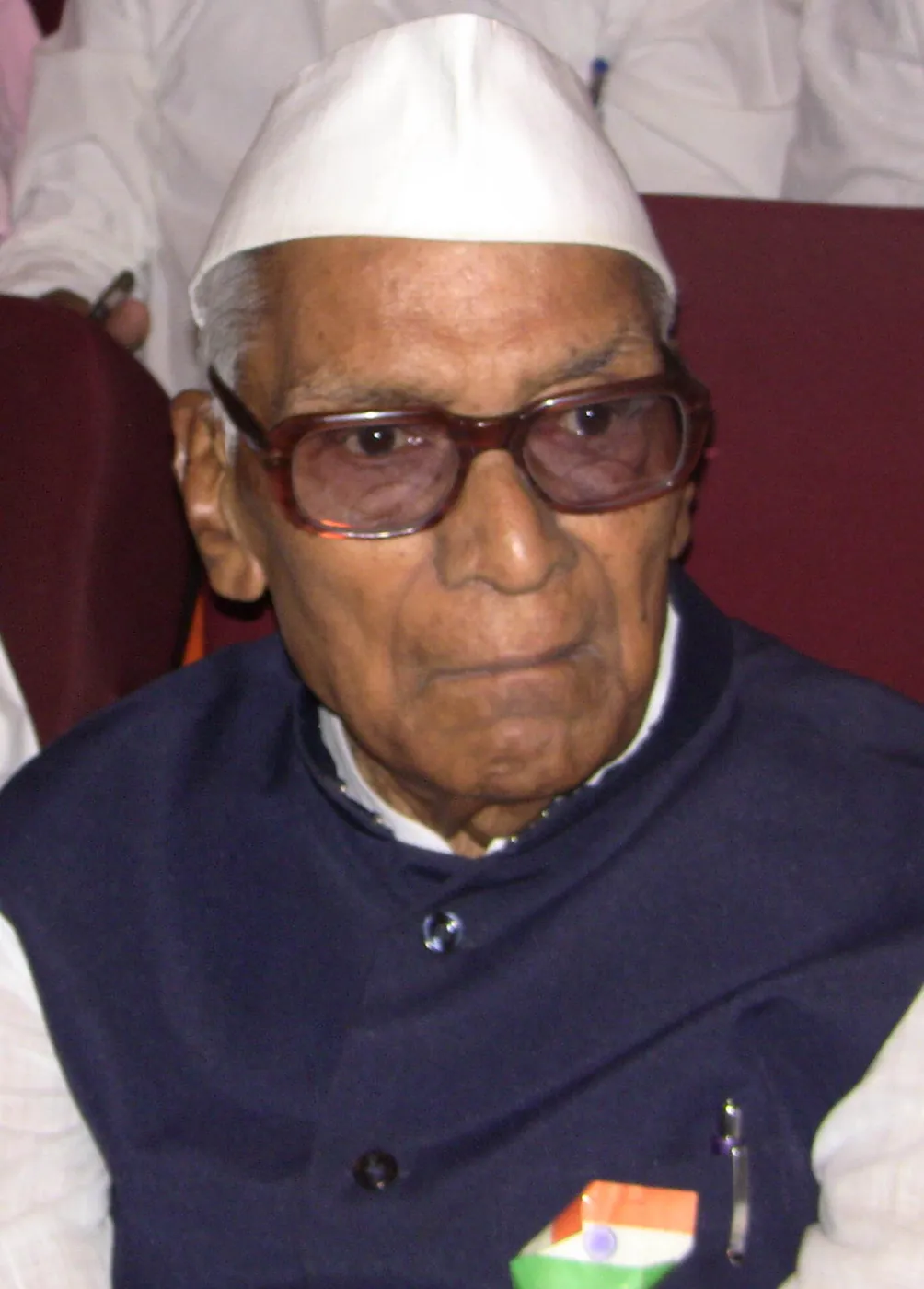
Veteran of the 1969 movement who kept supporting statehood in later decades.
Credit: Batthini Vinay Kumar Goud · CC0 · source
1. How to interpret the emergence phase
The emergence of the renewed Telangana movement should be explained as a process of reconstruction. Public organisations revisited regional experience, questioned the working of safeguards and brought statehood back into discussion. The chapter’s starting point in 1983 captures this earlier revival, whereas the familiar ideological-spread phase is often dated 1990–1996. These are different scales of periodisation, not necessarily contradictory claims. For a mains answer, identify the framework being used before describing its stages, and avoid presenting an analytical boundary as if all activity suddenly changed in one year.
A three-part approach distinguishes ideological spread, movement building and the political process. The years 1996–2001 are especially useful for studying the passage from argument to coordination, while 2001 marks the appearance of TRS as a dedicated party vehicle. However, ideas, cultural work and public organisation continued after that transition. The most convincing interpretation therefore treats the phases as overlapping emphases. It also distinguishes the emergence of a sustained demand from the much later constitutional achievement of statehood on 2 June 2014.
- State the periodisation explicitly.
- Distinguish revival from legal state formation.
- Do not make 2001 the beginning of all activism.
Timeline
1983
Early revival and electoral debates provide the chapter’s starting context.
1987
Late-1980s public and university organisations renew regional discussion.
1992
TLSO adds an organised student channel.
15 August 1996
Deve Gowda announces the Uttarakhand initiative.
8–9 March 1997
Bhongir meeting associated with Telangana Hakkula Samithi.
1997
Mahasabha mobilisation and BJP’s Kakinada resolution.
October 1997
Aikya Vedika is formed.
28–29 December 1997
AIPRF’s Warangal conference and declaration.
5–6 July 1998
Jana Sabha revival conference in Hyderabad.
27 April 2001
KCR launches TRS at Jala Dhrushyam.
17 May 2001
Simha Garjana at Karimnagar.
March 2004
Vidyavanthula Vedika is established in the later phase.
24 December 2009
Political JAC forms under Kodandaram’s coordination.
2 June 2014
Telangana becomes a state; endpoint beyond the emergence phase.
2. Early organisations, information and student networks
During the 1980s, relatively small forums helped preserve discussion when a powerful statehood party was absent. Electoral debates, public meetings and revived organisational names kept regional representation visible. The Telangana Information Trust is important because information itself became an organisational resource: publications and discussions allowed claims to circulate beyond the experience of individual activists. Such work must be evaluated critically rather than accepted as proof of every numerical claim. Its historical contribution lay in making regional questions available for public debate and creating a vocabulary through which supporters could explain them.
Student organisation gave the revival another social base. TLSO, the Telangana Liberation Students Organisation, belongs to 1992 and should not be confused with the later student JACs. The OU Forum for Telangana represents the contribution of university discussion, teachers and campus networks. These institutions differed in membership and method, but all helped reproduce interest across generations. An answer should explain how publications, meetings and campus activity connected knowledge with participation instead of merely listing names and dates. Where minor-group details are uncertain, institutional function is safer than an invented founding chronology.
- Information Trust: documentation and circulation.
- TLSO: 1992 student organisation.
- OU Forum: university-based public discussion.
- Separate verified institutions from noisy minor-group lists.
How a revived demand acquires political leverage
- 1. Document and reinterpret regional experience
- 2. Build campus, professional and cultural networks
- 3. Articulate demands through conferences and declarations
- 4. Coordinate organisations around common programmes
- 5. Translate support into electoral and wider political pressure
3. Legislators, revived parties and political opportunity
The revival was not confined to organisations outside the legislature. Regional politicians and legislators’ forums raised questions of public investment, irrigation, education and employment through representative institutions. Electoral contests could also become occasions for expressing concerns about local representation. Yet a constituency result cannot automatically be treated as a referendum on statehood: candidates, parties and immediate circumstances all matter. A careful account therefore distinguishes evidence of regional sentiment from evidence that every voter supported a particular constitutional solution, and distinguishes an informal forum from a separate electoral party.
Revived statehood parties and small-state fronts supplied another channel, even when their electoral reach remained limited. The BJP state unit’s Kakinada resolution in 1997 showed that the demand also entered the calculations of an established national party. Its later association with the phrase ‘one vote, two states’ can cause confusion with the 1998 electoral context. Keep adoption and campaigning separate. More generally, support expressed in a resolution is not the same as implementation in government; political commitments must be analysed alongside coalition constraints, competing priorities and the constitutional legislative process.
- Forums, fronts and parties are different organisational forms.
- Avoid interpreting every local election as a single-issue vote.
- Kakinada resolution: 1997.
- Political support does not itself create a state.
| Organisational form | Main resource | Analytical caution |
|---|---|---|
| Information Trust | Documentation and publications | A published claim still needs verification |
| Student organisations | Campus participation | TLSO is not identical with later JACs |
| OU Forum | University networks | Not an electoral party |
| Legislators’ forums | Representative access | Not all participants share a party |
| Cultural networks | Language and public memory | Not merely meeting entertainment |
| Aikya Vedika | Coordination | Unity does not remove differences |
| TRS | Electoral bargaining | Founded after years of revival |
| Political JAC | Joint programmes | A later, 2009 institution |
4. The 1996 opening and the public declarations of 1997
Prime Minister H. D. Deve Gowda’s Red Fort address on 15 August 1996 announced the government’s intention to pursue Uttarakhand statehood. For Telangana advocates, the significance was comparative: reorganisation could again be discussed as a live political possibility. The speech was not a Telangana promise, nor did it immediately create the hill state. Uttaranchal came into existence in November 2000. This distinction illustrates a wider principle for movement history: a national opening can alter expectations and encourage mobilisation even when the immediate policy decision concerns another region and produces no direct local concession.
Bhongir’s meeting on 8–9 March 1997 was associated with Telangana Hakkula Samithi. Later that year, the AIPRF-organised conference at Hanumakonda on 28–29 December produced the Warangal Declaration. These were separate events, not alternative names for a single conference. Their importance lay in giving the regional demand a collective public form and, particularly at Warangal, linking statehood with democratic and livelihood concerns. Land, tribal safeguards, employment and migration widened the meaning of the demand beyond drawing a boundary. Attribute these programmes to their advocates rather than assuming universal agreement.
- Uttarakhand announcement: 15 August 1996.
- Bhongir: March 1997, Hakkula Samithi.
- Warangal: December 1997, AIPRF.
- Declarations articulate programmes; they are not legislation.
5. Mass platforms and the problem of coordination
Telangana Mahasabha, associated with Maroju Veeranna, belongs to the mobilisation of 1997 and the Suryapet setting. It illustrates the effort to give the movement a wider social presence. Telangana Aikya Vedika, formed in October 1997, addressed a related but distinct problem: numerous organisations could share statehood as an objective while remaining divided by ideology, constituency or working method. A common platform could pool contacts, speakers and resources without necessarily dissolving its members. This combination of shared purpose and organisational autonomy is central to understanding an umbrella movement’s potential and its limitations.
The revival of Telangana Jana Sabha through the Hyderabad conference of 5–6 July 1998, associated with Akula Bhumaiah, represented another mobilisation initiative. It should not be confused with Mahasabha or with Telangana Jana Parishat simply because the names resemble one another. Jana Parishat appears among public-group references, but an exact founding account is not asserted here without adequate verification. This restraint matters in objective preparation: a confidently memorised error is harder to correct than a clearly marked uncertainty. In mains writing, explain the coordinating function before adding only securely established names and dates.
- Mahasabha: mass mobilisation in 1997.
- Aikya Vedika: coordination from October 1997.
- Jana Sabha revival: July 1998.
- Do not merge Jana Sabha with Jana Parishat.
6. Culture, journalism and public reasoning
Literature and performance made regional experience communicable to audiences that formal policy discussion might not reach. Kaloji Narayana Rao, Gaddar and Nandini Sidda Reddy represent different forms of cultural participation rather than a single ideological organisation. Language, memory and dignity helped supporters interpret material questions about work, water and education. Cultural assertion should therefore not be treated as decoration added to an otherwise economic movement. It helped define the people imagined as a political community, the experiences considered worthy of recognition and the emotional meaning attached to collective action.
Journalism and seminars supplied complementary means of communication. Reporting could carry local disputes into wider circulation, while meetings allowed professionals, students and employees to discuss policy and historical claims. Some journalists also became organisers, but this should not erase the distinction between reporting and advocacy or imply unanimity across the profession. The relationship between smaller discussions and larger mobilisation is especially important: participants could become speakers, writers and organisers elsewhere. Hyderabad was a major hub, but district settings such as Siddipet show that the conversation was not confined to the capital.
- Explain culture as a form of political communication.
- Connect identity and material grievances rather than choosing only one.
- Recognise diversity among writers and journalists.
- Seminars multiplied both arguments and networks.
7. TRS and the later continuities
On 27 April 2001, K. Chandrasekhar Rao announced his resignation as Andhra Pradesh Deputy Speaker, MLA and TDP member and launched TRS at Jala Dhrushyam in Hyderabad. Contemporary reporting places regional-development concerns and the power-tariff controversy within the political background. The formation of a dedicated party offered an electoral and bargaining mechanism for a demand already sustained through public work. The party’s first public meeting, Simha Garjana, followed at Karimnagar on 17 May 2001. Keep Hyderabad’s foundation venue, Karimnagar’s meeting and KCR’s Siddipet constituency distinct in examination answers.
The political transition did not make independent organisations redundant. Telangana Vidyavanthula Vedika, established in March 2004, extended intellectual advocacy into the later movement. The Telangana Political JAC, formed on 24 December 2009 under Prof. M. Kodandaram’s coordination, represents a subsequent effort to connect parties and civil society. Neither institution should be backdated into the 1990s. Likewise, references to student coordination in the mid-2000s do not establish one foundation date for every student JAC. The concluding lesson is continuity through changing forms, with coordination repeatedly negotiated rather than permanently secured.
- TRS: 27 April 2001, Hyderabad.
- Simha Garjana: 17 May 2001, Karimnagar.
- Vidyavanthula Vedika: March 2004.
- Political JAC: 24 December 2009.
Real-world case studies
Warangal: territorial demand with social content
The December 1997 declaration illustrates how statehood could be framed as a democratic programme addressing livelihoods and social protections. Its importance is analytical as well as chronological: the territorial objective provided a common language, but supporters could attach different social expectations to it. A good answer identifies AIPRF, distinguishes Bhongir and avoids attributing every demand to every participant.
The 2001 sequence: constituency, foundation and mobilisation
Siddipet explains KCR’s representative background, Hyderabad locates TRS’s foundation, and Karimnagar locates the subsequent Simha Garjana meeting. The sequence shows how a new party sought to move from a leadership break to wider regional mobilisation. It does not establish that earlier public organisations disappeared or that the entire movement began with the party.
Previous year questions
No source-linked PYQ is available here yet. Use the practice questions below.
Practice questions
Practice MCQ 1 · Easy
Deve Gowda’s relevant 1996 announcement concerned which state?
- Uttarakhand
- Telangana
- Vidarbha
- Bodoland
Practice MCQ 2 · Moderate
Which organisation is associated with the Warangal Declaration conference?
- TRS
- AIPRF
- Political JAC
- SRC
Practice MCQ 3 · Moderate
Which came first?
- TRS foundation
- Political JAC
- Aikya Vedika
- Vidyavanthula Vedika
Practice MCQ 4 · Easy
Which pair is correctly matched?
- Simha Garjana—Karimnagar
- TRS foundation—Bhongir
- Political JAC—1992
- TLSO—2009
Practice MCQ 5 · Moderate
The revived Jana Sabha of July 1998 is associated with whom?
- Akula Bhumaiah
- Deve Gowda
- Sikandar Bakht
- Parvataneni Upendra
Practice MCQ 6 · Moderate
Which statement is correct?
- Vidyavanthula Vedika dates to 2004
- Political JAC founded TRS
- Kakinada resolution dates to 2009
- Bhongir and Warangal were one meeting
Mains practice · Examine the role of civil society in the re-emergence of Telangana statehood advocacy before 2001.
- Define the emergence period and explain overlapping phases.
- Discuss information, student and university networks.
- Connect cultural dignity with material grievances.
- Use the 1997 declarations and umbrella initiatives as examples.
- Conclude with the transition to, not replacement by, party politics.
Mains practice · Compare public declarations and umbrella organisations as instruments of mobilisation.
- Distinguish articulation of a programme from coordination of groups.
- Locate Bhongir and Warangal accurately.
- Explain Aikya Vedika and the Jana Sabha revival.
- Assess strengths, internal diversity and limits.
Mains practice · Why was the formation of TRS a turning point rather than the starting point of the renewed movement?
- Outline pre-2001 public preparation.
- Give the verified April and May 2001 sequence.
- Explain electoral representation and bargaining.
- Recognise continuing independent organisations.
- Place the 2004 Vedika and 2009 JAC in their later context.
Further reading
Preparing for TGPSC Group 1 or Group 2? See the TGPSC Groups coaching course at Pragnya IAS Academy for fees, batches and registration.
Long study hours taking a toll? Try the free breathing exercise and self check-in in Pragnya’s student wellness programme for UPSC aspirants.