
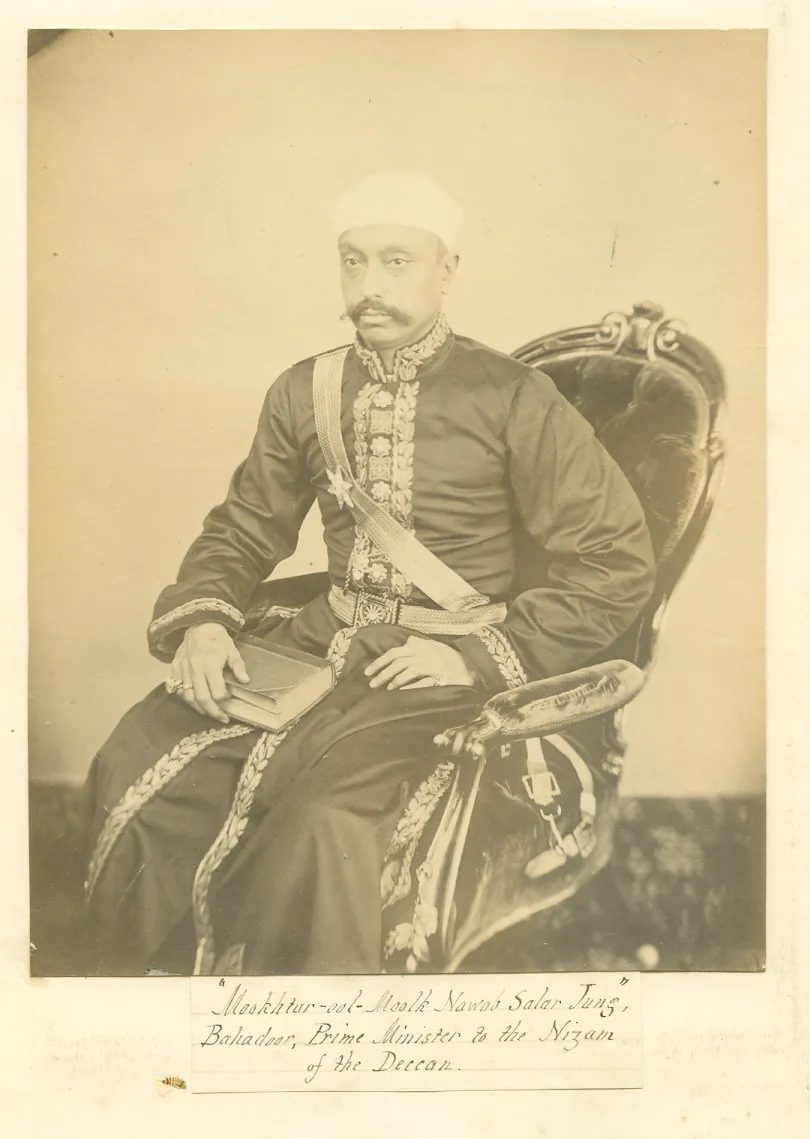
Mir Turab Ali Khan, Salar Jung I, Diwan of Hyderabad from 1853 to 1883
Credit: Unknown photographer · Public domain · source
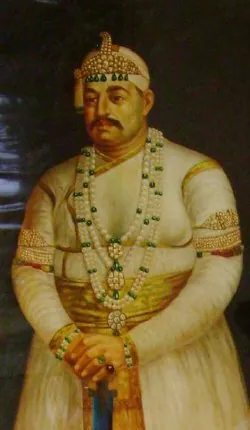
Nasir-ud-Daula, the fourth Nizam, who appointed Salar Jung Diwan in 1853
Credit: Unknown photographer · Public domain · source
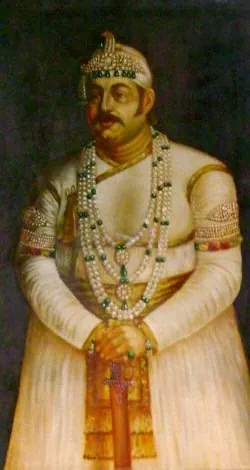
Afzal-ud-Daula, the fifth Nizam, in whose reign the district (zilabandi) system was introduced
Credit: Unknown photographer · Public domain · source
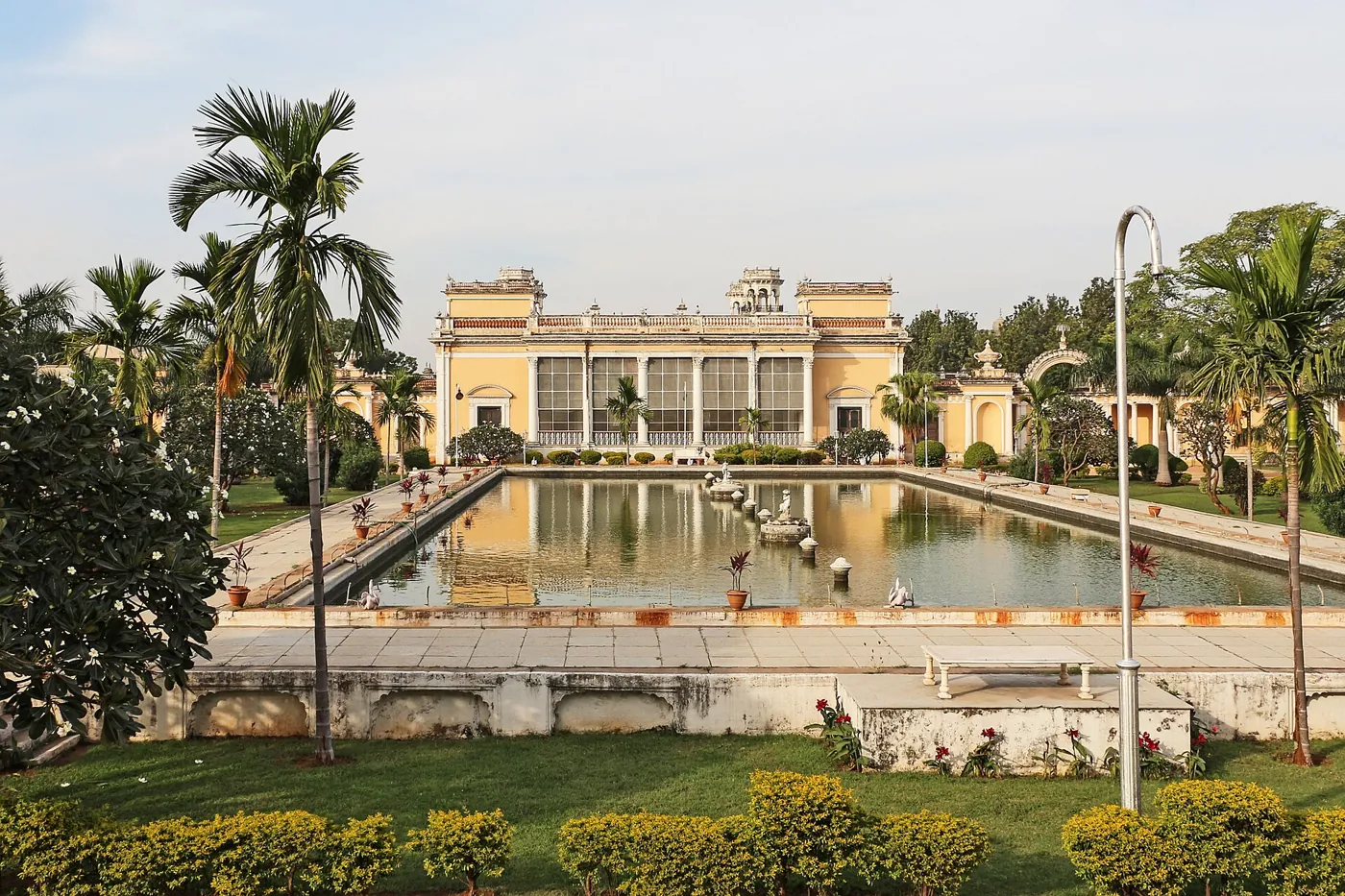
Chowmahalla Palace, seat of the Asaf Jahi court in Hyderabad
Credit: Bernard Gagnon · CC BY-SA 3.0 · source
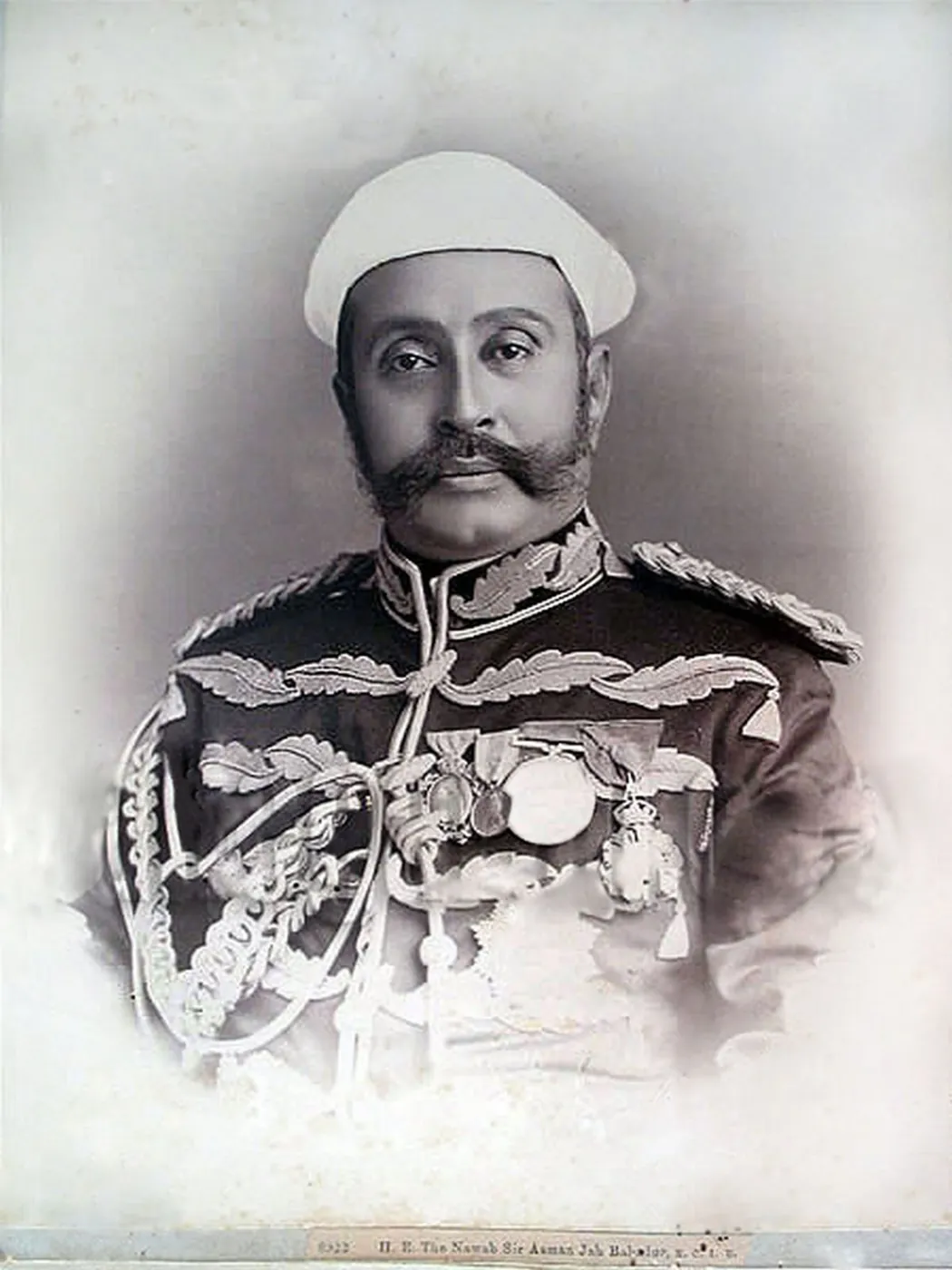
Asman Jah, a Paigah nobleman of the period who later became Diwan (1887–1894)
Credit: Aslam Nawab · Public domain · source
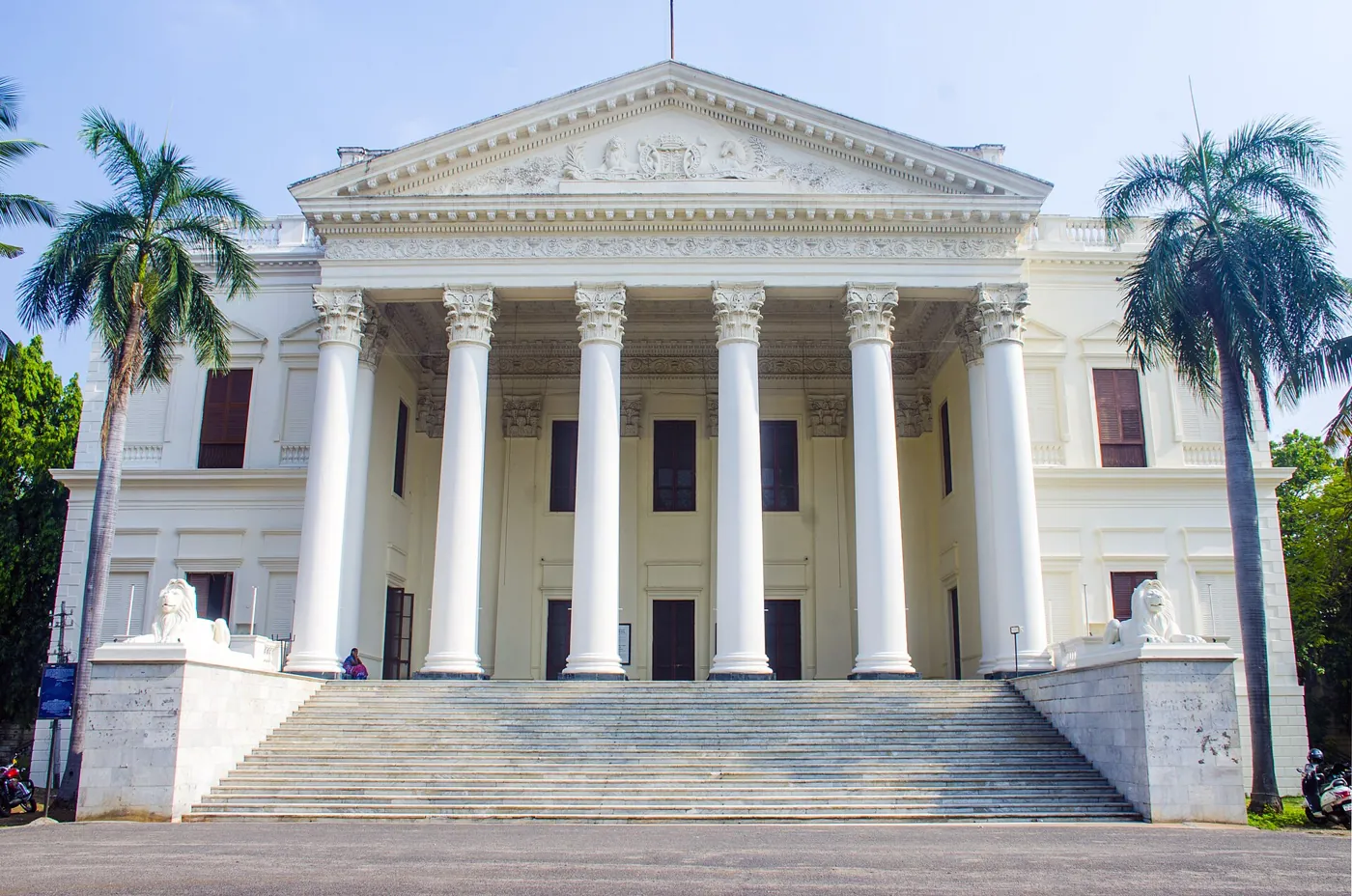
The British Residency, Hyderabad — the Resident watched closely over the Nizam’s government
Credit: Rangan Datta Wiki · CC BY-SA 4.0 · source
1. State-building under Salar Jung I, 1853–1883
Salar Jung I’s importance lies in the reconstruction of executive capacity rather than the introduction of popular sovereignty. When Mir Turab Ali Khan became Diwan in 1853, Hyderabad faced financial pressure, assigned revenues and powerful intermediaries. A government unable to command dependable receipts could not sustain regular officials or effective supervision. His response connected fiscal repair to institutional change: revenue offices, territorial jurisdictions and specialised departments were parts of the same project. British paramountcy nevertheless constrained the political space within which that project operated.
The long ministry extended across Nasir-ud-Daulah, Afzal-ud-Daulah and Mir Mahbub Ali Khan. Such continuity helped consolidate reforms, especially during the last ruler’s minority, but did not make the Diwan an elected chief minister. A balanced historical judgement therefore recognises administrative achievement without treating modernisation as democratisation. The historian must also distinguish the reformer from Salar Jung III, whose collecting activity is associated with the famous museum. Dynastic continuity, imperial dependence and administrative innovation could coexist within the same political order.
- Use 1853–1883 for the reforming ministry.
- Identify Turab Ali Khan as Salar Jung I.
- Separate executive improvement from representative government.
Timeline
1853
Salar Jung I enters office as Diwan.
1854/55
Dar-ul-Uloom foundation, with differing dates in Gazetteer and later accounts.
1865–1867
District and police reorganisation develops.
1868
Early local-employment preference measure.
1869
Departmental ministerial restructuring recorded in the contemporary account.
1872
Appellate judicial reorganisation.
1874
Wadi–Secunderabad railway opens.
1875
Survey and Settlement Department organised.
1883
Salar Jung I dies; his long ministry ends.
1887
Nizam College established through amalgamation.
1918
Osmania University established.
1919
Formal Mulki service-rule framework under Osman Ali Khan.
1931
Idara-e-Adabiyat-e-Urdu foundation according to Rekhta.
1935
Nizam Subjects League organises local civic and economic claims.
2. Zilabandi and the problem of territorial control
Zilabandi addressed a basic requirement of administration: an officer must know the territory for which he is answerable. Defining districts and subordinate units made collection, reporting and supervision more systematic. Divisional oversight connected district officials with the central establishment, while tahsildars and village personnel carried administrative work downward. These arrangements mattered because rules issued in the capital were ineffective without territorial responsibility and dependable information. The district talukdar’s collector-like role must consequently be distinguished from other Indian uses of talukdar to mean a landed magnate.
Numerical precision requires chronological precision. Cheragh Ali describes successive alterations in territorial organisation, so a later district total cannot automatically be assigned to every stage of the 1860s. Equally important, Hyderabad contained Khalsa or directly administered territory alongside jagir, Paigah and private royal domains. Reorganisation did not erase these differences. For a mains answer, the strongest argument is that Zilabandi increased the legibility and reach of the state while leaving substantial variations in jurisdiction. Avoid equating its units with present-day Telangana districts.
- Talukdar: district-level administrative context.
- Tahsildar: subordinate territorial administration.
- Date all totals; distinguish Khalsa from special jurisdictions.
How administrative capacity became a question of belonging
- 1. Fiscal pressures encouraged regular collection and territorial supervision.
- 2. Specialised departments created demand for qualified personnel.
- 3. Outside recruitment met immediate needs while local education expanded.
- 4. Hyderabad graduates sought access to employment and recognition.
- 5. Preference rules and certificates formalised aspects of belonging.
- 6. Associations linked local access to civic cooperation and representation.
3. Departments, police and the administration of justice
Departmentalisation changed the way official business moved through government. Defined portfolios, secretaries and clerical establishments reduced dependence on the Diwan’s personal handling of every matter. In the contemporary account, Mukarram-ud-Daulah is associated with revenue, Bashir-ud-Daulah with justice and jails, and Shamshir Jung with police. The 1880–81 structure places public works, municipalities, education and medicine under Shahab Jung. Several functions could share a minister, so fourteen departments did not imply fourteen ministers. The date of a portfolio grouping is part of the fact itself.
Police organisation and judicial review developed through successive reforms rather than one instantaneous settlement. City policing centred on the Kotwal, while district establishments included muhtamims and subordinate ranks. Judicial supervision and appellate arrangements provided more regular channels for disputes, including the reorganisation of an appellate court in 1872. These changes differentiated enforcement from adjudication but did not establish complete separation of powers. The sovereign and executive retained extensive authority. The familiar twentieth-century High Court building should therefore never be used to date the origin of nineteenth-century judicial reforms.
- Keep Shamshir Jung’s documented title.
- Separate the city Kotwal from district supervision.
- Distinguish appellate institutions from the buildings later used by courts.
| Institution or measure | Primary purpose | Historical qualification |
|---|---|---|
| Zilabandi | Define territorial responsibility | Not a permanent set of modern district boundaries |
| Departmental ministries | Specialise official business | Not an elected cabinet |
| Police establishments | Regularise enforcement | City and district offices differed |
| Appellate courts | Review judicial decisions | Not complete separation from executive power |
| Survey and settlement | Record land and assess demand | Not annual jamabandi |
| Nizam College, 1887 | Consolidate higher education | Postdated Salar Jung I |
| Appendix N, 1919 framework | Define service eligibility | Residence was not its only route |
| Subjects League, 1935 | Organise local civic and economic claims | Retained allegiance to the dynasty |
4. Revenue collection, measurement and rural society
The transition away from revenue farming aimed to place collection on a more dependable official basis. A contractor promising a fixed remittance had incentives to recover both that sum and a private surplus from the countryside. Salaried officers reduced reliance on this mechanism and improved the government’s capacity to supervise receipts. Recovery of assigned revenue sources also strengthened central finances. The reform can be described as a movement towards more direct dealings with cultivators, but not as a universal transfer of property rights or an abolition of all intermediaries.
Survey and settlement added a different kind of capacity: recorded knowledge about land, cultivation and assessment. Cheragh Ali dates the organisation of the Survey and Settlement Department to 1875, with early work in the Paithan area and subsequent expansion. Measurement and longer-term assessment must be distinguished from jamabandi, the recurrent scrutiny of revenue accounts. Neither regular records nor official salaries guaranteed an end to hardship. Unequal local power, indebtedness, collection pressure and surviving landed jurisdictions remained important. Evaluate both improved fiscal administration and the continuing limits of agrarian relief.
- Contrast contractor incentives with salaried accountability.
- Distinguish settlement operations from revenue-account review.
- Do not claim that jagirs or peasant debt disappeared.
5. Education and infrastructure: capacity and unequal access
Education supplied the human resources required by the developing state. Oriental learning continued alongside instruction in English and modern subjects, while schools and teacher training widened the institutional base. Dar-ul-Uloom illustrates a genuine dating problem: the Imperial Gazetteer tradition uses 1854, whereas many later teaching accounts use 1855. The uncertainty should be attributed rather than concealed. Nizam College presents a clearer case: its official history dates establishment through amalgamation to 1887. It therefore consolidated earlier developments after Salar Jung I’s death, rather than originating during his ministry.
Transport and communication similarly enlarged practical capacity. The Wadi–Secunderabad railway section opened in 1874, connecting the state’s system to routes beyond its borders. Calling it the Hyderabad–Wadi connection is acceptable as regional shorthand only if the actual first section remains clear. Roads, post, telegraph and public works facilitated administration as well as commerce and strategic movement. Financial obligations and uneven geographical coverage qualify any simple story of progress. Educational opportunities were also unequal, but their expansion eventually produced local graduates who expected a fair share of government employment.
- Nizam College: 1887; initial Madras affiliation.
- Osmania University: 1918, a later institutional phase.
- First railway opening: Wadi–Secunderabad, 1874.
6. Mulki identity and the 1868–1919 legal trajectory
The modern Mulki question grew from competition over a bureaucratic labour market. Recruiting trained outsiders could meet immediate administrative needs, while local educational expansion increased the number of Hyderabadis seeking the same posts. Belonging to the state consequently acquired economic significance. Older Deccani–Afaqi rivalry offers background for thinking about patronage and regional identity, but it does not establish a single uninterrupted movement. Mulki was also not synonymous with Telugu speaker, Muslim, or resident within today’s Telangana boundaries: the historical frame was the multilingual Hyderabad State.
Preference measures are commonly traced to 1868, under Afzal-ud-Daulah and Salar Jung I. The later 1919 framework belonged to Mir Osman Ali Khan and defined eligibility in the civil-service regulations. Appendix N, reproduced in later litigation, included several routes. The residence route required at least fifteen years of permanent residence, abandonment of the intention to return elsewhere and the prescribed declaration. Birth as a state subject, qualifying paternal government service and a wife’s derivative status also appeared. These historically gendered provisions should be explained, not presented as current citizenship law.
- 1868: early preference measure, fifth Nizam’s reign.
- 1919: formal service framework, seventh Nizam’s reign.
- Fifteen years was one qualifying route, not the entire definition.
7. Dakhni scholarship and the politics of language
Language influenced more than literary taste: it affected credentials, official communication and cultural authority. Urdu’s later nineteenth-century replacement of Persian in administration and its place in Osmania University created new possibilities for learning. Yet prestige attached to northern forms of Urdu could leave Deccani scholars feeling that local traditions were undervalued. Recovering Dakhni manuscripts and literary history therefore had a political resonance. It offered evidence that the Deccan had contributed to Urdu’s development rather than merely receiving a finished language from elsewhere.
Mohiuddin Qadri Zore’s scholarship and the Idara-e-Adabiyat-e-Urdu are central to this cultural recovery. Rekhta’s institutional profile dates the Idara to 1931, unlike the unqualified 1930 date in the reference checklist. Literary preservation should not, however, be collapsed into the administration of Mulki certificates. Nor did Dakhni advocacy resolve every linguistic grievance: Telugu, Marathi and Kannada speakers had distinct concerns within the state’s language hierarchy. The historical significance lies in the interaction between cultural self-respect and political belonging, without assuming that all local identities shared one programme.
- Use cultural recovery as an explanation, not a claim of uniform linguistic identity.
- Attribute the Idara’s 1931 date to the institutional profile.
- Distinguish Urdu-medium higher education from equal access for all regional languages.
8. The Nizam Subjects League and constitutional limits
The Nizam Subjects League, associated with 1935 and also called the Mulki League, organised local-rights claims beyond individual recruitment disputes. Sir Nizamat Jung was president, Burgula Ramakrishna Rao served as a secretary, and Padmaja Naidu was among prominent participants. Its civic language crossed religious boundaries. Public employment was part of a wider demand for access to economic resources, including contracts and licences, and for the rights of Hyderabad’s subjects. The familiar slogan Hyderabad for Hyderabadis expressed a state-based claim rather than a demand drawn around present Telangana.
The League’s constitutional aspirations must be read alongside its loyalty to the Asaf Jahi dynasty and respect for aristocratic institutions. Its programme could seek equal civic access without challenging every foundation of the social order. This combination makes it important but not equivalent to a later mass democratic or separate-state movement. For TGPSC mains, explain its contribution as an organisational bridge between opportunity, subjecthood and representation, then assess the limits imposed by its elite leadership and monarchical setting. Later Telangana politics inherited questions from this history without simply repeating its institutions or territorial assumptions.
- President: Sir Nizamat Jung; secretary: Burgula Ramakrishna Rao.
- Cross-community participation did not eliminate social inequality.
- Constitutional reform coexisted with dynastic allegiance.
Real-world case studies
Nizam College: a chronology test
An institution can extend a reformer’s legacy without being founded in his lifetime. The official 1887 establishment of Nizam College, following Salar Jung I’s death in 1883, demonstrates why an answer should distinguish earlier schools, later amalgamation and subsequent university affiliation.
Appendix N: belonging turned into evidence
The fifteen-year residence route combined duration with permanent-settlement intent and documentary procedure. This shows how a broad identity became an administratively testable status. It also explains why eligibility, certificates and actual appointments could become separate sources of dispute.
The League: inclusion with limits
Nizamat Jung’s presidency, Burgula’s secretaryship and Padmaja Naidu’s participation illustrate cooperation across communities. Yet loyalty to the dynasty and respect for aristocratic institutions qualified the reach of reform. The case supports neither an exclusively communal reading nor an uncritical claim of mass egalitarian democracy.
Previous year questions
No source-linked PYQ is available here yet. Use the practice questions below.
Practice questions
Practice MCQ 1 · Easy
Which pair correctly identifies the reforming Diwan and his tenure?
- Salar Jung I: 1853–1883
- Salar Jung III: 1853–1883
- Ali Imam: 1868–1919
- Nizamat Jung: 1853–1883
Practice MCQ 2 · Moderate
Consider the statements: 1. Nizam College was founded before Salar Jung I died. 2. Its official foundation year is 1887. Which is correct?
- 1 only
- 2 only
- Both 1 and 2
- Neither 1 nor 2
Practice MCQ 3 · Easy
Which section opened in 1874?
- Hyderabad–Godavari Valley
- Kazipet–Balharshah
- Wadi–Secunderabad
- Delhi–Hyderabad
Practice MCQ 4 · Moderate
Which statement best describes Appendix N’s residence route?
- A short visit alone conferred status
- Every Hyderabad employee qualified automatically
- Only Urdu speakers could apply
- Fifteen years’ permanent residence with the prescribed settlement declaration
Practice MCQ 5 · Easy
Who presided over the Nizam Subjects League?
- Nizamat Jung
- Salar Jung I
- Osman Ali Khan personally
- Mahmud Gawan
Practice MCQ 6 · Difficult
Which inference is most defensible?
- Mulki status was identical to present Telangana residence
- Administrative expansion and education helped politicise local opportunity
- The League abolished dynastic loyalty
- Dakhni scholarship administered all employment certificates
Mains practice · Examine the claim that Salar Jung I modernised the Hyderabad administration without democratising its political order.
- Begin with the fiscal and political setting of 1853.
- Use territorial, revenue and departmental reforms as connected evidence.
- Assess policing, appellate review, education and railways.
- Distinguish executive specialisation from legislative accountability.
- Conclude with the persistence of monarchy, special tenures and imperial constraints.
Mains practice · How did public employment and education contribute to the development of Mulki identity?
- Explain why the expanding administration recruited outside personnel.
- Connect local education with rising expectations of access.
- Distinguish the 1868 preference measure from the 1919 framework.
- Explain multiple qualifying routes and the role of certification.
- Avoid reducing the historical category to one religion, language or today’s boundaries.
Mains practice · Assess the significance and limitations of the Nizam Subjects League in the politics of Hyderabad State.
- Identify 1935 and the verified president and secretary.
- Discuss cross-community participation and local economic opportunity.
- Explain the link between subjecthood, civic rights and representation.
- Assess dynastic loyalty and aristocratic commitments as limits.
- Distinguish its state-based programme from later Telangana statehood politics.
Further reading
- https://archive.org/stream/hyderabaddeccanu00alic/hyderabaddeccanu00alic_djvu.txt
- https://www.nizamcollege.ac.in/AboutUs/
- http://indiankanoon.org/doc/1267864/
- https://www.rekhta.org/editors/idara-e-adabiyat-e-urdu-hyderabad/profile
- https://telanganatoday.com/the-rise-of-hyderabad-for-hyderabadis
- https://telanganatoday.com/understand-objectives-of-nizams-subjects-league-well
- https://wiki.fibis.org/w/Wadi-Secunderbad_Railway
- https://teluguhistory.org/en/institutions/dar-ul-ulum/
Preparing for TGPSC Group 1 or Group 2? See the TGPSC Groups coaching course at Pragnya IAS Academy for fees, batches and registration.
Long study hours taking a toll? Try the free breathing exercise and self check-in in Pragnya’s student wellness programme for UPSC aspirants.