
Delhi Invokes GRAP Stage II: AQI Triggers, CAQM Powers and Airshed Governance
Revise the static topic: UPSC Environment notes
In short: The Commission for Air Quality Management invoked GRAP Stage II after Delhi’s average Air Quality Index reached 324, placing it in the ‘very poor’ category. The response intensifies dust control, increases parking charges and promotes public transport, but sustained improvement requires coordinated emission reduction across the regional airshed.
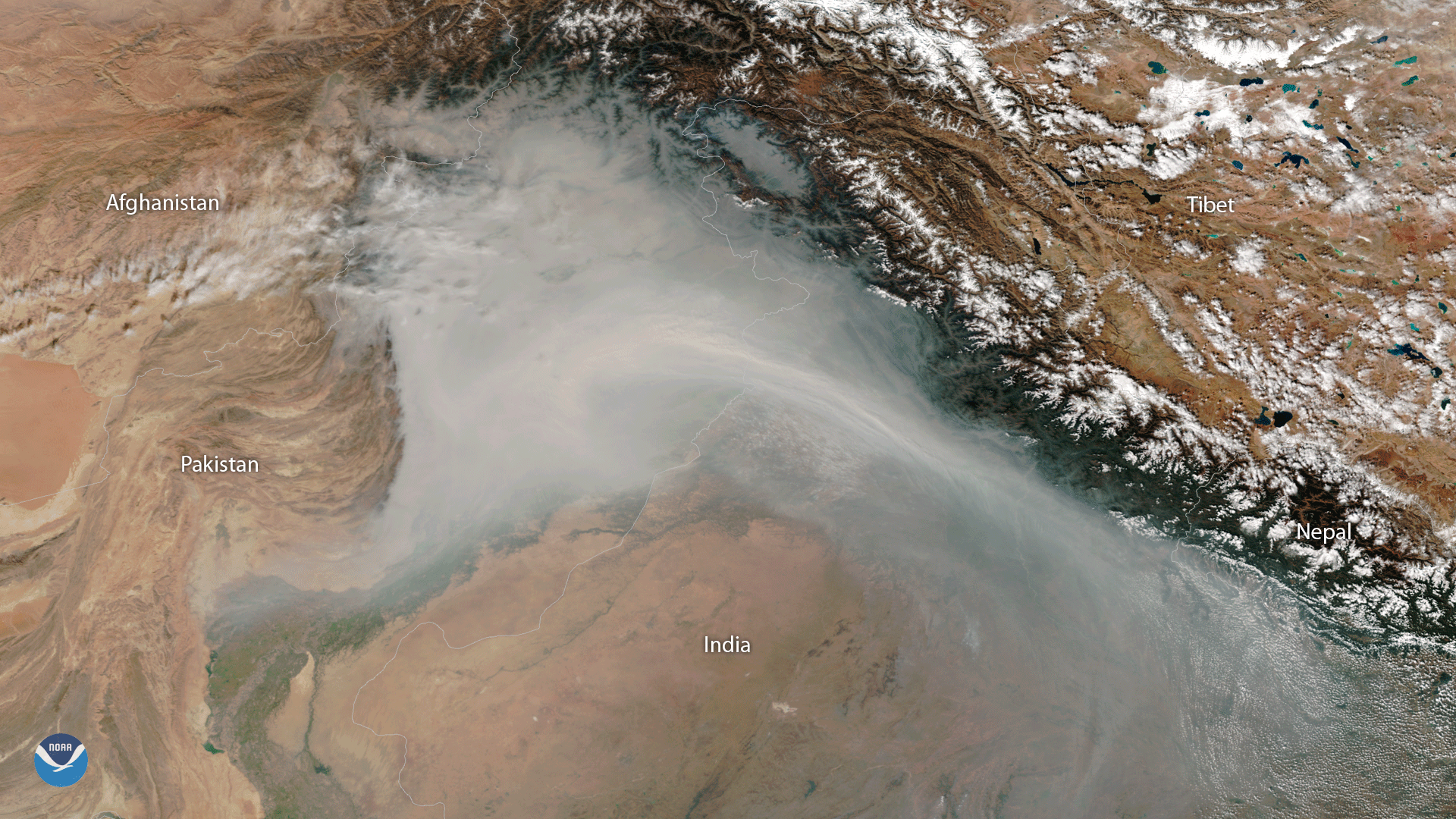
Reference satellite view from November 1, 2017: smog blankets the Upper Indo-Gangetic Plain across India and Pakistan, illustrating the regional scale of air pollution relevant to Delhi’s airshed governance—not the current Stage II activation.
Image: NOAA · Public domain
Why in news
According to the supplied report, Delhi’s AQI rose from 117 on October 31, 2026 to 324 on November 2, 2026 amid unfavourable meteorological conditions. With very poor air quality expected to persist, CAQM activated Stage II measures.
117
Delhi AQI on October 31
261
Delhi AQI on November 1
324
Delhi AQI on November 2
301–400
Stage II AQI band
Background
Delhi’s air pollution is a regional problem shaped by emissions from transport, industry, construction, road dust, waste burning and seasonal agricultural residue burning. Their relative contributions vary with location, season and meteorology. Weak winds and temperature inversions can restrict dispersion, allowing pollutants to accumulate near the surface. GRAP provides an escalating emergency response to deteriorating air quality; it complements, rather than replaces, continuous pollution control under environmental laws.
What Stage II activation means
GRAP links worsening air quality to progressively stronger preventive and restrictive measures. Stage II corresponds to the very poor AQI category. Measures at higher stages supplement those already applicable at lower stages rather than replacing them.
The reported response focuses on reducing dust resuspension and discouraging private vehicle use. Additional weekday Metro trips seek to make the shift towards public transport practical.
- Authorities are to intensify mechanical road sweeping, water sprinkling and dust suppression.
- NCR governments are to increase parking fees to discourage private vehicle use.
- Public office and municipal body timings are to be staggered in Delhi, Gurugram, Faridabad, Ghaziabad and Gautam Buddha Nagar.
- Open burning of garbage, leaves and municipal solid waste is prohibited.
Infographic
Trigger
AQI 324 places Delhi in the very poor category.
Authority
CAQM coordinates; state and local agencies implement.
Immediate action
Control dust, discourage private travel and expand public transport.
Legal clarity
Distinguish GRAP directions from separate vehicle restrictions.
Structural solution
Reduce emissions year-round across the shared airshed.
AI-assisted infographic by Pragnya IAS Academy, based on the cited sources.
Institutional basis: CAQM directs, multiple agencies implement
CAQM is a statutory commission established under the Commission for Air Quality Management in National Capital Region and Adjoining Areas Act. Its mandate includes coordination, planning and action on regional air-quality problems, including pollution from adjoining areas that affects NCR.
CAQM issues directions and coordinates the graded response, while state governments, pollution control boards, municipal bodies, transport departments and enforcement agencies implement relevant measures. The Central Pollution Control Board’s AQI framework provides a common language for communicating air quality; it is not itself an enforcement authority.
- The governance challenge is to translate regional directions into consistent local enforcement.
- Forecast-based preparedness is important because waiting for severe pollution can delay protective action.
- Statutory coordination must be supported by clear agency responsibilities, monitoring and accountability.
Read vehicle restrictions and stage thresholds carefully
The report combines GRAP measures with vehicle restrictions attributed to a separate government order. These should not automatically be treated as identical legal instruments: vehicle eligibility may depend on fuel, emission standard, registration location, vehicle category, exemptions and the operative order.
The source also contains internal inconsistencies. Its broad claim prohibiting non-BS-VI vehicles differs from its later allowance for Delhi-registered BS-IV-and-above cars. It describes Stage III as AQI 401–500 while placing Stage IV above 450, creating an overlap; the conventional GRAP distinction is Stage III at 401–450 and Stage IV above 450.
For compliance, the latest CAQM schedule and relevant transport orders must prevail over a news summary. The reliable examination takeaway is the distinction between ambient air-quality triggers, vehicle emission standards and separate legal restrictions.
- Bharat Stage norms regulate emissions from vehicles; AQI communicates ambient air quality.
- A valid PUC certificate does not override an independently applicable vehicle restriction.
- Vehicle-specific bans should not be attributed to Stage II solely on the basis of this internally inconsistent report.
Effectiveness: emergency relief versus structural emission reduction
Emergency restrictions can limit additional emissions during unfavourable weather. Dust suppression targets resuspended particles, while higher parking charges and expanded public transport can reduce incentives for private vehicle use. Their effectiveness depends on coverage, enforcement and the availability of alternatives.
However, local restrictions cannot fully address pollution transported across administrative boundaries. An airshed approach treats the region sharing pollutant transport and dispersion as the planning unit, coordinating interventions across transport, industry, waste, construction and agriculture.
The source provides no post-intervention measurements establishing how much Stage II reduced pollution. Evaluation must distinguish changes caused by enforcement from those caused by wind, rainfall or other meteorological changes.
- Track actual compliance and emission reduction rather than only the number of inspections or sprinkling operations.
- Use source apportionment and emission inventories to identify priority interventions without assuming fixed source shares.
- Combine emergency health protection with year-round reduction of baseline emissions.
| Stage | Delhi AQI trigger band | Response logic |
|---|---|---|
| Stage I | 201–300: Poor | Strengthen baseline pollution-control enforcement. |
| Stage II | 301–400: Very poor | Intensify dust control and public transport measures; discourage private vehicle use. |
| Stage III | 401–450: Severe | Apply stronger sectoral restrictions specified in the operative schedule. |
| Stage IV | Above 450: Severe-plus | Apply the most stringent scheduled emergency measures. |
- 1. Monitor ambient air quality and assess meteorological forecasts.
- 2. Evaluate observed and anticipated deterioration against the GRAP framework.
- 3. CAQM activates the applicable stage through directions.
- 4. State and local agencies implement cumulative sector-specific measures.
- 5. Review air quality, forecasts and compliance to decide continuation, escalation or withdrawal.
September 2026
According to the report, CAQM revised GRAP to extend specified Stage III restrictions on BS-III petrol and BS-IV diesel four-wheelers to Sonipat.
October 31, 2026
Delhi recorded an AQI of 117, in the moderate category.
November 1, 2026
Delhi’s AQI rose to 261, in the poor category.
November 2, 2026
Delhi’s AQI reached 324, in the very poor category; this deterioration formed the basis for the reported Stage II invocation.
Significance, challenges & way forward
Significance
- A graded framework makes emergency action more predictable by connecting air-quality deterioration with predefined responses.
- Regional coordination recognises that pollution affecting Delhi originates both within and beyond its boundaries.
- Expanded public transport can make pollution-control restrictions more workable and socially acceptable.
- Early action can help limit further deterioration and reduce exposure during adverse weather.
Challenges
- Fragmented implementation across states and local agencies can weaken otherwise uniform regional directions.
- Vehicle restrictions and higher parking charges can disproportionately affect people lacking affordable transport alternatives.
- Dust-control operations cannot substitute for reducing combustion emissions from vehicles, industry and burning.
- Meteorological variability complicates attribution of short-term AQI improvement to particular restrictions.
- Overlapping orders and inconsistent public explanations can create uncertainty about vehicle eligibility.
- Repeated emergency action can divert attention from year-round infrastructure and emission-control investment.
Way forward
- Adopt an airshed-wide emission-reduction strategy with coordinated sectoral responsibilities across NCR and relevant adjoining areas.
- Expand reliable buses, Metro connectivity and last-mile access before and alongside travel restrictions.
- Publish a consolidated public advisory distinguishing GRAP measures from separate vehicle-entry and transport orders.
- Strengthen construction-dust management, waste collection and enforcement against open burning throughout the year.
- Support viable crop-residue management and cleaner industrial operations through infrastructure, incentives and enforcement.
- Evaluate interventions using emissions, exposure and meteorology-adjusted air-quality trends, not activity counts alone.
- Issue timely health advisories and strengthen exposure protection for children, older persons, outdoor workers and people with respiratory or cardiovascular conditions.
Key terms
- GRAP
- The Graded Response Action Plan is an escalating framework of emergency measures to prevent further deterioration of air quality.
- AQI
- The Air Quality Index translates ambient pollutant concentrations into a public-facing indicator of air quality and associated health concern.
- CAQM
- The Commission for Air Quality Management is the statutory body coordinating air-quality management in NCR and relevant adjoining areas.
- Airshed
- A geographical area linked by shared atmospheric processes through which pollutants are emitted, transported and dispersed.
- Temperature inversion
- An atmospheric condition in which warmer air overlies cooler near-surface air, restricting vertical mixing and trapping pollutants.
- Source apportionment
- Scientific estimation of the contributions of different sources to measured ambient pollution.
- Bharat Stage norms
- Vehicle emission standards that limit specified pollutants emitted by motor vehicles.
- PUC certificate
- A Pollution Under Control certificate records compliance with applicable in-use vehicle emission-testing requirements.
Link with static syllabus
Prelims practice MCQs
Q1. With reference to GRAP, consider the following statements: 1. Stage II corresponds to the very poor AQI category. 2. Activation of a higher stage automatically discontinues all lower-stage measures. 3. GRAP is an emergency response framework rather than a substitute for year-round pollution control. Which of the statements given above are correct?
Q2. Which of the following best describes an airshed approach to pollution management?
Q3. Consider the following statements: 1. AQI communicates the condition of ambient air quality. 2. Bharat Stage norms prescribe emission standards for motor vehicles. 3. A valid PUC certificate automatically exempts a vehicle from every temporary entry restriction. Which of the statements given above are correct?
Q4. With reference to winter air pollution, consider the following statements: 1. A temperature inversion can suppress vertical mixing near the surface. 2. Weak winds can favour the local accumulation of pollutants. 3. An improvement in AQI after restrictions necessarily proves that enforcement alone caused the improvement. Which of the statements given above are correct?
Mains practice questions
GS 3 · 15 marks · 250 words
Emergency restrictions are necessary but insufficient to address Delhi-NCR’s air pollution. Examine the institutional role of GRAP and suggest an airshed-based strategy for durable improvement.
Frequently asked questions
Why was GRAP Stage II invoked in Delhi?
Delhi’s AQI reached 324, within the very poor category, and was expected to remain very poor. The source attributes the rapid deterioration to unfavourable meteorological conditions.
Does GRAP Stage II automatically ban every non-BS-VI vehicle?
That conclusion is not supported reliably by the supplied report, which gives conflicting vehicle eligibility descriptions and references a separate government order. Check the operative CAQM and transport orders for category-specific restrictions and exemptions.
Can GRAP permanently solve Delhi’s air pollution?
GRAP is an emergency framework intended to prevent further deterioration. Permanent improvement requires year-round emission reduction across the regional airshed.
Why is cooperation beyond Delhi necessary?
Pollutants move across administrative boundaries, and regional weather influences their accumulation and dispersion. Delhi’s air quality therefore depends partly on coordinated action in surrounding jurisdictions.
Sources
Analysis prepared by the Pragnya IAS Academy current-affairs desk with AI assistance from the cited reports. Verify figures with the original sources.
Turn current affairs into marks
Join Pragnya IAS Academy's mentorship for daily answer-writing evaluation on stories like this — classroom programmes from a trusted name in IAS coaching in Hyderabad.