
E100 Vehicle Rules: Ethanol Certification, Energy Security and Ecological Trade-offs
Revise the static topic: UPSC Environment notes
In short: The Centre has amended the Central Motor Vehicles Rules, 1989, to enable certification of specially designed vehicles for ethanol fuels containing up to 100% ethanol. The change does not make existing petrol vehicles E100-compatible or require their conversion. It expands India’s fuel-diversification options, but environmental and consumer benefits depend on vehicle efficiency, ethanol production methods, feedstock choices and water use.
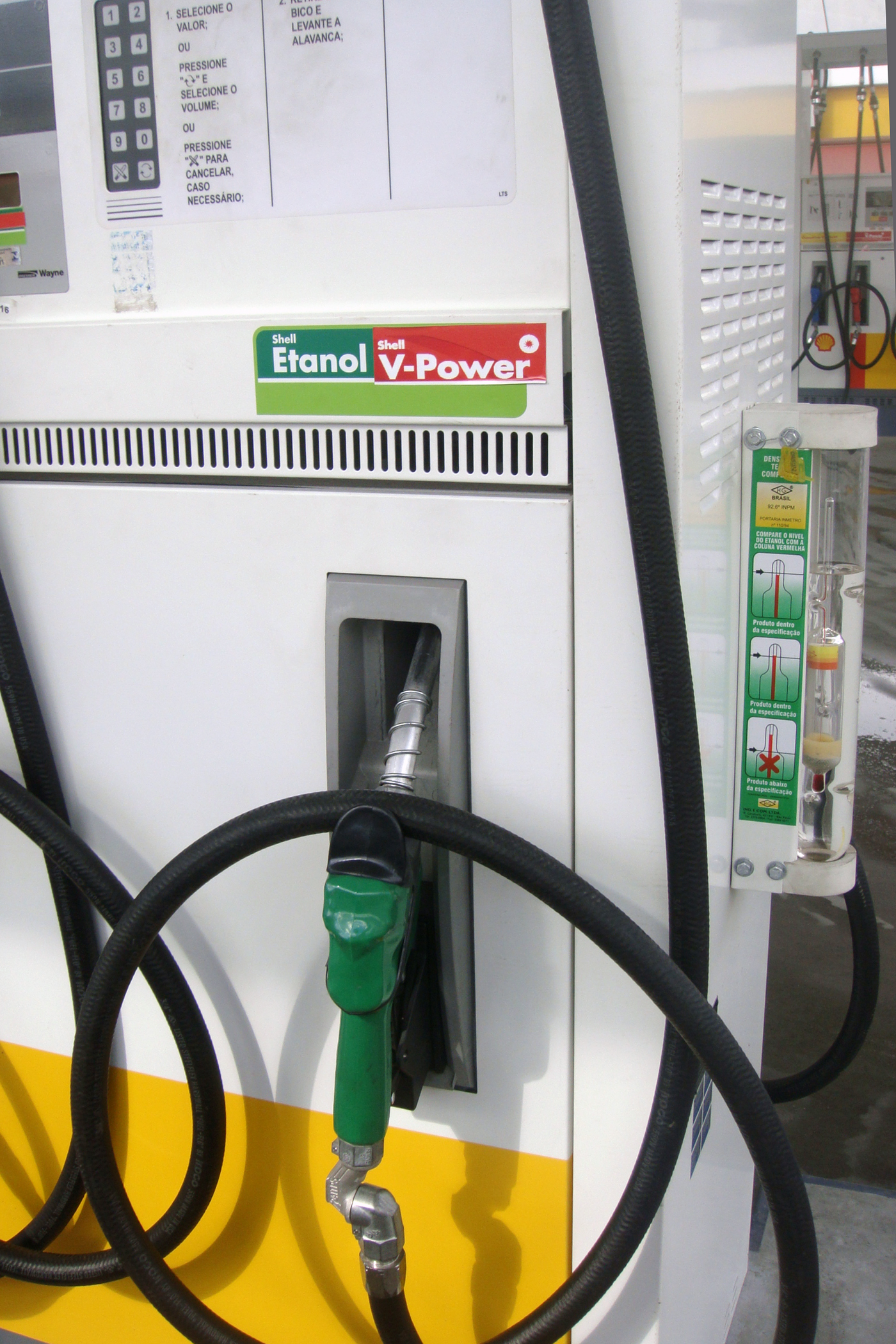
Reference view of an E100 ethanol pump at a fuel station in São Paulo, Brazil. India’s amended rules enable certification of specially designed ethanol vehicles; they do not make existing petrol vehicles E100-compatible.
Image: Mariordo (Mario Roberto Duran Ortiz) · CC BY-SA 3.0
Why in news
On October 26, 2026, the government amended vehicle emission and testing provisions to accommodate E100 and facilitate flex-fuel vehicle approvals. The changes widen the regulatory pathway beyond E20 while raising questions about compatibility, running costs and sustainable ethanol supply.
100%
Ethanol content in E100, subject to fuel specifications
20%
Ethanol content in E20
3,500 kg
Revised threshold for specified light-vehicle classifications
About 30%
Lower energy per gallon in E100 than petrol
2025
India achieved its E20 blending target
Background
Ethanol is an alcohol that can be produced from sugar- and starch-bearing crops or from agricultural residues and other plant material. India’s ethanol programme links transport-fuel diversification with domestic agricultural production and reduced dependence on imported petroleum. The National Policy on Biofuels, 2018, provides policy context, while the Central Motor Vehicles Rules, 1989, framed under the Motor Vehicles Act, 1988, govern vehicle-related technical requirements. A fuel-blending policy and a vehicle-certification framework perform different functions: availability of a fuel does not establish that every vehicle can safely use it.
What the amendments change
The Ministry of Road Transport and Highways has amended Rule 115, covering motor-vehicle emission standards and related requirements, and Rule 115E, containing additional emission-testing provisions. E100 has been included alongside E85 in several tables under Rule 115, creating a clearer regulatory basis for certifying vehicles for these fuels.
The amendments also correct a fuel-classification reference from E10 to E20 and raise the weight threshold for specified light petrol and diesel vehicle classifications from 3,000 kg to 3,500 kg. These are regulatory classification changes; they do not confer ethanol compatibility on an existing vehicle.
- E85 or E100 may be used only in flex-fuel vehicles designed by original equipment manufacturers for the relevant fuel.
- The amendments facilitate homologation and type approval for E100-powered vehicles.
- The supplied reports do not establish a general relaxation of emission limits or describe a new universal testing cycle.
Infographic
Certification
Approve vehicles for their intended fuels through applicable testing.
Compatibility
Match fuel labels with OEM-certified vehicle capability.
Affordability
Compare travel cost per kilometre, not just pump prices.
Climate integrity
Count lifecycle emissions, not only exhaust performance.
Resource security
Protect food, water, soil and biodiversity.
AI-assisted infographic by Pragnya IAS Academy, based on the cited sources.
Certification is not permission to fuel every petrol vehicle with E100
Homologation is the official verification that a vehicle or component meets applicable technical, safety and environmental standards. Authorised agencies, such as the Automotive Research Association of India, undertake this verification before approval for sale or road use. Recognising E100 within the regulatory framework allows appropriately designed vehicles to be assessed against applicable requirements.
A flex-fuel vehicle needs compatible fuel-system materials and suitable engine controls. Pumps, injectors, pipes and seals must tolerate the fuel, while electronic controls must adjust fuel delivery and ignition. Ethanol’s lower energy content generally requires more fuel volume for comparable power, although its high octane rating can benefit engines optimised for it.
- E10 or E20 compatibility does not establish suitability for E85 or E100.
- The notification does not require owners of existing vehicles to switch to E85 or modify their vehicles.
- Motorists should follow the fuel-compatibility label and manufacturer’s manual.
- High-ethanol fuel deployment also requires suitable storage, dispensing and contamination-control arrangements.
Energy security and the consumer-cost test
Domestic ethanol can replace part of petrol consumption, diversify transport-energy supply and create demand for agricultural feedstocks and processing. Its strategic value becomes particularly relevant when international disruptions threaten oil supplies. However, imported-oil displacement should be assessed alongside the domestic resources and energy used to produce ethanol.
Ethanol contains less energy per unit volume than petrol. The supplied Indian Express report cites a US Department of Energy estimate that E100 contains about 30% less energy per gallon than petrol. This is an energy-content comparison, not a universal mileage-loss estimate: actual performance depends on the vehicle, fuel blend and engine design.
- Consumer affordability should be measured through cost per kilometre rather than pump price alone.
- Lower energy density does not imply lower octane quality; the two describe different fuel properties.
- Comparing ethanol procurement prices directly with crude-oil prices cannot by itself establish final retail-fuel economics.
Lifecycle emissions: renewable does not mean pollution-free
Ethanol combustion does not eliminate tailpipe emissions. Any reduction in particular pollutants depends on the fuel blend, engine calibration and emission-control system; a renewable feedstock does not justify treating all exhaust pollutants as automatically lower.
Climate assessment must extend beyond the exhaust pipe. Cultivation, fertiliser use, irrigation, processing energy, transport and land-use change influence ethanol’s lifecycle greenhouse gas balance. Consequently, replacing petrol with crop-based ethanol does not automatically guarantee a lower overall climate footprint.
- Distinguish regulated tailpipe pollutants from lifecycle greenhouse gas emissions.
- Assess emissions per unit of transport service, not merely per litre of fuel.
- Ethanol should complement, rather than displace, investment in public transport and electrification.
- Electric mobility also requires lifecycle assessment, including electricity generation and vehicle production.
Food, water and land determine the sustainable scale
Crop-based ethanol links energy demand with food systems. Expanding demand for sugarcane and grains can create farm-market opportunities but may also compete for land, irrigation and food or feed supplies. Sugarcane’s substantial water requirement makes feedstock location and local water availability central to environmental assessment.
Agricultural residues offer an alternative to direct food-crop diversion, but their use also requires safeguards. Residues have competing uses, and excessive removal can reduce organic matter returned to soils. Sustainable expansion therefore requires feedstock-specific and region-specific assessment rather than a uniform assumption that all ethanol is equally beneficial.
- Water-stressed regions should not be encouraged towards unsuitable feedstock expansion.
- Food and feed availability must be considered when allocating crops to fuel production.
- Land-use change and biodiversity risks must enter project appraisal.
- Residue-based pathways need sustainable collection practices and viable processing infrastructure.
| Fuel | Composition in the supplied reports | Compatibility implication |
|---|---|---|
| E10 | Petrol containing 10% ethanol | E10 approval does not establish suitability for high-ethanol fuels. |
| E20 | Petrol containing 20% ethanol | E20 approval does not establish E85 or E100 compatibility. |
| E85 | Fuel containing up to 85% ethanol | Requires an OEM-designed flex-fuel vehicle approved for the fuel. |
| E100 | Entirely ethanol, subject to applicable fuel specifications | Requires a vehicle specifically designed and certified for E100. |
- 1. E100 is recognised within relevant emission and testing provisions.
- 2. Manufacturers design compatible fuel systems and calibrate engines for the intended fuels.
- 3. Authorised agencies verify compliance through homologation and applicable testing.
- 4. Compliant vehicle types receive approval.
- 5. Suitable fuel storage, dispensing and clear compatibility information support deployment.
- 6. Owners use only fuels permitted by the manufacturer.
1989
The Central Motor Vehicles Rules established the vehicle regulatory framework subsequently amended for ethanol-related requirements.
2018
The National Policy on Biofuels provided the policy framework under which the original E20 target year was 2030.
2025
India achieved its E20 blending target ahead of the original deadline, according to the supplied report.
April 2026
The Hindu reports that E20 emission-standard requirements took effect for BS-VI vehicles and E20 became mandatory for petrol sold nationally.
October 26, 2026
Amendments to the Central Motor Vehicles Rules widened the certification pathway for flex-fuel vehicles using fuels up to E100.
Significance, challenges & way forward
Significance
- The amendments remove a regulatory barrier to certification of E100-compatible vehicles without mandating conversion of the existing fleet.
- Domestic ethanol can diversify transport-fuel supply and reduce exposure to imported petroleum.
- Feedstock procurement and processing can support agricultural markets and rural value chains.
- Explicit fuel compatibility can improve regulatory clarity for manufacturers, testing agencies and consumers.
- The transition brings lifecycle emissions and agricultural resource use into transport-policy decision-making.
Challenges
- Incorrect fuelling can expose incompatible vehicles to material deterioration and unsuitable engine operation.
- Lower volumetric energy content can reduce mileage and weaken consumer savings unless pricing and efficiency compensate.
- Ethanol’s affinity for water increases the importance of storage quality and contamination control.
- Crop-based expansion can intensify competition for food, feed, irrigation water and land.
- Production energy and land-use change can erode anticipated lifecycle climate benefits.
- Excessive reliance on ethanol infrastructure could divert attention from deeper transport decarbonisation.
Way forward
- Publish clear compatibility guidance, pump labels and model-specific manufacturer information to prevent misfuelling.
- Disclose independently assessed mileage, emissions and cost-per-kilometre performance across approved fuel blends.
- Evaluate ethanol through transparent lifecycle accounting that includes cultivation, processing, transport and land-use effects.
- Align feedstock procurement with regional water availability and safeguards for food and feed security.
- Promote sustainably sourced residue-based ethanol while protecting soil health and existing residue uses.
- Develop high-ethanol dispensing infrastructure in step with compatible vehicles and robust fuel-quality controls.
- Treat ethanol as one component of a wider strategy centred on efficient mobility, public transport, electrification and cleaner electricity.
Key terms
- Flex-fuel vehicle
- A vehicle designed and certified to operate on petrol, ethanol or specified mixtures of the two.
- Homologation
- Official verification of compliance with applicable technical, safety and environmental requirements.
- Type approval
- Regulatory approval of a vehicle type after conformity with applicable requirements is established.
- Energy density
- The energy contained in a given quantity of fuel; volumetric energy density influences fuel volume needed for travel.
- Octane rating
- A measure of a fuel’s resistance to engine knocking, not its energy content.
- Lifecycle emissions
- Emissions assessed across relevant production, supply, use and end-of-life stages rather than at the exhaust alone.
- Second-generation ethanol
- Ethanol produced from lignocellulosic material such as agricultural residues rather than directly from sugar or starch crops.
Link with static syllabus
Prelims practice MCQs
Q1. With reference to the new E100 vehicle rules, consider the following statements: 1. E20 compatibility automatically establishes a vehicle’s suitability for E100. 2. E85 or E100 may be used only in appropriately designed OEM flex-fuel vehicles. 3. The notification requires existing petrol-vehicle owners to convert their vehicles to flex-fuel operation. Which of the statements given above is/are correct?
Q2. Consider the following statements about ethanol: 1. It has lower energy content per unit volume than petrol. 2. Its high octane rating indicates resistance to engine knocking. 3. Its renewable origin guarantees zero lifecycle greenhouse gas emissions. Which of the statements given above are correct?
Q3. In the context of motor-vehicle regulation, homologation most appropriately refers to:
Q4. Consider the following pairs: 1. Rule 115: Motor-vehicle emission standards and related requirements 2. Rule 115E: Additional provisions relating to emission testing 3. Octane rating: Energy contained per litre of fuel How many of the pairs given above are correctly matched?
Mains practice questions
GS 3 · 15 marks · 250 words
India’s E100 vehicle rules enable fuel diversification but do not by themselves ensure sustainable mobility. Examine with reference to vehicle compatibility, energy security and food-water-climate trade-offs.
Frequently asked questions
Can an existing E20-compatible car use E100 after the amendment?
No. E20 compatibility does not establish E100 suitability; the vehicle must be specifically designed and certified for the fuel.
Do the new rules require vehicle owners to convert to flex-fuel technology?
No. The notification enables certification of compatible vehicles and does not require existing owners to switch to E85 or modify their vehicles.
Will ethanol necessarily make driving cheaper?
No. Running costs depend on fuel price and vehicle efficiency because ethanol contains less energy per litre than petrol.
Is E100 automatically carbon-neutral?
No. Its lifecycle climate impact depends on feedstock cultivation, land-use effects, processing energy and transport, while combustion still generates emissions.
Sources
- The Hindu: What the new E100 vehicle rules mean | Explained
- Indian Express: In graphics: Centre's new E100 fuel rule change and what it means for you
Analysis prepared by the Pragnya IAS Academy current-affairs desk with AI assistance from the cited reports. Verify figures with the original sources.
Turn current affairs into marks
Join Pragnya IAS Academy's mentorship for daily answer-writing evaluation on stories like this — classroom programmes from a trusted name in IAS coaching in Hyderabad.