
India’s UN Arms Control Vote: Regional Security and Legal Implications
Revise the static topic: UPSC International Relations notes
In short: India and Israel voted against a draft resolution on regional conventional arms control approved by the UN General Assembly’s First Committee on November 2, 2026. India argued that security concerns extend beyond regional boundaries and questioned fresh deliberations on matters already covered by consensus outcomes of the UN Disarmament Commission. The vote highlights the tension between regional military balance and wider security requirements; the committee’s approval does not itself create binding arms-control obligations.
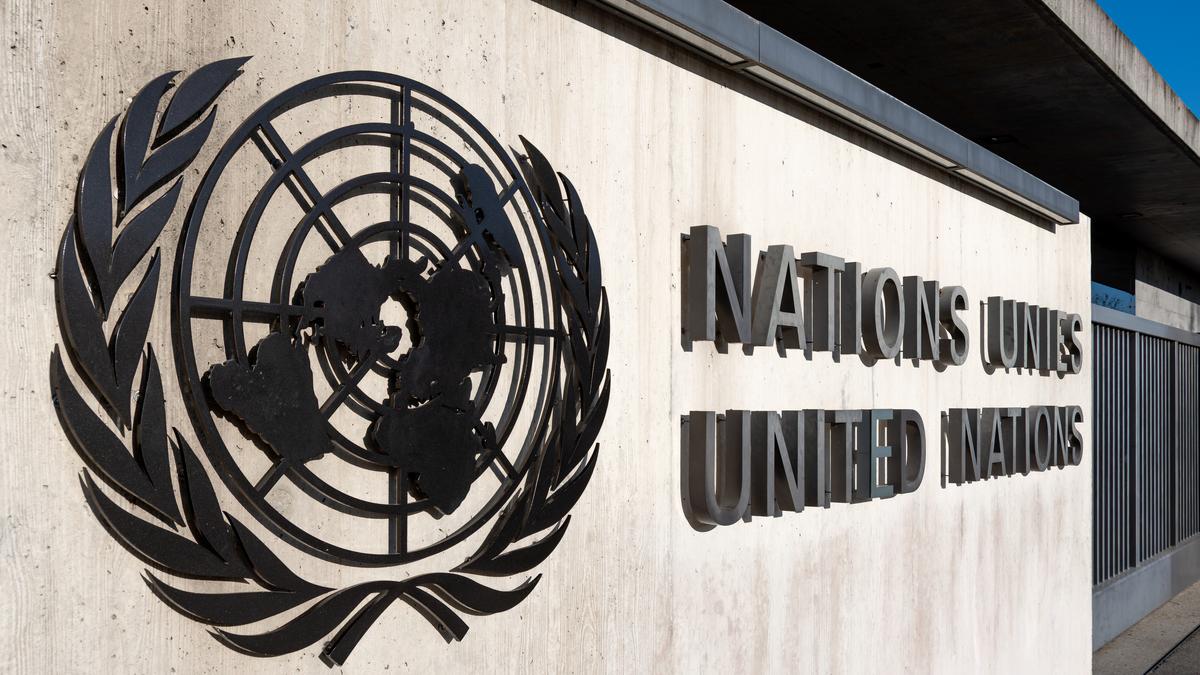
India’s opposition to the UN draft on regional conventional arms control highlights its argument that security concerns extend beyond regional boundaries. Committee approval does not itself impose binding arms limits.
Image: The Hindu
Why in news
The First Committee approved the draft sponsored by Pakistan and Belarus with 180 votes in favour, two against and no abstentions. India also separately opposed a paragraph referring to conventional arms-control proposals concerning South Asia.
180
Votes in favour
2
Votes against
0
Abstentions
193
UN member states
Background
Conventional arms control concerns the regulation, limitation or reduction of weapons other than weapons of mass destruction, along with related military capabilities and activities. It may operate through global, regional or bilateral arrangements and can include transparency, verification and confidence-building measures. The UN General Assembly’s First Committee deals with disarmament and international security, while the UN Disarmament Commission is a deliberative subsidiary body of the General Assembly that develops recommendations. Neither should be confused with the Conference on Disarmament, a multilateral disarmament negotiating forum.
What the draft proposes and what was approved
The draft, titled ‘General and complete disarmament: Conventional arms control at the regional and subregional levels’, argues that conventional arms control should be pursued primarily within regions and subregions. Its premise is that most post-Cold War threats to peace and security arise among states located within the same region or subregion.
It seeks agreements that strengthen regional peace and security at the lowest possible level of armaments and military forces. It also assigns a special responsibility to militarily significant states and states with larger military capabilities, and asks the UN Disarmament Commission to consider principles for regional arms-control agreements.
The reported approval was in the First Committee, not a reported final plenary adoption by the General Assembly. The UN’s total membership is not the same as the number of votes recorded in this ballot; the source does not explain the difference.
- Pakistan and Belarus sponsored the draft.
- India and Israel were the only states voting against it.
- India separately opposed the paragraph mentioning conventional arms-control proposals in the context of South Asia.
- The source provides India’s explanation of vote, but not Israel’s reasons for opposing the draft.
Infographic
Decision
First Committee approval; India and Israel opposed.
Security
Threats can extend beyond regional boundaries.
Asymmetry
Military parity does not automatically mean equal security.
Institutions
Build on existing consensus; avoid repetitive mandates.
Law
Recommendatory resolutions are not binding arms-control treaties.
AI-assisted infographic by Pragnya IAS Academy, based on the cited sources.
Why India rejects a primarily regional approach
India’s stated objection concerns the framework of arms control rather than a rejection of arms control as such. Its representative argued that conventional arms control is a global issue and that states’ security concerns cannot be confined within narrowly defined regional boundaries. New Delhi described its vote as consistent with its past position.
The analytical issue is the difference between numerical balance and security adequacy. Defence requirements depend on geography, multiple potential contingencies, military capabilities and external strategic relationships. An arrangement focused on one regional balance may therefore overlook the wider threats faced by a participating state.
For India, its land borders with both Pakistan and China illustrate why security planning cannot necessarily be reduced to a single bilateral balance. This is an analytical application of India’s broader argument, not a claim that the supplied explanation of vote explicitly named either country.
- Equal or comparable force levels do not automatically generate equal security.
- Regional agreements can be useful, but their design must account for relevant extra-regional capabilities and relationships.
- India’s objection to the South Asia paragraph indicates sensitivity to region-specific framing; the source does not establish a broader negotiating position beyond this vote.
Institutional duplication versus implementation
India questioned why the UN Disarmament Commission should undertake another exercise on principles for regional conventional arms control when it had already produced consensus outcomes on related subjects. It cited regional disarmament guidelines and recommendations adopted in 1993, conventional arms-control and disarmament guidelines adopted in 1999, and recommendations on practical confidence-building measures concerning conventional weapons adopted in 2017.
This raises an institutional-efficiency question: should multilateral bodies draft additional general principles or prioritise implementation and identification of specific gaps? Updating guidance may be justified by changed security conditions, but a fresh mandate should explain what existing recommendations fail to address.
- Existing consensus outcomes provide a starting point for further work.
- New deliberations should have a clearly identified purpose and avoid repetitive mandates.
- Confidence-building measures can offer practical risk reduction even where comprehensive force limitations remain difficult.
Legal status: political endorsement is not a binding arms limit
Under the UN Charter, the General Assembly has broad powers to discuss matters and make recommendations, including on disarmament and the regulation of armaments. Articles 10 and 11 are relevant. A General Assembly resolution of this kind is generally recommendatory, and First Committee approval does not itself impose enforceable ceilings on national armed forces or weapons.
Binding arms-control obligations may arise through a treaty in force for the states concerned. Separately, Article 25 of the UN Charter requires members to accept and carry out Security Council decisions in accordance with the Charter. This does not mean that every Security Council text is binding, nor that General Assembly recommendations have the same legal status.
Recommendatory resolutions can still carry diplomatic weight, shape expectations and influence later negotiations. However, voting against this draft neither violates an arms-control treaty nor cancels any existing legal obligation; existing obligations must be assessed independently.
- Distinguish committee approval from General Assembly plenary adoption.
- Distinguish political influence from legal enforceability.
- A favourable vote on a recommendatory resolution is not, by itself, consent to be bound by an arms-control treaty.
| Instrument or stage | Function | Legal implication |
|---|---|---|
| First Committee approval | Advances a draft through the General Assembly’s committee process | Does not itself create binding arms-control limits |
| UNGA disarmament resolution | Expresses collective positions and recommends action | Generally recommendatory rather than legally binding |
| UN Disarmament Commission recommendations | Develop guidelines and principles through deliberation | Do not themselves constitute a binding arms-control treaty |
| Arms-control treaty in force | Establishes agreed rules for its parties | Creates obligations for states bound by it, according to its terms |
| Binding Security Council decision | Requires action under the UN Charter | Must be carried out in accordance with Article 25 |
- 1. States sponsor a draft setting out principles or proposed action.
- 2. The First Committee considers and votes on the draft.
- 3. Committee recommendations proceed for consideration by the General Assembly plenary.
- 4. A plenary resolution of this kind provides recommendations, not automatic binding arms limits.
- 5. A separate treaty process can create binding limits for states that consent to be bound, once the treaty enters into force for them.
1993
The UN Disarmament Commission adopted consensus guidelines and recommendations on regional disarmament.
1999
The Commission adopted consensus guidelines on conventional arms control and disarmament.
2017
The Commission adopted consensus recommendations on practical confidence-building measures concerning conventional weapons.
November 2, 2026
The UNGA First Committee approved the regional conventional arms-control draft; India and Israel voted against it.
Significance, challenges & way forward
Significance
- India’s vote asserts that national defence requirements must be assessed against the full security environment, not only a prescribed regional balance.
- The debate exposes the difficulty of reconciling a common arms-control framework with unequal geography, capabilities and strategic responsibilities.
- The wide support for the draft gives it political significance without converting it into a binding international obligation.
- India’s institutional critique shifts attention from repeated norm formulation towards the practical utility of existing consensus recommendations.
Challenges
- Defining the relevant region is difficult when military capabilities, alliances and arms transfers link several security theatres.
- Numerical force comparisons may overlook differences in readiness, technology, deployment and geography.
- Arms reductions without credible verification and reciprocal compliance can deepen insecurity rather than reduce it.
- Assigning special responsibility to larger military powers can become contentious if corresponding security concerns are not adequately recognised.
- Opposing a widely supported draft creates a diplomatic need to explain the objection clearly and offer constructive alternatives.
Way forward
- India should distinguish opposition to an overly restrictive regional framework from support for credible, equitable arms control.
- Future initiatives should map relevant threats and capabilities before prescribing force balances or reductions.
- States should build on existing UN Disarmament Commission outcomes and identify precise gaps before creating additional deliberative mandates.
- Practical measures such as military communication channels, incident-prevention arrangements and appropriate exercise notifications should be explored where mutually acceptable.
- Any negotiated limitations should incorporate reciprocity, verification and review arrangements suited to changing security conditions.
- Public explanations should clearly separate committee votes, recommendatory resolutions and binding treaty obligations.
Key terms
- Conventional arms
- Weapons other than weapons of mass destruction, including small arms and major conventional weapon systems.
- Arms control
- Measures regulating or limiting weapons, military capabilities or their use to improve security and stability.
- Disarmament
- The reduction or elimination of weapons and military capabilities.
- Security asymmetry
- An uneven distribution of threats, capabilities or strategic circumstances among states.
- Confidence-building measures
- Arrangements that reduce mistrust, uncertainty and the risk of military miscalculation.
- Explanation of vote
- A statement through which a state explains its reasons for supporting, opposing or abstaining on a proposal.
- Soft law
- Non-binding principles or instruments that may influence state conduct and the development of legal norms.
Link with static syllabus
Prelims practice MCQs
Q1. With reference to the reported vote on regional conventional arms control in November 2026, consider the following statements: 1. The draft was approved by the UN General Assembly’s First Committee. 2. India and Israel were the only states that voted against the draft. 3. The approval immediately imposed binding limits on India’s conventional forces. Which of the statements given above are correct?
Q2. Which of the following correctly distinguishes the UN Disarmament Commission from the Conference on Disarmament?
Q3. Consider the following statements about international legal obligations: 1. A General Assembly recommendation on disarmament automatically creates treaty obligations for states voting in favour. 2. Article 25 of the UN Charter concerns members’ acceptance and implementation of Security Council decisions in accordance with the Charter. 3. A vote against a General Assembly draft automatically terminates a state’s existing arms-control treaty obligations. Which of the statements given above is/are correct?
Q4. India cited earlier consensus outcomes of the UN Disarmament Commission while explaining its vote. Which sequence correctly identifies these outcomes chronologically?
Mains practice questions
GS 2 · 15 marks · 250 words
Regional arms control must reconcile military balance with unequal security requirements. Discuss in the context of India’s opposition to the UN draft on regional conventional arms control, distinguishing political recommendations from binding obligations.
Frequently asked questions
Why did India vote against the regional conventional arms-control draft?
India argued that security concerns extend beyond regional boundaries and questioned the practicality of preserving a narrowly defined regional military balance. It also objected to renewed deliberations on subjects already covered by UN Disarmament Commission consensus outcomes.
Did the vote create binding restrictions on India’s armed forces?
No. The reported action was First Committee approval of a draft, and a General Assembly resolution of this kind is generally recommendatory rather than a source of automatic binding force limits.
Does India’s opposition mean it rejects all conventional arms control?
The reported explanation does not support that conclusion. India challenged the primacy of regional framing and the need for another deliberative exercise, not the entire concept of conventional arms control.
Was the draft adopted by the full General Assembly?
The supplied source reports approval by the General Assembly’s First Committee on November 2, 2026. It does not establish subsequent adoption by the General Assembly plenary.
Sources
Analysis prepared by the Pragnya IAS Academy current-affairs desk with AI assistance from the cited reports. Verify figures with the original sources.
Turn current affairs into marks
Join Pragnya IAS Academy's mentorship for daily answer-writing evaluation on stories like this — classroom programmes from a trusted name in IAS coaching in Hyderabad.