
Intercensal Surveys and Gender-Inclusive Census Towns: Parliamentary Panel’s Reform Push
Revise the static topic: UPSC Polity notes · UPSC Governance notes
In short: A parliamentary panel has recommended intercensal surveys and gender-inclusive criteria for identifying census towns. These proposals could make demographic planning more responsive and urban classification more representative, but their impact would depend on survey quality, the revised criteria and administrative follow-through.
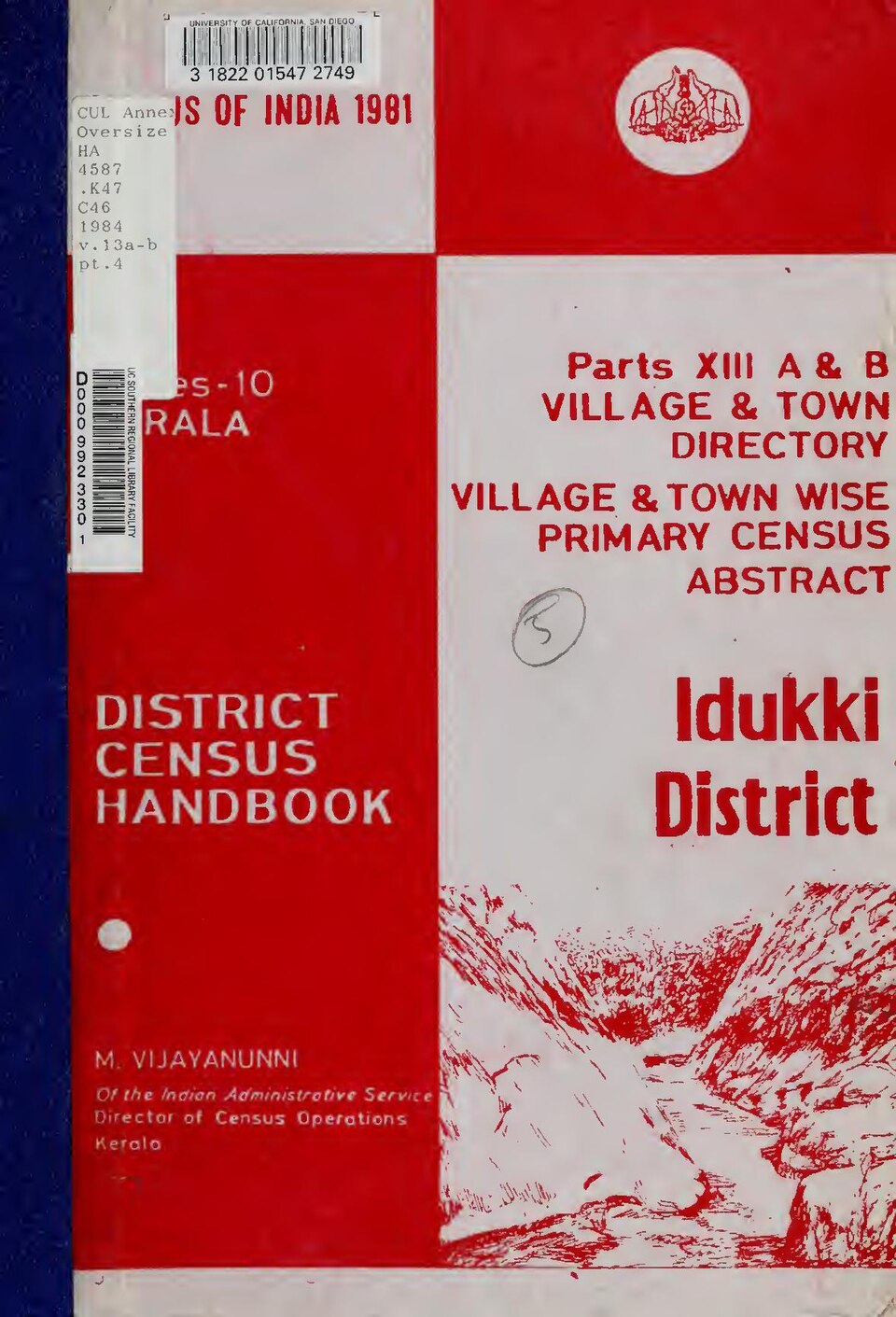
Archival reference: a 1981 Census of India publication from Kerala’s census operations. Historical census records provide context for the panel’s call for more frequent demographic evidence and revised census-town criteria.
Image: India. Director of Census Operations, Kerala · Public domain
Why in news
The Times of India reports that a parliamentary panel has advocated intercensal surveys and gender-inclusive census-town norms. The supplied material does not specify the proposed survey frequency, detailed methodology or revised classification thresholds.
Background
The Census provides a comprehensive demographic benchmark, while sample surveys can supply estimates between census exercises. Census is a Union subject and is administered through the Office of the Registrar General and Census Commissioner, India, under the Ministry of Home Affairs. India distinguishes statutory towns, recognised under law, from census towns, identified statistically through population, density and occupational criteria. The conventional census-town occupational criterion focuses on male main workers engaged in non-agricultural pursuits. A census town need not have an urban local body: statistical recognition and municipal status are separate.
What the panel’s recommendations mean
The reported recommendations address two distinct limitations of demographic governance: the time lag between comprehensive population counts and the gender sensitivity of the rules used to recognise urban settlements.
Intercensal surveys would provide evidence between census exercises. Gender-inclusive census-town criteria would reconsider whose economic activity counts when determining whether a settlement has an urban occupational character. The available source establishes recommendations, not an adopted policy or an implementation schedule.
- The data reform concerns how frequently demographic change is measured.
- The classification reform concerns how urban characteristics are defined.
- Neither recommendation should be treated as an automatic change in municipal boundaries or fiscal entitlements.
Infographic
Timeliness
Use intercensal surveys to update demographic understanding.
Gender inclusion
Reflect women’s economic activity in urban classification.
Statistical integrity
Publish precision measures and preserve comparability.
Urban recognition
Distinguish statistical status from municipal governance.
Service delivery
Translate evidence into appropriate plans, resources and capacity.
AI-assisted infographic by Pragnya IAS Academy, based on the cited sources.
Why intercensal evidence matters for planning
Population distribution, migration and household characteristics can change between censuses. Interim estimates could help governments reassess demand for schools, health facilities, housing, transport and basic services rather than relying exclusively on an ageing benchmark.
However, a sample survey is not a substitute for complete enumeration. Its usefulness for local allocation depends on sample design, geographic coverage and precision. An estimate reliable at State level may not be reliable for an individual settlement.
- Use surveys to update planning assumptions and identify emerging service gaps.
- Publish sampling errors and methodological notes alongside estimates.
- Distinguish survey estimates, administrative records and census counts when making allocation decisions.
Gender-inclusive urban classification: beyond a male-worker lens
A male-focused occupational criterion does not directly account for women’s contribution to a settlement’s non-agricultural economy. A gender-inclusive approach could better reflect work undertaken by women, including informal, home-based and self-employed activity.
Changing the denominator alone would be insufficient. Enumerators must identify qualifying economic work accurately and distinguish it from unpaid domestic services for one’s own household. Otherwise, reporting gaps could persist under a formally inclusive rule.
The direction and scale of reclassification cannot be inferred from the recommendation alone. Including additional worker groups could change the measured non-agricultural share differently across settlements; it would not necessarily increase the number of census towns.
- Test alternative definitions before adopting revised occupational criteria.
- Publish sex-disaggregated work data to make classification outcomes auditable.
- Compare old and proposed criteria on the same dataset to separate definitional change from actual urbanisation.
From statistical recognition to urban governance
Census-town identification records urban characteristics; it does not itself establish a municipality. Article 243Q provides the constitutional framework for Nagar Panchayats, Municipal Councils and Municipal Corporations, with urban-area specification taking account of factors such as population, density, revenue, non-agricultural employment and economic importance.
Better classification can reveal settlements requiring urban-scale infrastructure even while they remain under rural administration. Yet improved data will translate into services only when States, local bodies and financing institutions use it in planning and institutional decisions.
- Parliamentary committee recommendations require action by the competent authorities; they do not themselves amend law.
- Municipal transition should be accompanied by adequate functions, funds and personnel.
- Settlements with urban service pressures should not be neglected merely because their administrative status remains rural.
| Instrument | Primary purpose | Key limitation |
|---|---|---|
| Census | Comprehensive population enumeration and a detailed demographic benchmark | Cannot continuously capture changes between exercises |
| Intercensal survey | Estimate selected demographic and socioeconomic changes between censuses | Local reliability depends on sample design and estimation methods |
| Census-town classification | Identify settlements meeting statistical criteria for urban characteristics | Does not automatically confer municipal status |
| Statutory urban recognition | Recognise an urban settlement under law and provide the relevant governance framework | Legal status alone does not ensure administrative or fiscal capacity |
- 1. Establish the census benchmark and identify gaps in demographic information.
- 2. Conduct representative intercensal surveys with transparent quality standards.
- 3. Test gender-inclusive occupational criteria and assess classification effects.
- 4. Publish comparable estimates, uncertainty measures and settlement-level findings where reliable.
- 5. Use the evidence to revise service plans and inform appropriate resource-allocation rules.
- 6. Review governance arrangements and monitor whether service gaps narrow.
Significance, challenges & way forward
Significance
- More current demographic evidence could improve the alignment between population needs and public-service capacity.
- Gender-inclusive occupational criteria could make women’s economic contribution more visible in the measurement of urbanisation.
- Better identification of emerging urban settlements could support coordinated housing, transport, water and sanitation planning.
- Transparent demographic updates could strengthen the evidentiary basis for budgeting and legislative scrutiny.
Challenges
- Frequent surveys require sustained statistical capacity, trained personnel and dependable financing.
- Small samples may generate unstable local estimates, making mechanical settlement-level allocations inappropriate.
- Women’s informal and home-based economic work may remain under-recorded without improved questioning and enumeration.
- Revised definitions can disrupt comparability and create apparent urban growth that partly reflects methodological change.
- Statistical urban recognition may not be followed by adequate institutions, infrastructure or resources.
- Combining datasets requires safeguards for confidentiality, compatibility and appropriate use.
Way forward
- Define the objectives and geographic precision of intercensal surveys before determining their frequency.
- Pilot gender-inclusive criteria across different settlement types and publish the results of methodological testing.
- Train enumerators to identify women’s qualifying economic activities accurately, including informal and home-based work.
- Release classifications under both existing and proposed criteria during a transition period to preserve comparability.
- Use interim estimates in allocation decisions only where applicable rules permit and statistical reliability is adequate.
- Develop coordinated State and local plans for emerging urban settlements, linking recognition to infrastructure and institutional capacity.
Key terms
- Intercensal survey
- A survey conducted between census exercises to estimate selected demographic or socioeconomic characteristics.
- Census town
- A settlement classified as urban for census purposes on statistical criteria rather than statutory town status.
- Statutory town
- A settlement recognised as a town under law, such as one administered by a municipality or another legally constituted urban authority.
- Main worker
- A census work-status category referring to a person who worked for the major part of the reference year.
- Sampling error
- The variation arising because an estimate is based on a sample rather than the entire population.
- Definitional reclassification
- A change in statistical category caused by revised rules rather than necessarily by an underlying change in settlement characteristics.
Link with static syllabus
Prelims practice MCQs
Q1. With reference to census towns in India, consider the following statements: 1. Census-town classification is based on statistical criteria. 2. Classification as a census town automatically establishes a municipality. 3. The conventional occupational criterion focuses on male main workers engaged in non-agricultural pursuits. Which of the statements given above are correct?
Q2. Which of the following best describes an intercensal survey?
Q3. Consider the following statements concerning demographic data: 1. A survey estimate reliable at State level is necessarily reliable for every settlement in that State. 2. Revising urban classification criteria can affect comparability across census exercises. 3. Gender-inclusive occupational criteria necessarily increase the number of census towns. Which of the statements given above is/are correct?
Q4. Article 243Q of the Constitution of India primarily concerns which of the following?
Mains practice questions
GS 2 · 15 marks · 250 words
Examine how intercensal surveys and gender-inclusive census-town criteria can improve development planning in India. What safeguards are necessary to translate better measurement into better governance?
Frequently asked questions
Would intercensal surveys replace the Census?
They should complement, rather than replace, comprehensive census enumeration. Surveys provide interim estimates whose detail and reliability depend on their design.
Why is gender inclusion relevant to census-town criteria?
The conventional occupational criterion focuses on male main workers. A gender-inclusive approach could better reflect women’s non-agricultural economic activity, provided that such work is accurately recorded.
Does becoming a census town automatically mean getting a municipality?
No. Census-town status is a statistical classification, while municipal status requires separate action under the applicable constitutional and legal framework.
Have the recommended reforms been implemented?
The supplied source reports parliamentary panel recommendations. It does not establish adoption, revised thresholds or an implementation schedule.
Sources
Analysis prepared by the Pragnya IAS Academy current-affairs desk with AI assistance from the cited reports. Verify figures with the original sources.
Turn current affairs into marks
Join Pragnya IAS Academy's mentorship for daily answer-writing evaluation on stories like this — classroom programmes from a trusted name in IAS coaching in Hyderabad.