
UN Security Council Reform: India’s Case for Permanent Membership and Veto Equality
Revise the static topic: UPSC International Relations notes
In short: India has opposed a reformed UN Security Council that gives new permanent members no veto, arguing that this would preserve existing power inequalities. Its position links equal rights for permanent members with broader reform of representation, membership categories and working methods, but implementation requires overcoming resistance from existing powers and divisions among UN members.
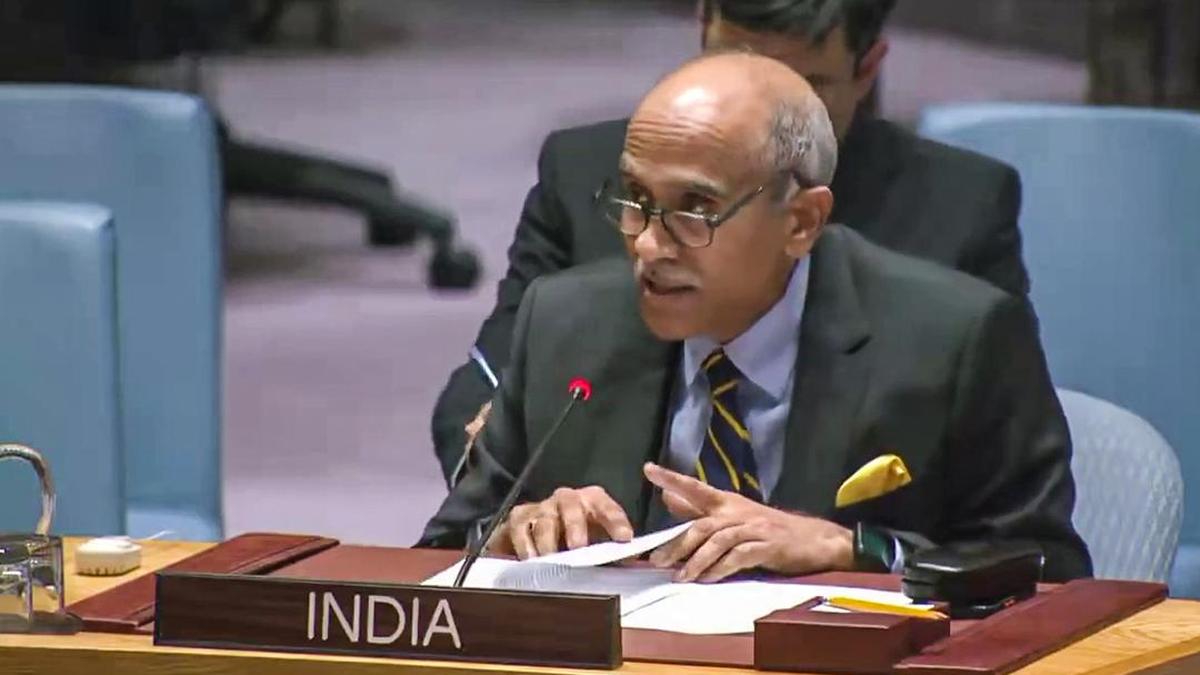
India argues that admitting new permanent Security Council members without veto rights would preserve unequal status within the Council.
Image: The Hindu
Why in news
On October 26, 2026, India’s Permanent Representative to the UN, Harish Parvathaneni, reiterated that all permanent members should possess the veto as long as it exists. Speaking in the General Assembly’s Intergovernmental Negotiations, he also sought early text-based negotiations with clear timelines and milestones.
15
Current Security Council members
5
Permanent members with veto
10
Elected non-permanent members
2 years
Non-permanent membership term
1965
Only Council expansion
17
IGN cycles cited by India without an outcome
Background
The UN Security Council has primary responsibility for maintaining international peace and security under the UN Charter. Its permanent members are China, France, Russia, the United Kingdom and the United States; its non-permanent members are elected by the General Assembly. The veto enables a permanent member to block a substantive Council decision, but does not apply to procedural decisions. The institutional design reflects the post-war settlement associated with the UN’s establishment in 1945. India seeks expansion of both permanent and non-permanent membership to make the Council more representative of contemporary geopolitical realities.
What India has proposed—and what remains undecided
India’s position is conditional but clear: as long as the veto exists, it should belong to every permanent member of a reformed Council. Permanent membership without equivalent decision-making rights would, in India’s assessment, create a subordinate category rather than redistribute authority.
This is a negotiating position, not an adopted reform. India also rejects treating periodically elected, long-term seats as equivalent to genuine permanency and warns that expanding only elected membership would leave the central power imbalance intact.
- Expand both permanent and non-permanent membership.
- Ensure equal rights and responsibilities within the permanent category.
- Exercise the veto with restraint rather than for narrow political expediency.
- Address membership, regional representation, Council size and working methods together.
Infographic
Representation
Expand permanent and elected membership to reflect contemporary realities.
Equality
India seeks equal veto rights for all permanent members while the veto exists.
Effectiveness
Prevent wider membership and blocking powers from deepening paralysis.
Legal feasibility
Charter amendments require ratification by every existing permanent member.
Negotiating pathway
Move towards text-based talks, milestones and transparent working methods.
AI-assisted infographic by Pragnya IAS Academy, based on the cited sources.
India’s case for a permanent seat
India frames its claim around the gap between contemporary geopolitical realities and the Council’s inherited structure. Its repeated elected membership provides institutional experience: India last served in 2021–22, its eighth term. However, elected experience does not itself confer a legal entitlement to permanent membership.
A persuasive reform case must extend beyond India’s admission. Greater representation of developing countries and regions without permanent representation, particularly Africa, is central to the legitimacy argument. India’s demand is therefore strongest when presented as part of a wider redistribution of representation and responsibility.
- Representation: Permanent membership should better reflect the international community rather than only the inherited post-war settlement.
- Institutional experience: Repeated elected terms demonstrate familiarity with Council responsibilities and procedures.
- System-wide legitimacy: India’s inclusion should accompany broader regional representation rather than merely enlarge an exclusive club.
Veto equality versus Council effectiveness
India’s equality argument concerns parity among permanent members, not equal voting power for every UN member. A permanent seat without a veto would provide continuity and access but would not confer the same blocking authority enjoyed by the existing permanent members.
The counterargument is institutional effectiveness: extending the veto could increase opportunities for deadlock. This is a risk, not an inevitable outcome. The reform challenge is to reconcile representative legitimacy with the Council’s ability to act, while distinguishing equal legal status from restraint in exercising that status.
- Retaining exclusive veto rights for existing permanent members preserves a hierarchy within the permanent category.
- Extending the veto can improve parity but may create additional blocking points.
- Veto restraint can reduce misuse, but cannot by itself resolve unequal representation.
- Expansion without working-method reforms may improve membership diversity without ensuring more effective decisions.
Legal and political obstacles to reform
Changing the Council’s composition or formal veto arrangements requires amendment of the UN Charter. The amendment process requires the prescribed General Assembly majority and national ratifications, including ratification by every existing permanent member. A General Assembly political declaration alone cannot change these arrangements.
The existing permanent members therefore possess a decisive legal gatekeeping role over structural reform. Political obstacles also include competing national claims, disagreements over membership categories and regional representation, and differences over whether veto expansion would improve or weaken the institution.
India recalled that the 1965 expansion increased elected seats from six to ten while leaving permanent membership unchanged. The key lesson is that a larger Council need not entail redistribution of formal veto authority.
- Broad diplomatic support is necessary but is not sufficient for Charter amendment.
- Existing permanent members must accept and ratify changes affecting their institutional privileges.
- Agreement on the need for reform does not automatically produce agreement on a specific reform model.
The less visible barrier: consensus and de facto vetoes
India distinguished the formal veto from blocking power generated by consensus-based working methods. Presidential statements, press statements and sanctions committee decisions can be obstructed by a single Council member where consensus is required. This blocking capacity is not confined to permanent members.
India also criticised treating consensus as an indispensable condition in the Intergovernmental Negotiations. According to its intervention, the guiding standard is the widest possible political acceptance, not unanimity. Its demand for text-based negotiations seeks to move discussion towards concrete provisions that reveal agreements, alternatives and unresolved issues.
- A formal veto is a Charter-based privilege of permanent members over substantive Council decisions.
- A de facto veto arises when consensus procedures allow a participant to block an outcome.
- Text-based negotiations would provide a common draft against which competing proposals can be assessed.
- Clear milestones could improve accountability, although they cannot substitute for political agreement.
| Dimension | Formal Security Council veto | Consensus-based blocking power |
|---|---|---|
| Basis | UN Charter voting framework | Consensus-based procedures or working practices |
| Who can block | An existing permanent member | Any participating member whose agreement is required |
| Where it operates | Substantive Council decisions | Statements and sanctions committee decisions requiring consensus |
| Principal concern | Unequal legal authority and possible paralysis | Obstruction that may occur without a publicly explained vote |
| Reform approach | Charter reform and restraint in use | Greater transparency and review of working methods |
- 1. Build political convergence on representation, membership categories and veto arrangements.
- 2. Begin text-based negotiations with clear milestones, as proposed by India.
- 3. Secure General Assembly adoption of the required Charter amendments.
- 4. Obtain the prescribed national ratifications, including those of all existing permanent members.
- 5. Bring the amendments into force and implement the revised arrangements.
1945
The United Nations was established with a Security Council containing permanent and elected members.
1965
The Council’s only expansion increased non-permanent seats from six to ten while retaining five permanent members.
2021–22
India served its eighth term as an elected Security Council member.
October 26, 2026
India reiterated its demand for equal veto rights for all permanent members of a reformed Council.
June 2027
Elections are scheduled for the 2028–29 term; India and Tajikistan are to contest the available Asia-Pacific seat.
Significance, challenges & way forward
Significance
- India’s intervention places equality of authority, rather than seat expansion alone, at the centre of the reform debate.
- Broader regional representation could strengthen the legitimacy and acceptance of Council decisions.
- Separating formal and de facto vetoes reveals how both legal privileges and working practices can obstruct action.
- Linking veto reform with membership and procedures recognises that institutional credibility depends on the Council’s overall architecture.
Challenges
- Existing permanent members must ratify Charter amendments that could dilute their exclusive privileges.
- Competing membership claims and regional disagreements make a common reform package difficult to negotiate.
- Additional veto holders could create more opportunities for paralysis unless accompanied by responsible exercise.
- Consensus-based negotiations can allow procedural obstruction to prevent movement towards a concrete text.
- A larger Council may become more representative without becoming more effective if its working methods remain unchanged.
Way forward
- Begin text-based negotiations that clearly distinguish agreed provisions, alternatives and unresolved questions.
- Build a broad coalition linking India’s candidature with improved representation for underrepresented regions, especially Africa.
- Negotiate membership expansion, veto arrangements and working methods as a coherent package.
- Promote restraint and public explanation in veto use without presenting voluntary restraint as a substitute for structural reform.
- Improve transparency around holds and objections in sanctions committees while preserving fair procedures.
- Use timelines and milestones to assess negotiating progress rather than allowing repeated discussions without a negotiating text.
Key terms
- P5
- The existing permanent Security Council members: China, France, Russia, the United Kingdom and the United States.
- Veto
- A permanent member’s power to block a substantive Security Council decision through a negative vote.
- De facto veto
- Practical blocking power arising from consensus requirements rather than the formal Charter veto.
- Intergovernmental Negotiations
- The General Assembly-based negotiating process addressing Security Council reform.
- Text-based negotiations
- Negotiations organised around a common written draft containing proposals and alternative formulations.
- Charter amendment
- A formal change to the UN’s founding treaty requiring General Assembly approval and prescribed national ratifications.
- Sanctions committees
- Security Council subsidiary bodies that oversee particular sanctions regimes, including relevant listing and delisting procedures.
Link with static syllabus
Prelims practice MCQs
Q1. Consider the following statements about the UN Security Council: 1. It currently has five permanent and ten non-permanent members. 2. Non-permanent members are elected for two-year terms. 3. The permanent members’ veto applies to procedural decisions. Which of the statements given above are correct?
Q2. With reference to India’s October 2026 position on Security Council reform, consider the following statements: 1. As long as the veto exists, all permanent members of a reformed Council should possess it. 2. Expansion should be confined to the non-permanent category. 3. Veto reform should be considered together with representation and working methods. Which of the statements given above are correct?
Q3. Which of the following best explains the legal significance of existing permanent members in structural Security Council reform?
Q4. Consider the following statements concerning consensus-based decision-making: 1. A non-permanent Council member may block an outcome where consensus is required. 2. Such blocking power is legally identical to the permanent members’ Charter-based veto. Which of the statements given above is/are correct?
Mains practice questions
GS 2 · 15 marks · 250 words
“Expansion of the UN Security Council without redistribution of decision-making authority may improve representation but preserve institutional inequality.” Examine in the context of India’s demand for permanent membership and equal veto rights.
Frequently asked questions
Has India obtained permanent membership or veto rights?
No. The reported intervention reiterates India’s negotiating position; it does not announce an adopted reform.
Does India’s position mean it considers the veto indispensable?
The stated position is conditional: as long as the veto exists, every permanent member should possess it. India also calls for restraint in its exercise.
Can a non-permanent member exercise a veto?
It cannot exercise the formal Charter-based veto. However, it can block outcomes in bodies or procedures requiring consensus, creating a de facto veto.
Why cannot the General Assembly alone reform the Council’s permanent membership?
Structural changes require Charter amendment, not merely a political resolution. The amendment must satisfy national ratification requirements, including ratification by every existing permanent member.
Sources
Analysis prepared by the Pragnya IAS Academy current-affairs desk with AI assistance from the cited reports. Verify figures with the original sources.
Turn current affairs into marks
Join Pragnya IAS Academy's mentorship for daily answer-writing evaluation on stories like this — classroom programmes from a trusted name in IAS coaching in Hyderabad.