
VISTAR: Statistical Reform, Informal-Sector Coverage and Better GDP Estimation
Revise the static topic: UPSC Economy notes
In short: The Union Cabinet has approved VISTAR, a ₹4,371 crore scheme to modernise India’s statistical system during 2026-27 to 2030-31. It combines expanded surveys, digitalisation and AI, State-level capacity building, and the 8th Economic Census to improve data quality, informal-sector measurement and evidence-based policymaking.
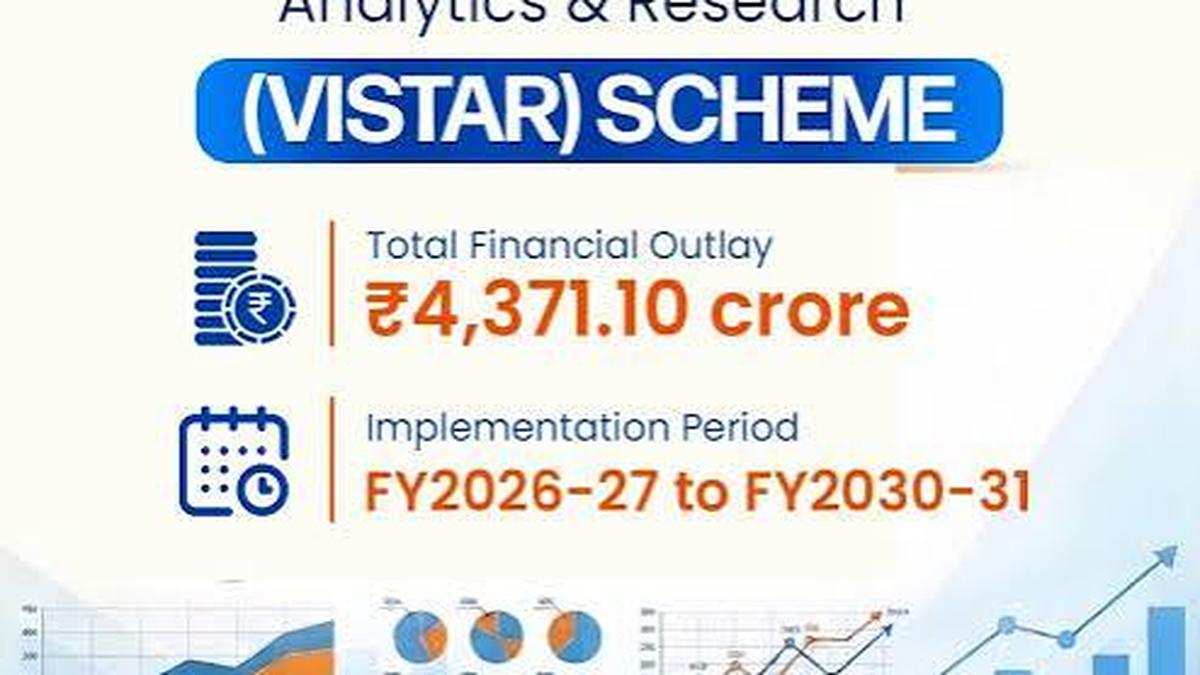
VISTAR aims to modernise India’s statistical system through expanded surveys, digital tools, State-level capacity building and the 8th Economic Census.
Image: The Hindu
Why in news
The Cabinet has approved the Viksit Bharat Initiative for Statistical Transformation, Analytics & Research (VISTAR). Its proposed Economic Census will provide a baseline for a National Statistical Business Register and support better estimation of the unorganised sector’s contribution to GDP.
₹4,371 crore
Approved scheme outlay
2026-27 to 2030-31
Scheme period
59
Proposed surveys
43
Major surveys conducted previously
8th
Proposed Economic Census
Background
GDP measures the value of final goods and services produced within a country’s economic territory during a specified period. Through the production approach, GDP at market prices is obtained by adding product taxes, net of product subsidies, to gross value added. India’s national accounts draw on surveys, administrative records and other statistical inputs. Measuring small, unincorporated enterprises is challenging because many lack regular accounts and have changing locations, activities or employment. MoSPI is the nodal Union ministry for official statistics, while State statistical systems are essential for field operations and subnational estimates.
What VISTAR proposes
VISTAR seeks to strengthen the statistical architecture at both Union and State levels. Its stated objectives include improved timeliness, greater granularity, interoperability and harmonised, AI-ready datasets.
The scheme has three components: comprehensive statistical operations and strengthening of the ecosystem; support for statistical strengthening; and an Economic Census. MoSPI proposes 59 surveys during the 16th Finance Commission cycle, compared with 43 major surveys conducted previously.
- Statistical operations will include end-to-end digitalisation and the use of AI and machine learning for processing, validation and analysis.
- Alternative sources such as mobile phones, scanners and e-commerce data are intended to complement traditional surveys.
- Support for statistical strengthening will provide States with funding through a redesigned, deliverable-linked framework.
- The 8th Economic Census will collect granular information on non-farm establishments and workers hired, down to gram panchayat and ward levels.
Infographic
Coverage
Economic Census and business register strengthen enterprise visibility.
Collection
Expanded surveys and digital workflows improve statistical inputs.
State capacity
Stronger local systems support granular, policy-relevant data.
Responsible AI
Validated automation can accelerate processing without sacrificing oversight.
Credibility
Transparent methods and privacy safeguards underpin public trust.
AI-assisted infographic by Pragnya IAS Academy, based on the cited sources.
How better informal-sector coverage can improve GDP estimates
The central measurement problem is not that the unorganised sector is wholly excluded from GDP, but that its contribution must often be estimated using survey-based benchmarks and indicators. Outdated enterprise lists and weak coverage can make it difficult to capture enterprise births, closures, shifts in activity and changes in productivity.
The Economic Census can provide a more comprehensive establishment baseline for the National Statistical Business Register. A stronger register can improve the sampling frame for enterprise surveys, helping statistical agencies select representative enterprises and measure their output, intermediate consumption and value added.
However, an establishment count is not itself a GDP estimate. Better coverage must be combined with reliable enterprise accounts or survey responses, appropriate price measures and transparent estimation methods. Improved measurement may revise estimates upwards or downwards; it does not guarantee a higher GDP figure.
- Non-farm establishments are the stated scope of the proposed census; it should not be described as a census of the entire economy.
- Unorganised-sector enterprises and informal employment are related but distinct concepts.
- The business register must be updated between census rounds to remain useful for a changing enterprise landscape.
Responsible AI: faster processing without weakening credibility
AI and machine learning can assist with detecting anomalous records, coding economic activities, identifying potential duplicates and prioritising observations for verification. Combined with digital collection, these tools can shorten the interval between fieldwork and statistical release.
Alternative datasets also introduce selection risks: e-commerce records represent platform transactions, not all commerce, while mobile-based data may inadequately represent people with limited digital access. Large datasets cannot automatically compensate for unrepresentative coverage.
The source describes AI integration, but does not specify detailed AI-governance safeguards. Explainable methods, human review, privacy protection and published validation standards should therefore be treated as implementation priorities rather than announced scheme provisions.
- Use representative surveys to assess the coverage and bias of alternative data.
- Retain human oversight for consequential edits, classifications and methodological changes.
- Document automated processing and distinguish observed values from imputed values.
- Protect confidential enterprise and household information through controlled access and secure processing.
Statistical federalism and evidence-based policymaking
VISTAR’s State-support component recognises that national data quality depends on local statistical capacity. Its emphasis on district-level and other disaggregated data, indigenous processing capabilities and local policy use can make statistics more relevant to development planning.
Granular establishment and employment information can help governments assess local economic structures and identify gaps in infrastructure, skills or enterprise support. Harmonised definitions and interoperable systems can improve comparability across States without eliminating the need for locally relevant surveys.
Deliverable-linked funding creates an opportunity for accountability, but implementation should reward accuracy, coverage and actual data use—not merely the volume of records collected or speed of release. Weaker statistical systems may require additional technical support to meet quality standards.
- Build lasting State-level expertise in sampling, survey operations, processing and analysis.
- Publish metadata and revision policies so users can interpret estimates correctly.
- Avoid treating fine geographical detail as automatically reliable; small-area estimates require adequate statistical support.
| Component | Source-backed proposal | Expected contribution |
|---|---|---|
| Comprehensive statistical operations and strengthening of the ecosystem | Expanded surveys, end-to-end digitalisation, AI and machine learning, and alternative data sources | More timely information and improved processing, subject to validation |
| Support for statistical strengthening | Deliverable-linked support for State and Union Territory statistical capabilities | Stronger district-level data and local policymaking capacity |
| Economic Census | 8th Economic Census covering non-farm establishments and providing a baseline for the National Statistical Business Register | Better enterprise sampling frames and support for unorganised-sector GDP estimation |
- 1. Enumerate non-farm establishments through the Economic Census.
- 2. Use the census baseline to develop the National Statistical Business Register.
- 3. Draw better-targeted and more representative enterprise survey samples.
- 4. Collect and validate information needed to estimate enterprise value added.
- 5. Integrate improved estimates into national accounts and local policy analysis.
Significance, challenges & way forward
Significance
- Better enterprise coverage can reduce gaps in measuring the unorganised sector’s economic contribution.
- Digital workflows and validated automation can improve the timeliness of official statistics.
- District-level data can support more context-specific development interventions.
- A harmonised business register can strengthen survey design and potentially reduce repeated respondent effort.
- Transparent methods and accessible statistics can improve public scrutiny of economic policy.
Challenges
- Mobile, seasonal and home-based enterprises can remain difficult to enumerate and track.
- Digital-source bias may systematically under-represent enterprises with limited platform participation.
- Uneven State-level staffing, infrastructure and analytical capacity can affect national comparability.
- AI-assisted processing can introduce opaque errors unless models and outputs are independently validated.
- Combining datasets creates confidentiality, access-control and re-identification risks.
- Faster publication and finer geographical detail can compromise reliability if survey design and quality checks are inadequate.
Way forward
- Treat the Economic Census as a baseline and establish a regular mechanism to update the business register.
- Maintain representative surveys as the statistical anchor for integrating alternative datasets.
- Publish classifications, metadata, coverage limitations and revision policies alongside statistical releases.
- Link State support to verified improvements in coverage, quality, timeliness and policy use, with capacity-building assistance.
- Introduce human oversight, documented validation and audit trails for AI-assisted statistical workflows.
- Apply privacy-by-design safeguards and provide research access through appropriately protected datasets.
Key terms
- Gross Domestic Product
- The value of final goods and services produced within a country’s economic territory during a specified period.
- Gross Value Added
- The value of output minus intermediate consumption, measuring a producer’s contribution to production.
- Economic Census
- An enumeration of establishments; under VISTAR, the proposed exercise covers non-farm establishments.
- Statistical Business Register
- A structured database of businesses used to support statistical operations, including enterprise survey sampling.
- Sampling frame
- The list or operational representation of units from which a survey sample is selected.
- Interoperability
- The ability of data systems to exchange and meaningfully use information through compatible standards.
- Informal employment
- Employment lacking relevant formal protections or arrangements, which can occur in both formal and informal enterprises.
- Imputation
- The use of statistical methods to assign values where observations are missing or unusable.
Link with static syllabus
Prelims practice MCQs
Q1. With reference to VISTAR, consider the following statements: 1. It includes support for strengthening State statistical capabilities. 2. The proposed Economic Census will provide a baseline for the National Statistical Business Register. 3. Alternative data sources are intended to replace traditional surveys entirely. Which of the statements given above are correct?
Q2. With reference to national income accounting, consider the following statements: 1. Gross value added is calculated by subtracting intermediate consumption from output. 2. GDP at market prices equals aggregate GVA plus product taxes minus product subsidies. 3. An increase in the number of enumerated establishments necessarily establishes an increase in real GDP. Which of the statements given above are correct?
Q3. Consider the following pairs: 1. Sampling frame — Operational list of units from which a sample is drawn 2. Interoperability — Ability of systems to exchange and meaningfully use data 3. Imputation — Physical enumeration of every establishment Which of the pairs given above are correctly matched?
Q4. Which of the following best explains why e-commerce data cannot, by themselves, provide a representative measure of all enterprise activity?
Mains practice questions
GS 3 · 15 marks · 250 words
VISTAR offers an opportunity to improve economic measurement, but digitalisation alone cannot ensure statistical credibility. Discuss with reference to informal-sector coverage, State capacity and responsible use of AI.
Frequently asked questions
What is VISTAR?
VISTAR stands for Viksit Bharat Initiative for Statistical Transformation, Analytics & Research. It is a Cabinet-approved scheme to strengthen India’s official statistical system through surveys, technology, State capacity building and an Economic Census.
Will VISTAR automatically raise India’s GDP?
No. Better coverage and methods can improve accuracy, but revisions may move estimates upwards or downwards; a higher establishment count is not itself evidence of higher real GDP.
How does the Economic Census support GDP estimation?
It can improve the establishment baseline used to build the Statistical Business Register and design enterprise surveys. Those surveys can provide information needed to estimate the unorganised sector’s value added.
Will AI replace traditional surveys under VISTAR?
The source describes AI mainly as a tool for processing, validation and analysis, and alternative datasets as complements to surveys. Representative field surveys remain important for coverage and validation.
Sources
Analysis prepared by the Pragnya IAS Academy current-affairs desk with AI assistance from the cited reports. Verify figures with the original sources.
Turn current affairs into marks
Join Pragnya IAS Academy's mentorship for daily answer-writing evaluation on stories like this — classroom programmes from a trusted name in IAS coaching in Hyderabad.