
World Bank’s FY27 India Growth Upgrade: Export Upside, Assumptions and Risks
Revise the static topic: UPSC Economy notes · UPSC International Relations notes
In short: The World Bank has raised India’s FY27 GDP growth forecast to 7.1% from 6.6%, following stronger-than-expected first-quarter growth and export performance. Exports provide the main upside relative to the April forecast, but private consumption remains the principal expected growth driver; the revised figure is a projection, not a realised full-year outcome.
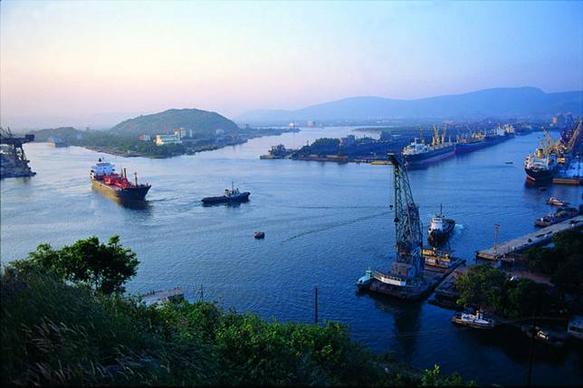
Reference view of Visakhapatnam port, illustrating infrastructure supporting India’s overseas trade. Stronger export performance contributed to the World Bank’s FY27 growth forecast upgrade to 7.1%, while private consumption remains the principal expected growth driver.
Image: vasu at en.wikipedia 59.162.175.35 08:37, 13 April 2012 (UTC)vasudevarao.k · CC BY-SA 3.0
Why in news
On October 6, 2026, the World Bank’s India Development Update upgraded India’s FY27 growth forecast by 0.5 percentage points. The revision highlights economic resilience despite trade and geopolitical uncertainty, alongside weaker agricultural prospects.
7.1%
Revised FY27 growth forecast
6.6%
April FY27 growth forecast
0.5 percentage points
Forecast upgrade
7.8%
Reported Q1 FY27 GDP growth
7.8%
Reported FY26 GDP growth
9.3%
Q1 electricity-sector expansion
Background
India’s financial year runs from April to March; FY27 refers to the financial year ending in March 2027. GDP measures the value of final goods and services produced within an economy. On the expenditure side, it comprises private consumption, government consumption, investment and net exports. On the production side, growth can be examined through agriculture, industry and services. The World Bank’s India Development Update assesses economic developments and prospects, but its forecasts are distinct from official national accounts estimates compiled by India’s National Statistical Office under the Ministry of Statistics and Programme Implementation.
What has changed in the growth outlook?
The World Bank raised its FY27 growth projection to 7.1% from the 6.6% forecast made in April. The immediate trigger was stronger-than-expected first-quarter performance: GDP grew by 7.8% in Q1 FY27, according to the supplied report.
The report places this resilience against a strong domestic-demand backdrop. Growth had accelerated to 7.8% in FY26 from 7.2% in FY25, supported by investment and private consumption. The revised FY27 outlook nevertheless envisages moderation after the strong opening quarter, rather than assuming that its pace will persist throughout the year.
- The upgrade is 0.5 percentage points, not a 0.5% increase in the growth rate.
- Q1 growth is a reported quarterly outcome; 7.1% is the projected full-year growth rate.
- An upward forecast revision can coexist with expected moderation from the previous year’s growth.
Infographic
Forecast
7.1%, revised from 6.6%; not a realised annual outcome.
Positive surprise
Exports outperform expectations and support the upgrade.
Core demand
Private consumption remains the main expected growth driver.
Supply balance
Stronger industry offsets weaker agricultural prospects.
Risk test
Trade uncertainty, rainfall weakness and fading frontloading.
Policy priority
Build durable exports, productive investment and rural resilience.
AI-assisted infographic by Pragnya IAS Academy, based on the cited sources.
Export upside does not mean exports are the main growth engine
The World Bank identifies better-than-expected exports as the main upside to the FY27 outlook relative to its April forecast. This describes the source of positive surprise against an earlier assessment, not necessarily the largest contribution to total growth. Private consumption is still expected to remain the main growth driver.
Stronger exports can support production, incomes and capacity utilisation. However, GDP accounting includes net exports, meaning exports minus imports. Without import data and expenditure-component contributions, the supplied material does not establish the size or direction of the net-export contribution to GDP growth.
- Distinguish the driver of a forecast revision from the driver of aggregate growth.
- Do not infer an improved trade balance merely from stronger exports.
- The source does not provide a goods-versus-services export breakdown or destination-wise performance.
- It does not quantify how much of the forecast upgrade is attributable to exports.
Domestic assumptions: consumption resilience and investment support
The outlook rests on private consumption remaining resilient. The report attributes earlier rural strength to agricultural performance, income support, food subsidies and low inflation, while urban demand strengthened later following income-tax relief and GST cuts. For FY27, the rainfall deficit through August is expected to weigh modestly on rural demand, while government consumption is expected to remain subdued.
The investment outlook is broadly unchanged. Heightened global uncertainty and the fading of frontloaded activity weigh on private investment, while supportive financial and policy conditions, including stronger public investment, provide an offset. Public investment and government consumption are different expenditure categories: stronger infrastructure spending can coexist with muted government consumption.
- The forecast assumes that rural-demand weakness remains limited rather than becoming a broad consumption shock.
- Supportive credit and policy conditions need to translate into actual expenditure and productive investment.
- The fading of frontloading makes the durability of later-quarter demand important.
Supply-side outlook: industry offsets agricultural weakness
Industry is now expected to perform better than previously anticipated and offset a weaker agricultural outlook. Infrastructure and construction goods growth accelerated to 7.2% in Q1 from 6.1% a year earlier. Higher summer utility demand also supported electricity-sector expansion of 9.3%, against a contraction of 1.5% a year earlier.
The report says above-average rainfall since July narrowed the monsoon deficit, but the overall southwest monsoon shortfall weakened agricultural prospects. Services growth remained elevated despite slowing from the high FY26 base. Strong industrial readings should therefore be interpreted alongside weather effects, base effects and the temporary influence of frontloading.
- Aggregate resilience can conceal uneven performance across sectors and regions.
- An electricity rebound partly linked to summer demand does not by itself establish a permanent improvement in productive capacity.
- Agricultural weakness can affect both farm output and rural purchasing power.
External risks and the limits of a forecast
The report explicitly flags trade and geopolitical uncertainty. Potential transmission channels include weaker overseas demand, trade restrictions, supply-chain disruption and higher imported input costs. These are analytical risk channels, not developments confirmed by the supplied extract.
A forecast is conditional on assumptions about demand, policy, financial conditions and sectoral performance. Strong initial data can justify an upgrade, but subsequent shocks or weaker activity can change the full-year outcome. The appropriate response is to monitor incoming evidence rather than treat 7.1% as assured growth.
- Export momentum may weaken if international demand or market access deteriorates.
- Prolonged uncertainty can delay private investment even when domestic financing conditions are supportive.
- Temporary frontloading can bring activity forward without producing an equivalent lasting increase in demand.
- The supplied extract does not disclose a detailed forecast model or quantified alternative scenarios.
| Concept | What the source indicates | Correct interpretation |
|---|---|---|
| Full-year forecast | FY27 growth projected at 7.1% | A conditional expectation, not a completed annual outcome |
| Quarterly outcome | Q1 FY27 GDP growth reported at 7.8% | Evidence supporting the upgrade, not proof of the full-year result |
| Main forecast upside | Exports performed better than expected | A positive surprise relative to April, not necessarily the largest growth contribution |
| Main growth driver | Private consumption expected to remain dominant | Domestic household demand remains central to the outlook |
| Public expenditure | Stronger public investment alongside muted government consumption | Capital formation and government consumption must be analysed separately |
| External-sector contribution | Export strength highlighted; import contribution not supplied | A net-export contribution cannot be inferred from exports alone |
- 1. Overseas demand generates export orders.
- 2. Domestic firms expand production or use existing capacity more intensively.
- 3. Domestic value addition supports incomes and employment.
- 4. Stronger incomes can reinforce consumption, while sustained orders can encourage investment.
- 5. The overall GDP effect depends on import requirements, domestic linkages and the persistence of demand.
April 2026
The World Bank projected FY27 GDP growth at 6.6%.
Q1 FY27
GDP growth was reported at 7.8%, exceeding expectations and strengthening the basis for a forecast upgrade.
October 6, 2026
The India Development Update raised the FY27 growth forecast to 7.1%, highlighting export resilience and stronger-than-expected activity.
Significance, challenges & way forward
Significance
- The upgrade indicates greater-than-anticipated economic resilience despite an uncertain international environment.
- Export strength offers an additional source of support alongside domestic consumption and investment.
- Improved industrial prospects provide a potential buffer against weaker agricultural performance.
- The assessment highlights the need to examine growth composition rather than rely only on the headline rate.
- The distinction between projected and realised growth is essential for evidence-based policy and accurate examination answers.
Challenges
- Trade and geopolitical uncertainty could undermine export orders, raise costs or delay investment.
- A weaker agricultural outlook could constrain rural incomes and consumption.
- The fading of frontloaded activity may expose weaker underlying demand in subsequent quarters.
- Muted government consumption limits one source of demand support even as public investment strengthens.
- The supplied material does not establish whether export gains are broad-based, employment-intensive or associated with higher domestic value addition.
Way forward
- Diversify export products and markets while improving logistics, standards compliance and trade facilitation.
- Strengthen domestic supplier networks so that export expansion generates greater local value addition and employment.
- Sustain productive public investment and improve project execution while maintaining fiscal prudence.
- Reduce policy uncertainty and financing frictions that discourage viable private investment.
- Protect rural resilience through better water management, irrigation efficiency and effective agricultural risk management.
- Track quarterly GDP components, imports, export orders, rural demand and investment execution before judging whether the forecast is being realised.
Key terms
- GDP growth forecast
- An estimate of future economic growth based on available evidence and assumptions that may subsequently change.
- Percentage point
- The arithmetic difference between two percentages, used to describe changes in rates.
- Net exports
- Exports minus imports, forming the external-demand component of expenditure-based GDP.
- Private consumption
- Final consumption expenditure by households and non-profit institutions serving households.
- Frontloading
- Bringing planned production, purchases or investment forward, potentially leaving weaker activity later.
- Base effect
- The influence of the comparison period’s level on a measured growth rate.
- Public investment
- Capital expenditure by public authorities or public enterprises that creates or improves productive assets.
- Domestic value addition
- The value generated within the domestic economy after accounting for intermediate inputs.
Link with static syllabus
Prelims practice MCQs
Q1. With reference to the World Bank’s revised FY27 outlook for India, consider the following statements: 1. The revised growth forecast is 7.1%. 2. Private consumption is expected to remain the main growth driver. 3. The forecast upgrade establishes that full-year FY27 growth has already been realised. Which of the statements given above are correct?
Q2. Consider the following statements about exports and GDP: 1. Expenditure-based GDP includes exports minus imports. 2. Faster export growth necessarily establishes that the trade deficit has narrowed. 3. Exports can provide the main upside to a forecast revision even when private consumption remains the main growth driver. Which of the statements given above are correct?
Q3. The World Bank revised India’s FY27 growth forecast from 6.6% to 7.1%. Which of the following correctly describes this change?
Q4. Consider the following statements: 1. Government consumption and public investment are identical expenditure categories. 2. Frontloading can strengthen current activity while contributing to moderation later. 3. A high comparison-period base can reduce a measured growth rate without implying a fall in the absolute level of output. Which of the statements given above are correct?
Mains practice questions
GS 3 · 15 marks · 250 words
The main source of an upward growth forecast revision need not be the principal driver of economic growth. Examine this statement in the context of the World Bank’s revised FY27 outlook for India, highlighting assumptions and external risks.
Frequently asked questions
Why did the World Bank raise India’s FY27 growth forecast?
Stronger-than-expected first-quarter growth and resilient activity supported the revision to 7.1%. Better-than-expected exports provide the main upside relative to the April outlook.
Does the upgrade mean India has already achieved 7.1% growth in FY27?
No. It is a full-year forecast; the supplied report separately records Q1 FY27 growth at 7.8%.
Has India’s growth become primarily export-led?
The supplied source does not support that conclusion. It identifies exports as the main upside to the earlier forecast, while private consumption remains the main expected growth driver.
What could prevent the forecast from being realised?
Key risks include trade and geopolitical uncertainty, weaker agricultural prospects and the fading of frontloaded activity. Their effects on exports, rural consumption and private investment could alter the outcome.
Sources
Analysis prepared by the Pragnya IAS Academy current-affairs desk with AI assistance from the cited reports. Verify figures with the original sources.
Turn current affairs into marks
Join Pragnya IAS Academy's mentorship for daily answer-writing evaluation on stories like this — classroom programmes from a trusted name in IAS coaching in Hyderabad.