
InfoGraphix by Pragnya · Indian Polity · Chapter 11
Local Government
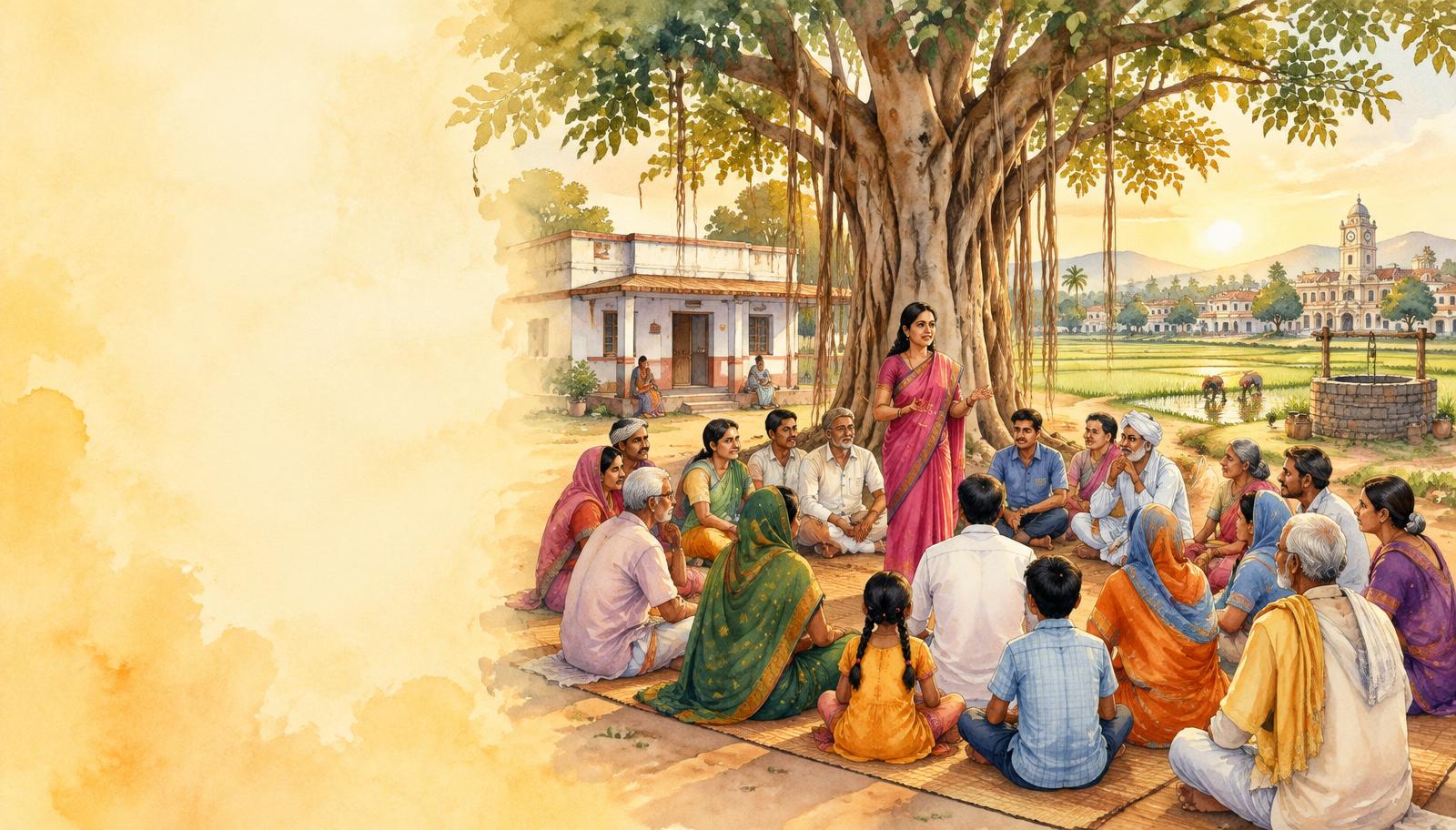
Grassroots democracy as visual maps — the evolution of Panchayati Raj, the 73rd Amendment's compulsory and voluntary provisions, the Gram Sabha, three tiers, reservation, powers and the Eleventh Schedule, panchayat finances, State Election Commissions and PESA; then the 74th Amendment, types of urban bodies, the Twelfth Schedule, planning committees, urban finance and governance challenges.
- 18 visual topics
- 54 practice MCQs
- 54 flip cards
Three pillars of the chapter
Part IX, Arts 243–243O
Panchayati Raj
Evolution, Gram Sabha, three tiers, reservation, powers, the Eleventh Schedule and PESA.
Part IXA, Arts 243P–243ZG
Municipalities
Types of urban bodies, ward committees, the Twelfth Schedule and planning committees.
SEC and SFC
Elections & money
State Election and Finance Commissions, local finances and governance challenges.
Chapter mind-map: 1688 → 2021
Scroll the ribbon and tap any milestone to open its infographic.
1688
Madras Corporation
India's oldest municipal body.
Open topic →1882
Ripon's resolution
'Magna Carta' of local self-government.
Open topic →1957
Balwant Rai Mehta
Democratic decentralisation.
Open topic →1959
Nagaur
First Panchayati Raj, 2 October.
Open topic →1978
Ashok Mehta
Two-tier model.
Open topic →1992
73rd & 74th Amendments
Constitutional status for local bodies.
Open topic →1993
In force
24 April (Panchayats) and 1 June (Municipalities).
Open topic →1996
PESA
Panchayats in Fifth Schedule areas.
Open topic →2006
Kishan Singh Tomar
Timely local elections.
Open topic →2010
K. Krishna Murthy
OBC local quotas need data.
Open topic →2021
Triple test
Vikas Kishanrao Gawali.
Open topic →
Topic index
Follow the numbers in order, or jump to what you need.
0 of 18 revised on this device
- 1Parts IX, IXA
Local Government at a Glance
Parts IX and IXA, two schedules, common pillars
Government closest to the people — Panchayats under Part IX (73rd Amendment) and Municipalities under Part IXA (74th Amendment), the Eleventh and Twelfth Schedules, and the State Election and Finance Commissions that sustain them.
Open infographic - 21957–1992
Evolution of Panchayati Raj
Mehta, Ashok Mehta, Rao and Singhvi committees
How Panchayati Raj grew from Article 40 to constitutional status — the Balwant Rai Mehta, Ashok Mehta, G.V.K. Rao and L.M. Singhvi committees, the first panchayat at Nagaur, the failed 64th Amendment Bill and the 73rd Amendment.
Open infographic - 3Arts 243–243O
73rd Amendment: Compulsory vs Voluntary
What every State must adopt and what it may choose
What the 73rd Amendment requires and what it leaves to States — the compulsory provisions every State must adopt and the voluntary ones that depend on State choice, a favourite Prelims distinction.
Open infographic - 4Art 243A
Gram Sabha
Direct democracy, social audit and PESA powers
The Gram Sabha — every registered voter of the village, the only body of direct democracy in the Constitution, its role in planning, social audit and beneficiary selection, and its stronger powers in Scheduled Areas.
Open infographic - 5Arts 243B–243C
Three-Tier Panchayat Structure
Tiers, composition and the 20-lakh rule
The three tiers of Panchayati Raj — village, intermediate and district — under Article 243B, how members and chairpersons are elected under Article 243C, and the 20-lakh exemption for small States.
Open infographic - 6Art 243D
Reservation in Panchayats
SC/ST, women, chairpersons and the OBC triple test
Who gets reserved seats in panchayats — SCs and STs in proportion to population, one-third for women (raised to half in many States), rotation of seats and chairpersons' posts, and the triple test for backward-class reservation.
Open infographic - 7Arts 243E–243G
Duration, Disqualification & Powers
Five-year term, age 21, Art 243G and the 3Fs
How long panchayats last and what they may do — the five-year term and six-month election rule (Art 243E), disqualifications (Art 243F), powers under Article 243G, and the gap between law and real devolution.
Open infographic - 8Eleventh Schedule
Eleventh Schedule: 29 Subjects
Rural subjects in four families
The 29 subjects of the Eleventh Schedule that States may devolve to panchayats, grouped into agriculture and resources, infrastructure, social sector and welfare, with tips to tell them apart from the Twelfth Schedule.
Open infographic - 9Arts 243H–243J
Panchayat Finances & State Finance Commission
Arts 243H–243J and Finance Commission grants
Where panchayat money comes from — State-authorised taxes and fees (Art 243H), the State Finance Commission (Art 243I), audit (Art 243J), Union Finance Commission grants under Article 280(3)(bb), and the weak own-revenue base.
Open infographic - 10Art 243K
State Election Commission
Arts 243K and 243ZA, removal, key rulings
The State Election Commission — superintendence of local body elections under Articles 243K and 243ZA, the State Election Commissioner's High Court-judge level protection, the bar on courts, and key rulings on its independence.
Open infographic - 11Art 243M
PESA & Exempted Areas
Art 243M and the PESA Act, 1996
Where Part IX does not automatically apply — Article 243M exemptions for Nagaland, Meghalaya, Mizoram and Scheduled and Tribal Areas, and the PESA Act, 1996, which extends panchayats to Fifth Schedule areas with strong Gram Sabha powers.
Open infographic - 12Arts 243P–243ZG
74th Amendment: Municipalities
Three types, ward committees, powers
Urban self-government under Part IXA — three types of municipalities (Art 243Q), composition and ward committees, reservation, term, powers under Article 243W, and exempted areas.
Open infographic - 13Urban bodies
Types of Urban Local Bodies
Corporations to cantonment boards; mayor vs commissioner
The full family of urban bodies — the three constitutional municipalities plus statutory bodies such as cantonment boards, notified area and town area committees, townships, port trusts and special purpose agencies — and the role of the mayor and commissioner.
Open infographic - 14Twelfth Schedule
Twelfth Schedule: 18 Subjects
Urban subjects and the schedule-matching grid
The 18 Twelfth Schedule subjects for municipalities — from urban planning and water supply to fire services, slum improvement and burial grounds — and how to separate them from the Eleventh Schedule.
Open infographic - 15Arts 243ZD–243ZE
District & Metropolitan Planning Committees
Arts 243ZD and 243ZE
Bottom-up planning bodies — the District Planning Committee (Art 243ZD) that consolidates rural and urban plans, and the Metropolitan Planning Committee (Art 243ZE) for areas of ten lakh or more.
Open infographic - 16Arts 243X–243Y
Urban Finance & Governance Challenges
Property tax, bonds, 3Fs and reform ideas
Money and capacity in local bodies — municipal taxes (Art 243X), State Finance Commission duties (Art 243Y), property tax and municipal bonds, and the recurring challenges of the 3Fs, parastatals, delayed elections and proxy leadership.
Open infographic - 17Comparison
Panchayats vs Municipalities
Side-by-side grid and landmark cases
Part IX and Part IXA side by side — structure, reservation, planning bodies and subjects — plus the landmark cases that shaped local democracy.
Open infographic - 18Revision
Chapter Quick Revision
Article map, thresholds and traps on one sheet
Local government on one sheet — Article map, numbers, committees, compulsory provisions, schedules and the traps that recur in Prelims.
Open infographic
Full reading notes in the Study Library
- Panchayati Raj →
- Municipalities →
- 73rd Amendment →
- Gram Sabha →
- Devolution of functions →
- State Finance Commission →
- Devolution of funds →
- State Election Commission →
- 74th Amendment →
- Mayor →
- Devolution of functionaries →
Previous year questions