

A closeup of Pearl Millet (Cumbu)
Credit: Thamizhpparithi Maari · CC BY-SA 3.0 · source
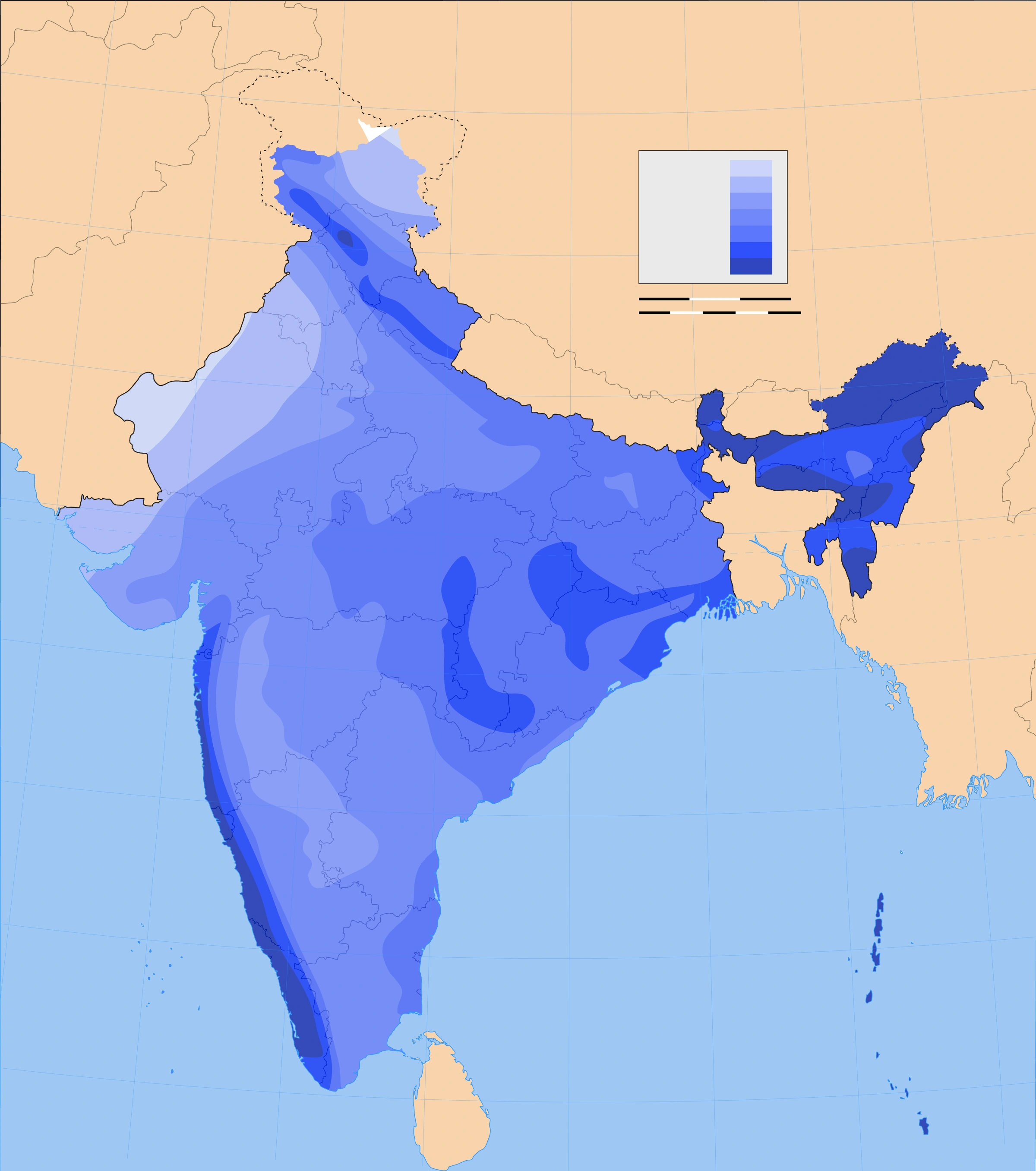
Map study
Annual rainfall distribution: compare the western coast and northeast with the dry northwest and rain-shadow interior. Historical climatological reference, not a current-year forecast.
- Read the source legend, scale and reference period before comparing regions.
- Connect spatial patterns to the processes discussed in this topic; this map is a study reference, not live operational data.
Credit: Planemad · CC BY-SA 3.0 · sourceConverted to WebP on an opaque white background; proportionally resized without cropping. Original cartography and legend retained.
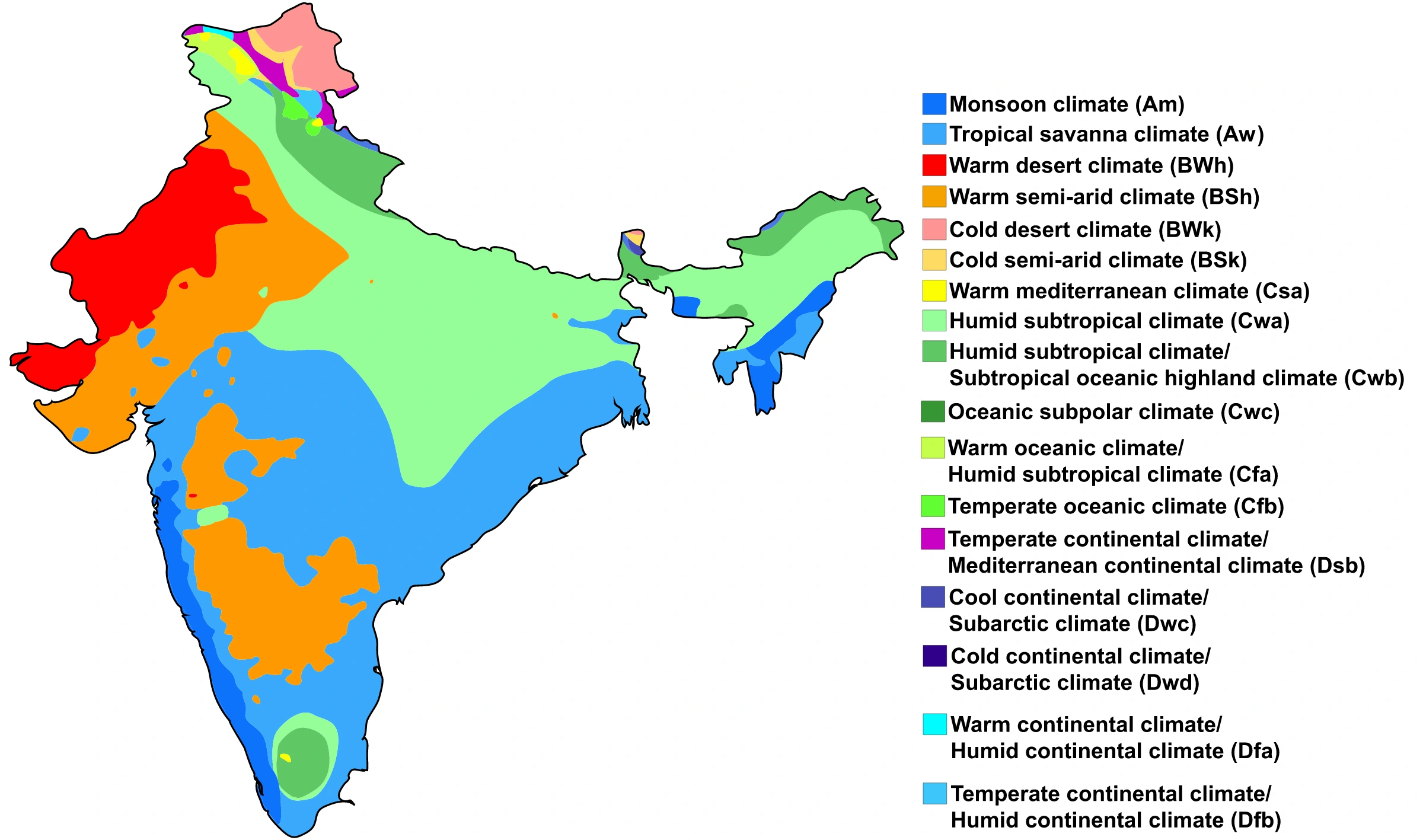
Map study
Köppen climate zones of India: compare arid, tropical and mountain classes. Long-term climate classes are not daily weather.
- Read the source legend, scale and reference period before comparing regions.
- Connect spatial patterns to the processes discussed in this topic; this map is a study reference, not live operational data.
Credit: Ali Zifan · CC BY-SA 4.0 · sourceConverted to WebP on an opaque white background; proportionally resized without cropping. Original cartography and legend retained.
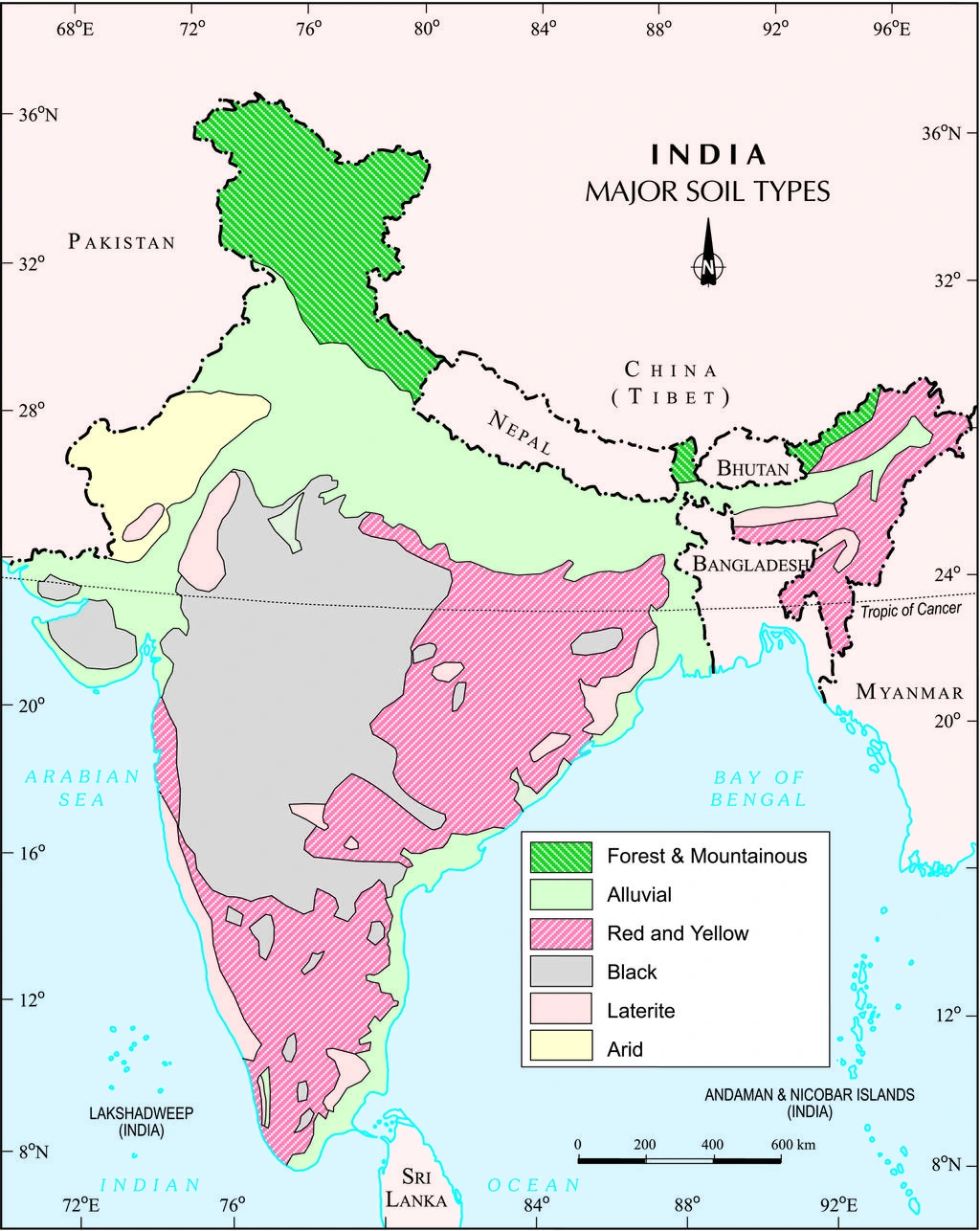
Map study
Major soil groups of India: NCERT reference map via NROER. Compare alluvial, black, red, lateritic and desert soils through the legend; local variation is finer than this national map.
- Read the legend and reference date before interpreting regional patterns.
- Relate the map to the article’s topic; verify current administrative boundaries or data separately.
Credit: NCERT via NROER · CC BY-SA 3.0 · sourceConverted to WebP on an opaque white background; proportionally resized without cropping. Original cartography and legend retained.
1. Meaning, significance and climate risks
Climate-resilient agriculture is the capacity of agricultural systems and dependent communities to maintain essential functions under climate variability and long-term climate change. It combines short-term risk management with longer-term adaptation. Resilience is broader than restoring yields after a drought: it includes stable incomes, food and nutritional security, viable natural resources and the ability to change production systems when existing practices become unsuitable.
Indian agriculture faces rising temperatures, erratic monsoon rainfall, prolonged dry spells, intense precipitation, floods, cyclones and coastal salinity. Heat during sensitive growth stages can impair flowering, pollination and grain filling. Terminal heat is particularly important for wheat, while water stress around flowering can sharply reduce yields in several crops. Warmer conditions can also alter pest distributions, increase livestock heat stress and affect fisheries through changes in water temperature and dissolved oxygen.
Exposure differs across regions. Rainfed Deccan farming is vulnerable to moisture stress, Himalayan agriculture to changing snowfall and extreme rainfall, and coastal farming to storm surges and saline intrusion. Vulnerability also depends on irrigation, savings, credit, land tenure and access to information. Since small and marginal farmers dominate operational holdings, resilience must be assessed at household and landscape levels rather than through average crop yields alone.
- Adaptation reduces vulnerability to actual or expected climate impacts; mitigation reduces greenhouse-gas emissions or enhances carbon sinks.
- A resilient farm may accept a slightly lower maximum yield in exchange for lower crop-failure risk and more stable income.
2. Resilient crops, soils and water management
Crop-based adaptation begins with matching varieties and sowing windows to local risks. Drought-tolerant, heat-tolerant, submergence-tolerant and salt-tolerant varieties address different stresses and are not interchangeable. Short-duration cultivars can escape terminal drought, while timely sowing can reduce exposure to late-season heat. Community seed banks, decentralised seed production and access to alternative seeds after failed sowing improve the practical value of breeding advances.
Soil and water management provide a second line of defence. Mulching, suitable cover crops, residue retention, balanced fertilisation and organic amendments can improve infiltration, soil structure and moisture retention. Contour bunds, farm ponds, check dams and vegetative barriers help retain runoff where hydrology and land conditions permit. In waterlogged areas, drainage and raised-bed planting may be more appropriate than additional water harvesting. Micro-irrigation improves water application efficiency, especially when combined with irrigation scheduling.
Diversification spreads risk across crops, seasons and income sources. Millets, pulses and locally adapted crops can be valuable in suitable dryland environments, but market access and household preferences determine adoption. Intercropping, agroforestry and integrated crop–livestock systems reduce dependence on a single harvest. Their design must account for fodder supply, labour, tree–crop competition and local water availability rather than assuming that diversification automatically creates resilience.
- Conservation agriculture combines minimum soil disturbance, permanent soil cover and crop diversification; adopting only one component may not deliver the full benefits.
- Water-use efficiency is not identical to basin-level water saving: farmers may use efficiency gains to expand irrigated area or grow thirstier crops.
Planning climate resilience at village level
- 1. Assess climate hazards, resource conditions and vulnerable households
- 2. Identify locally suitable technologies and institutional measures
- 3. Test options through participatory trials and economic assessment
- 4. Converge finance, extension, seed supply and collective institutions
- 5. Implement advisories, contingency plans and risk-transfer arrangements
- 6. Monitor outcomes and revise plans as risks change
3. Climate services, livestock and institutional protection
Climate information becomes useful when translated into timely farm decisions. Seasonal outlooks can support crop planning, while short- and medium-range forecasts inform sowing, irrigation, spraying and harvesting. IMD’s Gramin Krishi Mausam Sewa links weather forecasts with agrometeorological advisories. ICAR institutes, agricultural universities and Krishi Vigyan Kendras help connect scientific information with local farming conditions. Advisories should communicate forecast uncertainty and reach farmers through local languages and accessible channels.
District agricultural contingency plans identify responses to delayed monsoons, failed sowing, drought, floods and other weather abnormalities. Their effectiveness depends on advance arrangements for seed, fodder, machinery and extension personnel. Livestock adaptation includes shade, ventilation, adequate drinking water, suitable breeds, fodder reserves, preventive vaccination and disease surveillance. Fisheries require attention to pond water quality, flood escape risks, suitable stocking and early warning for hazardous weather.
Financial and collective institutions help households absorb losses without distress sales or unsustainable borrowing. Crop insurance, including the Pradhan Mantri Fasal Bima Yojana, can transfer part of production risk but cannot replace adaptation. Its contribution depends on credible loss assessment, timely settlement and farmer awareness. Farmer Producer Organisations, self-help groups and custom-hiring centres can reduce the cost of machinery, storage and market access. Tenants, women farmers and landless livestock keepers need explicit inclusion because land-linked benefits may exclude them.
- Weather-index insurance can settle claims using observed weather triggers, but basis risk arises when payouts do not match an individual farmer’s actual loss.
- Early warnings require actionable instructions, trusted communication and resources for response, not merely forecast dissemination.
| Climate risk | Possible response | Important limitation |
|---|---|---|
| Terminal heat | Timely sowing and suitable heat-tolerant cultivars | Sowing may depend on the harvest of the preceding crop |
| Intermittent drought | Mulching, intercropping and supplemental irrigation | Irrigation must remain within sustainable water availability |
| Short-duration submergence | Submergence-tolerant rice and improved drainage | Tolerance does not imply survival under prolonged deepwater flooding |
| Coastal salinity | Salt-tolerant varieties and suitable water and drainage management | Performance depends on salinity intensity and freshwater access |
| Livestock heat stress | Shade, ventilation, drinking water and adjusted feeding | Infrastructure and recurring costs can constrain smallholders |
4. Indian programmes and farm-sector reform priorities
ICAR’s National Innovations in Climate Resilient Agriculture combines research, technology demonstration and capacity building. It addresses natural-resource management, crop production, livestock and fisheries, and institutional interventions. The National Mission for Sustainable Agriculture, linked to the National Action Plan on Climate Change, promotes sustainable agriculture through interventions including rainfed-area development and soil and water conservation.
Complementary instruments include watershed development under the Pradhan Mantri Krishi Sinchayee Yojana, micro-irrigation support, Soil Health Cards and agricultural research and extension. MGNREGS can support eligible water-conservation and land-development works, creating productive rural assets. These programmes become more effective when village plans connect infrastructure with catchment hydrology, crop choices and maintenance responsibilities. Individual assets without coordinated management may fail to reduce landscape-level vulnerability.
Farm-sector reform must align incentives with resource sustainability. Cheap or unmetered electricity, assured procurement concentrated on a few crops and weak groundwater regulation can encourage water-intensive production in stressed regions. Reform should therefore combine gradual incentive changes with remunerative alternatives, processing, procurement diversification and transition assistance. Digital tools and precision farming can help, but affordability, connectivity, data quality and independent advice matter. Public investment in research, rural infrastructure and last-mile extension remains essential; private technology cannot substitute for these public goods.
- Convergence should be organised around an agroecological risk plan rather than separate scheme targets.
- Local institutions must coordinate groundwater use because individual pumping decisions affect a shared resource.
5. Trade-offs, implementation gaps and evaluation
Resilience interventions can create trade-offs. Solar irrigation reduces dependence on diesel but may accelerate groundwater depletion unless abstraction is managed. Residue retention can compete with livestock fodder requirements. Agroforestry may diversify income and store carbon, yet delayed returns and uncertain markets discourage smallholders. Alternate wetting and drying in rice can reduce irrigation demand and methane emissions under suitable conditions, but requires water-level control and careful management to avoid yield loss.
Maladaptation occurs when an intervention increases future vulnerability or shifts risk to others. Expanding irrigation around an unreliable aquifer, promoting one supposedly climate-proof crop everywhere, or constructing poorly located water-harvesting structures can produce such outcomes. Adaptation must also remain dynamic: incremental adjustments may suffice initially, but severe water stress can require changes in cropping patterns, livelihood diversification or broader regional economic transitions.
Monitoring should go beyond hectares covered and equipment distributed. Useful indicators include yield and income variability, recovery time after shocks, groundwater trends, soil condition, irrigation-water productivity, insurance settlement time and inclusion of vulnerable households. Participatory trials and independent evaluation can identify which practices work under particular conditions. The policy objective is not merely to preserve current production patterns, but to sustain equitable food production and rural livelihoods within ecological limits.
- Prioritise low-regret measures such as improved forecasts, seed diversity, soil conservation and stronger extension.
- Assess adaptation benefits separately from mitigation benefits; an intervention may deliver one without necessarily delivering the other.
Real-world case studies
Swarna-Sub1 rice in flood-prone eastern India
Swarna-Sub1 incorporates the SUB1 submergence-tolerance trait into the widely cultivated Swarna rice background. It can survive approximately two weeks of complete submergence under suitable conditions, helping farmers facing transient flooding in eastern India. It is not a solution for prolonged deepwater conditions or every type of flood damage. The example shows how targeted breeding, seed availability and accurate identification of local hazards must work together.
Community-managed adaptation in Hiware Bazar, Maharashtra
Hiware Bazar in drought-prone Ahmednagar district, now officially named Ahilyanagar, is widely documented for watershed restoration, water budgeting and collective resource management. Its experience illustrates that structures alone are insufficient: community rules and cropping decisions must reflect available water. Replication requires attention to local hydrology, equitable participation and institutions capable of sustaining cooperation.
Previous year questions
No source-linked PYQ is available here yet. Use the practice questions below.
Practice questions
Practice MCQ 1
With reference to climate-resilient agriculture, consider the following statements: 1. It necessarily requires maximising crop yield in every season. 2. Crop diversification can reduce dependence on a single climate-sensitive source of income. 3. Climate adaptation and greenhouse-gas mitigation are identical objectives. Which of the statements given above is/are correct?
- A. 1 and 2 only
- B. 2 only
- C. 2 and 3 only
- D. 1, 2 and 3
Practice MCQ 2
A water-stressed district subsidises solar pumps without regulating groundwater extraction. Which outcome best illustrates maladaptation?
- A. Reduced expenditure on diesel
- B. Improved access to daytime electricity
- C. Increased pumping and expansion of water-intensive cropping
- D. Lower direct emissions from pump operation
Practice MCQ 3
Consider the following pairs: 1. Swarna-Sub1 — Tolerance to transient submergence. 2. NICRA — An ICAR programme for climate-resilient agriculture. 3. Basis risk — A mismatch between insurance payouts and actual farm losses. How many pairs are correctly matched?
- A. Only one
- B. Only two
- C. All three
- D. None
Mains practice · Climate-resilient agriculture requires reforming institutions and incentives as much as introducing new technologies. Discuss with reference to India. Suggest safeguards against maladaptation. (250 words)
- Define resilience and distinguish adaptation from mitigation.
- Explain region-specific climate risks and smallholder vulnerability.
- Discuss stress-tolerant varieties, soil-water conservation, diversification and climate services.
- Analyse procurement, electricity subsidies, groundwater governance, extension, insurance and tenant inclusion.
- Use Swarna-Sub1 and community watershed management as examples.
- Identify rebound effects, unsuitable crop promotion and inequitable access as maladaptation risks.
- Recommend participatory planning, scheme convergence and outcome-based monitoring.
Further reading
- ICAR–Central Research Institute for Dryland Agriculture: NICRA publications and district agricultural contingency plans.
- Department of Agriculture and Farmers Welfare: National Mission for Sustainable Agriculture operational guidelines.
- India Meteorological Department: Gramin Krishi Mausam Sewa agrometeorological advisories.
- IPCC Sixth Assessment Report, Working Group II: Chapter 5, Food, Fibre and Other Ecosystem Products.
- FAO: Climate-Smart Agriculture Sourcebook.
- NCERT, Fundamentals of Human Geography: Primary Activities.
Preparing for UPSC Civil Services? Get classroom teaching, answer-writing evaluation and mentorship at Pragnya IAS Academy, Ashok Nagar — see why aspirants choose us for IAS coaching in Hyderabad.