

Drip irrigation tubes for the use in banana farm at Chinawal village, India
Credit: ABHIJEET · CC BY-SA 3.0 · source

Sprinkler irrigation in agricultural fields supplied by Distributary 10 of the Narayanpur Right Bank Canal (NRBC) in Raichur district, Karnataka, India. The image shows a lined distributary canal in t
Credit: Vraj Acharya, WELL Labs · CC BY-SA 4.0 · source
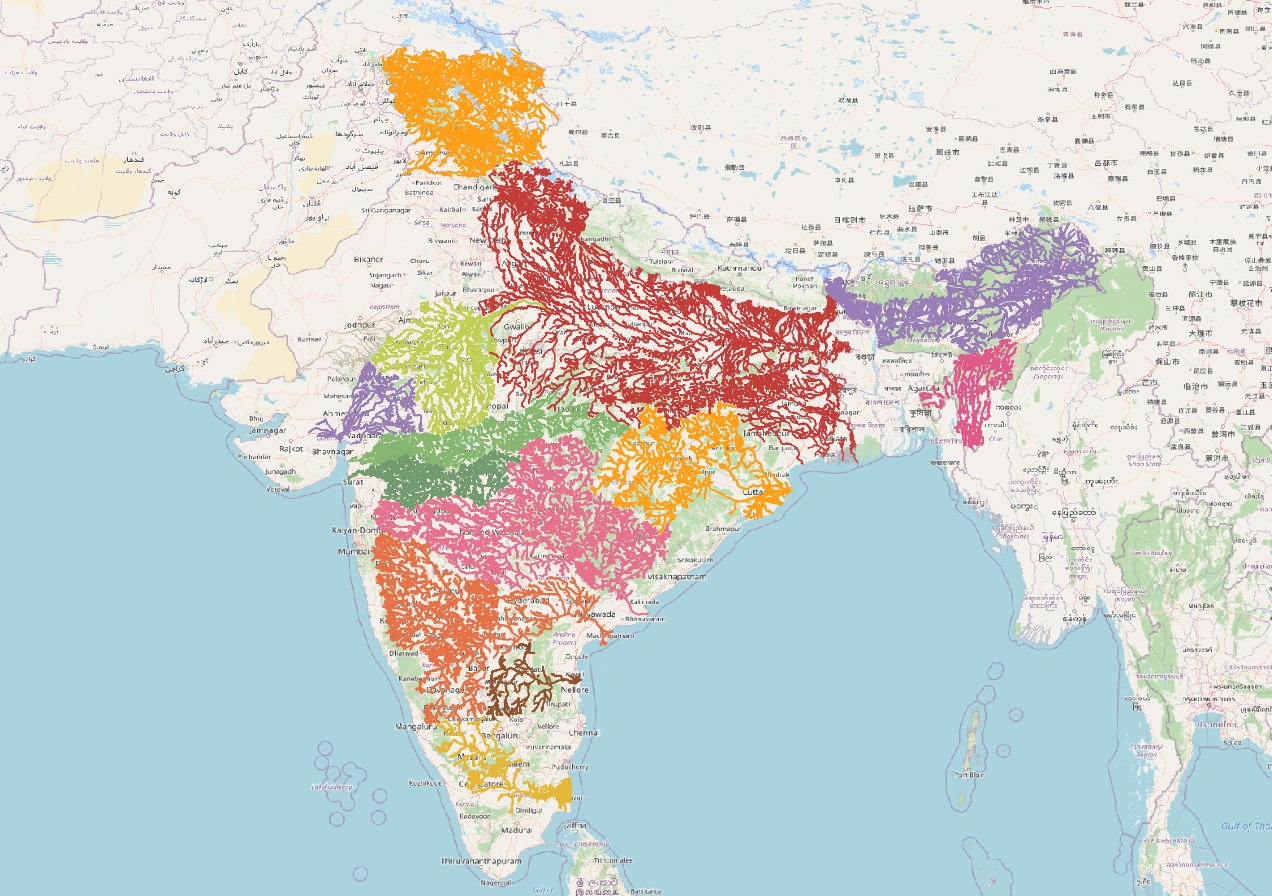
Map study
India river basins: distinguish watershed divides from state boundaries; compare east-flowing and west-flowing drainage.
- Read the source legend, scale and reference period before comparing regions.
- Connect spatial patterns to the processes discussed in this topic; this map is a study reference, not live operational data.
Credit: Heinz OSM · ODbL · sourceConverted to WebP on an opaque white background; proportionally resized without cropping. Original cartography and legend retained.
1. Meaning, components and agronomic suitability
Micro-irrigation supplies water frequently and in measured amounts, matching soil moisture conditions and crop requirements more closely than conventional uncontrolled surface irrigation. Indian agricultural programmes generally include drip and sprinkler systems within its scope. A typical installation comprises a water source, pump or gravity head, filtration unit, main and sub-main pipes, control valves and field distribution equipment. Pressure regulation and suitable design are essential for uniform application.
Drip systems release water through emitters placed along laterals, wetting only part of the soil surface. They are particularly suitable for orchards, vegetables, flowers, cotton and suitably configured sugarcane plantations. Subsurface drip places the laterals below ground, reducing surface wetting but making inspection and repairs more difficult. Sprinklers distribute water through nozzles and can serve closely spaced crops, undulating fields and light soils where conventional surface irrigation may be difficult.
Micro-sprinklers and bubblers are useful in orchards and nurseries where the wetted area must match the root distribution. Selection should consider crop spacing, soil infiltration, water quality, wind and available pressure. Sprinklers may perform poorly under strong winds, while drip requires careful emitter spacing in sandy soils. Neither technology is universally superior: the appropriate system is the one that meets crop needs reliably at an affordable life-cycle cost.
- Fertigation means applying soluble nutrients through irrigation water; it requires suitable fertilisers, calibrated dosing and safeguards against backflow.
- Filters, flushing valves and pressure checks are productive components, not optional accessories.
- Irrigation scheduling should combine crop growth stage, weather, effective rainfall and soil moisture rather than follow a fixed daily duration.
Timeline
2015–16
Per Drop More Crop launched under Pradhan Mantri Krishi Sinchayee Yojana.
2019–20
The Micro Irrigation Fund became operational through NABARD, with an initial corpus of ₹5,000 crore.
2022–23
Per Drop More Crop began implementation under Rashtriya Krishi Vikas Yojana.
2. Importance for agricultural reform and climate resilience
India faces uneven rainfall, recurrent dry spells and groundwater stress in major agricultural regions. Micro-irrigation can reduce avoidable field losses through runoff, evaporation from unnecessarily wetted soil and deep percolation below the root zone. It can also improve the timing of irrigation, limiting moisture stress during flowering and fruit development. Yield and water-saving outcomes nevertheless depend on the crop, soil, baseline irrigation method and quality of management; a single nationwide percentage is misleading.
More uniform water supply can improve produce quality and reduce labour used in field irrigation. Fertigation allows nutrients to be supplied in smaller, crop-stage-specific doses and may reduce nutrient losses when properly managed. Reduced surface wetting can suppress weeds between rows. These benefits make micro-irrigation relevant to diversification towards higher-value horticulture, although profitability still depends on markets, storage and price risk.
The technology supports adaptation to rainfall variability by stretching limited irrigation supplies across critical crop stages. Energy effects are context-specific: lower pumping volumes can save electricity or diesel, but pressurisation requires energy, particularly for sprinklers. Micro-irrigation should therefore be assessed through water productivity, net farm income and energy use together, rather than through installed area alone.
- Water productivity measures output or value generated per unit of water; specify whether the denominator is irrigation applied or water consumed.
- Protective irrigation stabilises production during dry spells, whereas full irrigation seeks to meet a larger share of seasonal crop-water needs.
- Micro-irrigation complements mulching, soil organic-matter improvement, rainwater harvesting and locally suitable crop diversification.
From installation to sustainable outcomes
- 1. Assess water availability, quality, soil and crop requirements
- 2. Select and size the appropriate system
- 3. Arrange finance, installation and farmer training
- 4. Schedule irrigation and fertigation according to crop needs
- 5. Maintain filters, pressure and emitters
- 6. Monitor withdrawals, income and system functionality; adjust management
3. Policy architecture and financing in India
Per Drop More Crop promotes water-use efficiency at farm level through drip and sprinkler systems. Introduced in 2015–16 as a component of Pradhan Mantri Krishi Sinchayee Yojana, it has operated under Rashtriya Krishi Vikas Yojana from 2022–23. It is important to distinguish this administrative placement from the wider policy objective of linking water availability, distribution and efficient agricultural use.
Assistance under the scheme is generally 55% of indicative unit cost for small and marginal farmers and 45% for other farmers. Prescribed cost norms, eligibility conditions and area limits apply; the percentage should not be interpreted as reimbursement of every actual installation bill. State top-ups can alter the effective beneficiary contribution. The Micro Irrigation Fund, operationalised through NABARD with an initial corpus of ₹5,000 crore, provides concessional lending to states for expanding coverage and supporting innovative projects.
Convergence can connect micro-irrigation with water harvesting, watershed development, horticulture promotion and farmer collectives. However, a farm pond or recharge structure must be hydrologically appropriate and legally permissible. Atal Bhujal Yojana offers a complementary approach through community participation and water budgeting in selected groundwater-stressed areas. Combining efficient delivery with demand management is more durable than financing equipment in isolation.
- Policy instruments include capital assistance, state-level financing, extension, quality standards and supplier accountability.
- Farmer producer organisations and water-user groups can aggregate demand, negotiate service contracts and organise shared infrastructure.
- Public investment should cover training and maintenance support as well as initial installation.
| Parameter | Drip | Sprinkler | Conventional surface irrigation |
|---|---|---|---|
| Application | Localised delivery near roots | Pressurised droplets over crop area | Water moves over soil by gravity |
| Typical suitability | Orchards, vegetables and row crops | Closely spaced crops and uneven terrain | Suitably levelled fields with manageable infiltration |
| Main operational concern | Emitter clogging and pressure variation | Wind drift and pressure requirements | Uneven distribution, runoff and excess percolation |
| Nutrient delivery | Well suited to precise fertigation | Possible with suitable equipment | Usually less precise |
| Key qualification | Requires filtration and regular servicing | Performance varies with weather | Improved levelling and scheduling can raise efficiency |
4. Adoption barriers, equity and the water-saving paradox
Upfront expenditure, beneficiary contributions and replacement costs discourage adoption by resource-poor farmers. Fragmented holdings complicate system design, while tenants may lack documents or incentives to invest in fixed equipment. Delayed assistance, unreliable power and seasonal water sources further weaken viability. Horticultural farmers with assured markets may benefit more readily than subsistence cultivators, creating an equity challenge for subsidy-led expansion.
Operational difficulties are equally significant. Suspended particles, biological growth and mineral precipitation can clog emitters. Poor filtration, incorrect pressure and damaged laterals cause uneven watering. Salts may accumulate around the edge of the wetted zone in saline conditions, requiring appropriate leaching and drainage management. Without accessible repair services, an installed system can become non-functional well before its expected life.
A central analytical distinction is between field-level efficiency and basin-level conservation. Water described as a loss from surface irrigation may partly recharge an aquifer or return downstream. Reducing that flow does not necessarily reduce consumptive water use. Farmers may also use apparent savings to expand irrigated area, grow more water-demanding crops or add another season. This rebound effect can offset reductions in pumping per hectare.
- Measure absolute withdrawals, crop evapotranspiration and groundwater trends alongside application efficiency.
- Avoid assuming that subsidised solar pumping plus drip automatically conserves groundwater; low marginal pumping costs can encourage expansion.
- Assess affordability through net returns after maintenance and replacement, not through subsidy size alone.
5. Reform priorities and an outcome-oriented approach
A stronger programme should begin with agro-climatic and aquifer-level planning. Crop-water requirements, source reliability and soil characteristics should guide system choice. In severely stressed groundwater blocks, micro-irrigation needs complementary crop diversification and locally credible water-use limits. Less water-intensive production should be supported through procurement signals, extension and market infrastructure rather than promoted through equipment subsidy alone.
Delivery reforms should emphasise transparent supplier selection, installation verification, service warranties and timely payment. Local technicians, including trained rural youth and women, can provide filtration checks, flushing, repairs and seasonal adjustments. Demonstration plots should compare costs and net returns under similar agronomic conditions. Shared installations require clear rules on electricity costs, scheduling, maintenance and dispute resolution.
Monitoring should move beyond hectares covered to functionality after several seasons, distribution uniformity, adoption by smallholders, yield stability and water extracted. Sensors and automated valves can improve scheduling, but simpler soil-moisture observations and weather advisories may be more affordable in many settings. The reform objective is not maximum hardware deployment: it is more resilient farm income within sustainable local water limits.
- Prioritise underserved farmers through targeted support, accessible procedures and appropriate arrangements for cultivators without ownership titles.
- Link incentives to verified functionality and after-sales service while avoiding excessive administrative burdens.
- Treat micro-irrigation as one component of integrated water-resource management, not a substitute for it.
Real-world case studies
Gujarat: coordinated implementation through GGRC
Gujarat Green Revolution Company, established in 2005, provides an institutional platform for implementing micro-irrigation support in Gujarat. Its model brings together assistance delivery, suppliers and technical requirements. The policy lesson is that adoption needs coordinated administration and service provision, not simply a subsidy announcement. Installation figures must still be supplemented by independent evidence on long-term functionality and groundwater outcomes.
Israel: technology within a wider water-management system
Israel's extensive use of drip irrigation is supported by agronomic research, water measurement, allocation arrangements and treated wastewater reuse. Its experience demonstrates that precision delivery works best within an integrated water-management framework. India can adapt the principles of scheduling and service quality, but differences in farm size, water governance and affordability limit direct replication.
Previous year questions
UPSC Mains 2021 · GS-III
How and to what extent would micro-irrigation help in solving India's water crisis?
- Explain drip and sprinkler irrigation and their potential to reduce excessive irrigation applications.
- Discuss productivity, fertigation, drought resilience and possible energy savings.
- Distinguish field-level efficiency from basin-level savings and examine rebound effects.
- Address cost, maintenance, source reliability and unequal access.
- Conclude with groundwater governance, crop diversification and water budgeting.
Practice questions
Practice MCQ 1
Consider the following statements: 1. Drip irrigation eliminates the need for filtration. 2. Sprinkler uniformity can be affected by strong winds. 3. Fertigation permits the application of suitable soluble nutrients through irrigation water. Which statements are correct?
- A. 1 and 2 only
- B. 2 and 3 only
- C. 1 and 3 only
- D. 1, 2 and 3
Practice MCQ 2
Which situation best illustrates a rebound effect following adoption of micro-irrigation?
- A. Farmers flush laterals to restore emitter discharge
- B. Farmers schedule irrigation using soil-moisture readings
- C. Farmers expand irrigated acreage so that total groundwater extraction does not decline
- D. Farmers repair leaks in main pipelines
Practice MCQ 3
Regarding Per Drop More Crop, consider the following statements: 1. It began in 2015–16 under PMKSY. 2. It has been implemented under RKVY from 2022–23. 3. Its prescribed assistance rate is identical for all farmer categories. Which statements are correct?
- A. 1 only
- B. 2 and 3 only
- C. 1 and 2 only
- D. 1, 2 and 3
Mains practice · Micro-irrigation is a productivity-enhancing technology, but not an automatic guarantee of water conservation. Discuss and suggest reforms for equitable, sustainable adoption. Answer in 250 words.
- Introduce drip and sprinkler systems.
- Explain improved irrigation timing, fertigation and income stability.
- Distinguish withdrawals, consumptive use and recoverable return flows.
- Discuss rebound effects, cropping incentives and pumping costs.
- Examine capital costs, tenancy barriers and maintenance.
- Recommend water budgeting, targeted assistance, service guarantees and outcome monitoring.
Further reading
- Department of Agriculture and Farmers Welfare: Per Drop More Crop operational guidelines and annual reports, agriwelfare.gov.in.
- NABARD: Micro Irrigation Fund documentation, nabard.org.
- Central Ground Water Board: National Compilation on Dynamic Ground Water Resources of India, cgwb.gov.in.
- FAO: Does Improved Irrigation Technology Save Water? A Review of the Evidence, 2017.
- NCERT: India: People and Economy, chapters on Water Resources and Land Resources and Agriculture.
Preparing for UPSC Civil Services? Get classroom teaching, answer-writing evaluation and mentorship at Pragnya IAS Academy, Ashok Nagar — see why aspirants choose us for IAS coaching in Hyderabad.