
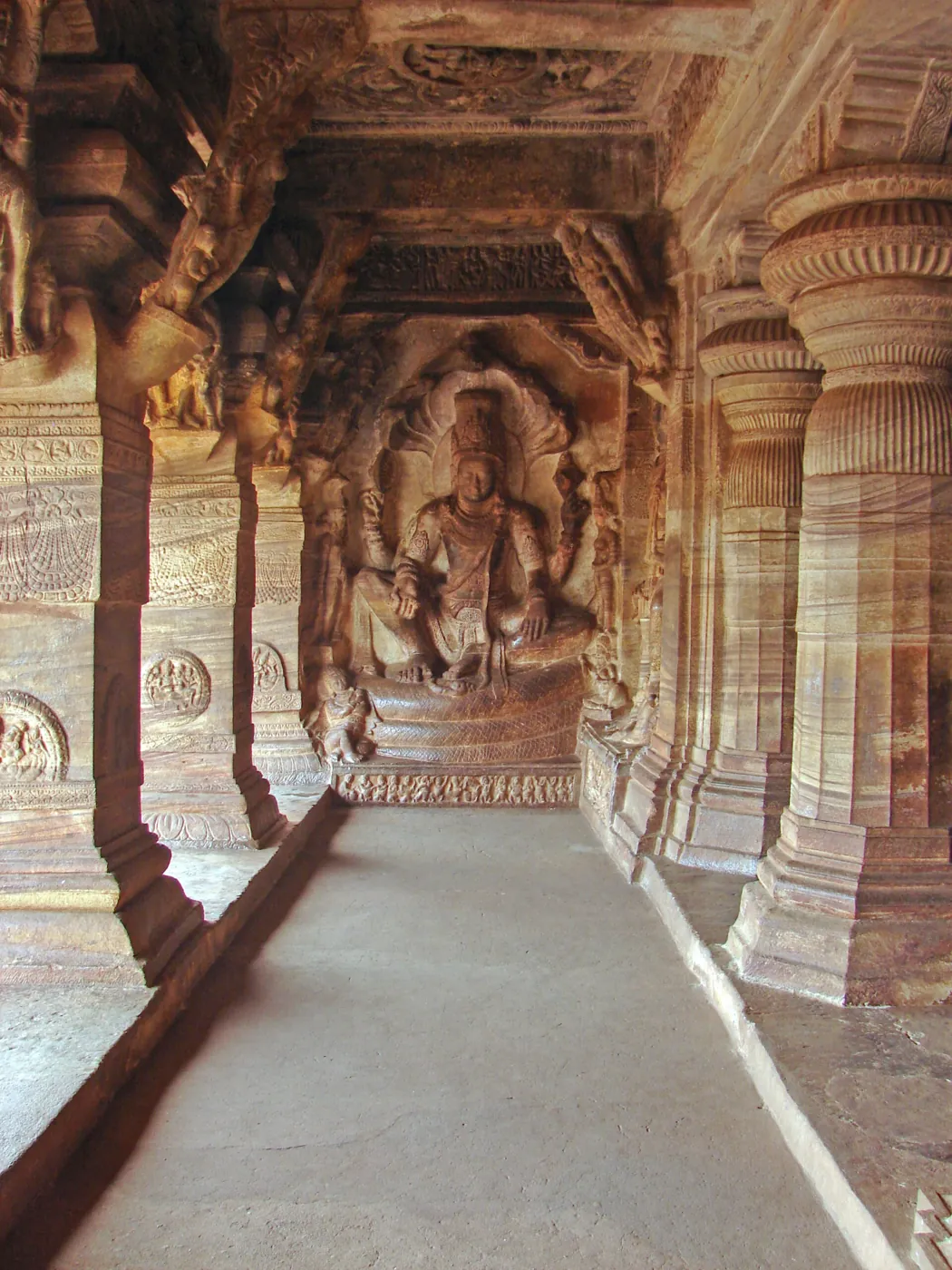
Badami: the parent dynasty’s monumental setting in Karnataka.
Credit: Dineshkannambadi (talk) 03:35, 13 August 2008 (UTC) · CC BY-SA 3.0 · source
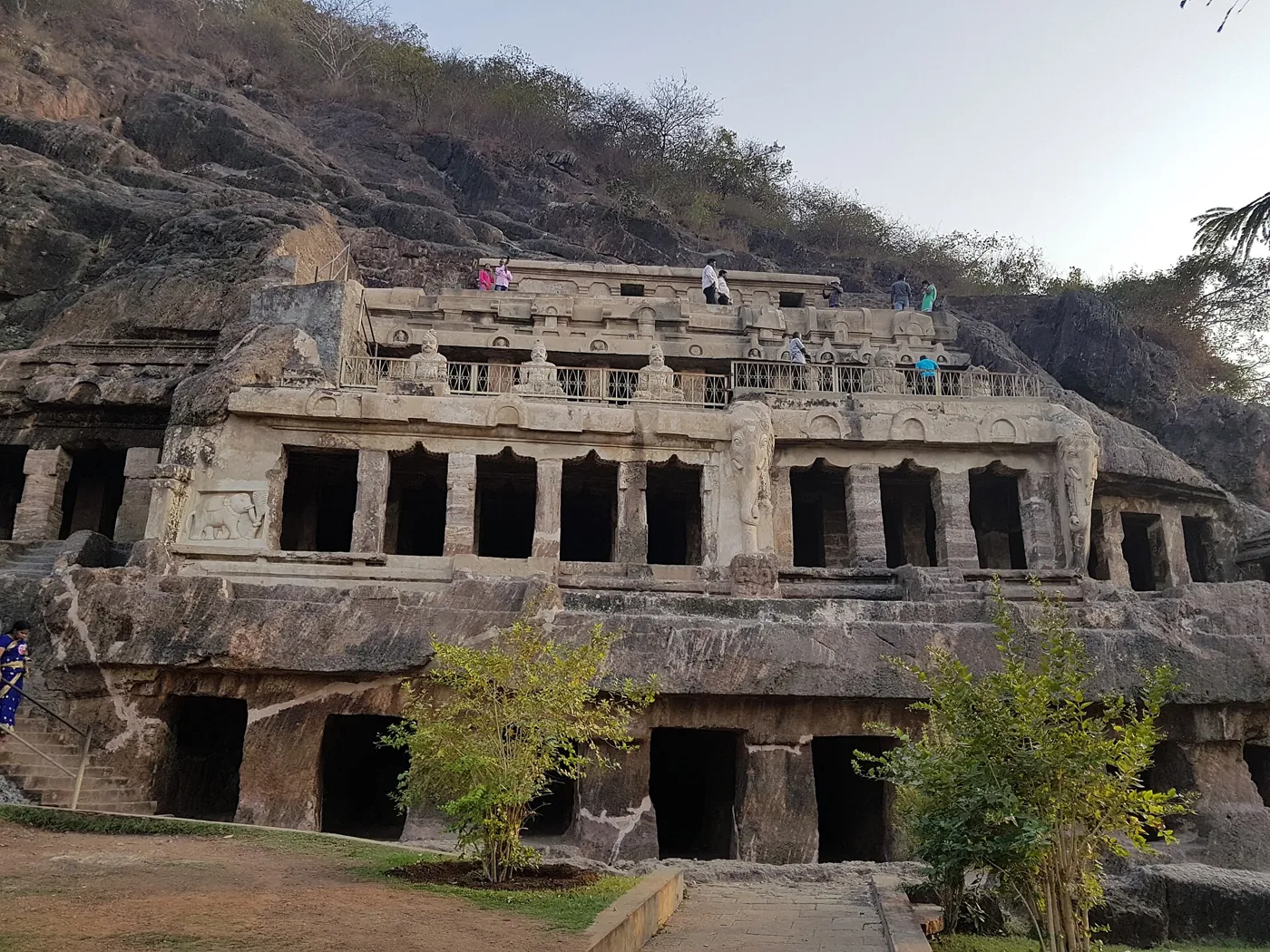
Undavalli: the inherited sacred landscape of coastal Andhra.
Credit: Laxmanvety · CC BY-SA 4.0 · source
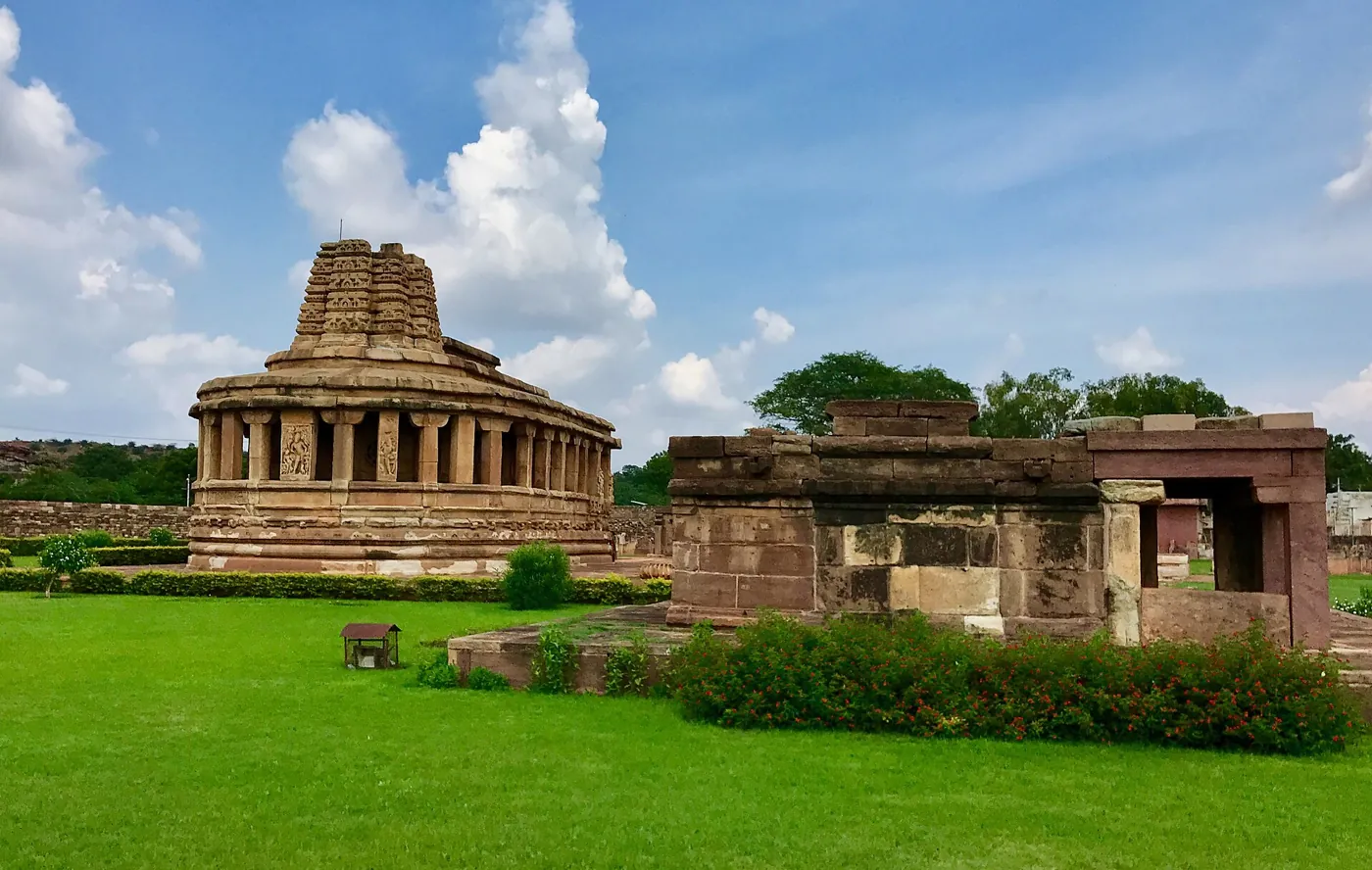
Aihole: architectural context of the parent Chalukya world in Karnataka.
Credit: Ms Sarah Welch · CC BY-SA 4.0 · source
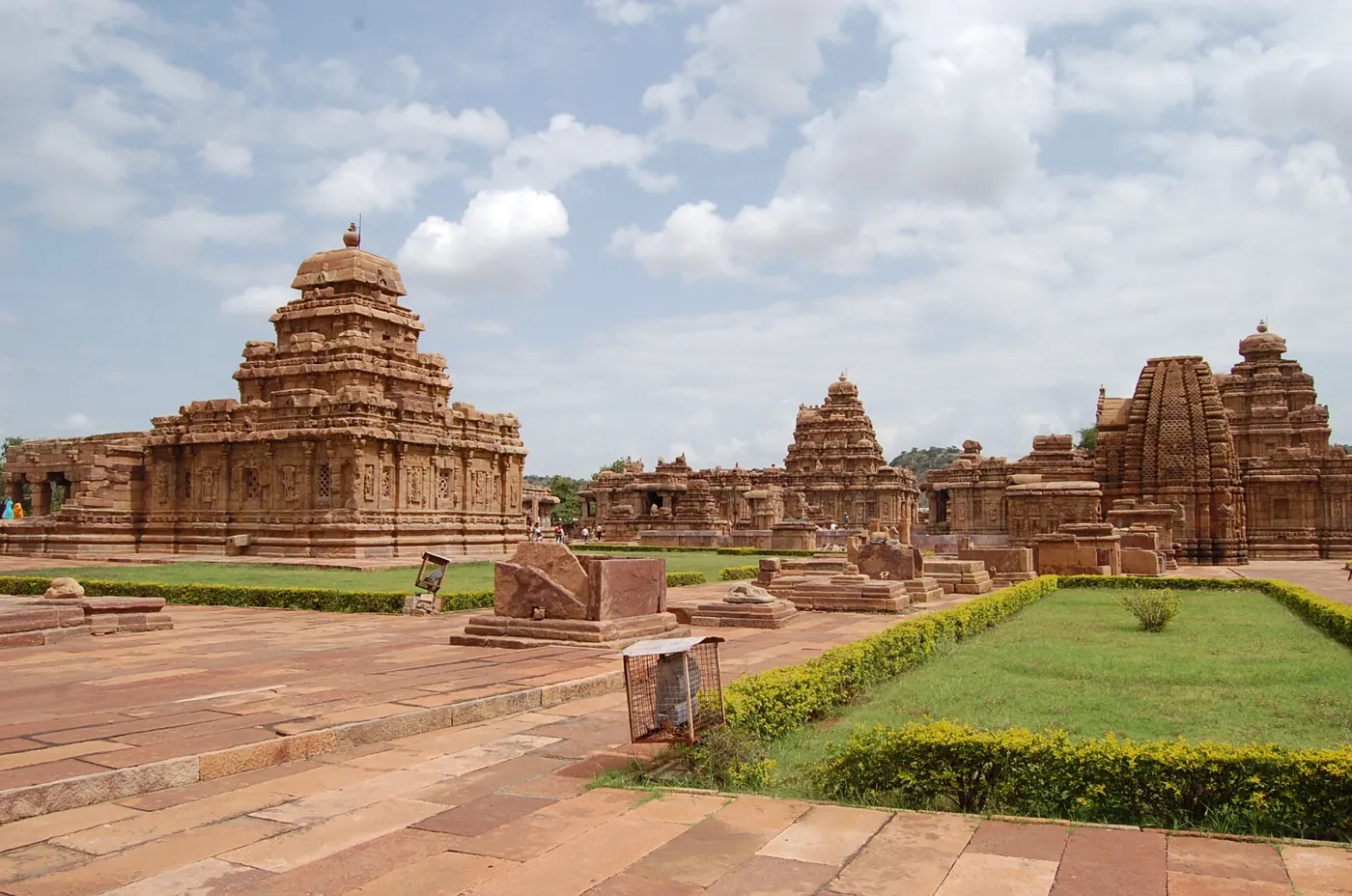
Pattadakal: a comparative Badami Chalukya temple centre, distinct from the Vengi branch.
Credit: Nithin bolar k · CC BY-SA 3.0 · source
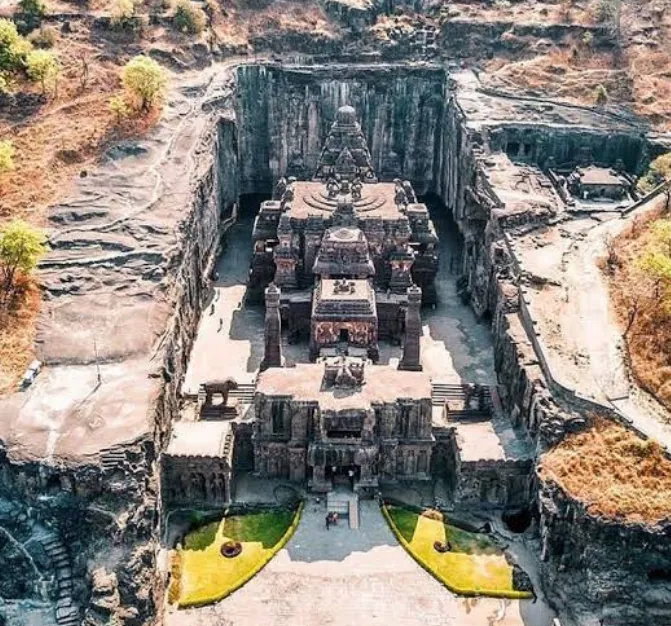
Ellora: monumental expression of Rashtrakuta power in the western Deccan.
Credit: Unknown photographer · CC BY-SA 4.0 · source
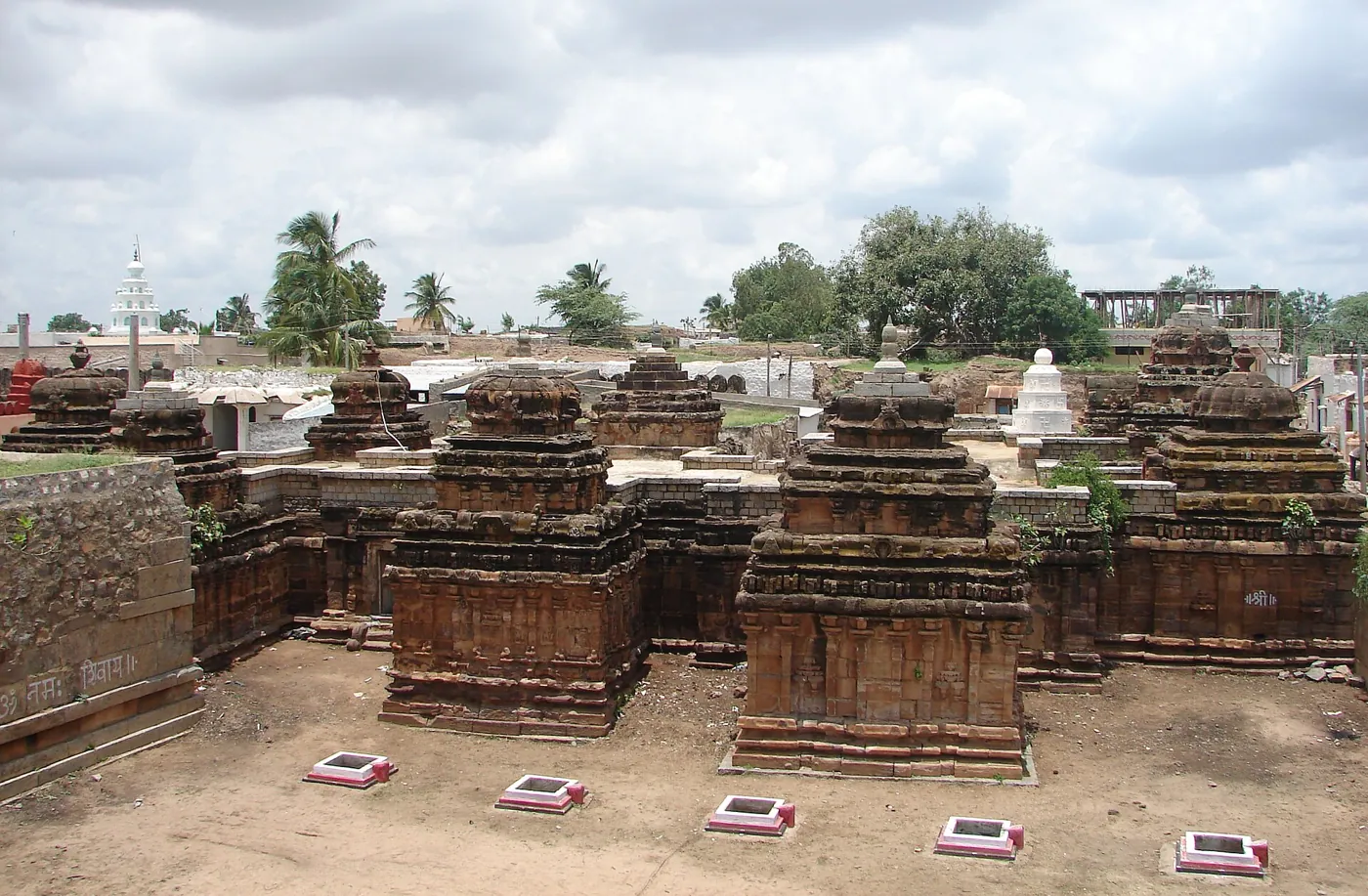
Kuknur: a temple group associated with the Rashtrakuta period, shown as the western political context.
Credit: en:User:Dineshkannambadi · CC BY-SA 3.0 · source
1. Geography, origins and the problem of dates
The Vengi kingdom occupied a coastal setting whose political importance came from both agricultural resources and connections with the Deccan interior. The lower Krishna and Godavari provided a durable regional focus, although the kingdom’s actual frontiers changed. Vengi can mean the settlement identified with Pedavegi near Eluru or the wider territory ruled by its kings. Pithapuram and, in the later period, Rajamahendravaram also belong to this political geography. These names should be used as historical centres rather than as evidence of one fixed capital sequence applying to every reign.
Pulakeshin II’s eastern expansion created the circumstances in which his brother Kubja Vishnuvardhana acquired authority in the coastal region. The conventional date about 624 CE is a useful starting anchor, but appointment to office, establishment of hereditary rule and effective independence are analytically distinct. Early chronologies depend heavily on reconstructed reign lengths and later genealogical records. An answer should therefore name the founder and parent dynasty confidently while qualifying the precision of the transition. This approach avoids converting a convenient chronological convention into an undocumented proclamation of independence.
- Locate Badami in present-day Karnataka and Vengi’s core in Andhra Pradesh.
- Separate conquest, provincial appointment and dynastic independence.
- Treat early reign dates as reconstructed rather than uniformly certain.
Timeline
About 575 CE
Kalamalla’s early Telugu record belongs to the Renati Chola setting; the date is palaeographic.
About 624 CE
Conventional beginning of Kubja Vishnuvardhana’s Eastern Chalukya line.
About 641–673
Jayasimha I’s reign represents an important early phase of consolidation.
Later eighth century
Vishnuvardhana IV ruled amid increasing Rashtrakuta involvement.
Early ninth century
Vijayaditya II’s reign is associated with extended military conflict.
Middle to late ninth century
Gunaga Vijayaditya III ruled; chronologies commonly differ between about 844–888 and 848–892.
Ninth century
Pandaranga’s Addanki inscription records Telugu verse in taruvoja metre.
Late ninth to early tenth century
Chalukya Bhima I defended Vengi authority against Rashtrakuta pressure.
Around 999–1000
Saktivarman I recovered Vengi with Chola assistance.
Eleventh century
Rajaraja Narendra’s court patronised Nannaya’s Telugu Mahabharata.
1070
Narendra’s son became Chola emperor Kulottunga I.
1070s
Vijayaditya VII’s continuing role complicates a single immediate end date for Vengi’s earlier political order.
Thirteenth century
Tikkana supplied the epic sections from Virata Parva onward.
Fourteenth century
Errana completed the remaining Aranya portion of the Telugu Mahabharata.
2. Consolidation and the changing western balance
Jayasimha I’s relatively long reign after the founder helped establish continuity in the eastern royal line. Subsequent rulers inherited a coastal base but not an automatically secure succession. Repeated names such as Vishnuvardhana and Vijayaditya make genealogy essential for identifying the correct king. Grants are particularly valuable because their descent sections connect donors with predecessors while their operative clauses locate local interests. Yet a king’s legitimacy claims should not be confused with a complete account of political events: rival claimants, interrupted control and unsuccessful actions can be understated or omitted.
The rise of the Rashtrakutas changed the western political environment without immediately extinguishing Vengi’s separate dynasty. Vijayaditya II is associated with extended resistance, while Gunaga Vijayaditya III illustrates how subordination and independent assertion could occur within one reign. Gunaga’s relations with Amoghavarsha I differed from his later stance toward Krishna II. Chalukya Bhima I also faced intervention when securing his position. The important analytical point is flexibility within an unequal regional order. Victories might secure prestige or tribute without creating lasting annexation, and royal praise must be read with that distinction in mind.
- Do not merge Vijayaditya II and Gunaga Vijayaditya III.
- Gunaga’s reign is placed around 844–888 or 848–892 in different chronologies.
- Assess raids, temporary control and incorporation as different outcomes.
How political resources became durable cultural institutions
- 1. An eastern command acquired a hereditary dynasty rooted in the Krishna–Godavari region.
- 2. Kings relied on officials, chiefs and local intermediaries to organise territory and agrarian resources.
- 3. Grants and endowments distributed selected rights while sustaining ritual, learning and institutional services.
- 4. Imperial rivalry and royal marriages connected Vengi’s succession politics to wider Deccan and Chola networks.
- 5. Inscriptions, literary patronage and temple additions preserved different aspects of those relationships for later historians.
3. Chola intervention, marriage diplomacy and Kulottunga
Chola support for Saktivarman I’s restoration around 999–1000 marked an important change in Vengi’s southern connections. Marriage reinforced intervention: Vimaladitya married Kundavai, a daughter of Rajaraja Chola I, and their son Rajaraja Narendra married Ammangadevi, daughter of Rajendra Chola I. These relationships supplied claims, allies and reasons for further involvement rather than a guarantee of peace. Rival Vengi branches and the Western Chalukyas of Kalyani continued to contest the region. The resulting politics are better understood as a network of linked succession disputes than as a simple transition from independence to dependence.
The son of Narendra and Ammangadevi became the Chola ruler Kulottunga I in 1070. His ancestry explains why the transition is described as a Chola–Chalukya union: paternal descent linked him to Vengi and maternal descent to the Cholas. However, accession to one throne did not instantly abolish all other claimants or settle the government of the eastern region. Vijayaditya VII remained significant into the 1070s, and later Chola princes exercised regional authority amid western pressure. A strong answer therefore distinguishes the clear accession date from the longer, contested process of political integration.
- Distinguish Rajaraja Narendra from Rajaraja Chola I.
- Kundavai, Vimaladitya’s wife, was the Chola emperor’s daughter, not his elder sister.
- Use 1070 for the accession, not for an assumed end to every Vengi institution.
| Person | Chronological setting | Secure association | Distinction to preserve |
|---|---|---|---|
| Kubja Vishnuvardhana | Early seventh century | Founder of the eastern royal line | Brother of Pulakeshin II, not a Chola appointee |
| Jayasimha I | Seventh century | Early Vengi consolidation and Telugu epigraphy | Not the later Western Chalukya rulers with similar names |
| Vijayaditya II | Early ninth century | Resistance to western pressure | Different from Gunaga Vijayaditya III |
| Gunaga Vijayaditya III | Ninth century | Expansion and the commander Pandaranga | His political position changed during his reign |
| Pandaranga | Ninth century | Addanki inscription | Commander rather than author of Nannaya’s epic |
| Rajaraja Narendra | Eleventh century | Patronage of Nannaya | Different from Rajaraja Chola I |
| Kulottunga I | Chola accession in 1070 | Son of Narendra and Ammangadevi | Dynastic union did not assure uninterrupted control of Vengi |
| Nannaya | Eleventh century | Adi, Sabha and part of Aranya parvas | Adikavi does not mean inventor of Telugu |
| Tikkana | Thirteenth century | Virata through the closing parvas | Did not supply the unfinished Aranya portion |
| Errana | Fourteenth century | Completion of the Aranya gap | A later contributor, not Narendra’s contemporary |
4. Governing land, intermediaries and agrarian society
Royal power in Vengi operated through relationships with ministers, military commanders, subordinate chiefs and local representatives. Charters mention territorial divisions such as the vishaya, but their boundaries and practical importance could change. The village mattered as a location of fields, revenue obligations and recognised rights. This evidence supports a picture of layered government rather than either complete royal control or total village autonomy. Central authority depended on intermediaries who could implement decisions, mobilise resources and recognise boundaries, yet those same intermediaries might exploit a succession crisis to advance their own claims.
Agrahara grants associated with Brahmana beneficiaries joined economic privileges to ritual status and learned activity. Temple endowments supported different institutional needs, including worship and recurring services. Neither category should be reduced to a simple transfer of absolute ownership over an empty landscape: cultivators and existing claims could remain relevant, and exemptions depended on specific clauses. Grants therefore illuminate how rulers distributed resources and created alliances, while also revealing unequal access to recognised privileges. Their concentration on named donors and recipients means that ordinary labour, women outside elite households and marginal groups are less consistently visible.
- Identify the beneficiary before interpreting the purpose of a grant.
- Distinguish Brahmana agraharas from temple endowments without treating them as unrelated.
- Use operative clauses, not general labels, to establish transferred dues and exemptions.
5. Telugu epigraphy and the evolution of writing
The history of written Telugu cannot begin with the Eastern Chalukya court alone. The Kalamalla record associated with Erikal Muturaju Dhananjaya belongs to the Renati Chola setting and is commonly placed about 575 CE through palaeographic comparison. It is therefore earlier than the conventional foundation of the Vengi line. Jayasimha I’s Vipparla record provides an early Eastern Chalukya connection, while the Addanki inscription of Pandaranga offers important ninth-century verse evidence. These records document different contexts and genres; treating them as one undifferentiated series obscures both regional diversity and changes in the purposes of writing.
Addanki is especially significant because Telugu verse in taruvoja metre appears in a record connected with Gunaga Vijayaditya III’s commander. Its exact calendar placement varies with reconstructions of the king’s reign, so a ninth-century description is safer than an unqualified single year. The Bezwada pillar inscription associated with Yuddhamalla adds another pre-Nannaya landmark. Meanwhile, the graphic traditions conventionally called Telugu–Kannada differentiated gradually from older southern writing. Language and script must remain distinct: Sanskrit could be written in regional letter forms, and a written language’s earliest surviving witness does not identify the beginning of speech or oral composition.
- Kalamalla is not an inscription of Kubja Vishnuvardhana.
- Pandaranga links inscriptional verse with the military world of Vengi.
- Palaeographic dating is an inference from letter forms, not necessarily a date stated in the record.
6. Nannaya, literary patronage and a work across centuries
Rajaraja Narendra’s support for Nannaya placed the Vengi court at a major turning point in surviving Telugu literature. The Andhra Mahabharatam brought a prestigious Sanskrit narrative into a developed regional literary medium. Nannaya’s accomplishment lay in shaping sustained narrative, learned diction and poetic form, not in creating Telugu itself. His use of champu combined prose and verse, while adaptation allowed literary choices beyond word-for-word substitution. The relationship between Sanskrit learning and Telugu expression was consequently productive rather than simply oppositional: regional literary authority could grow through the creative reworking of an established textual inheritance.
Nannaya completed Adi and Sabha parvas and part of Aranya Parva. Tikkana, in the thirteenth century, continued from Virata Parva through the remainder of the epic, while Errana in the fourteenth century supplied the unfinished Aranya portion. The Kavitrayam thus names contributors separated by centuries, not three colleagues at Narendra’s court. Likewise, Adikavi is a statement about Nannaya’s foundational place in the surviving canon, qualified by older inscriptional verse. The traditional attribution of Andhra Sabda Chintamani to him should be distinguished from the more secure evidence of his epic contribution.
- Match Nannaya with Narendra and the eleventh century.
- Champu describes a combination of prose and verse.
- Use the Kavitrayam to show continuity across changing political settings.
7. Temples, the Pancharamas and architectural evidence
Draksharama, Kumararama at Samalkot and the Biccavolu group are central to the framework’s architectural coverage. The first two feature important Bhimeswara shrines, while Biccavolu preserves a wider temple setting associated with early medieval Vengi. Chalukya Bhima is strongly linked with Kumararama’s historical attribution, but the monuments must be examined as layered complexes. A sanctum, an enclosure, a gateway and a hall may have different patrons and dates. Later inscriptions can document continuing worship and donations without necessarily providing a contemporary foundation record for the earliest surviving structure at the same site.
The Pancharamas are Draksharama at Draksharamam, Kumararama at Samalkot, Amararama at Amaravati, Ksheerarama at Palakollu and Somarama at Bhimavaram. Biccavolu is not a sixth member of this group. Shared Shaiva traditions connect the five, including narratives about the lingas, but sacred association does not establish simultaneous construction. Architectural comparison, inscriptions and later literary traditions answer different questions and should be combined rather than collapsed. For APPSC, this distinction supports both accurate location-based answers and a stronger discussion of temples as continuing institutions rather than isolated products of a single reign.
- Locate Amararama beside the Krishna; the other four lie in the wider Godavari region.
- Separate a temple’s earliest shrine from visible later additions.
- Do not assign all five foundations to one securely dated royal programme.
8. Religious plurality and a balanced historical assessment
Shaiva institutions became conspicuous in Vengi’s religious landscape, but patronage was not confined to one tradition. Vaishnava affiliations and Jaina endowments complicate any attempt to give an entire dynasty a single exclusive religious label. A renewed grant under Vishnuvardhana III recalls an earlier gift by Ayyana Mahadevi to a Jaina establishment at Vijayawada. Such evidence makes royal women visible as institutional patrons and shows why the recipient of a particular donation matters. It does not, however, establish equal support for every community or permit a numerical reconstruction of the population’s beliefs.
Buddhism’s loss of much of its earlier institutional prominence in Andhra was gradual and uneven. The survival of an earlier stupa or sculpture is evidence of a Buddhist past, but not by itself proof of continuous monastic occupation throughout Vengi’s history. Conversely, the greater visibility of later temples does not prove a single sudden replacement of belief. A balanced assessment connects changing patronage, agrarian resources, political competition and literary expression, while acknowledging the uneven archive. Vengi’s importance lies in this interaction between regional continuity and wider networks, not in an isolated story of either permanent independence or cultural dependence.
- A basadi is a Jaina establishment.
- Separate a ruler’s personal affiliation from the full range of supported institutions.
- Compare political, epigraphic, literary and architectural evidence before drawing broad conclusions.
Real-world case studies
Addanki: one record, two historical questions
Pandaranga’s Addanki record joins the world of military command with the history of Telugu expression. For political history, it places a commander within Gunaga Vijayaditya III’s sphere. For literary history, its taruvoja verse establishes a pre-Nannaya example of metrical Telugu. Those uses do not require an unqualified exact calendar year, since the record’s placement depends on regnal reconstruction. The case shows why a source can be highly informative even when one part of its chronology remains debated.
Kumararama: a monument is not a single date
The Samalkot shrine’s association with Chalukya Bhima gives it a prominent place in Vengi’s architectural history. Yet attribution of an early sanctuary, the date of a surviving inscription and the period of a later gateway are separate propositions. Reading all visible structures as one royal construction obscures the role of subsequent donors. A sound site account therefore begins with location and deity, then separates historical attribution, architectural phases, inscriptions and sacred tradition.
1070: accession versus integration
Kulottunga I’s Chola accession supplies a clear political anchor. His parentage explains the union of Eastern Chalukya and Chola claims, but continuing Vengi claimants and later princely government show that integration was not instantaneous. The same evidence supports both dynastic connection and regional political complexity. In an analytical answer, 1070 should open a discussion of changing authority rather than close it with a claim that every local institution or competing interest disappeared.
Previous year questions
No source-linked PYQ is available here yet. Use the practice questions below.
Practice questions
Practice MCQ 1 · Easy
Which statement correctly identifies the origins of the Eastern Chalukyas?
- They emerged from Pulakeshin II’s eastern expansion under his brother Kubja Vishnuvardhana.
- They began as governors appointed by Kulottunga I.
- They were founded by the poet Nannaya.
- They replaced the Kakatiyas in the fourteenth century.
Practice MCQ 2 · Moderate
Consider the pairs: 1. Kalamalla—Renati Chola context; 2. Addanki—Pandaranga; 3. Nannaya—Rajaraja Chola I as his Vengi patron. Which are correct?
- 1 only
- 1 and 2 only
- 2 and 3 only
- 1, 2 and 3
Practice MCQ 3 · Easy
Which relationship explains Kulottunga I’s connection with both royal houses?
- He was Pulakeshin II’s father and Rajendra I’s brother.
- He was Nannaya’s son and a Rashtrakuta heir.
- He was the son of Rajaraja Narendra and Ammangadevi.
- He was the founder of both Badami and Vengi.
Practice MCQ 4 · Moderate
Which conclusion about an agrahara grant is methodologically sound?
- Every grant transferred all village rights without exception.
- All villagers necessarily became beneficiaries.
- Temple endowment and agrahara are always identical terms.
- The charter’s clauses must establish the dues and privileges transferred.
Practice MCQ 5 · Moderate
Which set correctly matches the later contributors to the Andhra Mahabharatam?
- Tikkana—Virata onward; Errana—remaining Aranya portion
- Tikkana—Adi alone; Errana—Sabha alone
- Tikkana—entire epic; Errana—no contribution
- Tikkana and Errana—both eleventh-century colleagues of Nannaya
Practice MCQ 6 · Difficult
Which inference is NOT established merely by the shared Pancharama identity of five shrines?
- The five share a Shaiva pilgrimage association.
- All five were founded in the same year by one ruler.
- Kumararama belongs to the group.
- Biccavolu must be studied separately from membership of the five.
Mains practice · Examine how the Eastern Chalukyas maintained a regional political identity while participating in wider imperial rivalries.
- Begin with the Badami provincial origin and the coastal resource base.
- Discuss consolidation through local intermediaries and grants.
- Use changing Rashtrakuta relations to distinguish submission from permanent annexation.
- Explain Chola intervention, rival claimants and successive marriage alliances.
- Conclude with 1070 as a dynastic turning point, while qualifying the idea of an instantaneous merger.
Mains practice · Nannaya was a foundational literary figure, not the creator of Telugu. Discuss with reference to epigraphic and literary evidence.
- Separate the origin of speech, the use of a script and survival of a literary canon.
- Place Kalamalla in its Renati Chola setting before Vengi’s conventional foundation.
- Use Addanki’s taruvoja verse to demonstrate written poetic precedents.
- Explain Narendra’s patronage, champu and creative epic adaptation.
- Trace the later Tikkana and Errana contributions without placing the Kavitrayam in one court.
Mains practice · Assess the value and limits of temples and land grants for reconstructing the society and culture of Vengi.
- Explain what boundary descriptions, recipients and exemption clauses reveal.
- Distinguish agrahara beneficiaries from temple institutions and ordinary cultivators.
- Use Draksharama, Kumararama and Biccavolu as distinct architectural cases.
- Separate foundation attribution, later additions and sacred legends.
- Discuss Jaina patronage and the selective visibility of different religious communities.
- Recognise donor-centred sources and the limited representation of non-elite lives.
Further reading
- https://en.wikipedia.org/wiki/Eastern_Chalukyas
- https://en.wikipedia.org/wiki/Nannayya
- https://en.wikipedia.org/wiki/Kulottunga_I
- https://en.wikipedia.org/wiki/Pancharama_Kshetras
- https://kakinada.ap.gov.in/tourism/tourist-places/religious-tourism/
- https://ntm.org.in/download/ttvol/volume10-1/Translation-as-Negotiation-The%20Making-of-Telugu%20Language-and-Literature.pdf
- https://archive.org/stream/in.ernet.dli.2015.56256/2015.56256.Epigraphia-Indica-Vol-19_djvu.txt
- https://jainqq.org/explore/011014/137
Preparing for APPSC Group 1 or Group 2? See the APPSC Groups coaching course at Pragnya IAS Academy for fees, batches and registration.
Long study hours taking a toll? Try the free breathing exercise and self check-in in Pragnya’s student wellness programme for UPSC aspirants.