
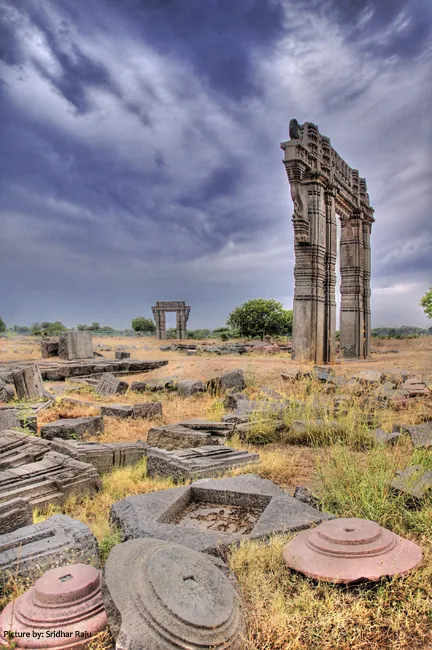
Surviving gateway and ruins at the Telangana royal centre.
Credit: B.Sridhar Raju · CC BY-SA 3.0 · source
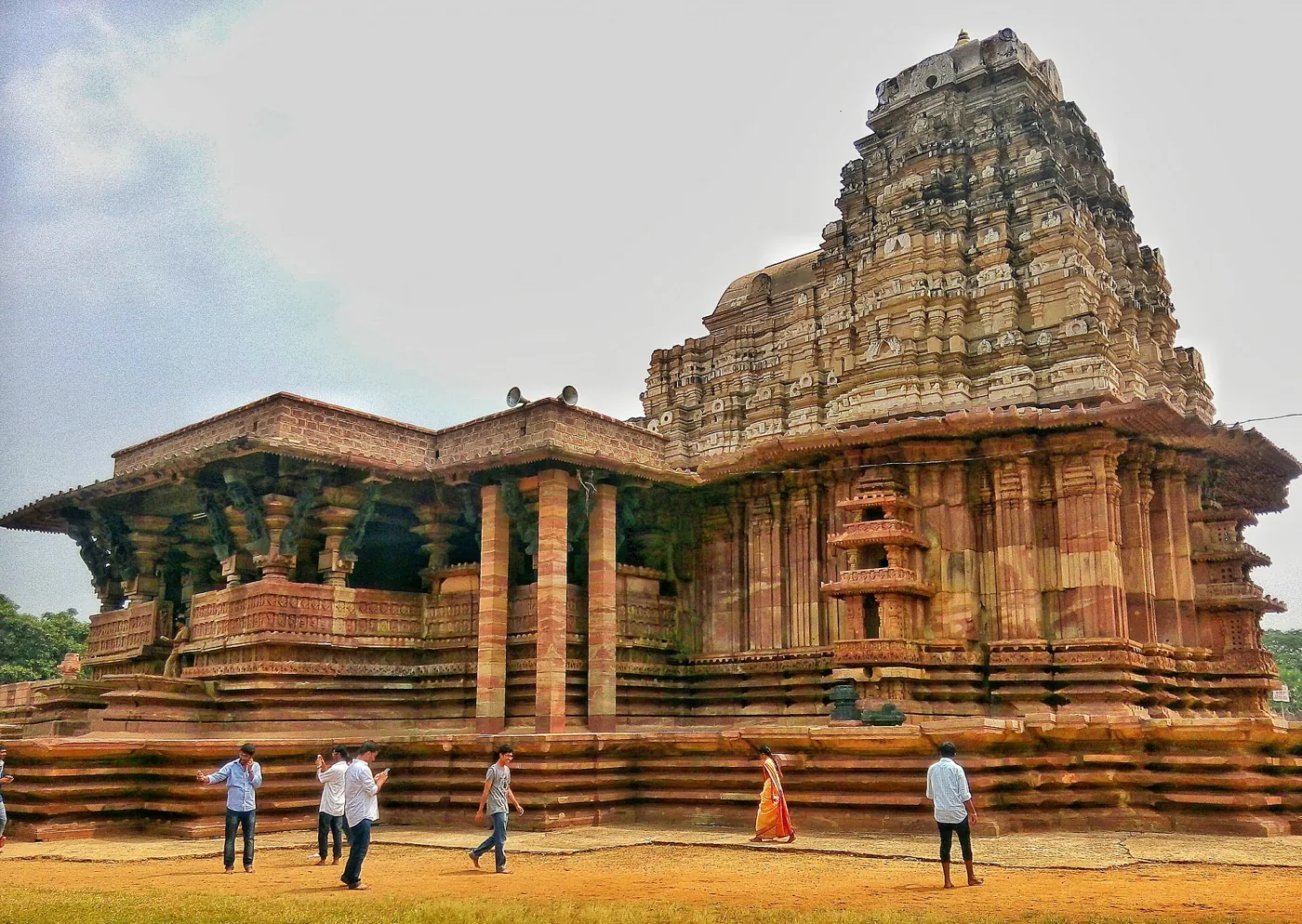
A major temple from the wider Kakatiya cultural landscape.
Credit: Nirav Lad · CC BY-SA 4.0 · source
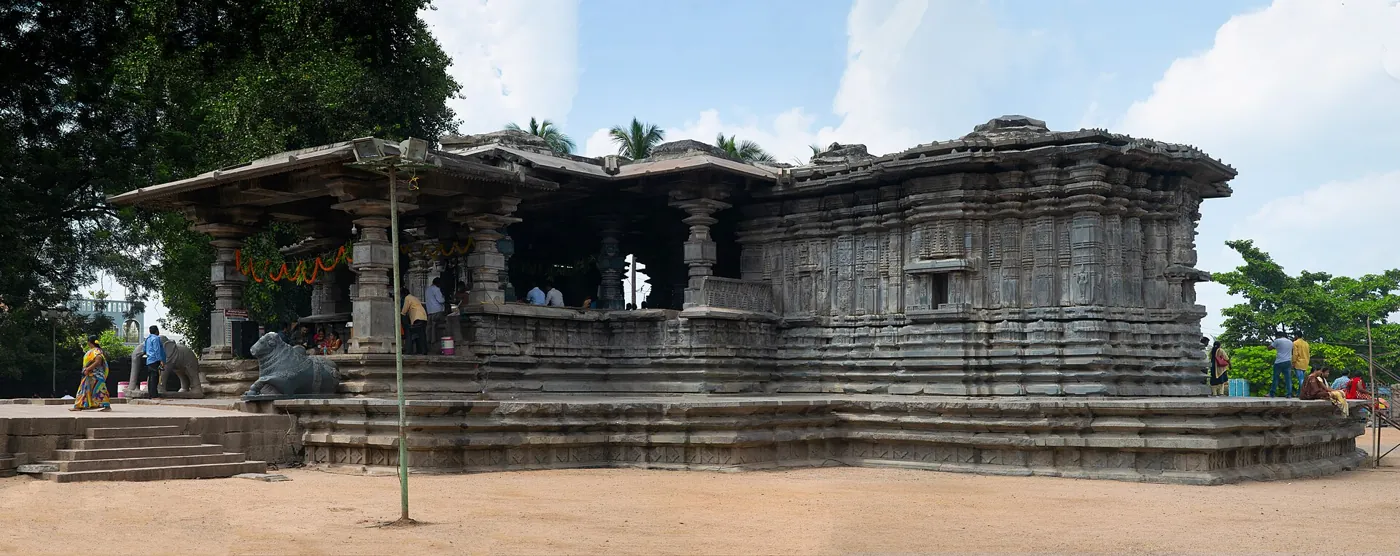
Rudradeva’s temple foundation, associated with the 1163 inscription.
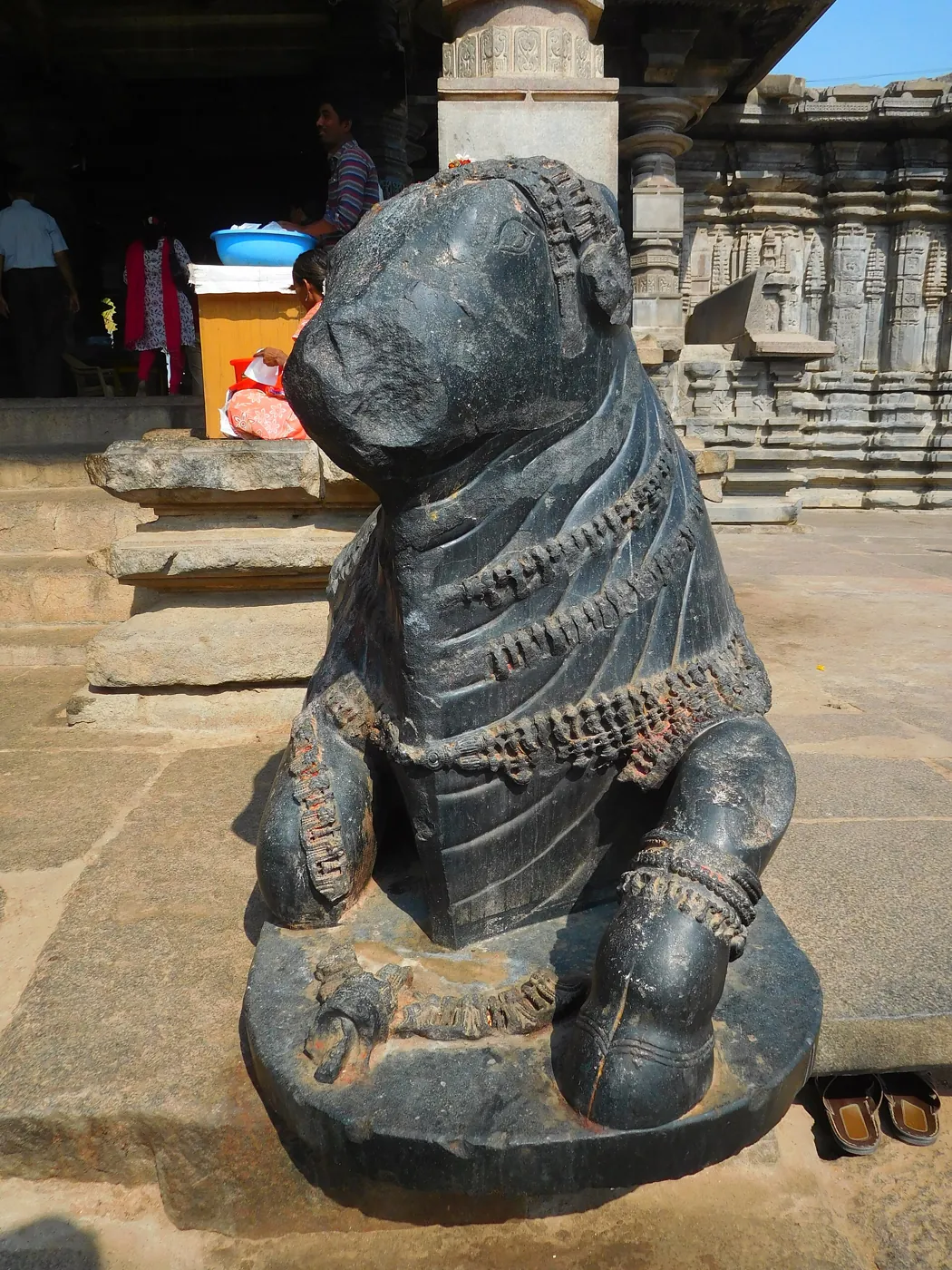
Carved Nandi at the Thousand Pillar Temple.
Credit: Shishirdasika · CC BY-SA 4.0 · source
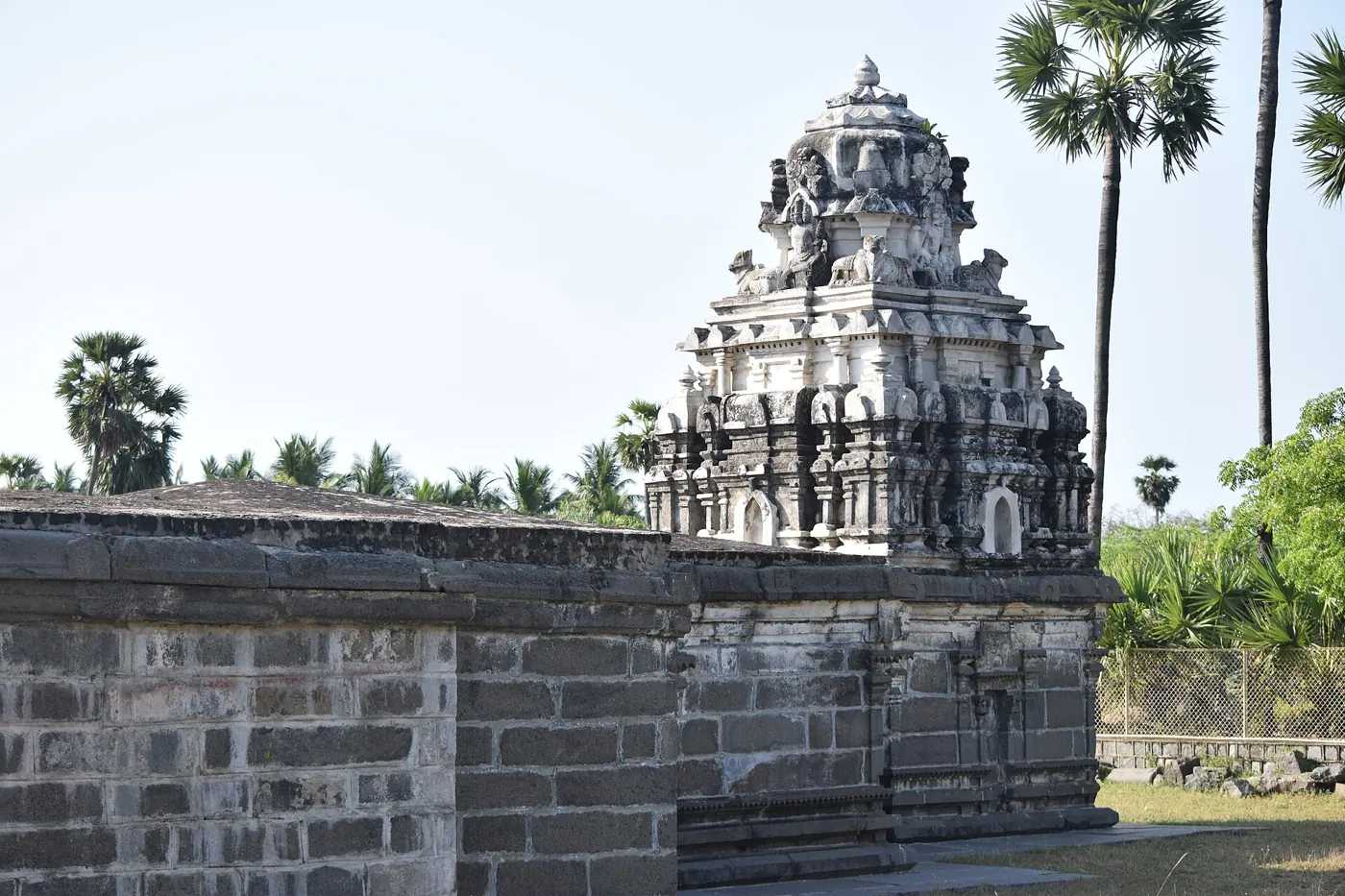
A surviving temple at the historic Andhra port.
Credit: Torchtelangana · CC BY-SA 4.0 · source
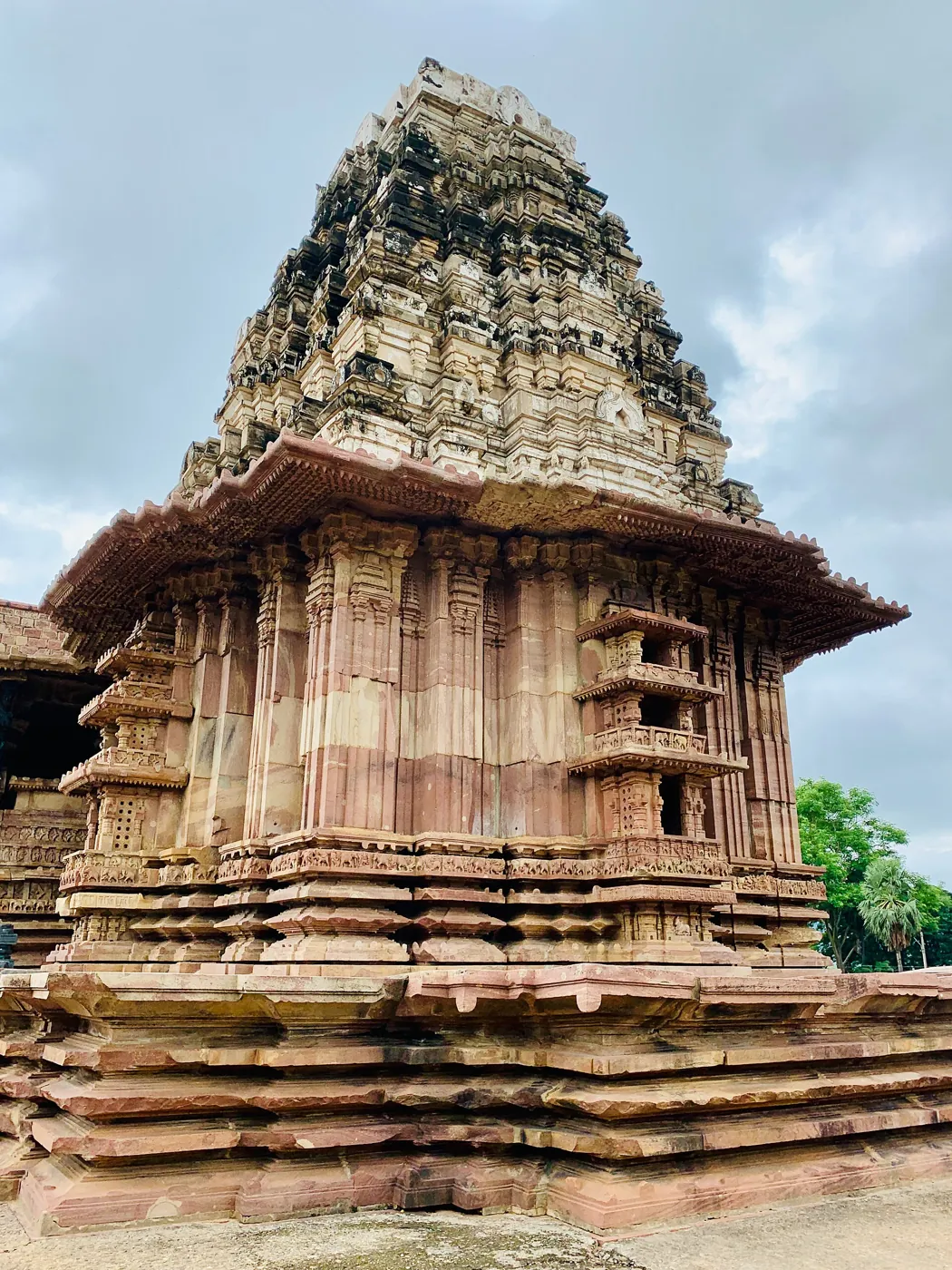
Temple patronage during Ganapatideva’s reign, in present-day Telangana.
Credit: Ms Sarah Welch · CC0 · source
1. Sources, chronology and the Andhra perspective
The Kakatiya kingdom should be understood as an eastern Deccan formation rather than a medieval version of a present-day state. Its principal centres, Hanamkonda and Warangal, lie in Telangana today, while much of its expansion and revenue strategy involved Andhra’s coastal plains. This distinction explains why an Andhra history syllabus includes rulers whose capitals were inland. Dated inscriptions at temples and trading centres make it possible to connect royal succession with regional activity, without assuming that the same degree of political control prevailed everywhere within a claimed realm.
Historical reconstruction requires separating three layers of evidence: what a document explicitly records, what its patron wished to proclaim, and what historians infer from comparison. Rudradeva’s 1163 record supplies a dependable chronological point, but its praise is not an impartial account of all neighbouring powers. Similarly, a commercial charter establishes announced policy rather than the volume of trade actually conducted. Temples, reservoirs, literary works and travellers’ reports supplement inscriptions. Where reign dates overlap or stories conflict, an approximate range and a clearly attributed interpretation are preferable to artificial precision.
- Locate the Telangana capitals separately from the Andhra coastal and southern evidence.
- Treat genealogical claims and victory boasts as arguments for legitimacy, not automatically literal history.
- Use dated records to test literary and travel narratives.
Timeline
Twelfth century
Prola II strengthened the Kakatiya regional base during the weakening of Chalukya authority.
1163
Rudradeva’s Hanamkonda inscription provided a dated statement of royal authority.
1199–c.1262
Ganapatideva’s conventional reign encompassed major expansion towards coastal Andhra.
1213
The foundation associated with Ramappa temple belongs to Recharla Rudra’s patronage.
1244–45
The Motupalli order promised protection to maritime merchants while retaining dues.
About 1262
Rudramadevi’s conventional independent reign began after association with her father.
Late 1289
The Chandupatla record indicates that Rudramadevi had died by this point.
1290
Ambadeva’s Tripurantakam inscription proclaimed chiefly power on the southern frontier.
1310
Malik Kafur obtained Prataparudra’s tributary submission.
1323
Ulugh Khan captured Warangal and ended independent Kakatiya sovereignty.
2021
UNESCO inscribed Kakatiya Rudreshwara (Ramappa) Temple on the World Heritage List.
2. From feudatories to a coastal power: Prola II, Rudradeva and Ganapatideva
Kakatiya sovereignty developed from service within larger Deccan political hierarchies. Prola II strengthened the family’s regional position as Western Chalukya authority weakened, and Rudradeva translated that advantage into an increasingly independent kingship. The temple inscription at Hanamkonda in 1163 linked religious endowment with an assertion of royal standing. Such patronage mattered because buildings and records made power visible to local elites and religious communities. Rudradeva, also called Prataparudra I, must be distinguished from the later Prataparudra who confronted the Delhi Sultanate in the fourteenth century.
After the brief reign of Mahadeva, Ganapatideva presided over the major expansion conventionally dated 1199–1262. The Krishna delta’s Divi area, coastal chiefdoms and the Nellore political sphere connected military strategy with richer agricultural resources and access to the sea. Alliances and subordinate rulers helped convert campaigning into influence; conquest alone did not produce identical administration in every locality. The familiar description of a sixty-three-year reign is based on conventional endpoints, while the transition to Rudramadevi involved overlapping authority. Southern rivalry, especially Pandya pressure, also exposed the limits of expansion.
- Explain coastal expansion through revenue, routes and political alliances together.
- Keep Rudradeva, Mahadeva and Ganapatideva in sequence.
- Use about six decades for Ganapatideva when exact reign-length arithmetic is unnecessary.
- Nellore was a contested political connection, not an unchanging royal province.
How regional integration could sustain and strain kingship
- 1. An inland political base supplied the leadership and military networks for expansion.
- 2. Coastal campaigns and alliances widened access to agrarian resources and southern routes.
- 3. Irrigation, endowments and merchant protection reinforced production and exchange.
- 4. Resource assignments supported military service while strengthening regional intermediaries.
- 5. Chiefly assertion and Delhi’s repeated interventions tested royal coordination.
- 6. The 1323 conquest removed the dynasty, leaving local institutions to undergo uneven adaptation.
3. Rudramadevi, female sovereignty and the Andhra frontier
Rudramadevi inherited kingship as Ganapatideva’s daughter and designated successor. Her association with her father preceded the conventional independent reign of about 1262–1289, which helps explain variation in accession dates. The masculine title Rudradeva Maharaja expressed her authority through an established political vocabulary; it does not make her a male ruler or a mere placeholder for one. Her position required support from important officers and chiefs, as did that of other monarchs. Her achievement is therefore best analysed through succession, legitimation and coalition-building, not through the unsupported claim that medieval gender hierarchies disappeared.
The southern challenge brings the Andhra region into the centre of this story. Ambadeva, a Kayastha chief, accumulated power at the expense of Kakatiya allegiance, and his 1290 Tripurantakam inscription proclaimed his achievements. Its evidence illuminates the capacity of military subordinates to become independent contenders, although its boasts require scrutiny. The Chandupatla inscription indicates that Rudramadevi was dead by late 1289, correcting older chronologies extending her rule into the mid-1290s. It does not independently settle every detail of her final battle. Marco Polo’s celebrated queen likewise cannot be treated as proof of a personal interview.
- Identify Rudramadevi as a queen regnant rather than a regent.
- Tripurantakam is in Andhra Pradesh; the queen’s royal centre at Warangal is in Telangana.
- Separate the inscriptional endpoint of her life from reconstructions of the circumstances of death.
- Use Ambadeva to explain contested authority without accepting every victory claim literally.
| Evidence | Anchor | What it establishes | Limit |
|---|---|---|---|
| Hanamkonda inscription | 1163; Rudradeva | A dated royal assertion and temple patronage | Royal praise is not an impartial campaign diary. |
| Motupalli charter | 1244–45; Ganapatideva | An announced assurance for maritime traders | Policy does not measure actual trade or compliance. |
| Chandupatla inscription | Late 1289; Rudramadevi’s death | A chronological limit for the queen’s life | It does not settle every detail of her final conflict. |
| Tripurantakam inscription | 1290; Ambadeva | Chiefly ambition and contested allegiance in Andhra | Victory boasts require comparison with other evidence. |
| Marco Polo’s narrative | Late thirteenth-century regional description | External perceptions of products and rulership | Hearsay and uncertain travel dating constrain literal use. |
| Tikkana’s epic contribution | Thirteenth century; Nellore milieu | Vernacular literary achievement within regional patronage | A literary text is not a direct administrative survey. |
| Ramappa complex | Foundation associated with 1213 | Craftsmanship, materials and sacred landscape | Modern recognition must not be confused with medieval construction. |
4. Prataparudra and the distinction between tribute and conquest
Prataparudra, Rudramadevi’s grandson and successor, ruled in a setting of strong regional chiefs and growing Delhi intervention. Malik Kafur’s campaign for Alauddin Khalji produced the important settlement of 1310. Prataparudra accepted tributary subordination but remained on his throne, so this event should not be described as the final annexation of the kingdom. Tribute served an imperial purpose by obtaining resources and acknowledging superiority without immediately replacing local kingship. For the regional ruler it preserved a measure of continuity, although renewed military pressure made that accommodation unstable.
The decisive political break came in 1323, when Ulugh Khan’s successful campaign captured Warangal, in present-day Telangana, and terminated independent Kakatiya rule. Ulugh Khan was then acting under Ghiyasuddin Tughluq; he became Sultan Muhammad bin Tughluq later. Andhra’s subsequent history involved imperial claims, resistance and new regional formations, not a simple restoration of the old monarchy. The removal of a ruling house disrupted relationships linking plateau and coast, but did not erase every village institution, military network or commercial practice. An explanation of collapse should therefore distinguish dynastic rupture from uneven institutional continuity.
- 1310 belongs to the Khalji tribute settlement; 1323 belongs to the Tughluq conquest.
- Distinguish Alauddin Khalji, Malik Kafur, Ghiyasuddin Tughluq and Ulugh Khan by role.
- Avoid reducing the kingdom’s fall to a single alleged betrayal or institutional weakness.
- Follow the consequences into Andhra’s regional transition without collapsing all successor histories into 1323.
5. Nayankara, revenue and negotiated administration
The Kakatiya state mobilised military power through chiefs whose service rested on access to territorial resources. Nayankara is useful for describing this relationship between assignment, local authority and obligations to the monarch, but it should not become a rigid formula imposed on every record. A grant of revenue rights was not automatically unrestricted ownership of all land and people within a territory. Royal officers, subordinate rulers and military leaders exercised overlapping functions. Agrarian dues and commercial imposts supported political power, while the details of rights, exemptions and obligations varied across individual localities.
Village groups, temples and merchant organisations were not merely passive recipients of orders from the capital. They held resources, recorded transactions and mediated relationships among cultivators, donors and rulers. Such participation does not amount to modern representative democracy, nor does it prove that the crown was powerless. The polity worked through negotiated authority, whose strengths and dangers were connected: a locally rooted commander could provide effective troops and also resist the ruler. Ambadeva makes this tension visible. Comparisons with later Vijayanagara arrangements are valuable only when similarities are tested rather than assumed from the shared word nayaka.
- Differentiate revenue entitlement, jurisdiction and land ownership.
- Explain why military decentralisation could help expansion and later enable resistance.
- Use specific records rather than inventing a universal tax schedule.
- Distinguish Kakatiya practices from later amara-nayaka institutions.
6. Irrigation, agriculture and contrasting regional ecologies
The kingdom joined environments with different agricultural possibilities. In much of the inland plateau, storing seasonal runoff behind tank embankments helped cultivation and settlement; in coastal Andhra, the Krishna–Godavari lowlands supplied a contrasting riverine and deltaic resource base. Pakhal and the reservoir near Ramappa are important Kakatiya-period examples in present-day Telangana, not coastal barrage projects. Tanks could support agrarian expansion, but their effects depended on catchments, rainfall and working arrangements for water. It is therefore misleading to explain the whole realm’s agriculture through either tanks alone or delta cultivation alone.
Irrigation patronage combined practical investment, claims to merit and the assertion of social standing. Kings and chiefs were conspicuous sponsors, while other donors and local participants also mattered. The creation of a reservoir was only the beginning: bund repair, desilting and allocation of stored water required continuing organisation. Connected tanks could transfer benefits through a catchment, but the evidence does not justify imagining a single centrally designed chain covering the entire kingdom. Equally, a later tank cannot be assigned to the Kakatiyas simply because it is old or lies within their former political sphere.
- Relate irrigation to settlement, revenue and donor prestige.
- Distinguish the act of construction from long-term management.
- Do not project colonial delta anicuts backwards into the medieval period.
- Ask who benefited from water access rather than assuming equal gains for all cultivators.
7. Motupalli, commercial security and Marco Polo
Motupalli provides particularly direct Andhra evidence for a ruler’s interest in sea trade. Ganapatideva’s order of 1244–45, commonly called an abhaya-sasana, addressed merchants facing the risks of maritime transport and the seizure of wrecked cargo. By promising protection while retaining regulated dues, the crown linked commercial confidence with fiscal advantage. This was neither the abolition of customs nor a modern declaration of unrestricted trade. Ports depended on the hinterland’s production, transport and merchant intermediaries, so maritime policy belongs within the wider agrarian and political economy rather than in an isolated account of overseas adventure.
Marco Polo’s account of Mutfili, usually associated with the Motupalli kingdom or region, offers a different kind of evidence. Fine textiles, diamonds and the reputation of a queen helped shape an overseas image of this part of India. His narrative, however, contains reported information and marvels, and its chronology does not establish a documented audience with Rudramadevi. The safe method is to compare the travel account with dated inscriptions: the charter illuminates an announced legal assurance, while Polo conveys selective perceptions of products and rulership. Neither source independently measures the total value of maritime exchange.
- Connect merchant protection with the state’s expectation of revenue.
- Guild networks mattered, but a guild should not be assigned to a port without local evidence.
- Treat fantastic diamond-gathering stories as narrative motifs, not verified mining methods.
- Differentiate a charter’s promise from evidence of its consistent enforcement.
8. Tikkana, devotional writing and Sanskrit scholarship
Tikkana makes Nellore essential to an Andhra-centred cultural account. Associated with the Telugu Choda ruler Manumasiddhi II, he rendered fifteen later parvas of the Mahabharata into Telugu rather than completing the entire epic. Nannaya’s unfinished Aranya portion remained outside his contribution and was supplied by Errana in a later period. The kavitrayam therefore represents a cumulative literary achievement across generations and political settings. Tikkana’s connections with the Kakatiya world should be explained through regional patronage and diplomacy, not by relocating his primary courtly association from Nellore to Warangal.
The period’s cultural range also extended beyond epic translation. Palkuriki Somanatha’s Basava Puranamu and Panditaradhya Charitramu exemplify Shaiva narrative and devotional expression, while Jayapa’s Nrtta Ratnavali addresses dance and Vidyanatha’s Prataparudra Yasobhushanam belongs to Sanskrit poetics. These are different genres with different evidentiary purposes, not interchangeable chronicles. Shaiva prominence coexisted with Jain and Vaishnava traditions, although patronage and relations among communities varied. Telugu expanded as a language of powerful literary expression without displacing Sanskrit from learned disciplines. The result was a networked cultural world rather than production confined to a single court.
- Match author, work and genre before discussing cultural significance.
- Keep Nannaya, Tikkana and Errana in their separate historical settings.
- Recognise both devotional mobilisation and continued religious plurality.
- Compare dance sculpture with dance theory cautiously, without treating either as a complete record of performance.
9. Architecture, patronage and the limits of attribution
The best-known Kakatiya monuments stand in present-day Telangana: the Thousand Pillar Temple at Hanamkonda, the surviving stone gateways at Warangal, and Ramappa at Palampet. They demonstrate the relationship between sacred patronage and public authority through distinctive plans, carved architectural members and sculptural programmes. Rudradeva’s Hanamkonda foundation belongs with the 1163 record, whereas Ramappa’s foundation is associated with 1213 under Recharla Rudra during Ganapatideva’s reign. These patrons must not be confused merely because their names resemble one another. Different monuments and phases require their own evidence rather than a single generic dynastic date.
UNESCO’s account of Ramappa highlights the combination of sandstone with carved granite and dolerite elements, and lightweight porous bricks in the superstructure. The phrase floating bricks describes a material property, not a temple that floats. Its reservoir, catchment and agricultural surroundings are also part of the architectural interpretation, connecting craftsmanship to landscape. World Heritage recognition in 2021 applies to this specific site. In Andhra, places such as Tripurantakam offer important records of gifts and political claims, but a donation inscription alone cannot date every wall or establish that the dynasty originally constructed an entire surviving shrine.
- Separate sovereign, military patron, artisan tradition and modern heritage recognition.
- Explain engineering and setting alongside decorative sculpture.
- Use Andhra epigraphy without claiming unsupported architectural authorship.
- Distinguish a freestanding torana from a complete surviving temple complex.
Real-world case studies
Motupalli: a commercial assurance as statecraft
The 1244–45 charter can be read as a response to a specific problem of maritime risk: merchants could lose cargo not only to the sea but also to confiscation after shipwreck. A promise of predictable treatment made the port more attractive while preserving the ruler’s claim to dues. The case connects law, political reputation and revenue. Its limit is equally instructive: an engraved assurance records what the crown announced, not the number of ships arriving or proof that every official complied.
Tripurantakam: the chief speaks in his own voice
Ambadeva’s 1290 record is valuable because it reveals the ambitions of a challenger rather than merely the court’s view of its subordinates. Its setting in Andhra anchors a wider argument about delegated military authority: regional resources made chiefs useful supporters and potentially formidable opponents. Yet their inscriptions also served legitimation. A strong answer uses the record to demonstrate contested power without turning its boasts into independently established tallies of victories or casualties.
Ramappa: architecture beyond an isolated monument
At Palampet in Telangana, the temple and nearby reservoir invite a landscape-based interpretation. Materials, structural load, sculpture and the surrounding agrarian environment together explain the complex more fully than a list of ornaments. The 1213 foundation association and the 2021 World Heritage listing belong to different historical questions. This case also supplies a method for Andhra monuments: distinguish construction phases, donations and later recognition before assigning an entire structure to one ruler or dynasty.
Previous year questions
No source-linked PYQ is available here yet. Use the practice questions below.
Practice questions
Practice MCQ 1 · Easy
Which statement best describes Ganapatideva’s Motupalli order?
- It abolished every duty on sea trade.
- It protected maritime merchants while retaining regulated dues.
- It created the first colonial customs house in Andhra.
- It transferred the capital from Warangal to the coast.
Practice MCQ 2 · Moderate
Consider two statements: 1. Rudramadevi was Ganapatideva’s daughter. 2. The masculine title Rudradeva Maharaja proves she ruled only as a regent. Which is correct?
- 1 only
- 2 only
- Both 1 and 2
- Neither 1 nor 2
Practice MCQ 3 · Moderate
Which sequence is chronologically correct?
- Motupalli charter, Hanamkonda record, 1323 conquest, 1310 submission
- Hanamkonda record, 1310 submission, Motupalli charter, 1323 conquest
- Hanamkonda record, Motupalli charter, 1310 submission, 1323 conquest
- 1310 submission, Motupalli charter, Hanamkonda record, 1323 conquest
Practice MCQ 4 · Moderate
Which pairing of author and contribution is correct?
- Tikkana — completion of Nannaya’s unfinished Aranya portion
- Jayapa — Prataparudra Yasobhushanam
- Vidyanatha — Basava Puranamu
- Tikkana — fifteen later Mahabharata parvas
Practice MCQ 5 · Difficult
What is the strongest defensible inference from Ambadeva’s 1290 Tripurantakam inscription?
- Every claimed victory is independently verified.
- Chiefly power could contest Kakatiya allegiance in the Andhra region.
- Rudramadevi personally dictated the text.
- The entire present temple was first built in 1290.
Practice MCQ 6 · Moderate
Consider: 1. Ramappa is in present-day Telangana. 2. Its floating bricks refer to lightweight material in the superstructure. 3. The World Heritage listing covers every Kakatiya temple. Which are correct?
- 1 and 3 only
- 2 and 3 only
- 1 and 2 only
- 1, 2 and 3
Mains practice · Examine how coastal Andhra contributed to the expansion and consolidation of Kakatiya power.
- Begin by distinguishing the Telangana capitals from the Andhra arena of expansion.
- Connect Krishna–Godavari resources and strategic routes with Ganapatideva’s campaigns.
- Explain the use of alliances and subordinate rulers, including the Nellore connection.
- Use the Motupalli order to relate commercial protection to fiscal interests.
- Conclude with contested frontiers and the limits of uniform territorial control.
Mains practice · Nayankara was both a resource of monarchy and a potential basis of regional autonomy. Discuss with reference to the Kakatiyas.
- Define military service and assigned resources without equating them with unrestricted ownership.
- Explain how locally rooted chiefs enabled mobilisation and expansion.
- Include the mediating roles of villages, temples and revenue claims.
- Use Ambadeva and Tripurantakam as evidence of contested allegiance.
- Avoid treating later Vijayanagara arrangements as exact copies or blaming collapse on a single cause.
Mains practice · Assess the cultural achievements of the Kakatiya age with particular reference to Andhra connections and the nature of the sources.
- Place Tikkana in Manumasiddhi II’s Nellore setting and identify his precise epic contribution.
- Discuss Shaiva Telugu writing alongside Sanskrit dance theory and poetics.
- Explain materials, sculpture and landscape at Ramappa while locating it in Telangana.
- Use Andhra donation records cautiously when attributing entire temple structures.
- Compare literary, material and inscriptional evidence rather than presenting all sources as neutral chronicles.
Further reading
- https://en.wikipedia.org/wiki/Kakatiya_dynasty
- https://archive.org/details/in.ernet.dli.2015.48788/page/n246
- https://en.wikipedia.org/wiki/Rudrama_Devi
- https://en.wikipedia.org/wiki/Ambadeva
- https://en.wikipedia.org/wiki/Tikkana
- https://whc.unesco.org/en/list/1570/
- https://en.wikipedia.org/wiki/Prataparudra
- https://archive.org/details/bookofsermarcopo02polouoft/page/n413
Preparing for APPSC Group 1 or Group 2? See the APPSC Groups coaching course at Pragnya IAS Academy for fees, batches and registration.
Long study hours taking a toll? Try the free breathing exercise and self check-in in Pragnya’s student wellness programme for UPSC aspirants.