
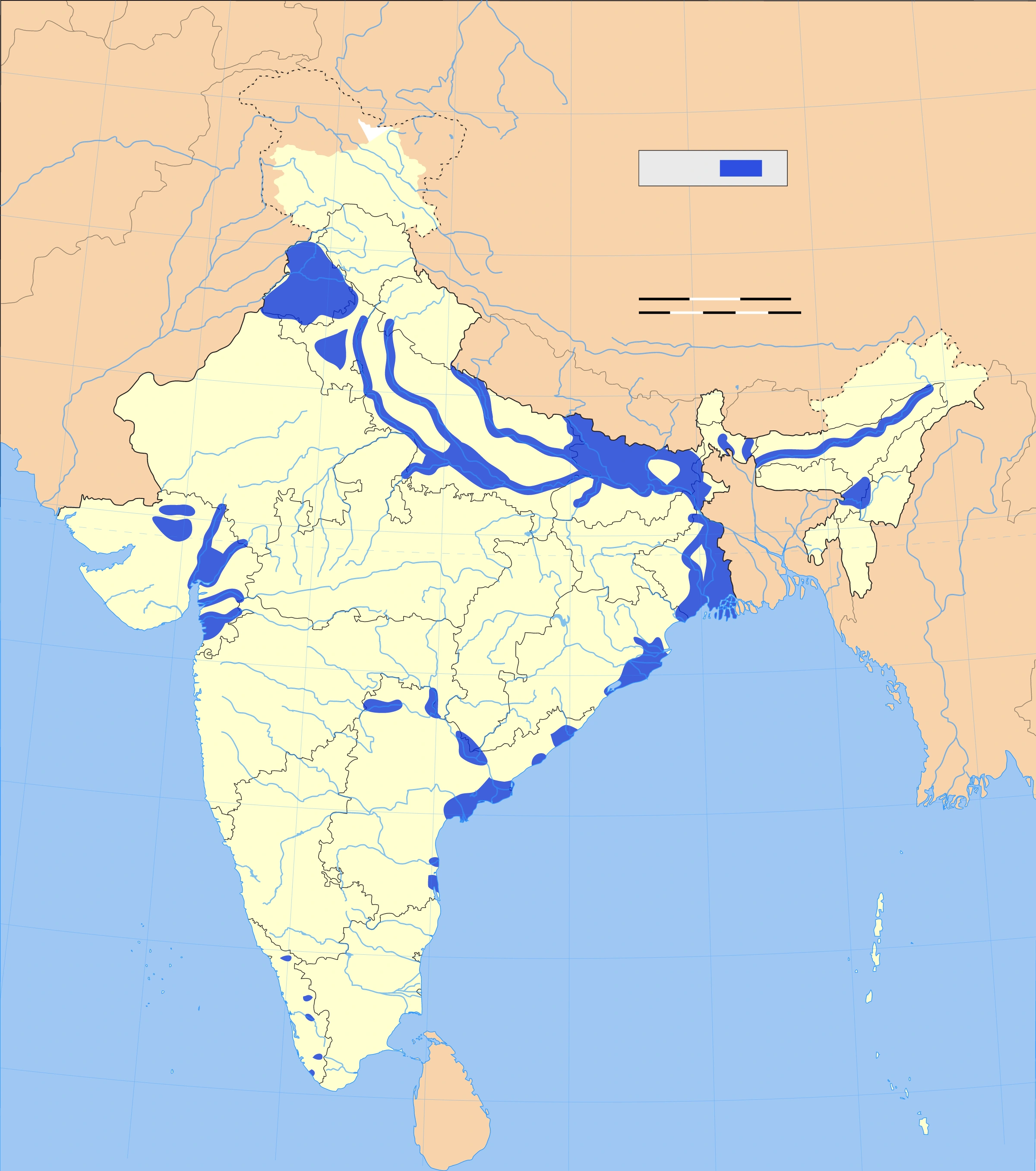
Map study
India flood-prone reference zones: relate plains to major river systems and monsoon rainfall. Not a live forecast or parcel-level risk map.
- Read the source legend and reference date before interpreting the map.
- Use spatial patterns to support topic revision; verify current official boundaries, designations and warnings separately.
Credit: Planemad · CC BY-SA 3.0 · sourceConverted to WebP on an opaque white background; proportionally resized without cropping. Original cartography and legend retained.
1. Meaning and dimensions of capacity
Capacity refers to what people and institutions can actually mobilise to anticipate, prevent, reduce, withstand and recover from disaster impacts. Resources alone do not establish capacity: a rescue boat without a trained crew, maintenance budget, fuel or deployment authority offers limited protection. Capacity therefore combines assets with competencies, coordination, access and the ability to act under stress.
Three interconnected levels are important. Individual capacity includes knowledge, skills, health and decision-making. Organisational capacity includes staffing, operating procedures, equipment, leadership and institutional memory. The enabling environment includes legislation, public accountability, financing arrangements, scientific systems and inclusive governance. Weakness at one level can undermine investment at another.
Capacity building often denotes creating or strengthening specific capabilities. Capacity development emphasises a sustained, locally owned process that recognises and improves capabilities already present. Coping capacity concerns using available resources to manage adverse conditions, whereas adaptive capacity concerns adjustment to changing risks, including climate change. Resilience is the broader ability to resist, absorb, adapt to and recover from disruption while preserving essential functions.
- Physical capacity: safe shelters, transport, hospitals, communications and resilient lifeline infrastructure.
- Human and technical capacity: first aid, search and rescue, forecasting, engineering and risk analysis.
- Social and institutional capacity: trusted networks, leadership, clear mandates and inclusive decision-making.
- Financial and ecological capacity: contingency funding, insurance where appropriate, healthy wetlands and other protective ecosystems.
2. How capacity reduces disaster risk
Disaster risk arises from the interaction of hazards, exposure and vulnerability. Capacity influences how these factors are understood and managed. A conceptual expression placing capacity against hazard, exposure and vulnerability can illustrate its protective role, but it is not a universal numerical formula. Capacity is hazard-specific and unevenly distributed: a district prepared for cyclones may remain poorly equipped for industrial accidents.
Across the disaster cycle, capacity supports risk mapping and safer land-use decisions before construction, preparedness through drills and stockpiles, timely response through incident coordination, and resilient recovery through damage assessment and safer reconstruction. Disaster risk reduction must therefore extend beyond emergency response to routine development decisions concerning housing, roads, drainage, health and livelihoods.
Capacity also determines whether early warning becomes early action. Accurate forecasts provide little protection if warnings are inaccessible, residents distrust officials, evacuation routes are flooded or livestock cannot be accommodated. Last-mile communication must specify the expected impact, location, timing and protective action, using local languages and accessible formats.
Local knowledge complements scientific expertise. Fishers’ understanding of coastal conditions, community maps of flood pathways and women’s knowledge of household care needs can improve operational plans. However, traditional practices should be assessed against current evidence because urbanisation, environmental degradation and climate change can alter familiar risk patterns.
- Prevention and mitigation: enforce building standards, protect drainage and screen public investments for risk.
- Preparedness and response: assign roles, rehearse evacuation and maintain interoperable communications.
- Recovery: assess losses transparently, restore livelihoods and apply Build Back Better principles.
Continuous capacity development cycle
- 1. Identify hazards, exposure and vulnerable groups
- 2. Define required capabilities and responsibilities
- 3. Assess existing strengths and operational gaps
- 4. Implement a funded capacity development plan
- 5. Test performance through exercises and events
- 6. Review lessons and update plans, budgets and skills
3. India’s institutional and community capacity
The Disaster Management Act, 2005 establishes national, state and district-level arrangements for disaster management. NDMA provides national policy direction and guidelines, while State Disaster Management Authorities and District Disaster Management Authorities support planning and coordination within their jurisdictions. Local authorities are essential for implementing measures on the ground. The 2025 amendment provides, among other changes, for urban disaster management authorities in specified cities and enables states to constitute State Disaster Response Forces; operational capacity depends on subsequent implementation.
The National Institute of Disaster Management develops knowledge and professional capability through training, research and documentation. The National Disaster Response Force supplies specialised response capability, while state forces, fire services, police, civil defence, health services and community volunteers provide complementary functions. The National Disaster Management Plan, revised in 2019, links responsibilities across sectors and levels of government.
Technical agencies supply specialised knowledge: the India Meteorological Department issues weather and cyclone warnings, the Central Water Commission supports flood forecasting, and INCOIS provides tsunami early warning services. Their information must reach district administrations, infrastructure operators and exposed communities through usable communication channels. NDMA’s Common Alerting Protocol-based SACHET platform supports dissemination of disaster alerts.
NDMA’s Aapda Mitra initiative strengthens community volunteer capability. Its up-scaling scheme was designed to train 100,000 volunteers across 350 disaster-prone districts. Such initiatives work best when volunteers have refresher training, protective equipment, insurance or other support, and a defined place within district response arrangements. Self-help groups, schools, resident associations and local NGOs can extend this community base.
- Avoid confusing the National Disaster Response Force with the National Disaster Response Fund: both are commonly abbreviated as NDRF.
- Panchayats and municipalities connect formal plans with settlement-level information, public services and vulnerable households.
- Private utilities, telecom providers, industries and hospitals require business continuity plans and coordination with public authorities.
| Dimension | Illustrative investment | Performance test |
|---|---|---|
| Human | First-aid and rescue training | Can personnel demonstrate skills during a drill? |
| Institutional | Clear roles and operating procedures | Can agencies coordinate without conflicting instructions? |
| Physical and technical | Shelters, backup power and warning systems | Do systems remain functional during disruption? |
| Financial | Contingency resources and maintenance budgets | Can funds be accessed and spent promptly with accountability? |
| Social | Volunteer networks and inclusive planning | Are isolated and vulnerable households reached? |
4. Capacity assessment and development
Capacity assessment should begin with a locally relevant risk scenario rather than a generic inventory. For example, an urban flood assessment should examine rainfall warnings, drainage operations, electricity safety, traffic management, hospital continuity and evacuation from informal settlements. It should ask who holds each responsibility, what resources can be mobilised, and what happens when normal systems fail.
An effective assessment compares required capabilities with existing ones. District resource inventories, including the India Disaster Resource Network, can help identify equipment and expertise, but entries need regular verification. Availability on paper must be distinguished from serviceability, travel time, trained operators and competing demands during a widespread disaster.
Development measures should combine training with institutional reform and recurrent expenditure. Standard operating procedures, mutual-aid agreements, delegated authority, backup power, redundant communications and equipment maintenance are as important as workshops. Tabletop exercises test decision-making, while field drills test actual mobilisation. After-action reviews should identify failures without discouraging honest reporting.
Inclusion is a performance requirement, not an optional welfare addition. Plans must account for children, older persons, persons with disabilities, pregnant women, migrants and people without secure housing. Consultation, accessible shelters, transport assistance, continuity of medication and privacy in relief facilities determine whether nominal capacity protects everyone.
- Measure outcomes: warning reach and comprehension, evacuation time, hospital continuity and restoration of essential services.
- Check functionality: trained staff retained, equipment serviceable and backup systems tested.
- Close the feedback loop: assign responsibility, budgets and deadlines for corrective actions after drills and disasters.
5. Constraints and priorities for India
India’s principal capacity gaps include uneven local staffing, frequent transfers, fragmented departmental information, weak enforcement of safety regulations and inadequate maintenance. Training may remain certificate-oriented, while plans are copied without reflecting local risks. Metropolitan areas face cascading failures across power, transport, water and telecommunications; remote regions face difficult access and limited specialist support.
Climate change makes capacity development a moving target. Heatwaves, intense rainfall and compound events require regularly updated scenarios rather than exclusive reliance on historical experience. Development authorities must integrate disaster risk into infrastructure appraisal, land-use planning and service delivery. Nature-based measures can complement engineered protection, but neither should be assumed sufficient without site-specific assessment.
The way forward is to professionalise district and local disaster management, retain trained personnel and link training to assigned operational roles. Predictable finance should support prevention, preparedness and maintenance alongside relief. Public dashboards, social audits and independent safety assessments can strengthen accountability. Universities and technical institutions can assist local governments with risk analysis and accessible planning tools.
For a GS-III answer, the central argument is that capacity converts resources and knowledge into reliable protective action. Success should be judged not by the number of workshops or equipment purchases, but by reduced losses, equitable protection, continuity of essential services and faster, safer recovery.
- Decentralise capability while maintaining common standards and interoperable systems.
- Build redundancy for critical functions and plan for simultaneous failures.
- Institutionalise learning through recurring exercises, updated risk assessments and funded corrective action.
Real-world case studies
Odisha: institutional learning after the 1999 super cyclone
Following the devastating 1999 super cyclone, Odisha strengthened its disaster management institutions, cyclone shelters, evacuation arrangements and community preparedness. Before Cyclone Phailin in 2013, roughly one million people were evacuated in Odisha and Andhra Pradesh. The experience illustrates how forecasts become protective action when linked to administrative coordination, shelters and trained communities. Mortality comparisons across cyclones require caution because hazard characteristics and exposure differ.
Ahmedabad: public health capacity for extreme heat
Ahmedabad introduced its Heat Action Plan in 2013 following the severe 2010 heatwave. The approach combines early warning, public communication, healthcare preparedness and inter-agency coordination. It demonstrates that disaster capacity includes routine public health systems, not only rescue forces. Protecting outdoor workers and households with limited cooling access remains essential to equitable implementation.
Previous year questions
UPSC Mains 2020 · GS-III
Discuss the recent measures initiated in disaster management by the Government of India departing from the earlier reactive approach.
- Explain the transition from relief-centred action towards risk reduction and preparedness.
- Discuss the Disaster Management Act, institutional arrangements and the National Disaster Management Plan.
- Connect early warning, community volunteers, resilient infrastructure and capacity development.
- Assess implementation gaps at district and local levels.
Practice questions
Practice MCQ 1
Which of the following best describes capacity development in disaster risk reduction?
- A. Procurement of specialised rescue equipment alone
- B. A continuous process strengthening people, institutions and the enabling environment
- C. Distribution of compensation after a disaster
- D. Transfer of all local responsibilities to national agencies
Practice MCQ 2
Consider the following pairs: 1. NIDM: Training and research in disaster management. 2. INCOIS: Tsunami early warning services. 3. Central Water Commission: Cyclone naming and weather forecasting. Which pairs are correctly matched?
- A. 1 and 2 only
- B. 2 and 3 only
- C. 1 and 3 only
- D. 1, 2 and 3
Practice MCQ 3
A district has sufficient evacuation buses, but no drivers have been assigned and no arrangements exist for transporting persons with disabilities. Which conclusion is most appropriate?
- A. Physical resources alone establish adequate evacuation capacity
- B. The district faces only a forecasting problem
- C. Operational and inclusive capacity gaps persist despite asset availability
- D. Evacuation planning is unnecessary once buses are procured
Mains practice · Capacity development in disaster risk reduction is a governance challenge rather than merely a training exercise. Discuss with reference to India. Suggest indicators to assess functional capacity. (250 words)
- Define capacity across individual, organisational and enabling-environment levels.
- Link capacity with prevention, preparedness, response and resilient recovery.
- Discuss local government staffing, agency coordination, finance and maintenance.
- Use Odisha’s cyclone preparedness and Ahmedabad’s heat planning as examples.
- Address community participation, disability inclusion and last-mile warning.
- Suggest indicators such as warning comprehension, mobilisation time, equipment functionality and service continuity.
Further reading
- UNDRR: Sendai Framework Terminology on Disaster Risk Reduction, entries on capacity and capacity development.
- NDMA: National Disaster Management Plan, 2019.
- India Code: Disaster Management Act, 2005, as amended.
- National Institute of Disaster Management: Training modules and publications, nidm.gov.in.
- NDMA: Aapda Mitra scheme documents and community preparedness resources, ndma.gov.in.
- UNDRR: Sendai Framework for Disaster Risk Reduction 2015–2030.
Preparing for UPSC Civil Services? Get classroom teaching, answer-writing evaluation and mentorship at Pragnya IAS Academy, Ashok Nagar — see why aspirants choose us for IAS coaching in Hyderabad.