

Aelbert Cuyp River-view with drinking Cows
Credit: Aelbert Cuyp · Public domain · source

Flamingos in Pallikaranai Marsh Wetland, residences to edge, view to NW from Sholinganallur Chennai, Tamil Nadu, India.
Credit: This Photo was taken by Timothy A. Gonsalves. Feel free to use my photos, but please mention me as the author. I would · CC BY-SA 4.0 · source
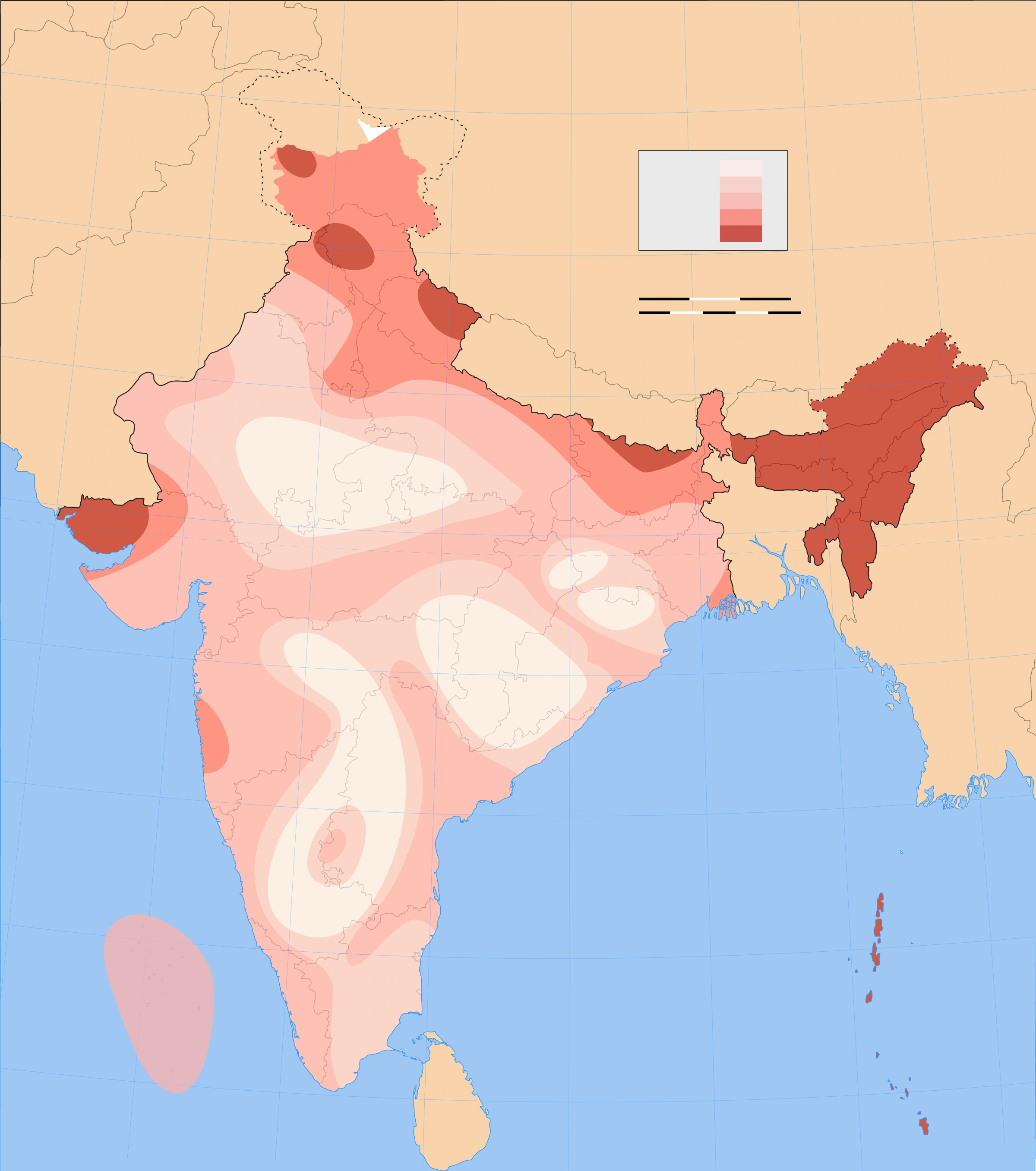
Map study
India seismic reference zones: compare the Himalayan belt, northeast and peninsula. Consult current BIS and official local guidance for engineering or safety decisions.
- Read the source legend and reference date before interpreting the map.
- Use spatial patterns to support topic revision; verify current official boundaries, designations and warnings separately.
Credit: Planemad · CC BY-SA 3.0 · sourceConverted to WebP on an opaque white background; proportionally resized without cropping. Original cartography and legend retained.
1. Meaning and place in the disaster cycle
Disaster prevention is the deliberate avoidance of disaster risk through actions taken before losses occur. A hazard is a potentially damaging process, phenomenon or human activity; a disaster is a serious disruption arising when hazardous events interact with exposure, vulnerability and capacity. Consequently, preventing disasters does not necessarily require preventing the underlying natural event. Earthquakes cannot presently be stopped, but prohibiting new settlement on an identified surface-fault rupture zone can prevent a particular form of exposure.
Prevention forms part of disaster risk reduction alongside mitigation and preparedness, but these terms are not interchangeable. Mitigation reduces the severity or likelihood of adverse impacts where complete avoidance is impracticable. Preparedness develops the ability to anticipate and respond effectively through evacuation planning, drills, emergency supplies and warning arrangements. A floodplain construction prohibition is primarily preventive; flood-resistant building design is mitigating; an evacuation drill is preparedness.
The disaster cycle is not a rigid sequence. Prevention can occur during normal development and after a disaster through reconstruction choices. Rebuilding outside an unstable slope zone can prevent renewed exposure. The practical test is whether an intervention avoids a specified risk or merely reduces its consequences. Absolute safety is rarely achievable, so prevention must operate alongside preparedness, response capacity and arrangements for residual risk.
2. Pathways for preventing disaster risk
Risk-sensitive land-use planning is the most direct preventive instrument. Hazard maps, historical event records, drainage studies and geological investigations should inform master plans, development permissions and infrastructure siting. Authorities can exclude settlements and critical facilities from unacceptable-risk locations, preserve natural drainage corridors and restrict excavation on unstable slopes. Maps must be sufficiently detailed for the decision involved: a regional landslide susceptibility map cannot substitute for a site-specific geotechnical investigation.
Engineering prevention is most credible when it removes an identifiable failure mechanism. Examples include eliminating unsafe electrical connections that can ignite fires, installing interlocks that prevent incompatible industrial operations, and securing hazardous storage systems against foreseeable failures. Building codes generally reduce collapse risk rather than guarantee that no disaster will occur. Similarly, embankments can prevent flooding within their design conditions but may be overtopped or breached, making maintenance, inspections and residual-risk planning essential.
Ecosystem protection prevents the creation of additional risk. Conserving wetlands and flood-storage areas avoids increases in runoff and downstream exposure caused by their conversion. Protecting dunes, mangroves and slope vegetation supports coastal and hill stability, although these systems do not provide unlimited protection. Social measures are equally important: secure housing, accessible services and livelihood options allow people to avoid dangerous locations. Restrictions without affordable alternatives may simply move informal settlements to another hazardous site.
- Prospective risk management prevents new risk through development choices.
- Corrective risk management reduces existing risk and can include removing exposure through carefully planned relocation.
- Structural and non-structural instruments work best together; infrastructure without regulation can encourage unsafe development.
Embedding prevention in development decisions
- 1. Identify hazards, exposure, vulnerabilities and cascading risks
- 2. Assess present and future risk at the appropriate spatial scale
- 3. Avoid unsafe locations, technologies or development choices
- 4. Apply enforceable planning, engineering and environmental safeguards
- 5. Inspect compliance and maintain protective systems
- 6. Monitor outcomes, revise assumptions and prepare for residual risk
3. Indian legal and institutional framework
The Disaster Management Act, 2005 provides the overarching framework. Its definition of disaster management explicitly includes prevention, mitigation, capacity building and preparedness. Sections 35 and 36 place responsibilities on the Central Government and its ministries, including integrating prevention and mitigation into development plans and projects. Section 38 provides corresponding responsibilities for State Governments. The National Policy on Disaster Management, 2009 and the revised National Disaster Management Plan, 2019 support a proactive, risk-reduction-oriented approach.
NDMA lays down national policies and guidelines, while State and District Disaster Management Authorities translate risk reduction into territorial planning and coordination. Local authorities are particularly important because building permissions, drainage maintenance, local roads and enforcement occur close to the source of exposure. Town-planning agencies, pollution control boards, fire services and sectoral departments must therefore participate; prevention cannot be delegated exclusively to emergency-management institutions.
Sectoral instruments give prevention operational effect. The National Building Code of India, 2016 and relevant Bureau of Indian Standards codes guide structural and fire safety, but enforceability depends on incorporation into applicable regulations and actual compliance. The Environment (Protection) Act, 1986, environmental-clearance procedures and the Manufacture, Storage and Import of Hazardous Chemical Rules, 1989 support industrial risk control. Coastal Regulation Zone notifications and the Wetlands (Conservation and Management) Rules, 2017 can constrain risk-producing development when properly implemented. The Dam Safety Act, 2021 provides for surveillance, inspection, operation and maintenance of specified dams to prevent dam-failure-related disasters.
| Function | Primary objective | Example |
|---|---|---|
| Prevention | Avoid specified disaster risk | Prohibit new housing in a designated high-risk floodway |
| Mitigation | Limit unavoidable adverse impacts | Retrofit a vulnerable school against earthquake shaking |
| Preparedness | Develop readiness for effective action | Conduct evacuation drills and stock emergency supplies |
| Response | Save lives and meet immediate needs | Rescue stranded people and provide emergency shelter |
| Recovery | Restore and improve affected systems | Reconstruct infrastructure using safer siting and design |
4. Prevention across India's major hazards
For riverine and urban floods, prevention priorities include protecting floodplains, avoiding construction across natural channels and retaining flood-storage spaces. Stormwater networks need catchment-based planning rather than isolated drain enlargement. Encroachment removal must follow due process and rehabilitation safeguards. For landslides, safer road alignment, controlled cutting, slope drainage and restrictions on unstable sites are central. Hill development must account for cumulative changes rather than assess each building or road in isolation.
For earthquakes, hazard-informed siting and code-compliant construction are indispensable, but they mainly prevent avoidable failure or mitigate earthquake consequences, not the earthquake itself. Independent design review and construction-stage inspections are necessary because compliance on paper does not ensure safe structures. For industrial accidents, prevention includes substituting less hazardous substances, reducing dangerous inventories, separating incompatible materials, maintaining equipment and enforcing safe operating procedures.
Heat-risk prevention includes protecting shade and water access in settlement design and avoiding work schedules that expose labourers to extreme heat. These measures usually reduce risk rather than eliminate the hazard. Hospital fire prevention similarly requires electrical safety, oxygen-system management and control of ignition sources. Across hazards, interdependence matters: a damaged power system can disable pumps, communications or medical equipment and trigger cascading emergencies.
5. Implementation challenges and a practical agenda
Prevention faces a political-economy problem: its costs are immediate, while benefits are often invisible because the avoided disaster never occurs. Short electoral horizons, fragmented jurisdictions, weak municipal staffing and incentives to maximise land values encourage risky permissions. Informality and poverty constrain household choices. Climate change adds uncertainty because historical rainfall, flood and heat records may no longer adequately represent future extremes.
A practical agenda begins with accessible, regularly updated risk information and mandatory screening of public investments. Development permissions should specify safety conditions, responsible agencies and inspection schedules. Prevention budgets must include maintenance and staffing, not merely new assets. Community participation can reveal blocked drainage, unsafe slopes and vulnerable residents overlooked in official databases. Relocation should be a last-resort, rights-sensitive option supported by livelihood restoration.
Performance should be measured through outcomes such as fewer new buildings in prohibited zones, verified compliance of critical facilities and removal of dangerous industrial conditions. Avoid counting only expenditure or training events. Independent audits, public disclosure and grievance mechanisms strengthen accountability. The guiding principle is to avoid creating risk first, reduce unavoidable risk next and retain preparedness for events exceeding design assumptions.
Real-world case studies
Netherlands: Room for the River
The Dutch Room for the River programme used measures including setting back dykes, lowering floodplains and creating side channels to give rivers more space. It illustrates risk-sensitive spatial planning rather than reliance only on higher barriers. Its preventive lesson is to reserve space for river processes; its limitation is that flood risk is reduced, not eliminated.
Bhopal gas disaster, 1984
The methyl isocyanate release at Bhopal on 2–3 December 1984 demonstrated the catastrophic consequences of hazardous industrial operations near exposed populations. The prevention lesson is to prioritise inherently safer processes, lower hazardous inventories, maintenance and independent regulatory oversight. Emergency plans are necessary but cannot substitute for preventing loss of containment.
Previous year questions
UPSC Mains 2018 · GS-III
Describe the various measures taken in India for Disaster Risk Reduction before and after signing the Sendai Framework for DRR, 2015–2030. How does this framework differ from the Hyogo Framework for Action, 2005?
- Cover the Disaster Management Act, 2005, national institutions and the National Policy, 2009.
- Discuss the National Disaster Management Plan, 2016 and the shift towards risk-informed development.
- Contrast Sendai's seven global targets and four priorities with Hyogo's five priorities.
- Highlight prevention of new risk, reduction of existing risk and broader stakeholder accountability.
Practice questions
Practice MCQ 1
Which intervention most clearly represents prospective disaster risk management?
- A. Distribution of relief after a flood
- B. Prohibiting a proposed housing project within a designated high-risk floodway
- C. Conducting a search-and-rescue exercise
- D. Restoring electricity after a cyclone
Practice MCQ 2
Consider the following statements: 1. Disaster prevention always requires stopping the underlying hazard. 2. Disaster risk may be avoided by preventing exposure. 3. Early warning removes the need for safe land-use planning. Which statements are correct?
- A. 1 and 2 only
- B. 2 only
- C. 2 and 3 only
- D. 1, 2 and 3
Practice MCQ 3
Which statement about preventive infrastructure is most appropriate?
- A. An embankment eliminates all future flood risk.
- B. Safety standards make inspections unnecessary.
- C. Protective works require maintenance and planning for events beyond design conditions.
- D. Structural measures always remove downstream risk.
Mains practice · Disaster prevention is as much a development-governance challenge as an engineering task. Discuss with Indian examples. Suggest measures to prevent the creation of new disaster risk. (250 words)
- Distinguish prevention from mitigation and preparedness.
- Explain how land use, infrastructure siting and environmental degradation create exposure.
- Use floodplain development, hill-road construction and industrial safety as examples.
- Discuss legal enforcement, municipal capacity and interdepartmental coordination.
- Recommend risk screening, independent inspections and protection of natural buffers.
- Address affordable alternatives, rehabilitation and residual-risk preparedness.
Further reading
- UNDRR: Terminology on Disaster Risk Reduction, entries on Prevention, Mitigation and Disaster Risk Management.
- UNDRR: Sendai Framework for Disaster Risk Reduction 2015–2030.
- India Code: Disaster Management Act, 2005, as amended.
- NDMA: National Disaster Management Plan, 2019.
- Government of India: National Policy on Disaster Management, 2009.
- Bureau of Indian Standards: National Building Code of India, 2016.
Preparing for UPSC Civil Services? Get classroom teaching, answer-writing evaluation and mentorship at Pragnya IAS Academy, Ashok Nagar — see why aspirants choose us for IAS coaching in Hyderabad.