
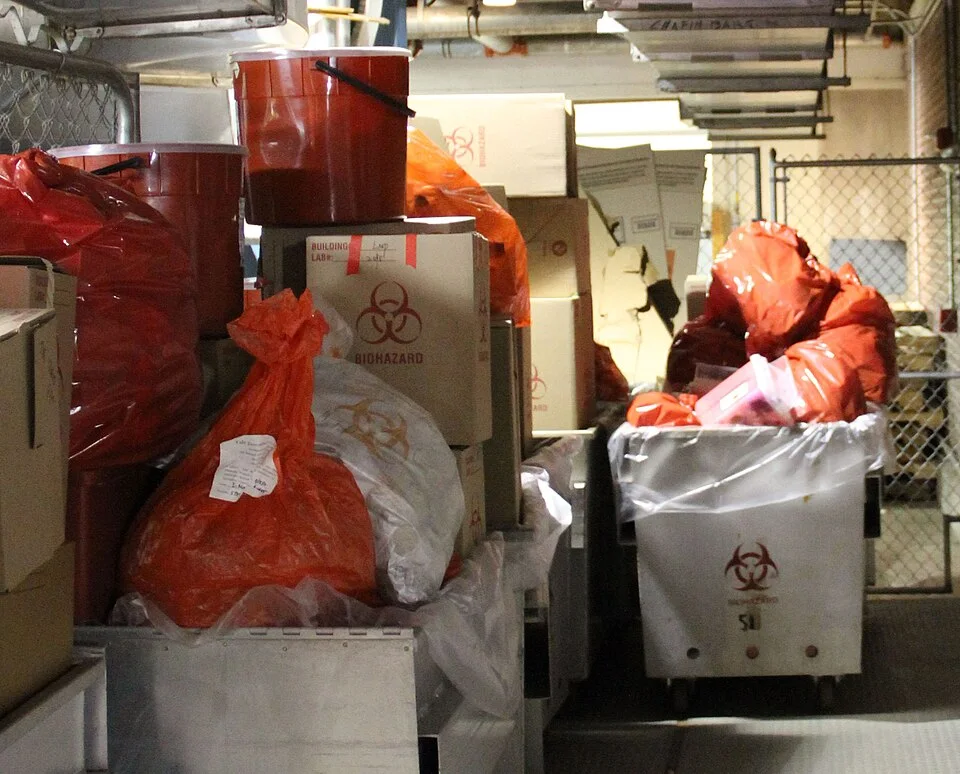
Biomedical waste: an illustration of the healthcare waste-management context.
Credit: MFERMION · CC BY-SA 3.0 · sourceResized and converted to WebP; uncropped.
1. Meaning, sources and environmental significance
Biomedical waste arises from hospitals, nursing homes, clinics, dispensaries, veterinary institutions, animal houses, pathological laboratories, blood banks, research institutions and health camps. The definition is activity-based: waste from a small vaccination camp can qualify just as waste from a large teaching hospital does. However, not everything discarded inside a hospital is biomedical waste. Uncontaminated office paper, food residues and packaging normally belong to the general solid-waste stream.
The hazardous fraction may be infectious, toxic or capable of causing physical injury. Blood-contaminated dressings, cultures containing microorganisms, discarded needles, anatomical material and cytotoxic medicines present different risks and therefore cannot be managed through a single disposal method. WHO's approximate 85:15 division between general and hazardous healthcare waste explains why segregation is crucial: mixing can convert a much larger quantity into a hazardous stream.
Poor management exposes healthcare workers, sanitation staff, waste transporters, informal recyclers and nearby communities. Needle-stick injuries can transmit blood-borne infections such as hepatitis B, hepatitis C and HIV. Untreated liquids can contaminate water, while insecure dumping allows scavenging, animal access and illegal reuse of medical disposables. Antibiotic residues and resistant organisms in healthcare effluents can also contribute to environmental pathways of antimicrobial resistance.
- Infectious hazard: pathogen-bearing blood, cultures and contaminated materials.
- Physical hazard: cuts and punctures from sharps, including metal needles and blades.
- Chemical hazard: disinfectants, laboratory chemicals, pharmaceuticals and cytotoxic drugs.
- Air-pollution hazard: particulates and toxic emissions from open burning or poorly operated incinerators.
Timeline
1998
India notified the Bio-Medical Waste (Management and Handling) Rules.
28 March 2016
The Bio-Medical Waste Management Rules, 2016 replaced the earlier framework and introduced four colour-coded categories.
2018–2019
Amendments refined implementation requirements under the 2016 rules.
2020 onward
CPCB issued and updated operational guidance for waste associated with COVID-19 treatment, diagnosis and quarantine.
2. India's regulatory framework and responsibilities
The Bio-Medical Waste Management Rules, 2016 were notified on 28 March 2016 under the Environment (Protection) Act, 1986 and subsequently amended. They replaced the earlier ten-category approach with four colour-coded categories linked to treatment and disposal. Their scope covers persons and institutions generating, collecting, receiving, storing, transporting, treating, disposing of or otherwise handling biomedical waste.
The occupier, meaning the person with administrative control over the institution and premises, is responsible for safe management. Key duties include segregation at source, suitable collection and storage, prescribed pretreatment, worker protection, record maintenance, accident reporting and submission of annual reports. Authorisation from the prescribed authority is required irrespective of the quantity handled; non-bedded facilities have a simplified one-time authorisation provision under the rules.
The Central Pollution Control Board prepares technical guidelines and coordinates implementation. State Pollution Control Boards and Pollution Control Committees grant authorisations, monitor compliance and enforce standards. Common Bio-Medical Waste Treatment Facilities, or CBWTFs, provide shared collection, treatment and disposal infrastructure. Outsourcing treatment does not remove the generator's responsibility for correct segregation and safe handover.
The rules require training at induction and at least annually, appropriate personal protective equipment, and immunisation of workers handling biomedical waste against diseases including hepatitis B and tetanus. Barcode-based tracking of bags and containers improves traceability. Radioactive waste, e-waste, batteries and other separately regulated streams must follow their respective legal frameworks rather than being indiscriminately placed in biomedical-waste containers.
- The 48-hour storage restriction specifically covers untreated anatomical, soiled and biotechnology waste, rather than every waste stream without distinction.
- Where such waste must be retained longer, protective measures are required and the prescribed authority must be informed with reasons.
- An institution should not establish an on-site treatment and disposal facility when an available CBWTF provides service within 75 kilometres, subject to the rules.
Safe biomedical-waste management chain
- 1. Minimise avoidable waste without compromising clinical safety
- 2. Segregate immediately at the point of generation
- 3. Collect in correctly labelled, colour-coded bags or containers
- 4. Pretreat specified streams and store securely within applicable time limits
- 5. Transfer through authorised, traceable transport
- 6. Apply category-specific treatment and authorised recycling or disposal
- 7. Maintain records, monitor compliance and report accidents
3. Segregation and colour-coded categories
Segregation must occur where waste is generated, such as at the bedside, operation theatre, laboratory or injection room, before storage or transportation. Sorting mixed waste later exposes workers and is not a substitute for source segregation. Containers must be appropriate to the waste: puncture resistance is essential for sharps, while bags used for relevant categories must be non-chlorinated.
Yellow is a broad category containing several distinct streams, including anatomical waste, soiled waste, discarded medicines, specified chemical waste and microbiology or clinical laboratory waste. It does not mean that every yellow-category item receives exactly the same treatment. Laboratory waste requires prescribed pretreatment; liquid chemical waste requires separate collection and suitable treatment. Deep burial is restricted to eligible rural or remote settings without access to a common facility and requires approval.
Red covers contaminated recyclable plastics, whereas white translucent containers hold metal sharps. Blue covers specified contaminated glassware and metallic body implants. A syringe barrel without its needle ordinarily belongs in red; its separated metal needle belongs in white. Cytotoxic-contaminated glass is not part of the ordinary blue-glass recycling pathway. These distinctions are frequent sources of objective-question errors.
- Yellow: anatomical and soiled waste, specified medicines, chemicals and laboratory waste.
- Red: contaminated recyclable plastics such as tubing, intravenous sets, catheters, urine bags and gloves.
- White translucent: metal sharps, including needles, scalpels, blades and syringes with fixed needles.
- Blue: contaminated glassware, except cytotoxic-contaminated glass, and metallic body implants.
| Colour | Examples | Treatment or disposal principle |
|---|---|---|
| Yellow | Anatomical waste, soiled dressings, expired medicines, specified laboratory waste | Stream-specific treatment; includes incineration, plasma pyrolysis or other prescribed routes, with pretreatment where required |
| Red | Contaminated tubing, intravenous sets, gloves, needle-free syringe barrels | Autoclaving, microwaving or hydroclaving, followed by shredding or mutilation and authorised recovery |
| White translucent | Metal needles, blades, scalpels and fixed-needle syringes | Puncture-proof, leak-proof, tamper-proof collection; sterilisation and prescribed destruction or encapsulation |
| Blue | Contaminated glass vials and bottles, except cytotoxic-contaminated glass; metallic implants | Prescribed disinfection or sterilisation, followed by recycling |
4. Treatment technologies and pollution control
Autoclaving uses steam under pressure to inactivate microorganisms. Microwaving and hydroclaving are other prescribed treatment options for suitable streams. Their effectiveness depends on operating conditions, loading and validation. Sterilisation does not necessarily destroy toxic chemical residues or render cytotoxic pharmaceuticals harmless; technology must therefore match the waste's biological and chemical properties.
Incineration destroys suitable waste through controlled high-temperature combustion, while plasma pyrolysis uses very high temperatures to decompose waste. Inadequate combustion and inappropriate feed materials can produce harmful emissions. Chlorinated plastics are especially problematic because their burning can contribute to dioxin and furan formation. Emission control, operating standards and safe ash management are therefore integral to incineration.
Contaminated recyclable plastics undergo authorised disinfection or sterilisation followed by shredding or mutilation and transfer through permitted recovery routes. Sharps require treatment and destruction or encapsulation through specified pathways to prevent reuse and injury. Wastewater needs appropriate treatment before discharge; dilution alone is not treatment. Uncontrolled dumping, open burning and sale of untreated contaminated plastics to informal recyclers are unacceptable practices.
- Incineration is not a universal solution for all healthcare waste.
- Disinfection addresses microbial hazards but may leave chemical hazards unresolved.
- Shredding prevents reuse but is not, by itself, a disinfection process.
- General waste should remain separate and enter the applicable municipal solid-waste system.
5. Implementation challenges and priorities
India's central implementation challenge is maintaining segregation and traceability across numerous small and dispersed generators. Rural access to treatment facilities, irregular collection, inadequate training, incomplete reporting and unsafe informal recovery can undermine otherwise adequate infrastructure. Mixing general refuse with biomedical waste also increases treatment costs and unnecessarily burdens incinerators.
Priorities include reliable collection networks, colour-coded containers at every generation point, repeated staff training, occupational-health surveillance and independently verified treatment performance. Barcode records should be reconciled with facility receipts and treatment logs. Public-health emergencies require reserve treatment capacity and clear operational guidance without abandoning normal segregation principles.
A life-cycle approach starts before disposal: rational purchasing, reduced unnecessary packaging and reusable products where clinically safe can lower waste generation. However, infection prevention and patient safety must remain decisive. The exam-ready conclusion is that biomedical-waste management combines public health, pollution control, worker safety and resource recovery; none can be achieved by colour coding alone.
- Monitor both the quantity collected and the quality of treatment.
- Protect sanitation workers as well as doctors, nurses and laboratory personnel.
- Use authorised recycling to recover materials only after the prescribed treatment.
- Integrate emergency preparedness with everyday compliance.
Biomedical waste: segregation determines safe treatment
Biomedical waste management interrupts pathways through which healthcare activities can spread infection, cause sharps injuries or release hazardous substances. The supplied metadata identifies the image as biomedical waste, making it relevant to this topic. However, it does not establish the waste’s composition, location, segregation category or compliance with disposal rules. These cannot be inferred from the title alone.
In India, the Bio-Medical Waste Management Rules, 2016 organise management around segregation at the point of generation and category-specific treatment. Healthcare waste is not automatically biomedical waste: uncontaminated general refuse must remain separate from regulated biomedical streams. Mixing waste increases risks for healthcare staff, sanitation workers and waste handlers, while complicating treatment and recovery. For Mains, effective implementation links hospital practices with worker training, protective equipment, authorised treatment facilities and regulatory oversight. Treatment technologies are not interchangeable; suitability depends on the waste category and prescribed standards.
- Yellow covers specified streams such as anatomical and soiled waste; red covers contaminated recyclable plastics. Yellow-category wastes do not all follow one identical treatment pathway.
- White translucent, puncture-proof containers collect contaminated metal sharps; blue covers specified glassware and metallic implants. Segregation depends on material and contamination, not merely the hospital department generating it.
- Disinfection is not final disposal: treated recyclable materials require authorised downstream handling. A photograph labelled biomedical waste cannot establish pathogen presence, treatment effectiveness or lawful disposal.
Real-world case studies
COVID-19 waste management in India
During the pandemic, CPCB issued guidance covering isolation wards, testing laboratories, quarantine centres and home care. Measures included separate identification of COVID-19 biomedical waste, strengthened collection precautions and tracking through the COVID19BWM application. The experience demonstrated the need for surge capacity while keeping ordinary food and packaging waste separate from biomedical waste.
Previous year questions
No source-linked PYQ is available here yet. Use the practice questions below.
Practice questions
Practice MCQ 1
Consider the following pairs: 1. Contaminated intravenous tubing — Red. 2. Discarded metal needle — White translucent. 3. Human anatomical waste — Blue. Which pairs are correctly matched?
- A. 1 and 2 only
- B. 2 and 3 only
- C. 1 and 3 only
- D. 1, 2 and 3
Practice MCQ 2
With reference to biomedical-waste treatment, consider the following statements: 1. Autoclaving uses steam under pressure. 2. Shredding alone reliably disinfects infectious waste. 3. Burning chlorinated plastics can contribute to dioxin and furan formation. Which statements are correct?
- A. 1 only
- B. 2 and 3 only
- C. 1 and 3 only
- D. 1, 2 and 3
Practice MCQ 3
Which statement best reflects India's biomedical-waste regulatory framework?
- A. All waste generated inside a hospital must be incinerated.
- B. A healthcare institution ceases to be responsible for segregation after contracting a common treatment facility.
- C. Biomedical-waste authorisation is required only above a minimum daily generation threshold.
- D. Biomedical waste must be segregated at its point of generation before storage or transport.
Mains practice · Biomedical-waste management is as much an institutional and occupational-safety challenge as a technological one. Discuss with reference to India's regulatory framework. Suggest measures to improve compliance. (250 words)
- Introduce the 2016 rules and the links between public health, worker safety and environmental protection.
- Explain source segregation, four colour categories and category-specific treatment.
- Identify occupier, CBWTF, CPCB and SPCB/PCC responsibilities.
- Discuss dispersed generators, mixed waste, weak tracking, rural service gaps and informal recycling.
- Recommend training, immunisation, protective equipment, barcode reconciliation, inspections and treatment validation.
- Conclude with safe resource recovery and emergency preparedness.
Further reading
- Ministry of Environment, Forest and Climate Change: Bio-Medical Waste Management Rules, 2016, with subsequent amendments.
- Central Pollution Control Board: Guidelines for Management of Healthcare Waste in Health Care Facilities.
- Central Pollution Control Board: Guidelines for Common Bio-Medical Waste Treatment and Disposal Facilities and annual implementation reports.
- World Health Organization: Safe Management of Wastes from Health-Care Activities, second edition.
- World Health Organization: Health-care waste fact sheet.
- https://commons.wikimedia.org/wiki/File:Biomedical_waste.jpg
Preparing for UPSC Civil Services? Get classroom teaching, answer-writing evaluation and mentorship at Pragnya IAS Academy, Ashok Nagar — see why aspirants choose us for IAS coaching in Hyderabad.