
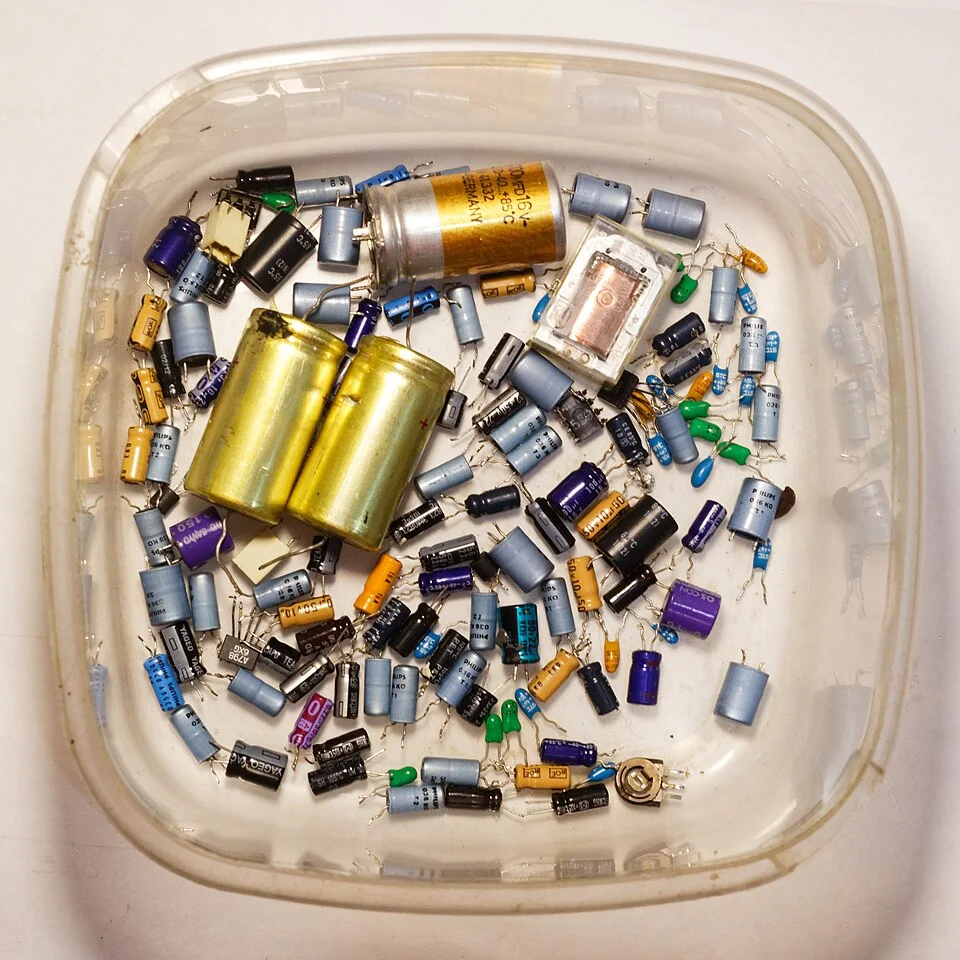
Discarded capacitors and other components from a Revox B215 cassette deck, illustrating component-level e-waste.
Credit: Retired electrician · CC0 · sourceResized and converted to WebP; uncropped.
1. Meaning, scope and sources
E-waste means electrical and electronic equipment discarded as waste, wholly or partly, as well as rejects from manufacturing, refurbishment and repair processes. Examples include computers, mobile phones, televisions, refrigerators, washing machines, printers and electronic medical or laboratory equipment covered by the applicable schedule. An old device still being used is not waste merely because it is technologically outdated; its disposal status matters.
Generation is driven by expanding access to electronics, shorter replacement cycles, falling device prices, software obsolescence and limited repairability. Household appliances contribute substantial mass, while smaller devices may contain comparatively concentrated valuable metals. E-waste is therefore heterogeneous: a refrigerator, circuit board and fluorescent lamp present different recovery opportunities and pollution risks.
The Global E-waste Monitor 2024, prepared by UNITAR and ITU, estimated global generation at 62 million tonnes in 2022 and projected about 82 million tonnes by 2030. India was the third-largest generator after China and the United States in the report’s estimates. Such international estimates should not be directly equated with Indian administrative figures, which may use different equipment coverage and estimation methods.
- Common streams include information technology equipment, consumer electronics, cooling appliances, lighting equipment and electrical tools.
- Urban mining refers to recovering useful materials from discarded products and infrastructure rather than extracting them only from natural ores.
Timeline
2011
India notified dedicated E-Waste (Management and Handling) Rules, effective from 1 May 2012.
2016
E-Waste (Management) Rules, 2016 replaced the earlier framework and strengthened EPR provisions.
1 April 2023
E-Waste (Management) Rules, 2022 came into force.
1 January 2025
Basel Convention e-waste amendments became effective, expanding prior informed consent controls.
2. Pollutants, exposure pathways and environmental effects
E-waste becomes especially dangerous when dismantling and material recovery occur without pollution controls. Breaking equipment can release contaminated dust; open burning of wires and plastics releases particulates and toxic fumes; crude acid leaching can discharge metal-rich wastewater. Dumping residues on bare ground allows pollutants to enter soil and water. Hazard depends on the equipment’s composition, the recovery method and the intensity of exposure.
Lead, historically used in solder and cathode-ray tube glass, damages the nervous system and is particularly harmful to children. Mercury occurs in some switches and lamps and can impair neurological development. Cadmium, present in certain components and older battery technologies, can damage kidneys and bones. Hexavalent chromium compounds can be toxic and carcinogenic. Not every electronic product contains every listed hazardous substance.
Some plastics contain brominated flame retardants. Poorly controlled burning of halogen-containing materials can form highly toxic dioxins and furans; these should not be treated as substances necessarily present in every intact device. Refrigerators and air conditioners also require safe recovery of refrigerants: depending on the refrigerant, leakage contributes to ozone depletion, climate change or both.
Workers may inhale fumes or dust, ingest contaminants through dirty hands, or experience skin contact with acids. Nearby communities face exposure through contaminated air, water and food. Children and pregnant women are particularly vulnerable. The environmental burden also extends upstream: premature disposal increases demand for mining, energy-intensive processing and manufacturing.
- Important distinctions: contamination is the presence of pollutants; exposure is contact with them; health risk depends on toxicity and dose.
- Safe recycling requires depollution, segregation, controlled material recovery and environmentally sound disposal of hazardous residues.
Environmentally sound end-of-life management
- 1. Segregate discarded electronics from mixed municipal waste.
- 2. Collect through traceable channels and assess reuse potential.
- 3. Refurbish suitable equipment and securely erase stored data.
- 4. Send non-reusable equipment to registered recyclers for depollution and dismantling.
- 5. Recover materials using controlled processes.
- 6. Send hazardous and unrecoverable residues to appropriate authorised facilities.
3. India’s regulatory framework and extended producer responsibility
The E-Waste (Management) Rules, 2022 were notified under the Environment (Protection) Act, 1986 and became effective on 1 April 2023. They cover listed electrical and electronic equipment and relevant components, consumables, parts and spares. Waste batteries, plastic packaging, radioactive waste and micro enterprises, as defined in the relevant law, are excluded from these rules’ application. Exclusion from this particular instrument does not mean freedom from all other environmental obligations.
Manufacturers, producers, refurbishers and recyclers must register through the Central Pollution Control Board’s portal as applicable. Extended producer responsibility, or EPR, makes producers responsible for meeting prescribed recycling obligations for equipment they place on the market. Producers fulfil these obligations by purchasing EPR certificates generated by registered recyclers. The certificate system is intended to link compliance to verified recycling rather than merely to collection announcements.
The scheduled recycling targets are 60% for financial years 2023–24 and 2024–25, 70% for 2025–26 and 2026–27, and 80% from 2027–28 onward. These percentages operate on the rules’ prescribed calculation base, involving historical sales and average product life, with special provisions for newer producers. They should not be interpreted as a percentage of all waste nationally generated in that year.
Bulk consumers must hand over their e-waste only to registered producers, refurbishers or recyclers. CPCB administers the central system, while State Pollution Control Boards and Pollution Control Committees undertake relevant monitoring and enforcement functions. Environmental compensation can be imposed for non-compliance; payment does not extinguish the underlying EPR obligation.
- Restriction of hazardous substances provisions generally limit lead, mercury, hexavalent chromium, polybrominated biphenyls and polybrominated diphenyl ethers to 0.1% by weight in homogeneous materials, and cadmium to 0.01%, subject to exemptions.
- Waste batteries follow the Battery Waste Management Rules, 2022 even when associated with electronic equipment.
| Constituent | Illustrative source | Principal concern |
|---|---|---|
| Lead | Older solder; cathode-ray tube glass | Neurotoxicity, especially in children |
| Mercury | Some lamps and switches | Neurological and developmental harm |
| Cadmium | Certain components and older batteries | Kidney and bone damage |
| Brominated flame retardants | Some plastic housings and circuit boards | Toxicity; hazardous emissions during uncontrolled burning |
| Copper, gold and aluminium | Wires, circuit boards and casings | Resource value; recovery needs pollution controls |
4. Circular economy, informal work and implementation challenges
A circular approach begins before waste is generated. Durable design, repairable construction, replaceable components and longer software support extend product life. Reuse and refurbishment preserve more of a product’s embedded value than immediate material recovery. Recycling remains essential when safe reuse is no longer feasible, but it cannot recover every material without loss.
India’s informal sector provides extensive collection networks, doorstep services and livelihoods. However, hazardous dismantling, open burning and uncontrolled chemical extraction can transfer recycling costs to workers and communities. Policy should distinguish useful collection and repair activities from unsafe processing, rather than treating all informal work as equally polluting.
Implementation requires convenient collection points, transparent buy-back arrangements, traceable material movement and sufficient environmentally sound recycling capacity. Informal collectors can be linked to registered facilities through training, contracts and worker protections. Independent verification is essential because false certificates, inflated recycling claims and diversion of collected waste can weaken EPR.
Data security is another practical barrier: households and institutions may retain unused computers and phones because they fear disclosure of personal information. Certified data destruction, consumer awareness and accessible return systems can release these stored materials into legitimate recovery channels. Public procurement can encourage repairability, longer warranties and responsible end-of-life management.
- Preferred sequence: prevent unnecessary consumption, extend life, reuse or refurbish, recycle, and safely dispose of unrecoverable residues.
- Formalisation should combine environmental compliance with occupational safety, social protection and viable livelihoods.
5. International governance and examination linkages
The Basel Convention regulates transboundary movements of hazardous wastes and their disposal. Its prior informed consent procedure requires the relevant consent process before controlled shipments proceed. E-waste amendments adopted in 2022 became effective on 1 January 2025, extending this control procedure to all electrical and electronic waste covered by the amended listings, including non-hazardous categories.
A shipment described as second-hand equipment may actually contain non-functional waste. Functionality, documentation and the intended destination therefore matter when distinguishing legitimate reuse from disguised dumping. In India, transboundary waste movements are also governed by the Hazardous and Other Wastes (Management and Transboundary Movement) Rules, 2016, as amended.
For Prelims, distinguish the Basel Convention from the Stockholm Convention on persistent organic pollutants and the Minamata Convention on mercury. For analytical answers, connect e-waste to resource efficiency, environmental justice and critical-mineral security. Recycling can reduce primary extraction and import dependence, but it complements rather than eliminates the need for responsible mining.
- EPR assigns end-of-life responsibility to producers; it does not mean that every producer must physically operate a recycling plant.
- Recycling is material recovery; refurbishment restores equipment for use. Collection alone is neither.
E-waste: Small Components, Larger Management Challenges
The supplied metadata identifies capacitors and other parts removed from a cassette deck and subsequently discarded. This makes the example directly relevant to e-waste: waste can arise from individual components during repair, not only when an entire appliance is thrown away. Repair can extend a product’s useful life while still generating residues requiring responsible management. However, component colours and the equipment’s identity do not establish chemical composition, hazardous content or actual pollutant release.
In India, such discarded parts connect repair activity with the wider e-waste collection and recycling chain. Poorly controlled dismantling, burning or chemical processing can expose workers and contaminate air, soil and water, depending on the materials and methods involved. Environmentally sound management combines collection, safe storage, material recovery and appropriate treatment of hazardous residues. Extended producer responsibility assigns producers obligations for the end-of-life management of covered equipment; it does not mean every discarded component is automatically collected or safely recycled. This example illustrates a general waste stream, not evidence of Indian disposal practices or regulatory compliance.
- Waste prevention differs from recycling: maintenance, repair and reuse prolong service life; recycling recovers materials after items become waste.
- Do not equate all capacitors with one hazardous substance. Composition varies, and metadata alone cannot establish the presence of lead, mercury or other toxic constituents.
- For Mains, connect circular-economy goals with worker protection and traceable recycling. Valuable recoverable materials do not eliminate the need to manage hazardous fractions safely.
Real-world case studies
Seelampur, Delhi: collection strength and processing risks
Seelampur is a prominent electronics scrap trading and dismantling centre. Its networks demonstrate the economic effectiveness of informal aggregation, while unsafe processing in such clusters raises occupational and neighbourhood health concerns. The policy lesson is to connect collectors and dismantlers with compliant facilities while providing training, protective measures and livelihood-sensitive transition support.
Guiyu, China: costs of uncontrolled recycling
Guiyu became internationally known for intensive informal electronics recycling, including crude dismantling and material extraction. Research documented environmental contamination and elevated lead exposure among children. Subsequent consolidation into more regulated facilities illustrates why recycling volumes alone are an inadequate measure of success: worker health, emissions and residue management also matter.
Previous year questions
No source-linked PYQ is available here yet. Use the practice questions below.
Practice questions
Practice MCQ 1
With reference to India’s E-Waste (Management) Rules, 2022, consider the following statements: 1. Producers may fulfil EPR obligations by purchasing certificates from registered recyclers. 2. Waste batteries are governed under these rules rather than a separate regulatory framework. 3. Collection of discarded equipment alone is equivalent to recycling. Which of the statements given above is/are correct?
- A. 1 only
- B. 1 and 2 only
- C. 2 and 3 only
- D. 1, 2 and 3
Practice MCQ 2
Which of the following practices can create dioxins and furans during informal e-waste processing?
- A. Secure erasure of data from a hard drive
- B. Uncontrolled burning of halogen-containing plastics
- C. Testing a used computer for refurbishment
- D. Manual sorting of intact aluminium casings without heating
Practice MCQ 3
The prior informed consent procedure for transboundary movement of controlled e-waste is principally associated with which convention?
- A. Ramsar Convention
- B. Convention on Biological Diversity
- C. Basel Convention
- D. Vienna Convention for the Protection of the Ozone Layer
Mains practice · E-waste management is as much a question of resource security and environmental justice as pollution control. Discuss with reference to India’s EPR framework. Suggest measures for integrating informal workers into environmentally sound recycling. (250 words)
- Explain valuable material recovery alongside toxic exposure and unequal health burdens.
- Describe the 2022 rules, registration, recycling targets and certificate-based producer compliance.
- Identify collection gaps, unsafe processing, unverifiable claims and weak traceability.
- Recommend collector partnerships, worker training, social protection and accessible registered facilities.
- Promote durable design, repair, refurbishment, secure data destruction and public procurement standards.
- Conclude with measurable outcomes covering recovery, emissions, health and livelihoods.
Further reading
- Ministry of Environment, Forest and Climate Change: E-Waste (Management) Rules, 2022 and subsequent amendments, official Gazette notifications.
- Central Pollution Control Board: e-waste management guidance and EPR portal.
- UNITAR and ITU: Global E-waste Monitor 2024.
- World Health Organization: Children and Digital Dumpsites, 2021.
- Basel Convention Secretariat: E-waste amendments and technical guidelines on transboundary movements.
- https://commons.wikimedia.org/wiki/File:Revox_B215_-_e-waste_-_old_capacitors.jpg
Preparing for UPSC Civil Services? Get classroom teaching, answer-writing evaluation and mentorship at Pragnya IAS Academy, Ashok Nagar — see why aspirants choose us for IAS coaching in Hyderabad.