
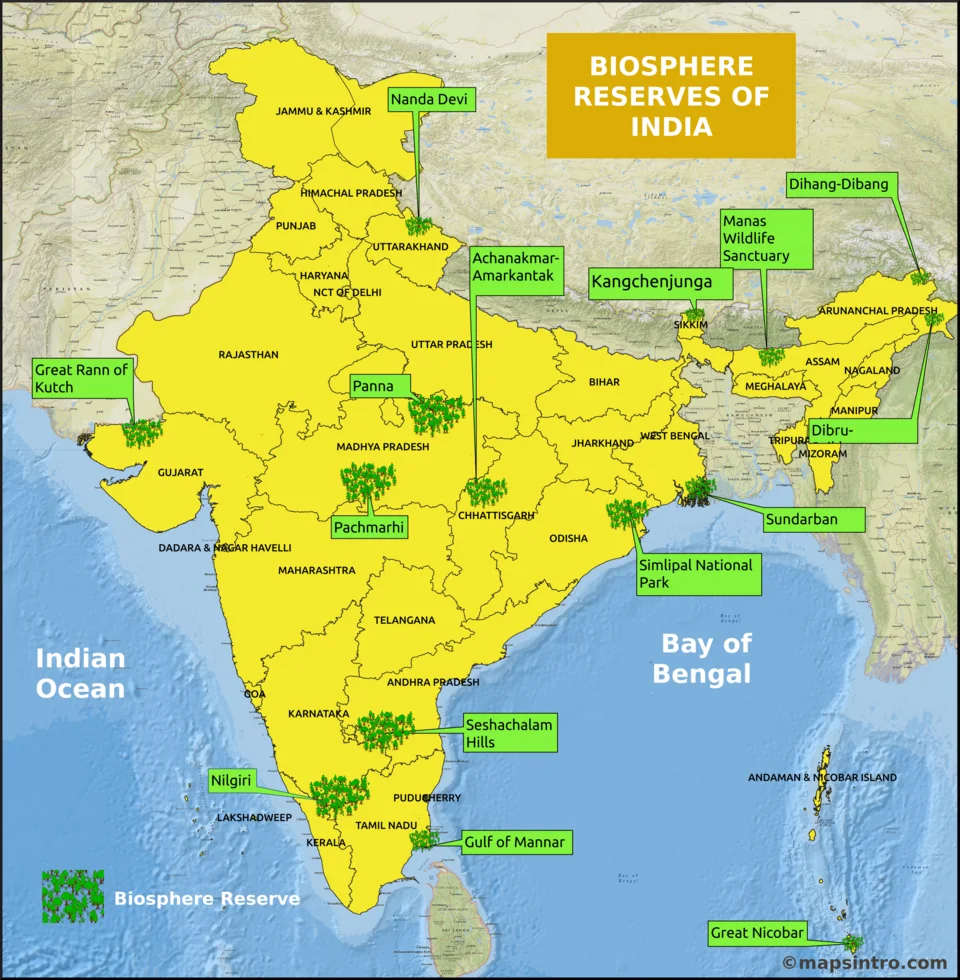
Illustrative map of India’s biosphere reserves; designation counts in the supplied metadata require date-specific verification.
Credit: MapsIntro · CC BY-SA 4.0 · sourceResized and converted to WebP; uncropped.
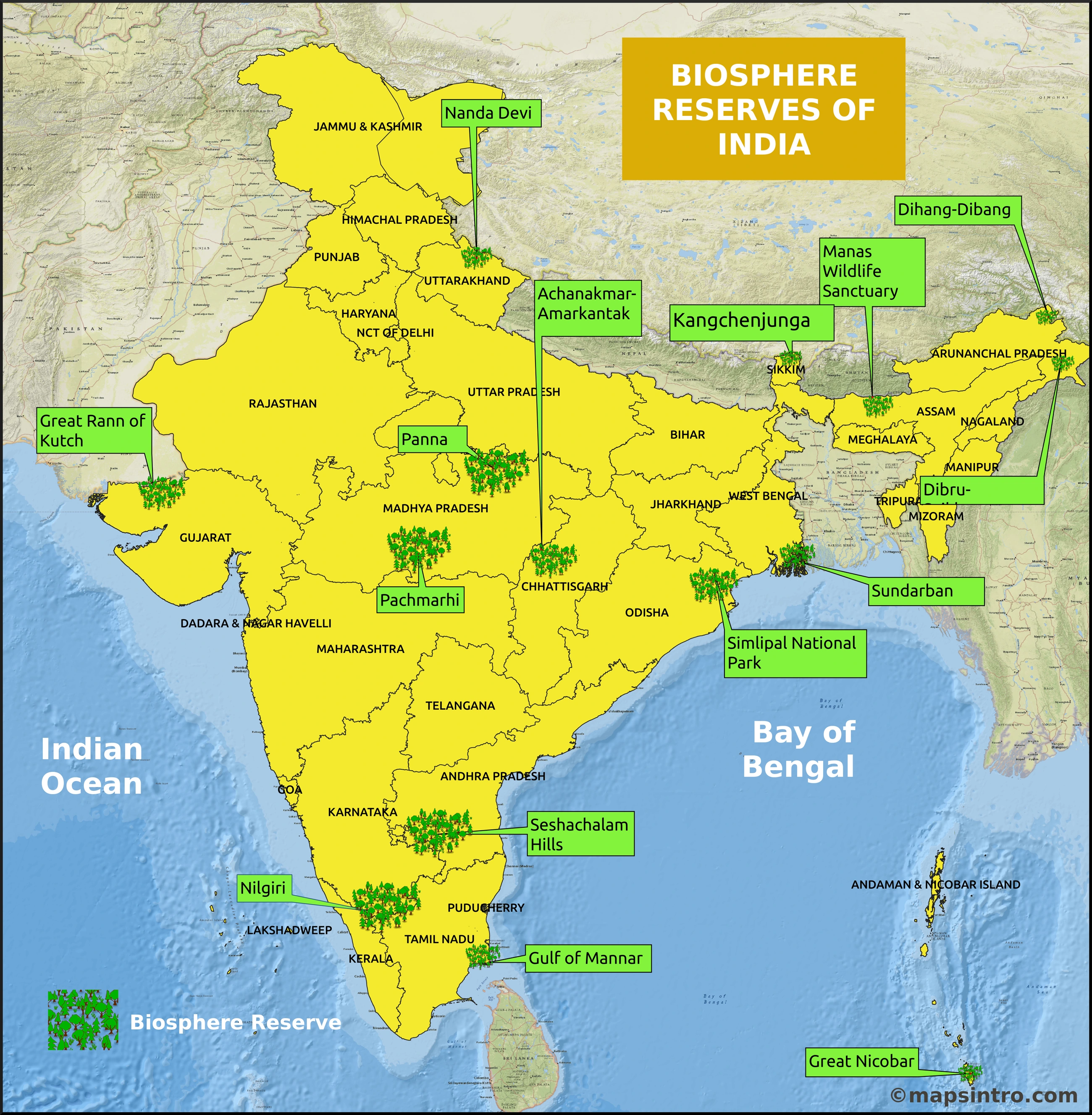
Map study
Biosphere reserves in the source reference map: locate mountain, plateau, coastal and island examples; verify the current official designation list separately.
- Read the source legend and reference date before interpreting the map.
- Use spatial patterns to support topic revision; verify current official boundaries, designations and warnings separately.
Credit: MapsIntro · CC BY-SA 4.0 · sourceConverted to WebP on an opaque white background; proportionally resized without cropping. Original cartography and legend retained.
1. Concept, objectives and international framework
A biosphere reserve is a representative area of terrestrial, coastal or marine ecosystems, or a combination of them, where biodiversity conservation is integrated with sustainable resource use. Unlike an approach centred only on fencing off wildlife habitat, the biosphere-reserve model treats people, livelihoods and ecological processes as connected. It seeks to maintain genetic diversity, species, ecosystems and landscapes while testing locally appropriate development practices.
UNESCO’s Man and the Biosphere Programme, commonly called MAB, is an intergovernmental scientific programme launched in 1971. Its World Network of Biosphere Reserves provides sites for research, education, monitoring and exchange of management experience. The Seville Strategy and the Statutory Framework of the World Network, adopted in 1995, clarified the functions, designation criteria and review arrangements of the network.
Every biosphere reserve should fulfil three mutually reinforcing functions. Conservation protects biodiversity and ecological processes. Development promotes economically and socially sustainable activities. Logistic support enables demonstration projects, environmental education, training, research and monitoring. Thus, a reserve should operate as a learning site for sustainability rather than merely as a wildlife refuge.
Countries nominate sites, and UNESCO’s MAB International Coordinating Council decides their inclusion in the network. Sites remain under national jurisdiction. Periodic review normally occurs every ten years to assess whether a reserve continues to meet the framework’s criteria. UNESCO biosphere-reserve recognition is distinct from World Heritage inscription and Ramsar designation, although these labels can overlap geographically.
Timeline
1971
UNESCO launches the Man and the Biosphere Programme.
1976
The World Network of Biosphere Reserves begins.
1986
Nilgiri becomes India’s first nationally designated biosphere reserve.
1995
The Seville Strategy and Statutory Framework establish key international guidance.
2000
Nilgiri becomes India’s first entry in UNESCO’s World Network.
September 2025
Cold Desert becomes India’s thirteenth UNESCO-recognised biosphere reserve.
2. Core, buffer and transition zones
Zonation reconciles strict ecological protection with surrounding human activity. The core area comprises one or more legally protected areas devoted to long-term conservation. It should protect important ecosystems and species with minimal disturbance. Non-destructive research and monitoring may be compatible with its purpose, but extractive use is generally excluded or tightly restricted under the applicable law.
The buffer zone surrounds or adjoins the core. Activities must be compatible with conservation objectives. Examples include ecological research, restoration, environmental education and carefully regulated tourism. A buffer is not an unrestricted commercial-use belt: infrastructure, visitor numbers and resource use must be assessed against their impacts on the core and wider ecosystem.
The transition area is the outer cooperative zone, where settlements, agriculture and other economic activities may occur. Communities, public authorities, researchers and businesses work together on sustainable land and water management. Agroforestry, efficient irrigation, community enterprises and responsible tourism can reduce pressure on sensitive habitats while maintaining livelihoods.
The familiar diagram of three concentric rings is only a teaching aid. Actual reserves may have several core areas, irregular boundaries and marine components. Ecological corridors and catchments may extend beyond administrative borders. Furthermore, a biosphere-reserve buffer is not automatically the same as a tiger reserve’s buffer, and its transition area is not automatically an eco-sensitive zone notified under environmental law.
From national proposal to international learning site
- 1. Identify a representative landscape and consult stakeholders
- 2. Define protected cores, compatible buffers and transition areas
- 3. Establish management and cooperation arrangements
- 4. Submit the national nomination to UNESCO
- 5. MAB International Coordinating Council considers designation
- 6. Implement management, monitoring and periodic review
3. Indian designation, legal status and governance
India initiated its Biosphere Reserve Programme in 1986, with Nilgiri as the first designation. The Ministry of Environment, Forest and Climate Change coordinates the programme nationally, while states and Union Territories undertake site-level implementation with relevant departments, scientific institutions and local communities. National designation and UNESCO recognition are separate processes: a nationally designated reserve need not already belong to the World Network.
A biosphere reserve is not a separate statutory protected-area category under the Wild Life (Protection) Act, 1972. National parks, wildlife sanctuaries, conservation reserves and community reserves have specific legal provisions; a biosphere reserve is a broader conservation and development framework. Its core may include national parks or sanctuaries, while other parts may contain reserved forests, villages, agricultural land or coastal waters.
Consequently, restrictions derive from the laws applicable to each constituent area, not simply from the biosphere-reserve label. Relevant instruments can include wildlife and forest legislation, the Environment (Protection) Act, 1986, coastal regulations and the Biological Diversity Act, 2002. The Scheduled Tribes and Other Traditional Forest Dwellers (Recognition of Forest Rights) Act, 2006 is important for recognising applicable community and individual rights.
Effective governance requires more than interdepartmental coordination. Gram Sabhas, Biodiversity Management Committees and livelihood groups can contribute local ecological knowledge and shape benefit-sharing arrangements. Conservation objectives should be pursued through lawful, rights-sensitive processes rather than assuming that designation automatically extinguishes existing rights or requires relocation.
| Zone | Primary purpose | Indicative compatible activities |
|---|---|---|
| Core | Long-term biodiversity protection | Non-destructive research and ecological monitoring, subject to legal restrictions |
| Buffer | Support and safeguard the core | Restoration, education, research and regulated tourism |
| Transition | Cooperative sustainable development | Settlements, sustainable agriculture and community enterprises |
4. Indian distribution and examination priorities
India’s biosphere reserves represent major biogeographic settings: Himalayan landscapes, deserts, the Western Ghats, northeastern hills, central Indian forests, mangroves, coasts and islands. Nilgiri spans Tamil Nadu, Kerala and Karnataka. Gulf of Mannar lies in Tamil Nadu and includes important marine ecosystems. Sundarban in West Bengal protects a tidal mangrove landscape, while Great Nicobar represents tropical island ecosystems.
Several names require careful map-based revision. Nokrek is in Meghalaya, Dibru-Saikhowa in Assam, Dihang-Dibang in Arunachal Pradesh and Khangchendzonga in Sikkim. Similipal is in Odisha, Pachmarhi in Madhya Pradesh and Achanakmar–Amarkantak spans Chhattisgarh and Madhya Pradesh. Cold Desert is in Himachal Pradesh, whereas Nanda Devi is in Uttarakhand.
As of September 2025, India has 18 national biosphere reserves and 13 UNESCO-recognised reserves. The five national reserves outside the World Network are Manas, Dibru-Saikhowa, Dihang-Dibang, Kachchh and Seshachalam Hills. Cold Desert became the thirteenth UNESCO-recognised Indian reserve in 2025. Always attach a reference date to membership counts because international recognition changes over time.
For Prelims, prioritise state–reserve pairs, ecosystem types, first designations and distinctions between overlapping labels. Nilgiri Biosphere Reserve is not identical to a single national park, and UNESCO recognition of a biosphere reserve does not mean that its entire area is a UNESCO World Heritage property.
5. Conservation significance and management challenges
Biosphere reserves support landscape-scale conservation by linking protected cores with surrounding production landscapes. They can conserve watershed functions, soil stability, pollinators and carbon stocks while providing space for species movement. Long-term monitoring helps distinguish climatic changes from local pressures and supports adaptive management.
Major threats include habitat fragmentation, invasive alien species, unsustainable tourism, pollution, extraction and human–wildlife conflict. Climate change adds risks such as shifting Himalayan vegetation, altered fire regimes, coral bleaching and coastal inundation. Protection of a core alone cannot address upstream water diversion, roads outside its boundary or pollution entering from surrounding settlements.
Management priorities include ecological connectivity, restoration using suitable native species, regulated visitor use, sustainable livelihood incentives and meaningful community participation. Monitoring should track ecological and social outcomes together: habitat condition, water quality, species trends, livelihood security and the distribution of conservation costs. Success means sustaining biodiversity alongside equitable development, not merely obtaining an international designation.
Biosphere reserves: landscapes, zonation and recognition
Biosphere reserves link biodiversity conservation with sustainable development and scientific learning across a landscape or seascape. An India-focused map is directly relevant for studying their geographical distribution and ecological diversity. However, the supplied metadata does not establish the map’s reference date, boundary accuracy or current recognition status. Its numerical claims should therefore be checked against authoritative Indian and UNESCO sources rather than treated as current facts.
The core–buffer–transition framework explains how these reserves function. Core areas prioritise long-term conservation; buffer zones accommodate activities compatible with conservation, such as research, monitoring and environmental education; transition areas encourage sustainable resource use and livelihoods through cooperation with local communities. In India, biosphere-reserve designation does not itself create a statutory protected-area category under the Wild Life (Protection) Act, 1972. Legal protection may instead arise from national parks, wildlife sanctuaries or other applicable laws within the wider reserve. National designation, inclusion in UNESCO’s World Network of Biosphere Reserves under the Man and the Biosphere Programme, and World Heritage inscription are distinct processes; one status does not automatically confer another.
- Map study: connect each reserve with its ecosystem and biogeographic setting; a map marker alone does not establish its extent or internal zonation.
- Prelims distinction: a biosphere reserve is not a conservation reserve, which is a separate statutory category under India’s wildlife law.
- Mains application: assess conservation alongside livelihood security, community participation and monitoring; UNESCO recognition alone does not demonstrate management effectiveness.
Real-world case studies
Nilgiri: conservation across state boundaries
Nilgiri links Western Ghats forests and montane ecosystems across three states, encompassing protected areas such as Mudumalai, Bandipur and Wayanad. Elephant movement, invasive plants and transport infrastructure require landscape-level coordination. It demonstrates why managing isolated parks is insufficient for wide-ranging species.
Gulf of Mannar: marine biodiversity and fishing livelihoods
Gulf of Mannar Biosphere Reserve includes coral reefs, seagrass beds and island ecosystems supporting marine biodiversity, including dugongs. The national park covers 21 islands and surrounding waters within the larger reserve. Sustainable fisheries, habitat protection and community participation are essential because marine ecological boundaries and livelihood-use areas overlap.
Previous year questions
No source-linked PYQ is available here yet. Use the practice questions below.
Practice questions
Practice MCQ 1
Consider the following statements: 1. Every nationally designated Indian biosphere reserve automatically enters UNESCO’s World Network. 2. A biosphere reserve may include national parks and inhabited landscapes. 3. UNESCO recognition transfers management jurisdiction to UNESCO. Which statement is correct?
- A. 1 only
- B. 2 only
- C. 1 and 2 only
- D. 2 and 3 only
Practice MCQ 2
Which pairing is incorrectly matched?
- A. Nokrek — Meghalaya
- B. Cold Desert — Himachal Pradesh
- C. Dihang-Dibang — Assam
- D. Seshachalam Hills — Andhra Pradesh
Practice MCQ 3
Which best describes logistic support as a function of biosphere reserves?
- A. Building freight corridors through protected cores
- B. Supporting research, monitoring, education and training
- C. Replacing local authorities with international administrators
- D. Restricting all human activity throughout the reserve
Mains practice · Biosphere reserves are instruments of landscape governance rather than merely additional protected areas. Discuss with Indian examples. (250 words)
- Explain conservation, development and logistic-support functions.
- Connect core–buffer–transition zonation with differing management objectives.
- Distinguish national designation, UNESCO recognition and statutory protection.
- Use Nilgiri for connectivity and interstate coordination, and Gulf of Mannar for marine livelihoods.
- Address community rights, fragmentation, tourism and climate risks.
- Recommend participatory governance and measurable ecological and livelihood outcomes.
Further reading
- UNESCO: Man and the Biosphere Programme and World Network of Biosphere Reserves directory.
- UNESCO: Seville Strategy and Statutory Framework of the World Network of Biosphere Reserves, 1995.
- Ministry of Environment, Forest and Climate Change: Biosphere Reserves programme and annual reports.
- India Code: Wild Life (Protection) Act, 1972.
- NCERT Biology, Class XII: Biodiversity and Conservation.
- https://commons.wikimedia.org/wiki/File:Biosphere_reserves_in_India.png
Preparing for UPSC Civil Services? Get classroom teaching, answer-writing evaluation and mentorship at Pragnya IAS Academy, Ashok Nagar — see why aspirants choose us for IAS coaching in Hyderabad.