
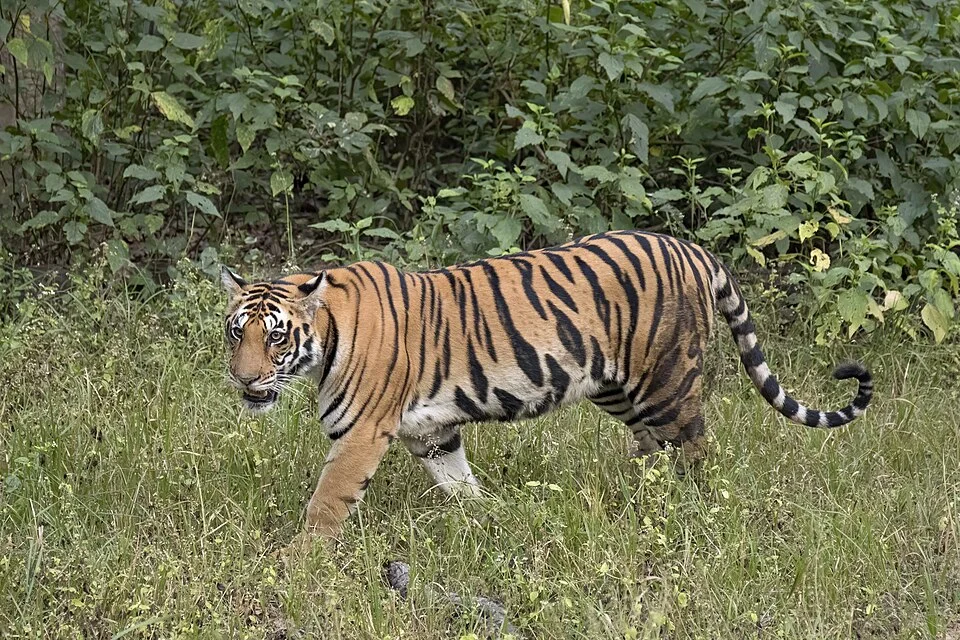
Female Bengal tiger at Kanha National Park, India, according to the image metadata; illustrative of tiger-reserve conservation.
Credit: Charles J. Sharp · CC BY-SA 4.0 · sourceResized and converted to WebP; uncropped.
1. Meaning, purpose and evolution
A tiger reserve is a conservation landscape designated under the Wild Life (Protection) Act, 1972, specifically to sustain viable populations of wild tigers. Tigers require adequate prey, water, cover and space; their protection therefore benefits forests, grasslands, wetlands and many associated species. This makes the tiger an umbrella species as well as a flagship species. Tiger reserves also safeguard watersheds, store carbon and support regulated nature-based livelihoods.
Project Tiger was launched on 1 April 1973, initially covering nine reserves, including Corbett, Kanha, Manas, Melghat, Palamau, Ranthambore, Similipal, Bandipur and Sundarbans. It responded to falling tiger numbers caused by hunting, habitat loss and prey depletion. The disappearance of tigers from Sariska, publicly established in 2005, exposed weaknesses in protection and monitoring and accelerated institutional reform.
Tiger reserve is not a synonym for national park. A reserve may include one or more national parks or wildlife sanctuaries and adjoining forests or other land in its buffer. Likewise, a tiger reserve is not a conservation reserve: the latter is a separate legal designation under Section 36A. Biosphere reserves follow a different conservation framework and are not, by that designation alone, a protected-area category under the Act.
- The tiger, Panthera tigris, is listed in Schedule I of the Wild Life (Protection) Act and classified as Endangered on the IUCN Red List.
- India's tiger landscapes include the Shivalik–Gangetic plains, Central India and Eastern Ghats, Western Ghats, northeastern hills and Brahmaputra plains, and Sundarbans.
Timeline
1973
Project Tiger launched with nine reserves.
2005
Sariska's loss of tigers exposed major protection and monitoring failures.
2006
Wildlife-law amendment established the statutory NTCA and tiger-reserve framework.
2023
Detailed results of the 2022 tiger assessment released, estimating 3,682 tigers.
March 2025
Madhav in Madhya Pradesh became India's 58th tiger reserve.
2. Legal framework and institutions
The 2006 amendment inserted dedicated tiger-conservation provisions into the Wild Life (Protection) Act. Section 38L provides for the National Tiger Conservation Authority, or NTCA, a statutory body under the Ministry of Environment, Forest and Climate Change. Chaired by the Union Environment Minister, it approves Tiger Conservation Plans, sets standards, evaluates management and supports protection and monitoring. Project Tiger is the programme; NTCA is the statutory authority.
Under Section 38V, the state government notifies a tiger reserve on NTCA's recommendation and prepares a Tiger Conservation Plan. The plan must address protection, habitat management, adequate prey, ecologically compatible land use and the livelihood interests of local people. Management must also consider dispersal habitats and connections with other protected areas, rather than treating each reserve as an isolated forest island.
The law places strong safeguards on reducing protection. A tiger reserve's boundaries cannot be altered except on NTCA's recommendation and the approval of the National Board for Wild Life. De-notification requires public interest and approval of both bodies. State forest departments undertake field management, while the Wildlife Crime Control Bureau supports action against organised wildlife crime. Tiger Conservation Foundations provide an institutional mechanism for supporting conservation and associated local development.
- NTCA does not replace the state forest department as the routine field-management agency.
- A Tiger Conservation Plan is a statutory planning requirement, not merely a tourism plan.
Simplified tiger-reserve planning and management sequence
- 1. Scientifically assess tiger habitat, prey and landscape connectivity
- 2. Undertake statutory consultations and determine core and buffer areas
- 3. Obtain NTCA recommendation and state notification
- 4. Prepare Tiger Conservation Plan for NTCA approval
- 5. Implement protection, rights safeguards and community measures
- 6. Monitor populations and evaluate management effectiveness
3. Core, buffer and community rights
The core or critical tiger habitat comprises areas of national parks and sanctuaries scientifically identified as necessary to be kept inviolate for tiger conservation. Its determination must follow the statutory expert-consultation process and must not casually override the rights of Scheduled Tribes and other forest dwellers. Inviolate habitat is intended to minimise incompatible human disturbance in essential breeding and survival areas.
The buffer or peripheral area surrounds or adjoins the core and requires a lower degree of habitat protection. Its purpose is to support dispersal, reduce pressures on the core and promote coexistence between wildlife and human activity, with due recognition of local livelihood, developmental, social and cultural rights. Buffer boundaries are determined using scientific and objective criteria in consultation with the concerned Gram Sabhas and an expert committee.
Notification does not automatically extinguish rights or authorise eviction. Where relocation is proposed to establish inviolate areas, statutory safeguards include recognition and determination of rights, examination of coexistence possibilities, an adequate rehabilitation package, informed consent of the Gram Sabha and affected persons, and provision of facilities and land allocation at the rehabilitation site before displacement. The Forest Rights Act, 2006 is therefore central to lawful implementation.
Critical tiger habitat under the wildlife law must be distinguished from critical wildlife habitat under the Forest Rights Act. Their legal bases and identification procedures differ. Tourism is also not an unrestricted entitlement: it must conform to applicable guidelines, zoning, carrying capacity and the Tiger Conservation Plan. Neither a blanket claim that tourism is permitted everywhere nor that all tourism is prohibited throughout every core is correct.
| Designation | Legal or institutional basis | Key distinction |
|---|---|---|
| Tiger reserve | Section 38V, Wild Life (Protection) Act | Tiger-focused landscape with core and buffer |
| National park | Section 35, Wild Life (Protection) Act | May form part of a tiger reserve |
| Conservation reserve | Section 36A, Wild Life (Protection) Act | Generally government land, often adjoining or connecting protected areas |
| Critical wildlife habitat | Forest Rights Act, 2006 | Not identical to critical tiger habitat |
| Biosphere reserve | National programme; selected sites recognised by UNESCO | Not a standalone protected-area category under the wildlife law |
4. Monitoring, corridors and conservation challenges
India's All India Tiger Estimation combines field evidence, camera trapping and statistical analysis. Individual tigers can be recognised from their unique stripe patterns. The 2022 assessment produced an estimated population of 3,682, with a range of 3,167–3,925. The earlier headline figure of 3,167 should not be confused with the subsequently released estimate of 3,682. National estimates include tigers outside notified reserves.
M-STrIPES, or Monitoring System for Tigers–Intensive Protection and Ecological Status, supports patrol recording and ecological monitoring. Camera traps, spatial analysis and field intelligence complement rather than replace trained personnel. Management Effectiveness Evaluation assesses how well reserves are managed, while population monitoring assesses tiger occurrence and abundance; the two exercises answer different questions.
Major threats include poaching, illegal trade in body parts, prey depletion, forest fragmentation, linear infrastructure, invasive plants and human–tiger conflict. Corridors permit dispersal and gene flow between populations, reducing isolation. Roads, railways, mines and poorly planned settlements can sever these connections. Mitigation requires landscape-level assessment, avoidance of critical habitats, appropriate wildlife crossings and monitoring of their actual use.
Conflict prevention combines secure livestock husbandry, prompt compensation, early warning and trained response teams. Reserve success should be judged by breeding populations, prey availability, habitat quality, connectivity and community outcomes, not tiger numbers alone.
5. Geography and Prelims distinctions
Map-based preparation should connect reserves with states, river systems and habitat types. Sundarbans in West Bengal protects tidal mangroves; Kaziranga in Assam includes floodplain grasslands; Periyar in Kerala lies in the southern Western Ghats; and Namdapha in Arunachal Pradesh spans a large altitudinal gradient. Nagarjunsagar–Srisailam in Andhra Pradesh is associated with the Nallamala hills and Krishna basin.
Among the original reserves, Corbett lies in Uttarakhand, Kanha and Bandipur in Madhya Pradesh and Karnataka respectively, and Melghat in Maharashtra's Satpura landscape. Learn these stable geographical associations before memorising changing totals. A reserve's notification does not mean that every part has identical legal restrictions, that all tiger habitat lies within reserves, or that corridors automatically acquire a separate protected-area status.
Tiger reserves: conserving habitats, prey and connected landscapes
The metadata identifies a female Bengal tiger at Kanha National Park, which forms part of the Kanha tiger-reserve landscape. This makes the photograph relevant to the species that anchors tiger-reserve management, but it does not establish habitat quality, population trends or conservation success. Effective tiger conservation requires adequate prey, breeding habitat, protection against poaching and movement routes beyond individual protected-area boundaries.
Under the Wild Life (Protection) Act, 1972, state governments notify tiger reserves on the recommendation of the National Tiger Conservation Authority. A reserve includes a core or critical tiger habitat and a buffer or peripheral area. Core areas are intended to be kept inviolate for tiger conservation through the statutory process, while buffer management promotes coexistence between wildlife and human activity, recognising local livelihood, developmental, social and cultural rights. A tiger reserve is therefore not simply another name for a national park: its boundaries and management framework can encompass national parks, sanctuaries and other land.
- Institutional distinction: Project Tiger is a conservation programme; the NTCA is a statutory authority. Neither term denotes a separate protected-area category equivalent to a national park.
- Legal distinction: critical tiger habitat under wildlife law differs from critical wildlife habitat under the Forest Rights Act. Relocation requires legal safeguards; core designation alone does not authorise automatic eviction.
- Landscape perspective: corridors support dispersal and genetic exchange. Assess conservation through monitored populations, prey, habitat connectivity and human–wildlife conflict, not an isolated photograph or sighting.
Real-world case studies
Panna: recovery through reintroduction
After losing its resident tiger population, Panna Tiger Reserve in Madhya Pradesh began tiger reintroduction in 2009. Translocations, intensive tracking, stronger protection and subsequent breeding rebuilt the population. The case shows that recovery requires addressing the causes of disappearance, not simply releasing animals.
Sundarbans: conserving tigers in a tidal landscape
The India–Bangladesh Sundarbans supports tigers in mangrove habitat. Tidal channels, cyclones, erosion and climate-related risks complicate monitoring and protection. Conservation requires transboundary cooperation alongside safeguards for fishing and forest-dependent communities.
Previous year questions
No source-linked PYQ is available here yet. Use the practice questions below.
Practice questions
Practice MCQ 1
Which statement correctly describes the notification of a tiger reserve?
- A. UNESCO notifies it on a state government's proposal.
- B. The state government notifies it on NTCA's recommendation.
- C. NTCA alone notifies it without state involvement.
- D. The National Biodiversity Authority notifies it.
Practice MCQ 2
Consider the following statements: 1. A tiger reserve may include a national park. 2. Critical tiger habitat and critical wildlife habitat are legally identical. 3. All wild tigers in India occur within notified tiger reserves. Which statements are correct?
- A. 1 only
- B. 1 and 2 only
- C. 2 and 3 only
- D. 1, 2 and 3
Practice MCQ 3
Which pair is incorrectly matched?
- A. Melghat — Maharashtra
- B. Namdapha — Arunachal Pradesh
- C. Periyar — Karnataka
- D. Sundarbans — West Bengal
Mains practice · Tiger conservation requires more than protecting core habitats. Discuss with reference to landscape connectivity and community rights. Answer in 250 words.
- Explain the statutory core–buffer model.
- Show how corridors sustain dispersal and genetic exchange.
- Discuss infrastructure fragmentation and habitat mitigation.
- Examine forest rights, lawful relocation and coexistence.
- Recommend conflict prevention, compensation and community participation.
- Evaluate success through ecological and social outcomes.
Further reading
- India Code: Wild Life (Protection) Act, 1972, especially Sections 38L–38XA.
- National Tiger Conservation Authority: tiger-reserve notifications, guidelines and reserve profiles, ntca.gov.in.
- NTCA and Wildlife Institute of India: Status of Tigers, Co-predators and Prey in India, 2022.
- Ministry of Tribal Affairs: Forest Rights Act, 2006 and associated rules.
- NCERT Biology, Class XII: Biodiversity and Conservation.
- https://commons.wikimedia.org/wiki/File:Bengal_tiger_(Panthera_tigris_tigris)_female_3.jpg
Preparing for UPSC Civil Services? Get classroom teaching, answer-writing evaluation and mentorship at Pragnya IAS Academy, Ashok Nagar — see why aspirants choose us for IAS coaching in Hyderabad.