
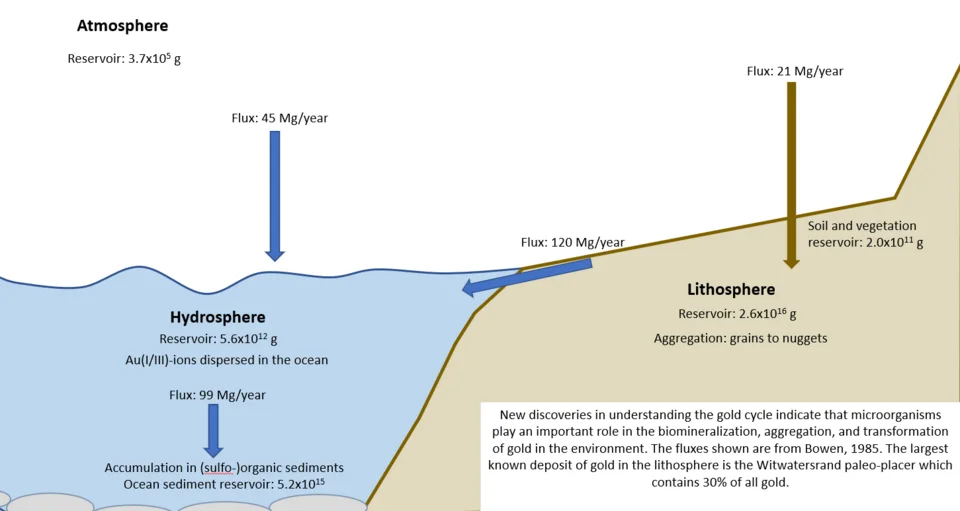
Gold-cycle illustration highlighting microbial interactions with non-living environmental materials.
Credit: Bernadette Drouhard · CC BY-SA 4.0 · sourceResized and converted to WebP; uncropped.
1. Ecosystems: living organisms and their environment
An ecosystem is a functional unit in which a community of organisms interacts with its physical environment through energy flow and material exchange. It may be a pond, forest, grassland, agricultural field or even a small water-filled tree cavity. Ecosystem boundaries depend on the purpose of study: a lake can be studied separately, but it also receives water, sediments and nutrients from its catchment. Most ecosystems are therefore open systems exchanging both energy and matter with their surroundings.
Biotic components are living organisms, including plants, animals, fungi, bacteria and archaea. Abiotic components are non-living environmental constituents and conditions. The distinction is not simply between visible organisms and invisible surroundings: microorganisms are biotic, while dissolved oxygen and mineral ions are abiotic. Dead leaves and carcasses are non-living organic matter rather than living components, although they originate from organisms and remain integral to ecosystem functioning.
A population comprises individuals of one species in an area; a community comprises populations of different species. An ecosystem includes the community plus its abiotic environment. Habitat refers to where an organism lives, while its ecological niche includes resource use, environmental requirements and interactions. These terms are related but not interchangeable.
2. Biotic components and their functional roles
Producers, or autotrophs, synthesise organic compounds from inorganic carbon using an external energy source. Green plants, algae and cyanobacteria generally use sunlight through photosynthesis. Some bacteria and archaea use energy from the oxidation of inorganic substances, such as ammonia or hydrogen sulphide, for chemosynthesis. Thus, sunlight is the principal energy source for most ecosystems, but not for every ecosystem.
Consumers, or heterotrophs, obtain organic matter from other organisms or their products. Herbivores generally function as primary consumers, while carnivores may occupy secondary or higher consumer levels. Omnivores can feed at several trophic levels. Trophic position is determined by feeding relationships, not merely by species identity: a fish eating algae and smaller fish participates at different levels within a food web.
Decomposers, especially bacteria and fungi, chemically break down dead organic matter, commonly by releasing enzymes and absorbing soluble products. Detritivores, such as earthworms, ingest detritus and often fragment it, increasing the surface area available to microbes. Scavengers, such as vultures, consume relatively large dead animal remains. These groups contribute to decomposition but are not functionally identical. Mutualism, competition, predation, parasitism and disease further shape community structure and ecosystem functioning.
Simplified nutrient recycling pathway
- 1. Inorganic nutrients occur in soil or water
- 2. Producers absorb nutrients and incorporate them into biomass
- 3. Feeding transfers nutrients to consumers
- 4. Death and excretion add organic matter to the detrital pool
- 5. Decomposers mineralise organic nutrients
- 6. Released inorganic nutrients become available for renewed uptake
3. Major abiotic components and their ecological effects
Light supplies energy for photosynthesis and provides signals regulating biological rhythms. Its intensity, duration and spectral composition influence plant growth, flowering and aquatic productivity. In water, light availability generally decreases with depth and turbidity. The euphotic zone receives enough light for substantial photosynthesis; its depth varies with water clarity rather than following one universal limit.
Temperature affects enzyme activity, metabolism, growth and reproduction. Species differ in their thermal limits and adaptations. Water availability influences terrestrial vegetation, animal activity and decomposition. In aquatic habitats, salinity and dissolved oxygen are particularly important. Warmer water generally holds less dissolved oxygen at equilibrium than cooler water, although actual oxygen levels also reflect photosynthesis, respiration, mixing and pollution.
Soil factors, also called edaphic factors, include texture, structure, depth, moisture, aeration, pH and mineral composition. These influence rooting, drainage and nutrient availability. Soil itself is a mixed system containing minerals, water, air, organic matter and living organisms; it should not be treated as wholly lifeless.
Atmospheric gases, wind, humidity, rainfall, altitude, slope and aspect also affect organisms. Nutrients such as nitrogen and phosphorus are necessary, but excessive inputs can cause eutrophication. Consequently, an abiotic factor can be beneficial within one range and harmful outside it.
| Component | Category | Ecological significance |
|---|---|---|
| Phytoplankton and aquatic plants | Biotic: producers | Fix inorganic carbon using light energy |
| Zooplankton and fish | Biotic: consumers | Transfer biomass through feeding relationships |
| Bacteria and fungi | Biotic: decomposers | Break down organic matter and mineralise nutrients |
| Light, temperature and dissolved oxygen | Abiotic conditions | Influence photosynthesis, metabolism and survival |
| Water and dissolved mineral nutrients | Abiotic resources | Provide the medium and materials for biological processes |
| Dead leaves and animal remains | Non-living organic matter | Supply detritus to detritivores and decomposers |
4. How biotic and abiotic components interact
Producers incorporate carbon dioxide, water and nutrients into biomass. Herbivores and predators transfer part of this biomass through food chains, while excretion and death supply detritus. Decomposers release inorganic nutrients through mineralisation, making them available for renewed uptake. Respiration returns carbon dioxide to the environment. Nutrient cycles therefore connect living biomass with atmospheric, aquatic and soil reservoirs.
Energy behaves differently from nutrients. It enters most ecosystems as sunlight, is transformed into chemical energy and ultimately dissipates as heat. It is not recycled within the ecosystem. The commonly taught 10 per cent law is an approximate description of trophic energy transfer, not a universal fixed efficiency applicable to every ecosystem or feeding relationship.
Organisms also modify abiotic conditions. Vegetation shades the ground, intercepts rainfall and reduces erosion; roots and microbes alter soil structure and chemistry. Photosynthetic organisms can raise oxygen concentrations during daylight, while respiration consumes oxygen continuously. Earthworms redistribute soil material, and corals construct structures that change local water movement and create habitats.
Decomposition demonstrates joint control by both component groups. Warm, moist and adequately aerated conditions often favour microbial breakdown. Low temperature, oxygen shortage and resistant material rich in lignin can slow it. Waterlogging may promote organic matter accumulation, although anaerobic decomposition continues and can generate methane.
5. Limiting factors, tolerance and Prelims applications
Liebig’s law of the minimum highlights that growth can be constrained by the essential resource in shortest supply relative to need. Adding other abundant resources may then produce little improvement. Shelford’s law of tolerance emphasises that organisms have lower and upper tolerance limits for environmental factors. Both deficiency and excess can restrict survival, reproduction or distribution.
Tolerance varies among species, life stages and physiological conditions. A species may survive at a site without reproducing successfully there. Eurythermal organisms tolerate a relatively wide temperature range, whereas stenothermal organisms tolerate a narrow range. Euryhaline and stenohaline describe broad and narrow salinity tolerance respectively. These terms indicate relative tolerance, not the complete absence of environmental limits.
For Prelims, avoid single-factor explanations. A plant’s absence may reflect unsuitable temperature, nutrient shortage, herbivory, competition or failure to disperse. Likewise, high nutrient concentrations do not always indicate a healthy aquatic ecosystem: algal growth followed by microbial decomposition can deplete oxygen.
Environmental management must address both living communities and physical conditions. Wetland restoration requires suitable hydrology and water quality, not merely planting vegetation. Forest restoration similarly depends on soils, rainfall, disturbance and appropriate species. Protecting organisms without maintaining their abiotic requirements may not secure a functioning ecosystem.
Biotic–abiotic interactions: microorganisms and gold
The gold cycle offers a specialised example of interaction between biotic and abiotic ecosystem components. Microorganisms are biotic components; gold-bearing minerals, dissolved chemical substances, water and surrounding physical conditions are abiotic components. The supplied description highlights microbial roles in gold biomineralization, aggregation and transformation. This illustrates a fundamental ecological principle: organisms do not merely respond to their physical environment; their activities can also modify the chemical forms and distribution of non-living materials.
However, gold cycling should not be confused with the cycling of essential nutrients such as carbon, nitrogen and phosphorus. Gold is not generally recognised as an essential nutrient, and its environmental movement does not itself represent energy flow through a food chain. For Indian ecosystems, the transferable concept is that soil and aquatic microorganisms mediate exchanges between living communities and their physical surroundings. This image is a conceptual illustration, not evidence of microbial processes at any particular Indian gold deposit. Its metadata alone cannot establish local transformation rates, ecological significance or the validity of individual depicted fluxes.
- Classify by living status: a microorganism is biotic; a mineral it transforms remains abiotic.
- Distinguish processes: matter can circulate among environmental reservoirs, whereas ecosystem energy flows and is progressively dissipated as heat.
- Avoid functional assumptions: microbial participation in mineral transformation does not automatically identify the organisms as producers, decomposers or detritivores.
Real-world case studies
Chilika Lake, Odisha: hydrology shapes biodiversity
Chilika is a brackish-water coastal lagoon where freshwater inflows and exchange with the Bay of Bengal regulate salinity. A new sea mouth opened in 2000 improved tidal exchange and helped restore ecological conditions supporting fisheries. Chilika was removed from the Ramsar Convention’s Montreux Record in 2002. The case demonstrates how changing an abiotic condition can influence biological communities and livelihoods.
Coral bleaching: thermal stress disrupts symbiosis
Reef-building corals depend on symbiotic photosynthetic dinoflagellates for much of their energy. Prolonged unusually high sea temperatures can disrupt this relationship, causing corals to lose symbionts or their pigments and appear white. Bleaching does not automatically mean death, but sustained stress increases mortality risk. Marine heatwaves affecting the Great Barrier Reef illustrate the dependence of biotic interactions on abiotic conditions.
Previous year questions
UPSC Prelims 2013
Which of the following best describes an ecosystem?
- A. A community of organisms interacting with one another
- B. The part of the Earth inhabited by living organisms
- C. A community of organisms together with the environment in which they live
- D. The flora and fauna of a geographical area
Practice questions
Practice MCQ 1
Consider the following statements: 1. All autotrophs obtain energy directly from sunlight. 2. Detritivores can facilitate microbial decomposition by fragmenting detritus. 3. An omnivore may occupy more than one trophic level. Which statements are correct?
- A. 1 and 2 only
- B. 2 and 3 only
- C. 1 and 3 only
- D. 1, 2 and 3
Practice MCQ 2
Which statement correctly distinguishes energy flow from nutrient cycling in an ecosystem?
- A. Both energy and nutrients are indefinitely recycled within the ecosystem.
- B. Energy is recycled, while nutrients move only from producers to consumers.
- C. Energy is progressively dissipated as heat, while nutrients can be reused after transformation.
- D. Decomposers return usable solar energy directly to producers.
Practice MCQ 3
Following a large nutrient inflow, a lake develops an algal bloom and subsequently experiences fish mortality. Which sequence most plausibly explains the mortality?
- A. Nutrient enrichment → algal growth → decomposition of dead biomass → oxygen depletion
- B. Nutrient enrichment → reduced microbial respiration → oxygen depletion
- C. Algal growth → permanent cessation of all respiration → oxygen depletion
- D. Nutrient enrichment → elimination of organic matter → increased oxygen demand
Mains practice · Ecosystem restoration requires the recovery of interactions between biotic and abiotic components, not merely an increase in species numbers. Discuss with examples. Answer in 150 words.
- Define an ecosystem as an interacting biological community and physical environment.
- Explain the importance of hydrology, soil, light, temperature and nutrient availability.
- Connect producers, consumers and decomposers through energy flow and nutrient cycling.
- Use Chilika’s hydrological restoration and coral thermal stress as examples.
- Conclude with integrated restoration of habitat conditions, native communities and ecological processes.
Further reading
- NCERT Biology, Class XII: Organisms and Populations; Ecosystem.
- NCERT Fundamentals of Physical Geography, Class XI: Life on the Earth.
- Chilika Development Authority: official restoration and ecosystem-management resources, chilika.com.
- Ramsar Sites Information Service: Chilika Lake site information, rsis.ramsar.org.
- NOAA Coral Reef Watch: coral bleaching and thermal-stress resources, coralreefwatch.noaa.gov.
- https://commons.wikimedia.org/wiki/File:The_Gold_Cycle.png
Preparing for UPSC Civil Services? Get classroom teaching, answer-writing evaluation and mentorship at Pragnya IAS Academy, Ashok Nagar — see why aspirants choose us for IAS coaching in Hyderabad.