
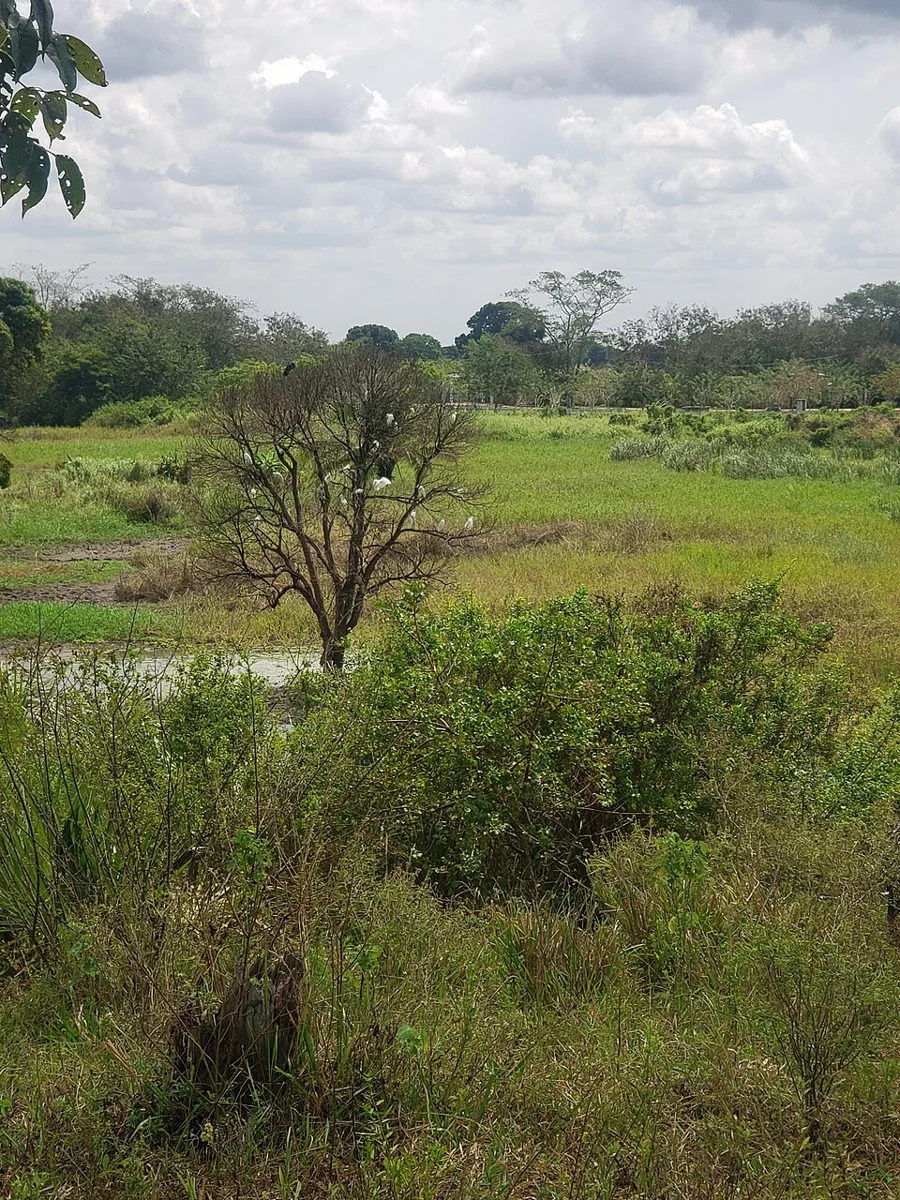
Wetland–terrestrial setting described at Kongo village, Tanzania: a comparative ecosystem example.
Credit: XCXNXH · CC BY-SA 4.0 · sourceResized and converted to WebP; uncropped.
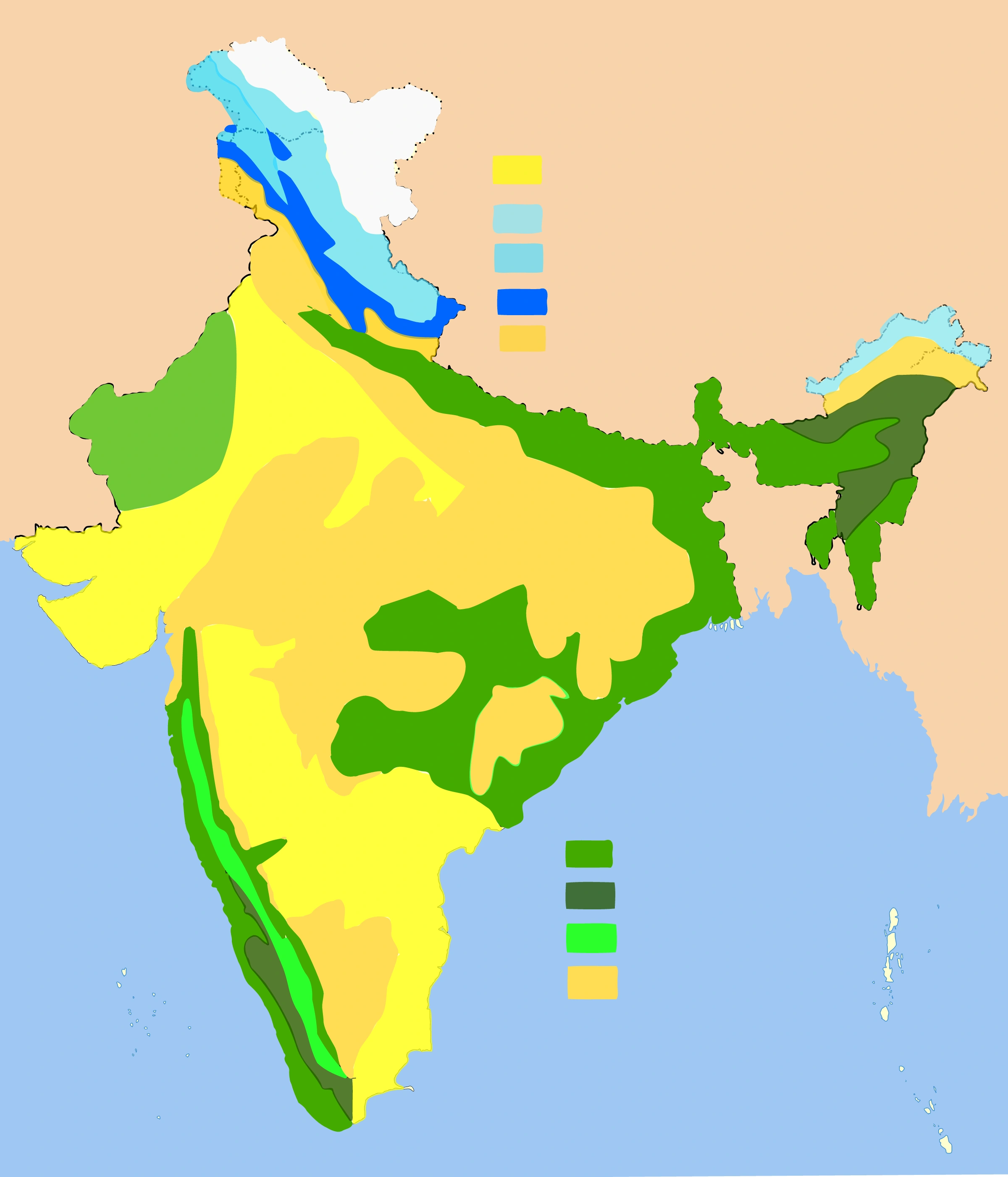
Map study
Natural vegetation zones: relate patterns to rainfall, relief and temperature. Potential natural vegetation differs from measured current forest cover.
- Read the source legend, scale and reference period before comparing regions.
- Connect spatial patterns to the processes discussed in this topic; this map is a study reference, not live operational data.
Credit: Amog · CC BY-SA 3.0 · sourceConverted to WebP on an opaque white background; proportionally resized without cropping. Original cartography and legend retained.
1. Meaning, scale and ecological organisation
An ecosystem comprises a biological community and the non-living environment with which it exchanges energy and matter. Examples include a pond, grassland, forest, estuary and agricultural field. Its defining feature is functional interaction, not simply the presence of organisms. Sunlight, water, soil and nutrients influence organisms, while organisms modify their surroundings through photosynthesis, respiration, decomposition and soil formation.
The ecological hierarchy generally proceeds from organism to population, community, ecosystem, biome and biosphere. A population consists of individuals of one species in a defined area; a community includes populations of different species. An ecosystem includes the community and its abiotic surroundings. A biome is a large ecological region characterised by broad climatic conditions and characteristic vegetation, such as tropical rainforest or tundra.
Ecosystems vary greatly in size and need not have sharply defined natural boundaries. A pond may be studied as one ecosystem, but it receives runoff, nutrients and organisms from its catchment. Most ecosystems are open systems, exchanging both energy and matter with their surroundings. Natural ecosystems include lakes and forests; human-managed ecosystems include croplands and reservoirs. Agroecosystems commonly depend on external inputs such as irrigation, fertilisers and labour.
- Habitat is where an organism lives; ecological niche describes its resource use, environmental requirements and functional relationships.
- An ecotone is a transition between ecological communities. Edge effects may alter species composition and abundance, but do not necessarily improve conservation value.
2. Components, food chains and food webs
Abiotic components include light, temperature, rainfall, water availability, salinity, soil texture, pH and inorganic nutrients. Their interactions determine environmental conditions and constrain biological activity. For example, low phosphorus availability can limit production in many freshwater systems, while changes in salinity strongly influence the distribution of estuarine organisms.
Biotic components are commonly grouped into producers, consumers and decomposers. Producers are autotrophs that synthesise organic matter from inorganic substances. Green plants, algae and cyanobacteria use light; certain bacteria and archaea obtain energy by oxidising inorganic compounds. Consumers obtain organic matter from other organisms. Herbivores are primary consumers, while carnivores feeding on them are secondary consumers. An omnivore may occupy different trophic levels in different feeding relationships.
A grazing food chain begins with living producers, for example grass → grasshopper → frog → snake. A detritus food chain begins with dead organic matter. Detritivores such as earthworms ingest and fragment detritus, whereas decomposers, especially fungi and bacteria, break down organic material through enzymatic action. These pathways are interconnected rather than isolated.
Food webs combine multiple food chains. They capture alternative feeding relationships better than a single linear chain. Arrows conventionally point from the food resource towards its consumer, indicating the direction of energy transfer. Decomposers process material originating from several trophic levels, so placing them at just one final trophic level is misleading.
Simplified nutrient recycling pathway
- 1. Producers absorb inorganic nutrients from their surroundings.
- 2. Nutrients enter organic compounds during growth.
- 3. Feeding transfers nutrients to consumers.
- 4. Death, litter fall and excretion generate detritus.
- 5. Detritivores and microbes process organic material.
- 6. Mineralisation releases inorganic nutrients for renewed uptake.
3. Energy flow, productivity and ecological pyramids
Solar radiation is the principal energy source for most ecosystems. Producers capture a fraction of incoming light and convert it into chemical energy. Chemosynthesis supports some ecosystems, including communities associated with deep-sea hydrothermal vents, without direct dependence on sunlight for primary production. Energy transfer follows thermodynamic principles: transformations dissipate usable energy as heat, requiring a continuing energy supply.
Gross primary productivity is the total rate at which producers fix energy or organic matter. Some is consumed in their own respiration. The remainder, net primary productivity, represents new producer biomass potentially available to consumers and decomposers. Secondary productivity is the rate of formation of new organic matter by consumers. Productivity is a rate, expressed per unit area per unit time; standing crop is the amount of living material present at a particular time.
Lindeman’s approximately 10 per cent transfer rule is a useful model for trophic energy transfer, not a universal fixed efficiency. Energy is lost through respiration, unconsumed material and waste. Consequently, higher trophic levels generally support less production, helping explain why food chains have limited lengths.
Ecological pyramids represent trophic-level numbers, biomass or energy. A tree ecosystem may have an inverted pyramid of numbers because a few trees support numerous insects. Aquatic biomass pyramids can be inverted because phytoplankton have low standing biomass but rapid turnover. The energy pyramid is always upright when comparable areas and time periods are considered.
- Biomass describes a stock; productivity describes a rate.
- Ecological pyramids simplify food webs and do not adequately represent organisms occupying multiple trophic levels.
| Concept pair | First concept | Second concept |
|---|---|---|
| Community and ecosystem | Interacting populations of different species | Community together with its abiotic environment |
| GPP and NPP | Total primary production before producer respiration | Primary production remaining after producer respiration |
| Standing crop and productivity | Living biomass or abundance at a given time | Rate of biomass or energy production |
| Detritivore and decomposer | Ingests and fragments detritus | Breaks down organic matter enzymatically |
| Resistance and resilience | Capacity to withstand disturbance | Capacity to recover or reorganise following disturbance |
4. Decomposition and nutrient cycling
Decomposition converts dead organic material into simpler substances and releases nutrients for reuse. Fragmentation breaks detritus into smaller particles. Leaching transfers water-soluble substances into soil or water. Microbial catabolism enzymatically breaks down organic compounds. Humification produces relatively resistant, dark-coloured humus, while mineralisation releases inorganic nutrients from organic matter. These processes overlap rather than necessarily occurring in a rigid sequence.
Temperature, moisture, oxygen availability and litter chemistry regulate decomposition. Warm, moist and aerated conditions generally favour rapid breakdown. Cold, dry or oxygen-poor conditions often slow it. Nitrogen-rich material usually decomposes faster than material rich in lignin. Waterlogging can restrict oxygen and promote organic matter accumulation, as in peatlands, although anaerobic decomposition still occurs.
Biogeochemical cycles move elements between organisms and air, water, rocks and soil. Carbon passes through photosynthesis, feeding, respiration, decomposition and combustion. Nitrogen fixation converts atmospheric nitrogen into biologically usable forms; nitrification, assimilation, ammonification and denitrification perform distinct roles in its cycle. Phosphorus cycling is closely associated with rock weathering and sediment movement and lacks a significant gaseous phase under normal ecosystem conditions.
- Energy is not recycled through an ecosystem in the same way as nutrients.
- Ecosystems recycle nutrients internally but may also gain or lose them through runoff, erosion, atmospheric deposition and harvesting.
5. Ecosystem change, services and conservation
Ecosystems are dynamic, responding to seasonal variation, succession and disturbances such as floods, fires and storms. Primary succession begins on a surface without developed soil, such as newly exposed rock. Secondary succession follows disturbance where soil and biological legacies remain, and is generally faster. Succession need not inevitably produce one permanent, fixed climax community.
Resistance is the ability to remain relatively unchanged during disturbance; resilience concerns recovery or reorganisation afterwards. Biodiversity and functional diversity can support ecosystem functioning, but more species do not automatically guarantee stability in every setting. Severe pressures can push ecosystems across thresholds, producing persistent changes such as a shift from clear, vegetated lake water to a turbid, algal-dominated state.
Ecosystem services include provisioning services such as food and freshwater; regulating services such as flood moderation and pollination; cultural services such as recreation; and supporting processes such as soil formation and nutrient cycling. These categories follow the Millennium Ecosystem Assessment framework. Wetlands, for example, can store floodwater and retain pollutants, but their treatment capacity is finite.
Conservation therefore requires maintaining ecological processes, connectivity and catchment conditions, not merely protecting selected species. In India, relevant instruments include the Environment (Protection) Act, 1986, Biological Diversity Act, 2002, and Wetlands (Conservation and Management) Rules, 2017. Restoration should address the original stressor: planting vegetation alone cannot restore a wetland if its natural water regime remains disrupted.
Ecosystems: Interactions Across Habitat Boundaries
The supplied metadata describes grasses, shrubs, trees, egrets and wetland patches at Kongo village in Tanzania. This is a relevant comparative example, not evidence about an Indian ecosystem. Its educational value lies in linking a biological community with its physical setting: plants and animals constitute biotic components, while water, soil, light and temperature form the abiotic environment. An ecosystem includes their interactions, rather than merely a list of species or an attractive landscape.
Wetland–terrestrial interfaces help explain why ecosystem boundaries are often permeable. Organisms, water, nutrients and organic matter can move between adjoining habitats. Producers capture solar energy, consumers obtain energy through feeding, and decomposers help return nutrients to forms available for uptake. Energy flows through the system and is progressively dissipated as heat; nutrients cycle. Comparable interactions occur in Indian floodplains, village ponds and seasonal wetlands, making surrounding land use relevant to conservation. However, this metadata alone cannot establish local feeding relationships, species richness, productivity, water quality or ecosystem health. Descriptions such as “thriving biodiversity” require ecological observations and measurements before being treated as scientific conclusions.
- Community versus ecosystem: a community comprises interacting populations; an ecosystem additionally includes the abiotic environment and exchanges of energy and matter.
- Ecotone caution: adjoining wetland and terrestrial habitats may form a transition zone, but higher diversity or an edge effect cannot be assumed from metadata.
- Indian application: wetland management should consider catchment runoff, nutrient inputs and habitat connectivity, rather than protecting only the water-covered area.
Real-world case studies
Chilika Lake: restoring hydrological exchange
Chilika, a brackish-water lagoon in Odisha, suffered ecological degradation associated with siltation, altered seawater exchange and other pressures. A new sea mouth was opened in 2000 to improve exchange with the Bay of Bengal. Restoration helped improve salinity conditions and fisheries. Chilika was removed from the Ramsar Convention’s Montreux Record in 2002, illustrating the importance of hydrology to ecosystem functioning.
Gulf of Mexico: nutrient enrichment and hypoxia
Nutrients carried by the Mississippi–Atchafalaya river system promote high algal production in the northern Gulf of Mexico. Microbial decomposition of organic matter consumes dissolved oxygen; water-column stratification restricts replenishment. Seasonal bottom-water hypoxia stresses or displaces aquatic animals. The example links catchment land use, primary production, decomposition and coastal ecosystem degradation.
Previous year questions
No source-linked PYQ is available here yet. Use the practice questions below.
Practice questions
Practice MCQ 1
Consider the following statements: 1. An aquatic ecosystem can have an inverted biomass pyramid. 2. An inverted biomass pyramid necessarily indicates an inverted energy pyramid. 3. Rapid turnover can allow phytoplankton to support consumers with a greater standing biomass. Which statements are correct?
- A. 1 and 2 only
- B. 2 and 3 only
- C. 1 and 3 only
- D. 1, 2 and 3
Practice MCQ 2
An ecosystem has a gross primary productivity of 2,400 g of dry matter per square metre per year. Producer respiration accounts for 900 g in equivalent units. What is its net primary productivity?
- A. 900 g per square metre per year
- B. 1,500 g per square metre per year
- C. 2,400 g per square metre per year
- D. 3,300 g per square metre per year
Practice MCQ 3
Which statement correctly describes decomposition?
- A. Mineralisation releases inorganic nutrients from organic matter.
- B. Humification is the fixation of atmospheric nitrogen.
- C. Leaching requires the ingestion of detritus by animals.
- D. Lignin-rich litter invariably decomposes faster than nitrogen-rich litter.
Mains practice · Explain how energy flow and nutrient cycling sustain ecosystems. Using a wetland example, examine how human interventions can disrupt these processes. Answer in 250 words.
- Define an ecosystem through biotic–abiotic interactions.
- Explain unidirectional energy transfer, respiratory losses and trophic constraints.
- Distinguish nutrient recycling from energy flow; explain decomposition and mineralisation.
- Link nutrient enrichment to algal growth, decomposition and oxygen depletion.
- Discuss altered hydrology, wetland conversion and catchment pollution.
- Use Chilika to illustrate restoration of ecological processes and conclude with catchment-scale management.
Further reading
- NCERT Biology, Class XII: Ecosystem chapter.
- NCERT Biology, Class XII: Organisms and Populations chapter.
- Millennium Ecosystem Assessment, Ecosystems and Human Well-being: Synthesis, 2005.
- Ministry of Environment, Forest and Climate Change: Wetlands (Conservation and Management) Rules, 2017.
- Chilika Development Authority: official restoration and ecosystem management publications.
- NOAA: Gulf of Mexico hypoxia resources.
- https://commons.wikimedia.org/wiki/File:JULY_2024_COBERMS_RESEARCH_WORK_AT_KONGO_VILLAGE.jpg
Preparing for UPSC Civil Services? Get classroom teaching, answer-writing evaluation and mentorship at Pragnya IAS Academy, Ashok Nagar — see why aspirants choose us for IAS coaching in Hyderabad.