

Sundarbans National Park is a major national park, tiger reserve, and biosphere reserve located in West Bengal, India. It forms the core part of the vast Sundarbans on the Ganges Delta and is adjacent
Credit: Kingshuk Mondal · CC BY 4.0 · source

Burned peatland due to 2015 El Niño event in South Sumatra, Indonesia.
Credit: Gambut Pratama · CC BY-SA 4.0 · source
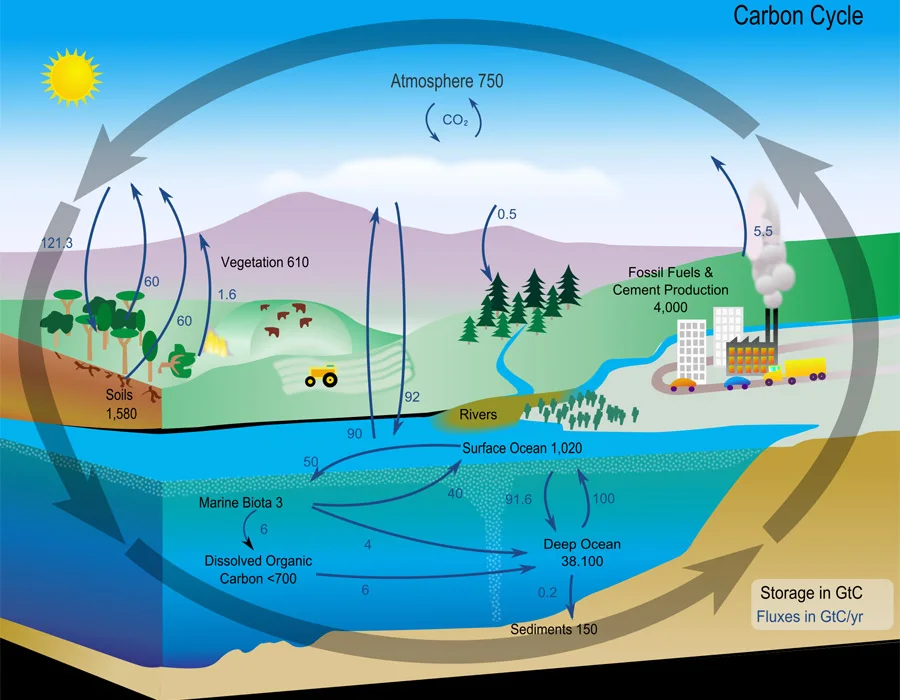
NASA carbon-cycle schematic showing carbon stores and transfers; historical diagram values are not current estimates.
Credit: NASA · Public domain · sourceResized and converted to WebP; uncropped.
1. Reservoirs, fluxes and the natural carbon budget
Carbon is a basic constituent of carbohydrates, proteins, fats and nucleic acids. It circulates as atmospheric carbon dioxide and methane, organic matter in organisms and soils, dissolved inorganic carbon in water, and carbonates or organic carbon in rocks. The carbon cycle is therefore both biogeochemical and climatic: biological, chemical and geological processes redistribute an element whose gaseous forms influence Earth's radiation balance.
Major reservoirs differ greatly in size and turnover time. Rocks and sediments hold the greatest quantities over geological periods. The ocean contains about 38,000 GtC, mainly as dissolved inorganic carbon, whereas the atmosphere contains roughly 900 GtC, with the amount continuing to rise. Soils store more organic carbon than living terrestrial vegetation, although estimates depend on soil depth and whether peatlands and permafrost are included.
A reservoir is not automatically a sink. A mature forest may hold a large stock yet have only a modest net annual uptake; a disturbed forest can become a source. Fluxes are expressed as carbon transferred per unit time, commonly GtC per year. Natural exchanges are large in both directions, so even a comparatively smaller persistent anthropogenic addition can substantially alter atmospheric concentrations.
- Stock: the quantity of carbon stored at a particular time.
- Flux: the rate of carbon movement between reservoirs.
- Net sink or source: the balance between carbon entering and leaving a reservoir over a defined period.
2. The fast biological cycle on land
The fast carbon cycle operates through organisms, soils and exchanges with the atmosphere, from daily to centennial timescales. Green plants, algae and cyanobacteria use photosynthesis to convert CO2 into organic compounds using sunlight. Carbon then passes through food webs as herbivores consume plants and predators consume other organisms. Respiration by plants, animals and microorganisms releases CO2 while making energy available for cellular processes.
Gross primary productivity, or GPP, is the total carbon fixed through photosynthesis. Net primary productivity, or NPP, equals GPP minus plant respiration. NPP supports plant growth and supplies organic matter to consumers and decomposers. However, NPP is not equivalent to net ecosystem carbon sequestration: microbial respiration, fire, harvesting and other losses must also be considered when estimating the ecosystem's carbon balance.
Dead biomass, roots and animal wastes enter litter and soil organic matter pools. Decomposers return much of this carbon to the atmosphere, while some persists through association with minerals or protection within soil aggregates. Waterlogging can slow decomposition and support peat formation. Under anaerobic conditions, microbial processes may generate methane; oxygenated soils and waters can support methane oxidation.
Land-use change alters both stocks and fluxes. Deforestation removes biomass, releases carbon through burning or decomposition, and can reduce future uptake. Tillage, erosion and drainage can deplete soil carbon. Conversely, protecting natural ecosystems, restoring degraded land and improving soil management can conserve or increase carbon stocks. Such gains remain vulnerable to drought, fire, warming and subsequent land conversion.
A terrestrial carbon pathway
- 1. Atmospheric CO2 is absorbed through photosynthesis
- 2. Carbon becomes plant biomass
- 3. Feeding transfers part of it through food webs
- 4. Litter, roots and wastes add carbon to soils
- 5. Respiration and decomposition return much carbon to the atmosphere
- 6. A fraction persists in soils or enters longer-term burial
3. Ocean carbon uptake and the slow geological cycle
CO2 moves between the atmosphere and the surface ocean according to the difference in its partial pressure across the air–sea boundary. Cold water generally dissolves more CO2 than warm water. Ocean circulation transfers some absorbed carbon to deeper layers through the solubility pump, where it may remain isolated from the atmosphere for centuries or longer.
The biological pump begins when phytoplankton fix dissolved CO2 through photosynthesis. Some organic material sinks as dead organisms, faecal pellets and aggregates. Most is consumed or decomposed before reaching the seabed, but a smaller fraction reaches deep waters and sediments. Thus, high marine productivity does not automatically imply equally high permanent carbon burial.
In seawater, dissolved CO2 participates in reactions involving carbonic acid, bicarbonate and carbonate ions. Bicarbonate is the dominant dissolved inorganic carbon form at normal seawater pH. Additional CO2 increases hydrogen ion concentration and reduces carbonate availability, making calcification more difficult for many corals and shell-forming organisms. Ocean acidification means declining pH; the open ocean remains alkaline overall.
The slow cycle links chemical weathering, rivers, sedimentation, burial, tectonics and volcanism. Weathering of silicate rocks consumes CO2, and rivers transport dissolved products to oceans. Over long timescales, carbonate formation and burial can lock carbon into sedimentary rocks. Subduction, metamorphism and volcanic degassing return carbon to the surface system. Carbonate-rock weathering alone should not be treated as an equivalent permanent sink, because subsequent carbonate precipitation can offset its CO2 uptake.
| Reservoir | Principal carbon forms | Important transfers or distinction |
|---|---|---|
| Atmosphere | CO2 and methane | Receives combustion and respiration emissions; loses CO2 through photosynthesis and ocean uptake |
| Vegetation and soils | Biomass and soil organic carbon | Storage depends on productivity, decomposition, disturbance and land management |
| Oceans | Mainly bicarbonate, with carbonate and dissolved CO2 | Solubility and biological pumps transfer carbon below the surface |
| Sedimentary rocks | Carbonates and buried organic carbon | Largest long-term reservoir; linked to weathering, burial and tectonics |
| Fossil-fuel deposits | Coal and hydrocarbons | Combustion rapidly releases carbon accumulated over geological timescales |
4. Human disturbance and climate–carbon feedbacks
Burning coal, petroleum and natural gas rapidly transfers geological carbon into the active atmosphere–ocean–biosphere system. Cement manufacture also releases CO2 when limestone is calcined, in addition to emissions from energy use. Deforestation and other land-use changes add emissions and modify uptake. Atmospheric CO2 has consequently increased from about 280 parts per million before industrialisation to more than 420 parts per million.
Land and ocean sinks slow atmospheric accumulation but do not neutralise fossil-fuel emissions. Their uptake varies with climate, ecological conditions and ocean circulation. Moreover, absorbed carbon can produce other impacts: ocean uptake moderates atmospheric warming while causing acidification. The atmospheric increase is the residual of human emissions after net land and ocean uptake.
A positive feedback amplifies an initial change. Warming can accelerate soil decomposition, thaw permafrost and increase wildfire risks, releasing additional CO2 or methane. Warmer surface waters also tend to hold less dissolved CO2. CO2 fertilisation can increase plant growth under suitable conditions, but nutrient limitations, water stress and heat constrain this response. These competing processes make the future strength of natural sinks uncertain.
- Methane belongs to the carbon cycle, but its lifetime and radiative effects differ from those of CO2.
- CO2 has no single atmospheric lifetime because different removal processes operate over very different timescales.
5. Carbon-cycle knowledge in climate governance
The UNFCCC, adopted in 1992, recognises the importance of conserving and enhancing greenhouse-gas sinks and reservoirs. The 2015 Paris Agreement seeks a balance between anthropogenic greenhouse-gas emissions by sources and removals by sinks in the second half of this century. This broader greenhouse-gas balance must be distinguished from net-zero CO2, which balances anthropogenic CO2 emissions and removals specifically.
National inventories account for emissions and removals from land use, land-use change and forestry, often abbreviated LULUCF. India's updated nationally determined contribution of 2022 retained the goal of creating an additional carbon sink of 2.5–3 billion tonnes of CO2 equivalent through additional forest and tree cover by 2030. This is a sink target, not simply a target for plantation area.
Credible carbon projects require additionality, reliable baselines, monitoring, avoidance of double counting and attention to leakage and permanence. A forest offset can be reversed by fire or clearing, whereas geological storage may provide much longer retention if appropriately selected and managed. Carbon capture from a fossil-fuel facility avoids some emissions but is not automatically atmospheric carbon removal. Bioenergy is likewise not automatically carbon-neutral: outcomes depend on land-use effects, supply-chain emissions and the time required for regrowth.
Carbon reservoirs, fluxes and climate governance
The carbon cycle connects reservoirs through transfers called fluxes. Photosynthesis moves atmospheric carbon into biomass, while respiration, decomposition and combustion return carbon to the atmosphere. Oceans exchange carbon dioxide with the air and store carbon mainly in dissolved forms; marine organisms also contribute to biological transfers and carbonate formation. Weathering, sediment burial and volcanic activity connect these processes to a slower geological cycle. A reservoir’s size is not the same as its annual uptake: a large carbon store need not be a strong net sink.
Climate governance seeks to limit the human-driven transfer of carbon into the atmosphere and protect or enhance sinks. Fossil-fuel combustion introduces carbon from geological stores into the active cycle, while land-use change can release vegetation and soil carbon. In India, forest conservation, ecosystem restoration and soil management can support mitigation, but outcomes depend on ecological conditions, land rights and management. Carbon-cycle illustrations explain mechanisms, not verified quantities: they cannot establish a project’s additional carbon removal, storage permanence or eligibility for credits.
- Distinguish stocks from flows: carbon storage is an accumulated quantity; sequestration is uptake over time. A forest can hold substantial carbon while losing it overall.
- Ocean uptake moderates atmospheric carbon dioxide but also drives acidification. Absorption does not make fossil-fuel emissions environmentally harmless.
- For carbon markets, examine additionality, leakage, permanence and double counting. Biological storage can be reversed by fire or clearing and should not be equated automatically with avoided fossil emissions.
Real-world case studies
Sundarbans: blue carbon with multiple benefits
The mangroves of the Indian and Bangladeshi Sundarbans store carbon in vegetation and waterlogged sediments. Mangroves, salt marshes and seagrasses are major coastal blue-carbon ecosystems. Conserving them can protect carbon stocks while supporting fisheries and coastal protection. Conversion, erosion and altered sediment supply threaten these benefits; restoration must consider tidal hydrology and suitable native species rather than merely tree numbers.
Indonesia's peat fires in 2015
Widespread fires during the 2015 El Niño drought affected drained peatlands in Indonesia. Drainage exposed carbon-rich peat to oxygen, encouraging decomposition and making it more combustible. The episode illustrates how a long-accumulated soil carbon stock can become a major emissions source. Peatland rewetting and fire prevention address the underlying hydrological conditions, not only vegetation loss.
Previous year questions
No source-linked PYQ is available here yet. Use the practice questions below.
Practice questions
Practice MCQ 1
With reference to ecosystem carbon accounting, consider the following statements: 1. Net primary productivity equals gross primary productivity minus plant respiration. 2. A large carbon stock necessarily implies a large annual net carbon sink. 3. Decomposer respiration influences the net ecosystem carbon balance. Which of the statements given above are correct?
- A. 1 and 2 only
- B. 1 and 3 only
- C. 2 and 3 only
- D. 1, 2 and 3
Practice MCQ 2
Which one of the following best describes the effect of increasing atmospheric CO2 on ocean chemistry?
- A. It increases seawater pH and carbonate-ion availability.
- B. It decreases seawater pH and generally reduces carbonate-ion availability.
- C. It immediately converts the entire ocean from alkaline to acidic.
- D. It affects ocean chemistry only through increased water temperature.
Practice MCQ 3
Consider the following processes: 1. Combustion of coal 2. Calcination of limestone in cement manufacture 3. Thawing and microbial decomposition of previously frozen organic matter. Which of these can release carbon dioxide into the atmosphere?
- A. 1 only
- B. 1 and 2 only
- C. 2 and 3 only
- D. 1, 2 and 3
Mains practice · Explain how human activities disturb the carbon cycle. Why can ecosystem-based carbon sequestration complement, but not substitute for, rapid reductions in fossil-fuel emissions? Answer in 250 words.
- Distinguish carbon reservoirs, fluxes and net sinks.
- Explain fossil-fuel combustion, cement calcination and land-use change.
- Discuss terrestrial uptake, ocean uptake and ocean acidification.
- Examine warming feedbacks involving soils, fires and permafrost.
- Identify saturation, reversal, land constraints, leakage and additionality concerns.
- Conclude with emissions reduction alongside protection and restoration of diverse natural ecosystems.
Further reading
- NCERT Biology, Class XII: Ecosystem.
- NCERT Fundamentals of Physical Geography, Class XI: Life on the Earth.
- IPCC Sixth Assessment Report, Working Group I, Chapter 5: Global Carbon and Other Biogeochemical Cycles and Feedbacks.
- Global Carbon Project: Global Carbon Budget.
- UNFCCC: Paris Agreement and India's Updated First Nationally Determined Contribution, 2022.
- NOAA Global Monitoring Laboratory: Trends in Atmospheric Carbon Dioxide.
- https://commons.wikimedia.org/wiki/File:Carbon_cycle_NASA.jpg
Preparing for UPSC Civil Services? Get classroom teaching, answer-writing evaluation and mentorship at Pragnya IAS Academy, Ashok Nagar — see why aspirants choose us for IAS coaching in Hyderabad.