
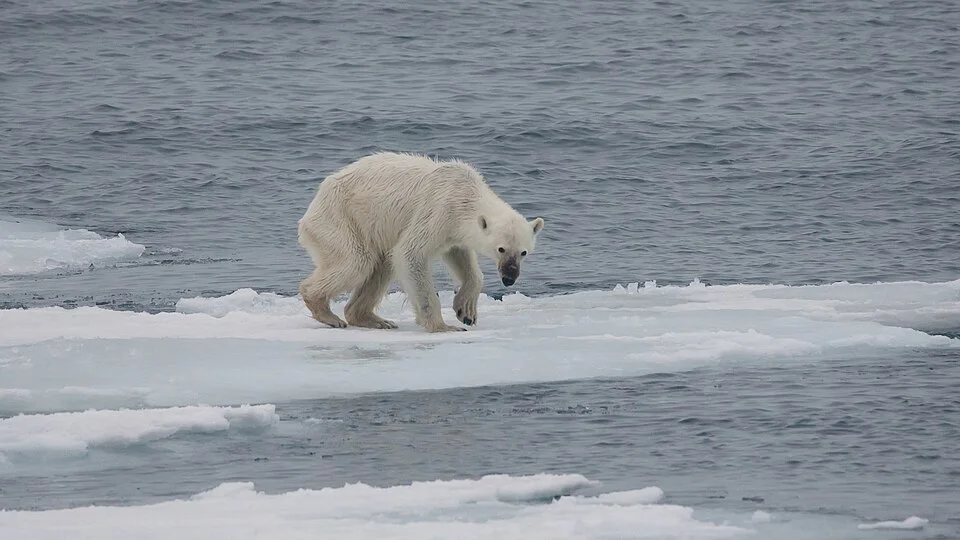
Polar bear in Svalbard, described in the source as starving; an Arctic illustration of warming-related habitat risks.
Credit: Andreas Weith · CC BY-SA 4.0 · sourceResized and converted to WebP; uncropped.
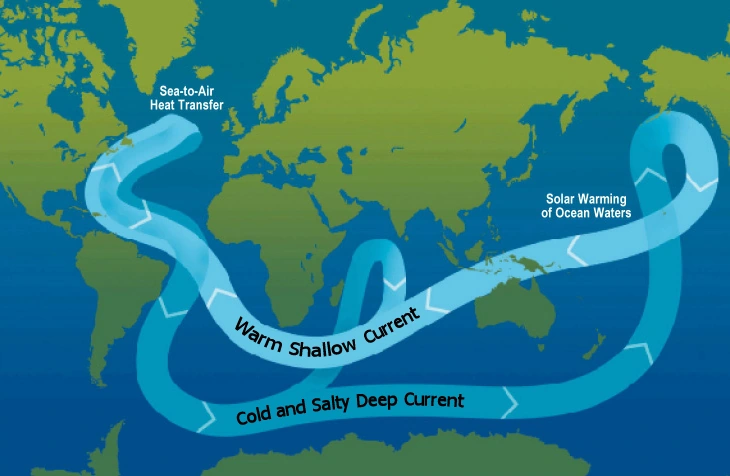
Map study
Global overturning circulation: distinguish surface and deep return flow. This conveyor pathway is a simplified model, not an exact current-speed map.
- Read the source legend, scale and reference period before comparing regions.
- Connect spatial patterns to the processes discussed in this topic; this map is a study reference, not live operational data.
Credit: Thomas Splettstoesser · Public domain · sourceConverted to WebP on an opaque white background; proportionally resized without cropping. Original cartography and legend retained.
1. Scientific basis of global warming
Earth receives incoming solar energy mainly as short-wave radiation and emits energy back towards space as long-wave infrared radiation. Greenhouse gases absorb and re-emit part of this outgoing radiation, warming the surface and lower atmosphere. The natural greenhouse effect makes Earth habitable; global warming arises when human activities strengthen this effect by increasing atmospheric greenhouse-gas concentrations.
Carbon dioxide is released through fossil-fuel combustion, cement production and land-use change. Methane originates from sources including livestock, rice cultivation, landfills and fossil-fuel production. Nitrous oxide is associated particularly with agricultural soils and nitrogen fertilisers. Fluorinated gases used in refrigeration and industrial processes can have very high warming effects per unit mass. Water vapour is an important greenhouse gas, but its increase in a warming atmosphere operates mainly as a feedback rather than the initial driver of present warming.
Radiative forcing describes a change in Earth’s energy balance, expressed in watts per square metre. Positive forcing tends to warm the climate, while negative forcing tends to cool it. Most sulphate aerosols produce cooling, whereas black carbon absorbs sunlight and can accelerate snow and ice melt after deposition. Black carbon is a particulate pollutant, not a greenhouse gas.
Global Warming Potential compares the integrated warming effect of a pulse emission of a gas with that of the same mass of CO2 over a specified period, commonly 100 years. CO2 has a GWP of one. GWP depends on the gas’s radiative efficiency, atmospheric lifetime and selected time horizon; methane’s relative importance is greater over a 20-year horizon than over a 100-year horizon.
- Global warming concerns temperature; climate change is the broader set of associated changes.
- Ozone depletion and global warming are distinct processes, although some ozone-depleting substances also act as greenhouse gases.
- A carbon sink absorbs more carbon than it releases over a specified period; forests, soils and oceans can serve as sinks.
Timeline
1992
UNFCCC adopted; opened for signature at the Rio Earth Summit.
1997
Kyoto Protocol adopted; entered into force in 2005.
2015–2016
Paris Agreement adopted in 2015 and entered into force in 2016.
2022
India submitted its updated NDC; COP27 agreed to establish a loss-and-damage fund.
2023
COP28 concluded the first global stocktake and operationalised the loss-and-damage fund.
2. Evidence, attribution and feedbacks
The IPCC’s 2023 Synthesis Report states that human activities, principally greenhouse-gas emissions, have unequivocally caused global warming. Evidence extends beyond thermometer records to increasing ocean heat content, retreating glaciers, declining Arctic sea ice and rising global mean sea level. Oceans absorb most of the excess heat accumulating in the climate system, so surface air temperature alone does not capture the full energy imbalance.
Attribution studies distinguish human influences from natural drivers such as volcanic eruptions, solar variability and internal ocean–atmosphere variability. El Niño can temporarily raise global mean surface temperature, while La Niña can suppress it relative to the underlying trend. These variations do not explain the sustained warming observed over recent decades. Large volcanic eruptions can cause short-term cooling through stratospheric sulphate aerosols.
Feedbacks modify the initial temperature response. Melting snow and ice expose darker surfaces, reducing albedo and increasing solar absorption. Warmer air can hold more water vapour, amplifying warming. Permafrost thaw can release CO2 and methane. Cloud feedbacks are complex because clouds both reflect sunlight and interact with outgoing infrared radiation.
A carbon budget is the cumulative quantity of CO2 emissions compatible with limiting warming to a specified level with a stated probability. Remaining budgets depend on the temperature target, non-CO2 emissions and scientific uncertainties. Delayed mitigation consumes the remaining budget and increases dependence on future carbon dioxide removal.
- Weather is short-term atmospheric behaviour; climate describes longer-term statistical patterns.
- A cold spell in one region does not invalidate a rising global temperature trend.
- Ocean acidification primarily results from seawater absorbing CO2, rather than from warming itself.
From emissions to climate risk
- 1. Human activities release greenhouse gases
- 2. Atmospheric concentrations rise
- 3. Positive radiative forcing creates an energy imbalance
- 4. Atmosphere and oceans warm, with feedbacks
- 5. Hazards interact with exposure and vulnerability
- 6. Mitigation and adaptation reduce future risks
3. Impacts and relevance for India
Warming increases the likelihood and intensity of many heat extremes and can intensify heavy precipitation because a warmer atmosphere can contain more moisture. Changes in drought, monsoon behaviour and tropical cyclones vary by region. It is incorrect to claim that every extreme event is caused solely by climate change; event-attribution research estimates how warming changes its probability or intensity.
Sea-level rise results mainly from thermal expansion of seawater and loss of land-based ice. Floating sea-ice melt has little direct effect on sea level. Coastal flooding, erosion and saltwater intrusion threaten settlements, infrastructure, freshwater and agriculture. Marine heatwaves contribute to coral bleaching, while warming shifts species distributions and increases risks to ecosystems.
India faces interacting risks from heat stress, rainfall variability, Himalayan cryosphere change and coastal exposure. Outdoor workers, small farmers, informal settlements and populations with limited access to cooling are especially vulnerable. Heat can reduce labour productivity and raise electricity demand, while compound heat and drought can undermine food and water security.
Himalayan glacier retreat can alter seasonal river flows, although effects differ across basins and timescales. Expanding glacial lakes can increase glacial lake outburst flood hazards where unstable dams and exposed settlements coincide. Climate risk therefore depends not only on the physical hazard but also on exposure and vulnerability.
- Coral bleaching is the loss of symbiotic algae or their pigments under stress; bleaching does not always mean immediate coral death.
- Urban heat islands amplify local heat exposure but are not the principal explanation for global warming.
- Adaptation priorities include heat-health planning, resilient agriculture, early warning systems and ecosystem protection.
| Agent | Important human-related sources | Key distinction |
|---|---|---|
| Carbon dioxide | Fossil fuels, cement and deforestation | Cumulative emissions strongly determine long-term warming |
| Methane | Livestock, rice fields, waste and fossil-fuel leakage | Shorter-lived than CO2; strong near-term warming influence |
| Nitrous oxide | Fertilised soils and manure management | Long-lived greenhouse gas |
| Hydrofluorocarbons | Refrigeration and air conditioning | Covered by the Kigali Amendment phase-down |
| Black carbon | Incomplete combustion | Warming aerosol, not a greenhouse gas |
4. International climate governance
The United Nations Framework Convention on Climate Change, adopted in 1992, seeks to stabilise greenhouse-gas concentrations at a level preventing dangerous anthropogenic interference with the climate system. Equity and common but differentiated responsibilities and respective capabilities recognise unequal historical contributions and capacities. The Conference of the Parties is the Convention’s supreme decision-making body.
The 1997 Kyoto Protocol established quantified emission-limitation and reduction commitments for listed developed-country parties. Its mechanisms included emissions trading, Joint Implementation and the Clean Development Mechanism. The 2015 Paris Agreement brought all parties into a framework of nationally determined contributions, while retaining differentiation in light of national circumstances.
Under Paris, parties communicate successive NDCs every five years, with each representing progression and reflecting the highest possible ambition. The Agreement combines temperature goals with adaptation, finance, transparency and a five-yearly global stocktake. The first global stocktake concluded at COP28 in Dubai in 2023 and called on parties to contribute to transitioning away from fossil fuels in energy systems in a just, orderly and equitable manner.
Climate finance supports mitigation and adaptation, especially in developing countries. The Green Climate Fund operates within the UNFCCC financial mechanism. Loss and damage addresses adverse climate impacts, including those beyond feasible adaptation; COP27 agreed to establish a dedicated fund, operationalised at COP28. The IPCC assesses scientific knowledge but neither negotiates treaties nor enforces national emission targets.
- The Paris Agreement is legally binding, but it does not make achievement of every numerical NDC target an internationally enforceable obligation.
- The Montreal Protocol’s Kigali Amendment phases down hydrofluorocarbons, which are powerful greenhouse gases but not ozone-depleting substances.
- Paris Agreement Article 6 provides for voluntary cooperation, including market approaches; environmental integrity requires avoiding double counting.
5. Response options and India’s commitments
Mitigation limits warming by reducing greenhouse-gas emissions or enhancing removals. Options include renewable energy, energy efficiency, public transport, electrification, methane control and ecosystem restoration. Adaptation reduces harm from actual or expected climate impacts. Both are necessary: adaptation cannot substitute for emissions reductions, and mitigation cannot eliminate all near-term climate risks.
India’s updated NDC, submitted in 2022, commits to reducing GDP emissions intensity by 45% from 2005 levels by 2030 and achieving about 50% cumulative installed electric-power capacity from non-fossil sources by 2030, with specified international support. The capacity target should not be confused with electricity generation. India also retains its goal of creating an additional carbon sink of 2.5–3 billion tonnes of CO2 equivalent through additional forest and tree cover by 2030.
India has announced a net-zero target for 2070. Its policy framework includes the National Action Plan on Climate Change, state action plans, renewable-energy expansion and the National Green Hydrogen Mission. The Energy Conservation (Amendment) Act, 2022 enabled a carbon-credit trading framework, followed by the Carbon Credit Trading Scheme, 2023.
Net-zero CO2 means balancing anthropogenic CO2 emissions with anthropogenic removals over a specified period; it does not require eliminating every emission source. Net-zero greenhouse gases is a broader concept. Credible pathways prioritise deep emissions cuts, address residual emissions transparently and ensure a just transition for workers and fossil-fuel-dependent regions.
- Afforestation cannot automatically compensate for permanent fossil-carbon emissions; permanence, biodiversity and land rights matter.
- Maladaptation occurs when a response increases future vulnerability, emissions or inequity.
- Climate justice links historical responsibility, development needs, finance, technology access and protection of vulnerable communities.
Arctic warming: ecological risks and limits of attribution
This Svalbard polar-bear photograph provides an illustrative context for understanding global warming, not proof of why an individual animal became undernourished. Polar bears depend heavily on sea ice as a platform for hunting seals. Warming-driven reductions in sea-ice extent and changes in its seasonal timing can restrict hunting opportunities and prolong periods ashore. However, the source description’s claims about this bear’s condition and increasing starvation cannot be established from image metadata alone; they require ecological monitoring and population-level evidence.
The Arctic also illustrates a reinforcing climate feedback: when reflective snow and sea ice retreat, darker surfaces absorb more solar energy, amplifying warming. Melting floating sea ice does not directly raise sea level appreciably, unlike the loss of land-based glaciers and ice sheets. This is a comparative ecological example, not evidence about Indian wildlife or Himalayan glaciers. Its relevance to India lies in the shared need to reduce greenhouse-gas emissions and adapt to climate risks. International climate governance, including the Paris Agreement, addresses these collective risks through national commitments, transparency and support, while climate justice concerns unequal historical contributions and capacities to respond.
- Distinguish mechanism from attribution: warming can increase habitat stress, but one animal’s condition cannot establish its cause or a population trend.
- Separate mitigation from adaptation: emissions reduction limits warming; habitat protection and monitoring support conservation but cannot substitute for mitigation.
- For India, assess Himalayan ice loss, coastal exposure and heat risks using region-specific evidence rather than extrapolating directly from Arctic wildlife.
Real-world case studies
Ahmedabad Heat Action Plan
Following the severe 2010 heatwave, Ahmedabad introduced a Heat Action Plan in 2013. Forecast-based alerts, public communication and health-system preparedness illustrate urban adaptation. Its wider lesson is that reducing heat mortality requires coordination and targeted protection for vulnerable people, not merely temperature forecasts.
Great Barrier Reef bleaching
Australia’s Great Barrier Reef experienced repeated mass bleaching, including in 2016 and 2017, during elevated sea temperatures. The case demonstrates that local management of pollution and fishing supports resilience but cannot replace global emissions reductions to address marine heat stress.
Previous year questions
UPSC Prelims 2016
With reference to the Paris climate agreement, consider these statements: 1. It was signed by all UN member countries, came into effect in 2017, and aimed to limit warming to 2°C or even 1.5°C. 2. It required developed countries to acknowledge historical responsibility and donate US$1,000 billion annually from 2020 to developing countries. Which is/are correct?
- A. 1 only
- B. 2 only
- C. Both 1 and 2
- D. Neither 1 nor 2
Practice questions
Practice MCQ 1
Consider the following statements: 1. Water vapour acts mainly as a feedback in current anthropogenic warming. 2. Black carbon is a greenhouse gas. 3. Sulphate aerosols generally exert a cooling influence. Which statements are correct?
- A. 1 and 2 only
- B. 1 and 3 only
- C. 2 and 3 only
- D. 1, 2 and 3
Practice MCQ 2
With reference to India’s updated 2022 NDC, consider the following: 1. Its emissions-intensity target uses 2005 as the baseline. 2. Its non-fossil electricity target concerns installed capacity rather than actual generation. 3. It mandates a 45% reduction in absolute national emissions by 2030. Which statements are correct?
- A. 1 only
- B. 2 and 3 only
- C. 1 and 2 only
- D. 1, 2 and 3
Practice MCQ 3
Which institution assesses climate science without negotiating climate treaties?
- A. Conference of the Parties to the UNFCCC
- B. Intergovernmental Panel on Climate Change
- C. Green Climate Fund
- D. World Trade Organization
Mains practice · Explain the scientific basis of global warming. Discuss how climate governance can reconcile urgent mitigation with equity and India’s development needs. (250 words)
- Explain enhanced greenhouse effect, anthropogenic forcing and feedbacks.
- Distinguish mitigation, adaptation and loss and damage.
- Discuss UNFCCC principles, Paris NDCs and the global stocktake.
- Use India’s intensity, non-fossil capacity and net-zero commitments.
- Examine finance, technology access, energy security and just transition.
- Conclude with measurable implementation and protection of vulnerable populations.
Further reading
- IPCC: Climate Change 2023, AR6 Synthesis Report, Summary for Policymakers.
- UNFCCC: Convention text, Paris Agreement and NDC Registry.
- Government of India: India’s Updated First Nationally Determined Contribution, 2022.
- NCERT: Fundamentals of Physical Geography, Class XI, Solar Radiation, Heat Balance and Temperature.
- Ministry of Earth Sciences: Assessment of Climate Change over the Indian Region, 2020.
- World Meteorological Organization: State of the Global Climate reports.
- https://commons.wikimedia.org/wiki/File:Endangered_arctic_-_starving_polar_bear.jpg
Preparing for UPSC Civil Services? Get classroom teaching, answer-writing evaluation and mentorship at Pragnya IAS Academy, Ashok Nagar — see why aspirants choose us for IAS coaching in Hyderabad.