

40km away from Dehradun, it is a beautiful bird watching site.
Credit: Sonal Saklani · CC BY-SA 4.0 · source

Beas River as viewed from NH3 between Kullu and Manali
Credit: ArmouredCyborg · CC BY-SA 4.0 · source
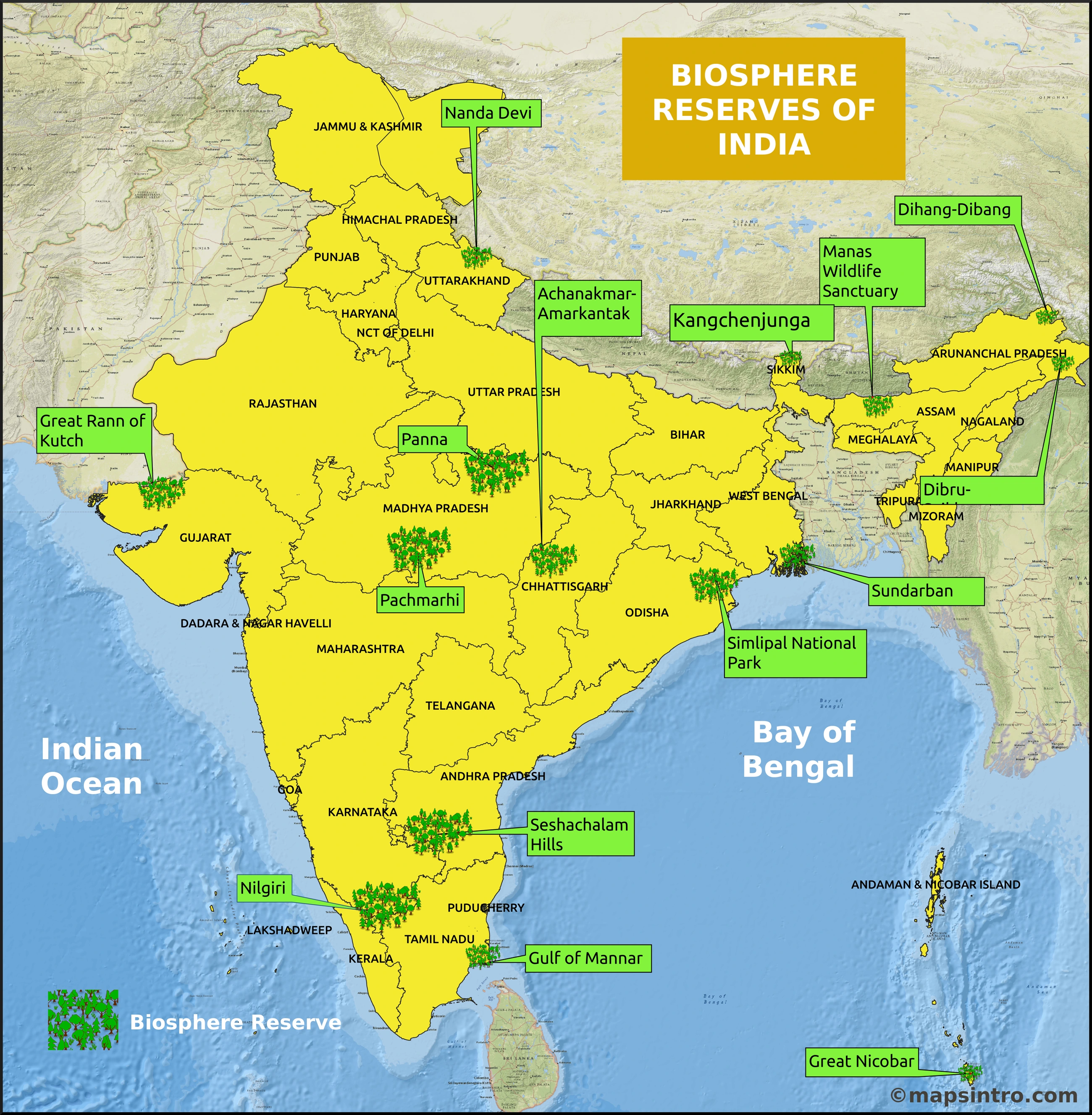
Map study
Biosphere reserves in the source reference map: locate mountain, plateau, coastal and island examples; verify the current official designation list separately.
- Read the source legend and reference date before interpreting the map.
- Use spatial patterns to support topic revision; verify current official boundaries, designations and warnings separately.
Credit: MapsIntro · CC BY-SA 4.0 · sourceConverted to WebP on an opaque white background; proportionally resized without cropping. Original cartography and legend retained.
1. Meaning, purpose and ecological significance
Conservation reserves are one of the protected-area categories recognised under India’s Wild Life (Protection) Act, 1972. They extend conservation attention beyond national parks and wildlife sanctuaries to government-owned habitats that are ecologically important. The category is particularly useful for areas adjoining existing protected areas and for landscapes connecting one protected area with another. Its statutory purpose includes protecting landscapes, seascapes, flora, fauna and their habitats.
The ecological rationale is landscape-level conservation. Wildlife populations cannot always survive indefinitely within isolated habitat patches. Animals may need to move for feeding, breeding, seasonal migration or dispersal. Connecting habitats facilitate gene flow and recolonisation, while reducing the risks associated with small, isolated populations. Rivers, wetlands, grasslands, forest patches and coastal habitats may all contribute to such connectivity.
A conservation reserve should not be confused with every area informally described as a conservation area. It acquires legal status through notification under the Act. Similarly, a wildlife corridor is an ecological feature, not automatically a conservation reserve. A corridor receives this particular legal status only if the competent government formally declares it under the relevant provision.
- In-situ conservation means protecting species within their natural habitats; conservation reserves support this approach.
- Connectivity is important, but a reserve need not function exclusively as a corridor.
- Protected-area boundaries and ecological boundaries do not necessarily coincide.
2. Legal basis and declaration procedure
Section 36A authorises the State Government to declare a conservation reserve after consultations with local communities. The eligible land must be owned by the government. The Act particularly mentions government land adjacent to national parks and sanctuaries and land linking one protected area with another. These are priority situations, not a requirement that every conservation reserve must connect two existing protected areas.
Where the proposed area includes land owned by the Central Government, the State Government must obtain the Central Government’s concurrence before declaration. This is a frequent examination distinction: the general declaring authority remains the State Government, while Central Government land triggers an additional concurrence requirement. Local communities must be consulted, but they do not themselves issue the statutory notification.
Conservation reserves and community reserves were introduced through the Wild Life (Protection) Amendment Act, 2002, which took effect in 2003. Their introduction widened the protected-area framework by recognising the importance of conservation outside the conventional national park and sanctuary model. Both categories incorporate local participation, but they differ fundamentally in land ownership and institutional responsibilities.
Section 36A also applies specified provisions relating to sanctuaries to conservation reserves, as far as may be applicable. These include provisions addressing matters such as damaging fires, injurious substances and habitat protection. However, this does not make a conservation reserve legally identical to a sanctuary. An examination answer should distinguish the specific statutory framework rather than assume that every sanctuary restriction automatically applies.
- A State Government notification establishes the reserve’s statutory identity and boundaries.
- Consultation is a legal requirement, not merely an optional outreach exercise.
- Government ownership, rather than voluntary dedication of private land, is the defining land-tenure feature.
Simplified pathway for a conservation reserve
- 1. Identify ecologically important government-owned habitat.
- 2. Verify ownership, boundaries and conservation objectives.
- 3. Consult local communities as required by Section 36A.
- 4. Obtain Central Government concurrence if Central Government land is included.
- 5. State Government issues the declaration notification.
- 6. Constitute the management committee and undertake conservation with monitoring.
3. Management and community participation
Section 36B requires the State Government to constitute a conservation reserve management committee. Its statutory role is to advise the Chief Wild Life Warden on conserving, managing and maintaining the reserve. The distinction between an advisory committee and the wildlife administration is important: the committee does not replace the Chief Wild Life Warden as the relevant wildlife authority.
The committee includes a representative of the Forest or Wildlife Department, one representative of each Village Panchayat within whose jurisdiction the reserve lies, three representatives of non-governmental organisations working in wildlife conservation, and one representative each from the Agriculture and Animal Husbandry Departments. The State Government regulates the committee’s procedure, including the tenure of its members.
This composition recognises that habitat management is connected with local livelihoods and surrounding land use. Farming practices influence pesticide runoff into wetlands; livestock management affects grazing pressure and disease risks; village institutions can assist in preventing fires and detecting illegal activities. Community knowledge can also improve understanding of seasonal wildlife movements and local resource use.
Participation does not imply that all activities become unrestricted. Management must remain consistent with applicable wildlife law and other legal obligations. Conversely, declaration should not be interpreted as automatically extinguishing every existing right or authorising displacement. Rights, access and proposed activities require examination under the applicable laws, notification and site-specific circumstances.
- Useful management measures include invasive-species control, habitat restoration, regulated visitor access and ecological monitoring.
- Meaningful consultation should identify livelihood concerns, resource dependence and opportunities for local stewardship.
| Feature | Conservation reserve | Community reserve |
|---|---|---|
| Legal provisions | Sections 36A and 36B | Sections 36C and 36D |
| Land ownership | Government-owned land | Private or community land |
| Participation at declaration | Consultation with local communities | Individual or community voluntarily offers land for conservation |
| Declaring authority | State Government; Central concurrence needed where Central Government land is included | State Government |
| Management committee role | Advises the Chief Wild Life Warden | Responsible for conservation, maintenance and management |
4. Distinguishing related conservation categories
The closest comparison is with a community reserve under Sections 36C and 36D. A community reserve concerns private or community land voluntarily offered for conservation by an individual or community, outside an existing national park, sanctuary or conservation reserve. Its objectives also include protecting traditional or cultural conservation values and practices. By contrast, a conservation reserve concerns government-owned land and requires consultation with local communities.
The management distinction is equally significant. A community reserve management committee is responsible for conserving, maintaining and managing its reserve. A conservation reserve management committee advises the Chief Wild Life Warden. Within a community reserve, changing the land-use pattern requires a resolution of its management committee and approval of the State Government.
A conservation reserve is not simply another name for reserved forest. Reserved forests arise under forest legislation, whereas conservation reserves arise under wildlife legislation. A biosphere reserve is a broader conservation and sustainable-development designation and may contain several land-use and protection categories. Likewise, an eco-sensitive zone notified under environmental law is not automatically a conservation reserve. Ramsar recognition identifies a wetland of international importance and may overlap with a conservation reserve without replacing its domestic legal status.
- Do not confuse conservation reserve with community reserve merely because both involve communities.
- Do not assume that an entire biosphere reserve has the same legal restrictions as its national park or sanctuary components.
- For any site, distinguish its ecological character, domestic legal category and international designation.
5. Indian examples, challenges and examination approach
Asan Conservation Reserve in Uttarakhand illustrates wetland and bird-habitat conservation. Located near the confluence of the Asan and Yamuna rivers in Dehradun district, it supports resident and migratory waterbirds. Beas Conservation Reserve in Punjab illustrates riverine conservation across a long river stretch. These examples show why conservation reserves should not be imagined only as forest corridors for large mammals.
Their effectiveness depends on pressures originating both inside and outside notified boundaries. Upstream pollution, altered river flows, invasive species, infrastructure, agricultural runoff and disturbance can undermine ecological objectives. Small reserves may be particularly vulnerable to surrounding land-use changes. Therefore, notification must be followed by coordination across departments, regular monitoring and adequately supported management.
For Prelims, prioritise five questions: who declares the reserve, who owns the land, whether community consultation is required, when Central Government concurrence becomes necessary, and what the management committee does. Avoid memorising an undated national count, since new notifications change totals. For descriptive answers, explain how the category complements core protected areas through connectivity, habitat diversity and participatory conservation.
- Assess success through habitat condition, water quality, species persistence and connectivity, not only the number of notifications.
- Use the Wildlife Institute of India’s National Wildlife Database for updated, dated protected-area statistics.
Real-world case studies
Asan Conservation Reserve, Uttarakhand
Declared in 2005, Asan covers approximately 444 hectares and became a Ramsar site in 2020. Its wetland habitats support migratory waterbirds, including the ruddy shelduck. It demonstrates overlapping designations: conservation reserve is its domestic statutory category, while Ramsar status recognises international wetland importance.
Beas Conservation Reserve, Punjab
Notified in 2017, the reserve encompasses an approximately 185-kilometre stretch of the Beas River, from the vicinity of the Pong Dam area to Harike. It was designated a Ramsar site in 2019. Its river channels, islands and sandbars support aquatic biodiversity, including the Indus river dolphin, illustrating the importance of water quality and river-flow management.
Previous year questions
No source-linked PYQ is available here yet. Use the practice questions below.
Practice questions
Practice MCQ 1
With reference to conservation reserves under the Wild Life (Protection) Act, 1972, consider the following statements: 1. They may be declared on government-owned land. 2. Consultation with local communities is required before declaration. 3. Every conservation reserve must connect two existing national parks. Which of the statements given above are correct?
- A. 1 and 2 only
- B. 2 and 3 only
- C. 1 and 3 only
- D. 1, 2 and 3
Practice MCQ 2
Which one of the following correctly describes a conservation reserve management committee?
- A. It declares conservation reserves independently of the State Government.
- B. It advises the Chief Wild Life Warden on conservation, management and maintenance.
- C. It consists exclusively of elected Village Panchayat representatives.
- D. It grants Ramsar status to wetlands within the reserve.
Practice MCQ 3
A State Government proposes to declare a conservation reserve that includes land owned by the Central Government. Which additional requirement follows specifically from Section 36A?
- A. Prior recognition as a UNESCO biosphere reserve
- B. Transfer of all land to the local Village Panchayat
- C. Concurrence of the Central Government before declaration
- D. Prior conversion of the area into a national park
Mains practice · Conservation reserves complement India’s core protected areas by combining landscape-level conservation with local participation. Discuss their legal framework, ecological importance and implementation challenges. Answer in 250 words.
- Introduce Sections 36A and 36B of the Wild Life (Protection) Act, 1972.
- Explain government land, State Government declaration, community consultation and conditional Central concurrence.
- Describe the committee’s advisory role and representative membership.
- Connect habitat corridors with dispersal, gene flow and ecological resilience.
- Use Asan and Beas to demonstrate wetland and riverine applications.
- Identify external pollution, habitat fragmentation, inadequate resources and weak coordination as challenges.
- Recommend meaningful participation, landscape planning and ecological outcome monitoring.
Further reading
- India Code: Wild Life (Protection) Act, 1972, Sections 36A–36D.
- Wildlife Institute of India: National Wildlife Database, Conservation Reserves.
- Ramsar Sites Information Service: Asan Conservation Reserve and Beas Conservation Reserve.
- NCERT Biology, Class XII: Biodiversity and Conservation.
- Ministry of Environment, Forest and Climate Change: National Wildlife Action Plan 2017–2031.
Preparing for UPSC Civil Services? Get classroom teaching, answer-writing evaluation and mentorship at Pragnya IAS Academy, Ashok Nagar — see why aspirants choose us for IAS coaching in Hyderabad.