
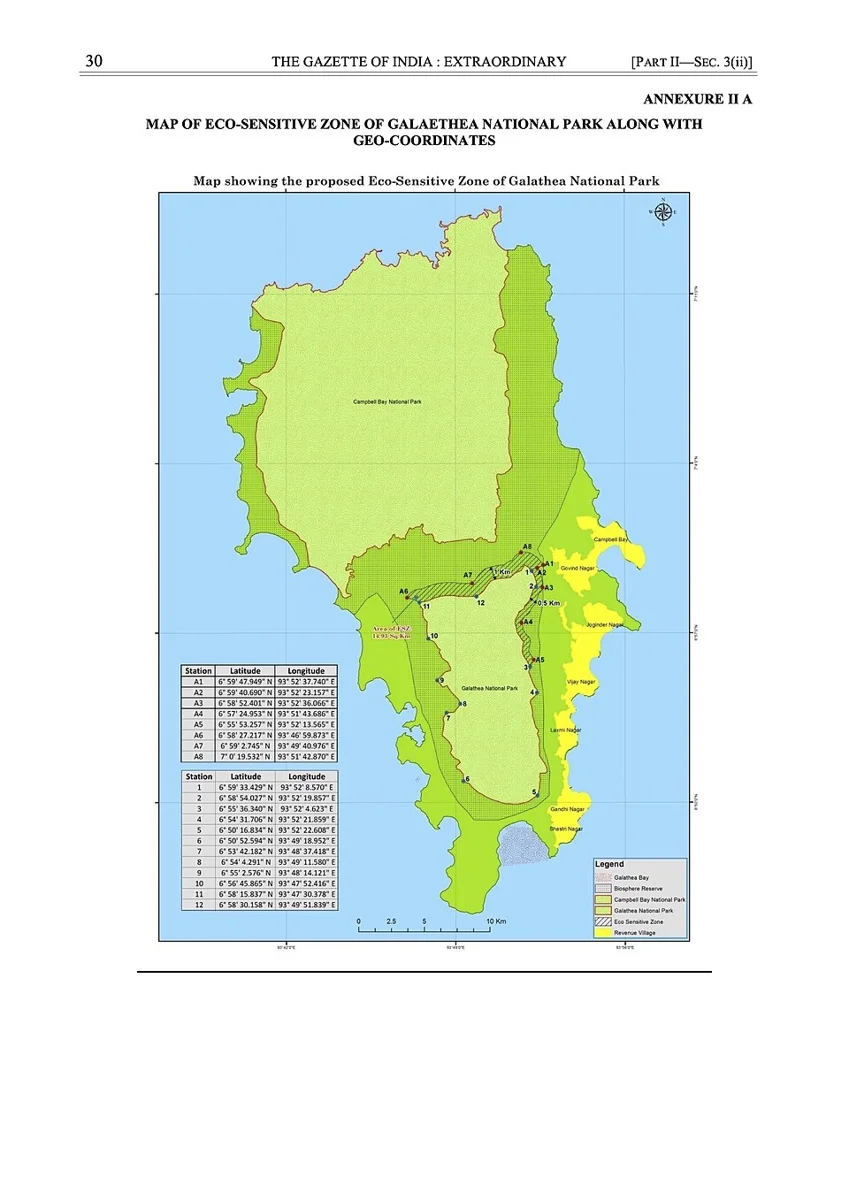
Map identified as showing the proposed eco-sensitive zone around Galathea National Park, Andaman and Nicobar Islands.
Credit: Government Of India · Public domain · sourceResized and converted to WebP; uncropped.
1. Meaning and ecological significance
An eco-sensitive zone, or ESZ, is a notified area in the vicinity of a protected ecosystem where certain activities are prohibited, regulated or encouraged according to their environmental implications. Around national parks and wildlife sanctuaries, ESZs act as shock absorbers against pressures originating outside protected boundaries. Their purpose is to create a transition between areas receiving relatively strict protection and surrounding landscapes used for settlement, farming, infrastructure and industry.
Ecological processes do not stop at administrative boundaries. Wildlife may move outside a sanctuary to feed, breed or disperse; rivers carry sediment and pollutants across boundaries; and roads can interrupt movement between habitats. Regulating surrounding land use therefore helps maintain habitat connectivity, water security, landscape integrity and the ecological effectiveness of protected areas.
ESZs are especially important where protected areas adjoin rapidly urbanising regions, mining belts, plantations or tourist destinations. However, they are not necessarily uninhabited wilderness. Villages, agricultural fields and existing livelihood activities may lie within them. The conservation objective is compatible land use rather than automatic displacement or the elimination of all economic activity.
- Ecological functions include buffering edge effects, reducing pollution, protecting catchments and maintaining wildlife movement routes.
- An ESZ can assist corridor conservation, but it is not automatically identical to a wildlife corridor.
- Notification does not by itself convert all included land into forest land or transfer private ownership to the government.
Timeline
1986
The Environment (Protection) Act and Rules establish the enabling framework for area-based restrictions on environmentally damaging activities.
9 February 2011
The Environment Ministry issues guidelines for declaring ESZs around national parks and wildlife sanctuaries.
3 June 2022
The Supreme Court issues directions on a minimum one-kilometre ESZ and new permanent structures.
26 April 2023
The Supreme Court qualifies the earlier directions while retaining the mining prohibition within protected areas and one kilometre of their boundaries.
2. Legal basis and notification process
The principal legal foundation is Section 3 of the Environment (Protection) Act, 1986. Section 3(2)(v) empowers the Central Government to restrict areas in which industries, operations or processes may operate, or to prescribe safeguards. Rule 5 of the Environment (Protection) Rules, 1986 provides the associated framework for restrictions based on environmental considerations. The Ministry of Environment, Forest and Climate Change issues ESZ notifications using these powers.
The Ministry’s guidelines of 9 February 2011 provide the policy framework for ESZs around national parks and wildlife sanctuaries. State governments and Union Territory administrations generally prepare site-specific proposals containing boundaries, maps, ecological features, settlements and proposed activity controls. A draft notification invites objections and suggestions before the final notification is issued. Public participation is important because boundary selection and restrictions affect local livelihoods and development choices.
Final notifications normally specify geographical coordinates, village coverage, an activity schedule, a monitoring committee and preparation of a Zonal Master Plan. Such plans should integrate ecological protection with local development and relevant sectoral plans. The committee monitors compliance, but its presence does not replace other statutory authorities. Forest diversion, wildlife-related approvals and environmental clearance requirements continue to apply wherever independently required.
An ESZ should not be confused with a conservation reserve or community reserve, which are protected-area categories under the Wild Life (Protection) Act, 1972. It is also distinct from a biosphere reserve, a Ramsar site or the buffer of a tiger reserve. These designations may overlap geographically but arise from different legal or policy frameworks.
Typical ESZ notification and implementation pathway
- 1. Identify ecological sensitivities and map surrounding land uses
- 2. State or Union Territory prepares a site-specific proposal
- 3. Union Ministry examines the proposal and publishes a draft notification
- 4. Objections and suggestions are considered
- 5. Final notification specifies boundaries and activity restrictions
- 6. Zonal planning, departmental enforcement and committee monitoring follow
3. Extent and Supreme Court directions
ESZ boundaries are intended to reflect local ecological and geographical conditions. Relevant factors include terrain, drainage, habitat continuity, species movement, existing settlements and development pressures. Their width can vary along different sides of the same protected area. The frequently cited distance of 10 kilometres is not a rule making every surrounding parcel a uniformly restricted ESZ. The 2011 guidelines contemplate site-specific delineation and, where ecologically necessary, inclusion of important areas beyond 10 kilometres.
In T.N. Godavarman Thirumulpad v. Union of India, the Supreme Court on 3 June 2022 directed that protected national parks and wildlife sanctuaries should generally have an ESZ of at least one kilometre from their demarcated boundaries. The order also imposed a restriction on new permanent structures. Its practical consequences generated concerns for settlements, public facilities and livelihood infrastructure around protected areas.
On 26 April 2023, the Court modified these directions. The minimum one-kilometre direction was made inapplicable to protected areas for which the Ministry had issued draft or final ESZ notifications, or for which proposals had been received by the Ministry. The Court also provided exceptions concerning protected areas along interstate boundaries or sharing common boundaries. It removed the blanket restriction on permanent structures in favour of the applicable regulatory framework.
A crucial retained safeguard is the prohibition of mining inside national parks and wildlife sanctuaries and within one kilometre of their boundaries. For examination purposes, distinguish this judicial mining restriction from the separate prohibition of commercial mining ordinarily found in ESZ notifications. Also distinguish an ESZ boundary from any distance-based requirement governing consideration of projects for wildlife clearance.
| Designation | Principal legal or policy basis | Key distinction |
|---|---|---|
| Eco-sensitive zone | Environment (Protection) Act, 1986 and Rules | Site-specific regulation of activities around protected ecosystems |
| National park or wildlife sanctuary | Wild Life (Protection) Act, 1972 | Statutory protected area with category-specific controls |
| Conservation reserve | Wild Life (Protection) Act, 1972 | Government-owned area, often adjoining or connecting protected areas |
| Community reserve | Wild Life (Protection) Act, 1972 | Conservation designation involving voluntarily conserved private or community land |
| Biosphere reserve | National programme and UNESCO framework | Landscape approach integrating conservation, development and research |
4. Activity regulation and local livelihoods
The 2011 guidelines broadly organise activities into prohibited, regulated and permissible or promoted categories. Commercial mining, sawmills, polluting industries and hazardous-substance-related activities are typical prohibited activities. The exact legal restrictions must nevertheless be read from the relevant final notification and applicable court orders rather than inferred from a generic list.
Tourism facilities, construction, tree felling, road works, extraction of groundwater and changes in farming systems may be regulated through permissions, location conditions or environmental safeguards. Regulated does not mean either automatically banned or automatically approved. Hotels and resorts, for example, are often subject to specific distance and planning conditions in notifications. Their treatment cannot safely be generalised across every ESZ.
Ongoing agriculture and horticulture, rainwater harvesting, organic farming, renewable-energy practices and restoration of degraded land are generally compatible with ESZ objectives, subject to the notification and other laws. Local residents therefore should not be treated as prohibited occupants merely because their village falls within an ESZ. Conservation policy must recognise livelihood dependence, applicable land and forest rights, and the need for essential services.
- Prohibited: incompatible activities that the notification does not permit.
- Regulated: activities allowed only under specified conditions or approval procedures.
- Promoted or permissible: activities compatible with ecological protection, subject to applicable safeguards.
5. Governance challenges and examination approach
Effective implementation requires more than drawing a buffer on a map. Poor boundary information, delayed Zonal Master Plans, fragmented departmental responsibilities and weak monitoring can undermine protection. Conversely, poorly communicated restrictions can generate uncertainty over house repairs, farming and community infrastructure. Transparent village-level maps and accessible explanations of activity rules are therefore essential.
A balanced approach combines ecological mapping with consultation involving residents, local bodies, forest departments and relevant rights holders. Tourism should reflect carrying capacity and waste-management requirements. Infrastructure planning should minimise fragmentation through alternative alignments and appropriate wildlife passages. Monitoring should examine cumulative pressures across the landscape rather than consider each project in isolation.
For Prelims, use three tests: identify the enabling law, distinguish prohibition from regulation, and reject absolute distance claims. For Mains, frame ESZs as an instrument of landscape-level conservation whose legitimacy depends on scientific delineation, livelihood-sensitive implementation and accountable governance.
Eco-sensitive zones: interpreting a proposed boundary
The supplied metadata identifies this map as depicting a proposed eco-sensitive zone (ESZ) around Galathea National Park. It is therefore directly relevant to understanding how ESZs translate ecological protection into spatial regulation. An ESZ provides a transition between a protected area and its surrounding landscape, helping manage pressures whose effects can cross park boundaries. Its extent need not form a uniform ring: ecological connections, terrain, settlements and other site-specific considerations inform delineation. The metadata alone does not establish the mapped distances, notification status or current legal boundary.
In India, ESZ notifications draw their legal authority from the Environment (Protection) Act, 1986 and the Environment (Protection) Rules, 1986. They distinguish prohibited, regulated and permissible activities rather than imposing an identical ban on all development. A proposed map should therefore be read alongside the relevant notification’s boundary description, coordinates, activity provisions and planning requirements. For this island setting, the useful Mains connection is the need to reconcile biodiversity protection, livelihood concerns and infrastructure pressures through landscape-sensitive planning. However, the map’s title cannot establish which particular projects or activities are allowed, nor substitute for applicable Supreme Court directions and subsequent legal developments.
- Prelims distinction: an ESZ is not itself a national park or wildlife sanctuary; its regulatory basis differs from protected-area designation under wildlife law.
- Evidence limit: “proposed” does not mean finally notified. Verify the final notification and amendments before treating a mapped boundary as operative.
- Mains application: assess ecological connectivity, cumulative impacts and local participation; avoid assuming either a universally fixed ESZ width or a blanket development prohibition.
Real-world case studies
Sanjay Gandhi National Park, Maharashtra
The ESZ notified in 2016 around Sanjay Gandhi National Park illustrates conservation at an urban interface. The park lies within the Mumbai metropolitan landscape, where construction, traffic and intensive land use create external pressures. Its surroundings demonstrate why location-specific boundaries, enforceable planning controls and coordination among forest and urban authorities matter.
Kerala and the one-kilometre buffer debate
The Supreme Court’s June 2022 directions prompted concern in Kerala because settlements and cultivated land occur close to several protected areas. Mapping inhabited areas became central to public debate. The episode illustrates the need to distinguish an ecological buffer from automatic eviction and to communicate the implications of judicial orders and site-specific notifications accurately.
Previous year questions
UPSC Prelims 2014
With reference to Eco-Sensitive Zones, consider the following statements: 1. They are areas declared under the Wildlife (Protection) Act, 1972. 2. Their purpose is to prohibit all kinds of human activities except agriculture. Which of the statements is/are correct?
- A. 1 only
- B. 2 only
- C. Both 1 and 2
- D. Neither 1 nor 2
Practice questions
Practice MCQ 1
Which provision principally enables the Union Government to restrict industries, operations or processes in areas notified as eco-sensitive zones?
- A. Section 3 of the Environment (Protection) Act, 1986
- B. Article 280 of the Constitution
- C. The Representation of the People Act, 1951
- D. The Indian Easements Act, 1882
Practice MCQ 2
Consider the following statements: 1. An ESZ must have an identical width along every side of a protected area. 2. Notification of an ESZ automatically converts all private land within it into government forest. 3. Activities within an ESZ may be regulated rather than entirely prohibited. Which of the statements is/are correct?
- A. 1 and 2 only
- B. 2 only
- C. 3 only
- D. 1, 2 and 3
Practice MCQ 3
With reference to the Supreme Court’s April 2023 ESZ directions, which statement is correct?
- A. Commercial mining became permissible inside wildlife sanctuaries.
- B. Every national park was required to have an ESZ exactly ten kilometres wide.
- C. Mining remained prohibited within one kilometre of national park and wildlife sanctuary boundaries.
- D. All site-specific ESZ notifications were cancelled.
Mains practice · Eco-sensitive zones must reconcile landscape-level conservation with the legitimate needs of neighbouring communities. Discuss their legal framework and suggest measures for effective implementation. Answer in 250 words.
- Explain ecological buffering, connectivity and catchment protection.
- Identify the Environment (Protection) Act, 1986, Rule 5 and the 2011 guidelines.
- Distinguish prohibited, regulated and permissible activities.
- Briefly explain the 2022 directions and their 2023 modification.
- Discuss livelihood uncertainty, mapping disputes and fragmented governance.
- Recommend participatory delineation, accessible maps, timely Zonal Master Plans, rights-sensitive implementation and cumulative-impact monitoring.
Further reading
- MoEFCC: Guidelines for Declaration of Eco-Sensitive Zones around National Parks and Wildlife Sanctuaries, 9 February 2011.
- India Code: Environment (Protection) Act, 1986, especially Section 3; Environment (Protection) Rules, 1986, Rule 5.
- Supreme Court of India: T.N. Godavarman Thirumulpad v. Union of India, orders dated 3 June 2022 and 26 April 2023.
- MoEFCC and e-Gazette of India: Site-specific draft and final ESZ notifications.
- NCERT Biology, Class XII: Biodiversity and Conservation.
- https://commons.wikimedia.org/wiki/File:Map_Showing_The_Proposed_Eco-Sensitive_Zone_Around_Galathea_National_Park.jpg
Preparing for UPSC Civil Services? Get classroom teaching, answer-writing evaluation and mentorship at Pragnya IAS Academy, Ashok Nagar — see why aspirants choose us for IAS coaching in Hyderabad.