

Clathria (Microciona) aceratoobtusa at Vilanguchalli Island, Gulf of Mannar. (a) A prominent and profound dermal canal pattern was radiating all over the body upon close observation underwater; (b) Sp
Credit: TY - JOUR AU - Ashok, Arathy AU - Calcinai, Barbara AU - Patterson, Edward PY - 2020/01/09 SP - 1 EP - 11 T1 - T · CC BY 4.0 · source
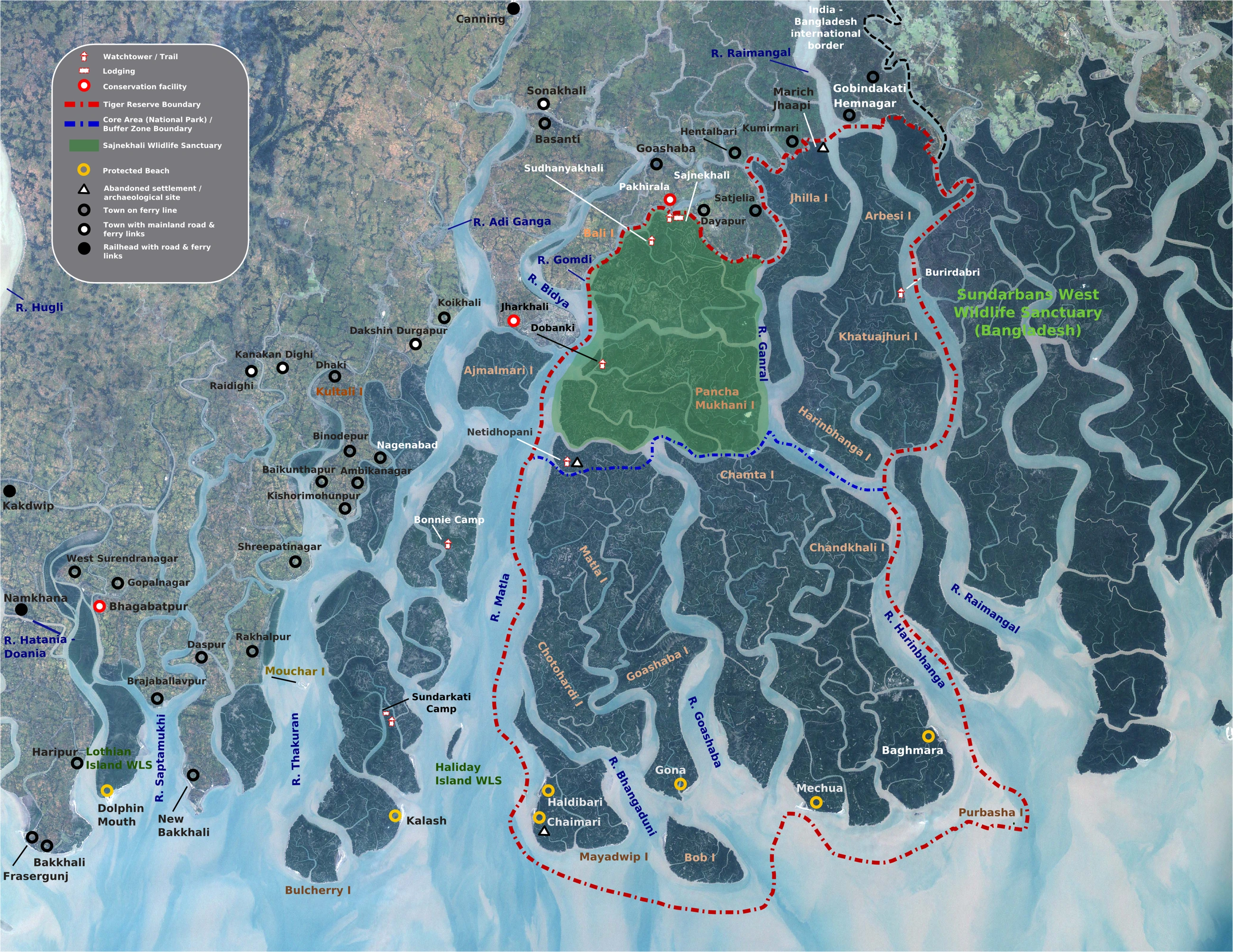
Map study
Sundarbans delta: relate distributaries and the Bay of Bengal coast to mangrove habitats. This geographic view is not a complete current protected-area boundary inventory.
- Read the source legend and reference date before interpreting the map.
- Use spatial patterns to support topic revision; verify current official boundaries, designations and warnings separately.
Credit: Pradiptaray · Public domain · sourceConverted to WebP on an opaque white background; proportionally resized without cropping. Original cartography and legend retained.
1. Meaning, scope and ecological importance
An MPA is a clearly defined geographical space in the marine or coastal environment, recognised and managed through legal or other effective means to achieve long-term conservation of nature. It can include intertidal shores, estuaries, mangroves, coral reefs, seagrass meadows, islands, seabed habitats and the waters above them. Its defining feature is a durable conservation objective, rather than merely being a sea area where some activity is regulated.
Marine ecosystems provide nursery grounds, feeding areas and migration routes for organisms whose life cycles cross administrative boundaries. Coral reefs support high biodiversity; seagrass meadows sustain dugongs and juvenile fishes; mangroves shelter young fish and reduce shoreline erosion. Protecting these habitats helps maintain food webs, genetic diversity and ecological functions, including nutrient cycling and carbon storage.
MPAs can improve fish abundance, body size and reproductive capacity within protected boundaries when damaging extraction is effectively controlled. Adult movement and the dispersal of eggs and larvae may benefit surrounding fishing grounds. These spillover benefits depend on species biology, habitat quality, enforcement and fishing pressure outside the reserve; they are neither immediate nor guaranteed.
Protection also supports research, environmental education and carefully regulated tourism. However, an MPA cannot independently stop ocean warming, acidification or pollution originating upstream. It strengthens local ecosystem resilience but must operate alongside emissions reduction, watershed management and wider fisheries regulation.
- No-take zone: extractive activities such as fishing and collection are prohibited within the designated zone.
- Multiple-use MPA: compatible activities may be allowed under defined conditions or in specified zones.
- MPA network: several protected sites planned together to represent habitats and maintain ecological connectivity.
2. Indian legal and institutional framework
The Wild Life (Protection) Act, 1972 provides the principal protected-area framework relevant to Indian MPAs. Marine and coastal habitats may be included within national parks, wildlife sanctuaries, conservation reserves or community reserves. These categories have different provisions concerning rights, management and permitted activities. National parks generally have a stricter statutory regime than sanctuaries; neither category should be confused with an unrestricted multiple-use coastal zone.
A conservation reserve may be declared on government-owned land, following consultation with local communities, particularly to protect landscapes, seascapes or links between protected areas. A community reserve concerns qualifying private or community land voluntarily conserved by a community or individual. The designation MPA does not replace these legal categories: one must examine the actual notification, boundaries and applicable rules.
The Environment (Protection) Act, 1986 supports complementary coastal safeguards. Coastal Regulation Zone notifications regulate specified activities along mainland coasts, while a separate Island Coastal Regulation Zone framework applies to the Andaman and Nicobar and Lakshadweep islands. Coastal zoning can protect ecologically sensitive habitats, but every CRZ-regulated stretch is not automatically an MPA.
Implementation involves state forest and wildlife departments, fisheries departments, coastal authorities and enforcement agencies, including the Indian Coast Guard where relevant. State marine fishing regulation laws govern matters such as fishing zones, vessels, gears and seasonal restrictions in their applicable waters. Consequently, effective marine conservation requires coordination across wildlife protection, fishing regulation, pollution control and coastal development.
- A Ramsar designation recognises an internationally important wetland; it does not itself create a national park or establish a universal fishing prohibition.
- A biosphere reserve integrates conservation, development and research through zonation; its entire area is not necessarily a statutory protected area.
- Other effective area-based conservation measures, or OECMs, are distinct from protected areas but deliver sustained, long-term in situ biodiversity conservation.
From designation to effective marine conservation
- 1. Map habitats, species, resource use and threats
- 2. Consult communities and identify rights and livelihood impacts
- 3. Select boundaries, legal category and compatible management zones
- 4. Implement restrictions, surveillance and livelihood measures
- 5. Monitor ecological and social outcomes
- 6. Revise management using evidence
3. Major Indian locations and examination linkages
India’s marine conservation geography spans the Arabian Sea, Bay of Bengal and island territories. The Marine National Park and Marine Sanctuary in the Gulf of Kachchh, Gujarat, protect an intertidal landscape containing coral communities, mangroves, mudflats and associated fauna. Large tidal fluctuations are a notable feature. Distinguish this gulf from the Gulf of Khambhat, also located in Gujarat.
The Gulf of Mannar Marine National Park in Tamil Nadu covers 21 islands and surrounding marine habitats between the Rameswaram and Thoothukudi region. Coral reefs, seagrasses and mangroves occur within this wider seascape. The national park is part of the larger Gulf of Mannar Biosphere Reserve; their boundaries and regulatory implications are not identical.
Gahirmatha Marine Wildlife Sanctuary in Odisha is particularly associated with olive ridley turtles and their mass nesting, or arribada. Protection of offshore breeding and congregation waters complements beach protection. Odisha’s other major olive ridley nesting locations include the Rushikulya river mouth and the Devi river mouth; not all such sites are part of Gahirmatha sanctuary.
Island examples include Mahatma Gandhi Marine National Park near Wandoor in the Andaman Islands and Rani Jhansi Marine National Park in the Andaman archipelago. These protect island-associated marine ecosystems, including reefs. Lakshadweep represents a contrasting coral-atoll setting. For map questions, relate each site to its sea, state or Union Territory, habitat and flagship species rather than memorising names alone.
- Dugong: herbivorous marine mammal dependent on seagrass habitats; it is not a fish.
- Olive ridley: marine turtle vulnerable to incidental capture in fishing gear and disturbance of nesting beaches.
- Corals: reef-building corals depend on suitable environmental conditions; marine protection does not prevent heat-driven bleaching.
| Site | Location | Key association |
|---|---|---|
| Marine National Park, Gulf of Kachchh | Gujarat; Arabian Sea | Intertidal reefs, mangroves and mudflats |
| Gulf of Mannar Marine National Park | Tamil Nadu | 21 islands; reefs and seagrasses |
| Gahirmatha Marine Wildlife Sanctuary | Odisha; Bay of Bengal | Olive ridley turtle congregation and nesting |
| Mahatma Gandhi Marine National Park | Andaman and Nicobar Islands | Island and coral-reef ecosystems near Wandoor |
| Dugong Conservation Reserve | Palk Bay, Tamil Nadu | Seagrass habitat and dugong conservation; notified in 2022 |
4. Designing effective and equitable protection
Site selection should protect representative habitats, breeding grounds and threatened species while considering connectivity. Ocean currents transport larvae, and mobile animals routinely cross protected boundaries. A connected network with adequate habitat representation can therefore outperform isolated sites selected only because they are easy to notify. Boundaries should reflect ecological processes as well as administrative practicality.
Zoning can separate strictly protected breeding or recovery areas from locations permitting regulated fishing, navigation or tourism where legally allowed. Seasonal restrictions may protect spawning or turtle congregation periods. These measures require clear rules, local communication, patrol capacity and coordination with fisheries authorities. Technology such as vessel tracking and remote sensing can assist surveillance but cannot replace field enforcement.
Conservation imposes costs when access to customary fishing grounds is restricted. Meaningful participation by small-scale fishers, recognition of legitimate rights, transparent decisions and suitable livelihood support improve fairness and compliance. Management should distinguish low-impact customary practices from destructive or illegal extraction rather than treating all coastal resource users alike.
Monitoring must assess outcomes rather than notifications alone. Indicators include coral cover, seagrass extent, fish biomass, turtle bycatch, water quality, compliance and livelihood effects. Baselines and comparisons with suitable unprotected sites help evaluate whether protection works. Management plans should be revised when monitoring reveals habitat decline, displaced fishing pressure or unforeseen social costs.
- Paper park: a protected area that exists formally but lacks adequate implementation or conservation outcomes.
- Important pressures: destructive fishing, bycatch, dredging, sewage, plastics, coastal construction, invasive species and climate change.
- Global benchmark: Target 3 of the Kunming–Montreal framework stresses effective, representative, connected and equitably governed conservation, not merely numerical expansion.
Real-world case studies
Palk Bay Dugong Conservation Reserve
Tamil Nadu notified India’s first Dugong Conservation Reserve in Palk Bay in 2022, covering approximately 448 square kilometres. It highlights the importance of seagrass conservation for a threatened marine mammal. The broader lesson is that species protection must address habitat degradation and accidental entanglement, with fishing communities participating in conservation.
Great Barrier Reef Marine Park, Australia
The park uses zoning to accommodate different activities while maintaining extensive no-take areas. It demonstrates large-scale marine spatial management, but recurrent mass coral bleaching also exposes the limits of local protection. Even well-managed MPAs require global climate action to address rising marine temperatures.
Previous year questions
UPSC Prelims 2015
With reference to dugong, consider these statements: 1. It is a herbivorous marine animal. 2. It occurs along the entire coast of India. 3. It receives legal protection under Schedule I of the Wild Life (Protection) Act, 1972. Which statements are correct?
- A. 1 and 2 only
- B. 2 only
- C. 1 and 3 only
- D. 3 only
Practice questions
Practice MCQ 1
Consider these statements: 1. Every marine protected area necessarily prohibits all fishing. 2. A marine protected area may include intertidal habitats. 3. Ecological connectivity is relevant when designing an MPA network. Which statements are correct?
- A. 1 only
- B. 2 and 3 only
- C. 1 and 3 only
- D. 1, 2 and 3
Practice MCQ 2
Which pair is incorrectly matched?
- A. Gahirmatha — Odisha
- B. Gulf of Mannar Marine National Park — Tamil Nadu
- C. Mahatma Gandhi Marine National Park — Lakshadweep
- D. Gulf of Kachchh Marine National Park — Gujarat
Practice MCQ 3
Which statement best describes Target 3 of the Kunming–Montreal Global Biodiversity Framework?
- A. It requires a complete global ban on marine fishing by 2030.
- B. It seeks conservation of at least 30% of coastal and marine areas globally by 2030 through protected areas and OECMs.
- C. It automatically converts all Ramsar sites into national parks.
- D. It measures conservation success solely through the area notified.
Mains practice · Marine protected areas must move beyond legal notification to ecological effectiveness and social legitimacy. Discuss with Indian examples. Answer in 250 words.
- Define MPAs and distinguish designation from outcomes.
- Explain habitat representation, connectivity, zoning and enforcement.
- Use Gulf of Mannar, Gahirmatha and Palk Bay examples.
- Discuss fishing rights, participation, bycatch reduction and livelihood support.
- Address pollution and climate threats beyond MPA boundaries.
- Conclude with measurable outcomes and adaptive management.
Further reading
- NCERT Biology, Class XII: Biodiversity and Conservation.
- India Code: Wild Life (Protection) Act, 1972, as amended.
- Wildlife Institute of India: marine protected areas and protected-area database.
- Ministry of Environment, Forest and Climate Change: coastal regulation notifications.
- Convention on Biological Diversity: Kunming–Montreal Global Biodiversity Framework, Target 3.
- Tamil Nadu Forest Department: Dugong Conservation Reserve and Gulf of Mannar information.
Preparing for UPSC Civil Services? Get classroom teaching, answer-writing evaluation and mentorship at Pragnya IAS Academy, Ashok Nagar — see why aspirants choose us for IAS coaching in Hyderabad.