
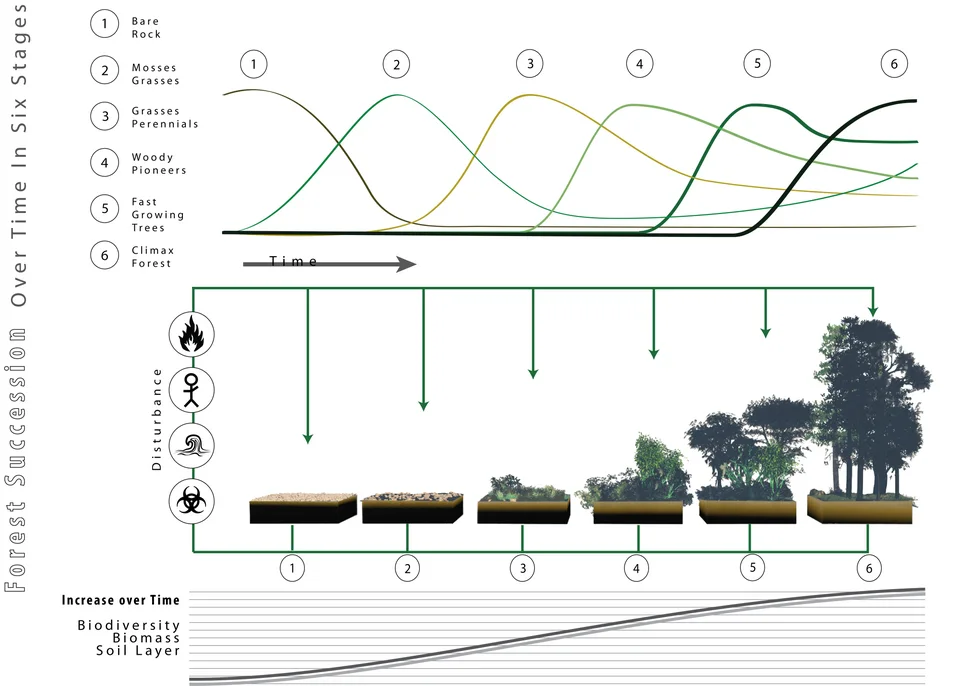
Illustrative diagram of forest succession, linking community change with biomass, biodiversity and soil development.
Credit: LucasMartinFrey · CC BY 3.0 · sourceResized and converted to WebP; uncropped.
1. Meaning, scope and ecological vocabulary
Ecological succession is a change in community composition and structure over time in which populations establish, expand, decline or are replaced. It often follows a disturbance or the creation of a new substrate. The process concerns communities and ecosystems rather than genetic change within a species. Seasonal replacement of annual plants or recurring seasonal plankton peaks is not, by itself, evidence of long-term succession.
A pioneer community comprises the organisms that first establish in a habitat. These organisms must tolerate the site's initial conditions, such as unstable sediment, drought, nutrient scarcity or strong exposure. Lichens and mosses are familiar pioneers on some bare rock surfaces, but microbes, grasses, herbs or woody plants may be pioneers elsewhere. Successful colonisation also depends on nearby source populations and the arrival of seeds, spores or other propagules.
The complete sequence of communities is called a sere, and its intermediate communities are seral stages. A relatively persistent late-successional community is traditionally called a climax community. Persistence is relative: populations continue to turn over, gaps form and environmental conditions change. Succession therefore should not be understood as a staircase that always ends in a permanently fixed community.
- Habitat refers to where an organism lives; succession concerns changes in the community occupying a habitat.
- Ecological succession operates through ecological time; evolution involves inherited changes across generations.
- Early colonisation and later community replacement may occur simultaneously in different patches of the same landscape.
2. Primary and secondary succession
Primary succession begins where a developed soil and a previously established terrestrial community are absent. Examples include fresh lava, recently exposed rock following glacial retreat and newly formed mineral surfaces. Organisms must establish despite limited nutrients and often poor water retention. Weathering, deposition of wind-blown material, biological activity and the accumulation of dead organic matter gradually help create a soil environment suitable for additional species.
On suitable rock surfaces, lichens contribute to weathering through chemical and physical processes. Microbes and plants add organic material, while roots influence substrate stability and soil formation. Nitrogen-fixing organisms can improve nitrogen availability in some primary successions, although not every pioneer is a nitrogen fixer. Soil development may be slow, especially in cold or arid settings; there is no universal duration for completing primary succession.
Secondary succession follows disturbance of an existing community where soil and some biological legacies survive. Abandoned fields, forests after many fires and storm-damaged woodlands provide examples. Seed banks, surviving roots, underground stems, microorganisms and nearby vegetation commonly accelerate recovery. Secondary succession is therefore generally faster than primary succession, but repeated burning, invasive species, erosion or severe degradation can delay or divert it.
The classification depends on what remains, not merely on the name of the disturbance. A fire usually initiates secondary succession if the soil persists. A disturbance that removes soil and exposes fresh mineral substrate may instead create conditions resembling primary succession. Similarly, mine reclamation may involve either retained topsoil or largely soil-free spoil, requiring different restoration approaches.
- Primary succession: development of a community on a substrate lacking developed soil.
- Secondary succession: reorganisation of a community with surviving soil and biological legacies.
- Faster recovery does not necessarily mean restoration of the original species composition.
A simplified successional pathway
- 1. A new substrate forms or disturbance creates an opening
- 2. Propagules arrive and suitable organisms establish
- 3. Populations expand and interact
- 4. Organisms and external forces modify site conditions
- 5. Species composition and community structure change
- 6. A relatively persistent community or shifting patch mosaic develops
3. Processes and mechanisms of succession
Classical descriptions identify nudation, invasion, competition and coaction, reaction, and stabilisation. Nudation is the creation of an open area. Invasion includes migration to the site, successful establishment or ecesis, and multiplication. As populations grow, interactions intensify. Reaction refers to organisms modifying their environment, for example through shading, litter deposition or changes in soil chemistry. These terms offer a useful framework, but actual processes overlap rather than follow rigid boundaries.
Autogenic succession is driven substantially by changes generated by the community itself. Accumulating litter may build soil organic matter, while a developing canopy reduces light and favours shade-tolerant plants. Allogenic change is driven by external factors such as flooding, sediment deposition, erosion or climatic shifts. Most real successions reflect both internal feedbacks and external influences, so these categories are analytical distinctions rather than mutually exclusive situations.
Three influential mechanisms explain species replacement. Facilitation occurs when early occupants improve conditions for later species. Tolerance occurs when later species establish without requiring such improvement and eventually persist because of their environmental tolerances or competitive abilities. Inhibition occurs when established occupants suppress newcomers until damage or death creates opportunities. Different mechanisms can operate together within one site.
Priority effects arise when the order of arrival influences the community that develops. An early coloniser may monopolise space or alter soil conditions, favouring some later arrivals and excluding others. Consequently, identical physical environments need not produce identical communities. Dispersal barriers, grazing pressure and the availability of suitable establishment sites also help explain why succession can be delayed or redirected.
| Feature | Primary succession | Secondary succession |
|---|---|---|
| Initial substrate | No developed soil | Soil generally retained |
| Biological legacies | Usually limited; colonisation depends strongly on arrivals | Seed banks, roots, microbes or surviving organisms often remain |
| Common examples | Fresh lava and recently exposed glacial rock | Abandoned farmland and many burned forests |
| Major constraints | Soil formation, nutrient supply and establishment | Competition, disturbance recurrence and propagule availability |
| Typical recovery rate | Generally slower | Generally faster, but strongly context-dependent |
4. Hydrarch, xerarch and climax concepts
Hydrarch succession begins in a wet or aquatic habitat, whereas xerarch succession begins under dry conditions. A lithosere starts on rock; a psammosere develops on sand. A textbook hydrosere may progress from open-water organisms through submerged and floating-leaved plants to emergent vegetation and marsh communities. If sediment and organic matter accumulate sufficiently, less waterlogged communities may develop.
The familiar rock-to-lichen-to-moss-to-herb-to-shrub-to-forest sequence is likewise an illustrative lithosere, not a universal rule. Traditional accounts suggest that hydrarch and xerarch successions tend towards more mesic conditions. This is a simplified generalisation: hydrology, climate, fire, grazing and substrate can maintain wetlands, grasslands or shrublands indefinitely. Natural grasslands and wetlands must not automatically be classified as incomplete forests.
Frederic Clements emphasised an orderly progression towards a climax largely determined by regional climate. Arthur Tansley's polyclimax perspective gave greater importance to factors such as soil, topography, fire and other local conditions. Modern ecology stresses patch dynamics, continuing disturbance and multiple possible trajectories. A mature forest can contain young gaps and old stands together, while feedbacks may sometimes maintain alternative ecosystem states.
- Hydrarch and xerarch describe starting conditions, not guaranteed endpoints.
- A climax community is relatively persistent, not absolutely unchanging.
- Natural disturbance can maintain biodiversity rather than merely interrupt ecosystem development.
5. Ecosystem trends and conservation significance
During many successions, standing biomass, vegetation height, litter and soil organic matter increase. More complex vegetation creates additional habitats and modifies temperature, humidity and light. However, these trends are context-dependent. Species richness can rise, plateau or decline, and early open-habitat specialists may disappear as a canopy closes. A later stage is therefore not automatically more valuable for every conservation objective.
Gross primary productivity is the total rate at which producers fix energy as organic matter. Net primary productivity equals gross primary productivity minus producer respiration. Biomass is a stock, whereas productivity is a rate: a high-biomass old forest need not have the highest net primary productivity. Classical models suggest that ecosystem production and respiration become more closely balanced in mature systems, but mature forests can still remain carbon sinks.
Successional knowledge supports ecological restoration by identifying barriers to recovery. Passive restoration may suffice where propagules and soil remain; assisted natural regeneration may require controlling repeated fires, excessive grazing or invasive plants. Severely altered sites may need erosion control, hydrological repair or native planting. India's National Plan for Conservation of Aquatic Eco-systems supports wetland conservation, where maintaining appropriate water regimes may be more important than promoting terrestrial vegetation. Restoration should target the appropriate reference ecosystem, not maximise tree cover everywhere.
Forest succession: interpreting community change
The metadata describes a conceptual diagram of forest succession, relating shifts in plant communities to biomass, biodiversity and soil thickness over time. Such a diagram helps explain how early colonists alter shade, litter, moisture and nutrient availability, changing opportunities for later species. These organism-driven changes are autogenic; externally imposed changes, such as sediment deposition or altered flooding, are allogenic. Facilitation is only one pathway: competition, inhibition and tolerance also influence which species establish and persist.
Do not read the diagram as a universal timetable or an inevitable progression towards forest. Primary succession begins on newly exposed substrate without developed soil, whereas secondary succession occurs where disturbance leaves soil and often seeds, roots or microorganisms. Biomass and soil development commonly increase during recovery, but biodiversity need not rise continuously; it may peak at intermediate stages or respond differently across taxa. In India, abandoned farmland and disturbed forest patches can illustrate secondary succession, although grazing, fire, invasive species and rainfall shape their trajectories. The image is a general teaching model, not evidence for any particular Indian site. Modern ecology recognises multiple pathways and disturbance-maintained communities rather than assuming one permanent climax.
- Classify succession by surviving soil and biological legacies, not simply by whether a disturbance occurred.
- Distinguish succession from seasonal turnover: succession concerns longer-term changes in community composition and structure.
- For restoration answers, avoid equating ecological recovery with tree planting; native grasslands need not succeed to forest.
Real-world case studies
Glacier Bay, Alaska: succession after glacial retreat
Glacial retreat at Glacier Bay exposed surfaces with limited soil development. Studies across differently aged sites documented colonisation, soil formation and changing vegetation, including nitrogen-fixing alder in some pathways. The landscape demonstrates primary succession, but also its variability: distance from seed sources, substrate and local conditions influence the route taken. A chronosequence compares sites of different ages; it is not equivalent to directly observing one site through its entire history.
Mount St. Helens, United States: contrasting legacies after the 1980 eruption
The eruption on 18 May 1980 produced a mosaic of severely affected habitats. Some new deposits offered conditions for primary succession, while other areas retained buried plants, roots or surviving patches that aided secondary recovery. Prairie lupines contributed nitrogen and organic matter on nutrient-poor deposits. The case shows why disturbance severity and surviving biological legacies matter more than simply labelling all volcanic recovery as primary succession.
Previous year questions
No source-linked PYQ is available here yet. Use the practice questions below.
Practice questions
Practice MCQ 1
With reference to ecological succession, consider the following statements: 1. Primary succession necessarily begins with lichens. 2. Surviving underground plant parts can accelerate secondary succession. 3. The distinction between primary and secondary succession depends partly on whether developed soil remains. Which of the statements given above are correct?
- A. 1 and 2 only
- B. 2 and 3 only
- C. 1 and 3 only
- D. 1, 2 and 3
Practice MCQ 2
A pioneer plant increases soil nitrogen and improves the establishment of later species. In another patch, a dense early coloniser prevents newcomers from establishing until it dies. These situations illustrate, respectively:
- A. Tolerance and facilitation
- B. Facilitation and inhibition
- C. Inhibition and tolerance
- D. Allogenic change and facilitation
Practice MCQ 3
Which one of the following statements about ecological succession is most accurate?
- A. Species richness must increase at every successive stage.
- B. All undisturbed wetlands eventually become forests.
- C. Standing biomass and net primary productivity need not reach their maxima at the same stage.
- D. Mature ecosystems cannot continue to accumulate carbon.
Mains practice · Ecological succession is better understood as a set of context-dependent pathways than as a fixed march towards a climax forest. Discuss its implications for ecosystem restoration. Answer in 250 words.
- Define succession and distinguish primary from secondary succession.
- Explain facilitation, tolerance, inhibition and the importance of biological legacies.
- Contrast classical climax theory with disturbance, patch dynamics and multiple trajectories.
- Show how climate, hydrology, dispersal, grazing and invasive species influence outcomes.
- Use Glacier Bay or Mount St. Helens to illustrate variable pathways.
- Recommend reference-ecosystem-based restoration, protecting natural grasslands and wetlands rather than prescribing tree planting everywhere.
Further reading
- NCERT, Biology, Class XII, chapter Ecosystem; older editions include a dedicated discussion of ecological succession.
- Eugene P. Odum and Gary W. Barrett, Fundamentals of Ecology.
- Manuel C. Molles Jr., Ecology: Concepts and Applications.
- US National Park Service, Glacier Bay National Park and Preserve: resources on plant succession.
- US Forest Service, Pacific Northwest Research Station: Mount St. Helens ecological research.
- Ministry of Environment, Forest and Climate Change: National Plan for Conservation of Aquatic Eco-systems.
- https://commons.wikimedia.org/wiki/File:Forest_succession_depicted_over_time.png
Preparing for UPSC Civil Services? Get classroom teaching, answer-writing evaluation and mentorship at Pragnya IAS Academy, Ashok Nagar — see why aspirants choose us for IAS coaching in Hyderabad.