
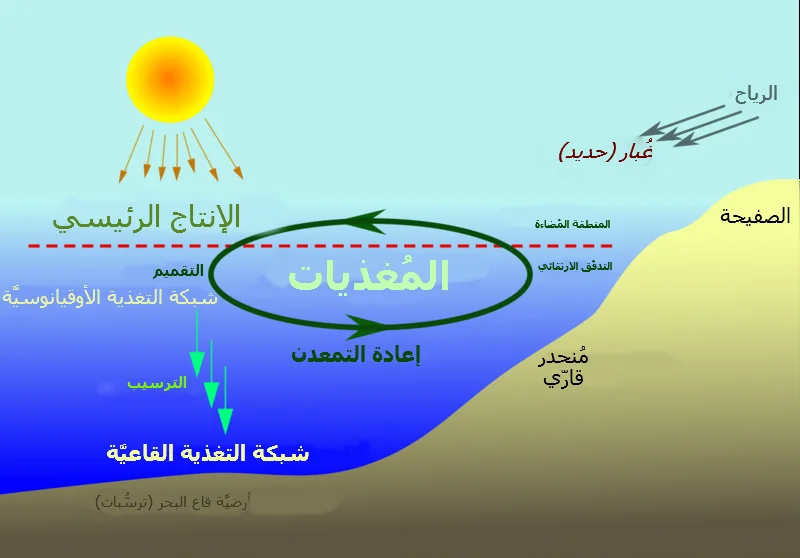
Marine nutrient cycling: an illustrative diagram described in the source metadata.
Credit: Original: Hannes Grobe 19:13, 20 June 2007 (UTC), Alfred Wegener Institute for Polar and Marine Research, Bremerhaven, Germany Derivative: باسم · CC BY-SA 2.5 · sourceResized and converted to WebP; uncropped.
1. Foundations of biogeochemical cycling
Biogeochemical cycles connect biological activity with chemical transformations and geological processes. Plants acquire mineral nutrients from soil or water; consumers obtain them through food; decomposers process wastes and dead organisms. Weathering, rainfall, erosion, sedimentation and volcanic activity link these biological exchanges with the physical environment. Carbon, nitrogen, phosphorus and sulphur are essential components of living matter, while water acts as a transport medium for many nutrients.
A reservoir is a store of an element, such as atmospheric nitrogen, carbon in carbonate rocks or phosphorus in marine sediments. Flux describes movement between stores. A pool can be small but exchange rapidly, as in living biomass, or large and exchange slowly, as in sedimentary rocks. Residence time is approximately the quantity stored divided by the outward flux under steady-state conditions; it is not a fixed property of an element.
Gaseous cycles have major reservoirs in the atmosphere or oceans and generally involve relatively rapid exchange. Sedimentary cycles have major reservoirs in rocks and sediments and often depend on slow weathering and geological uplift. This classification is a simplification: carbon has both a rapid biological cycle and a slow geological cycle, while sulphur has substantial sedimentary and atmospheric components.
- Energy flow is unidirectional at ecosystem scale; nutrient movement is cyclic.
- Standing state refers to the amount of inorganic nutrients present in soil or water at a given time; standing crop refers to living biomass or organism numbers.
- A limiting nutrient restricts growth relative to biological demand. Its identity varies with ecosystem, season and environmental conditions.
2. Carbon cycle and its connection with water
Photosynthesis incorporates inorganic carbon into organic compounds. Carbon moves through food chains and returns through respiration, decomposition and combustion. Oceans exchange carbon dioxide with the atmosphere and contain dissolved inorganic carbon mainly as bicarbonate, along with carbonate ions and dissolved carbon dioxide. Marine organisms incorporate carbon into organic matter or calcium carbonate shells; some reaches deep water and sediments.
The slow carbon cycle involves chemical weathering, transport of dissolved substances to oceans, carbonate formation, burial, subduction and volcanic release. Silicate weathering coupled with carbonate burial removes carbon dioxide over geological timescales. Fossil-fuel combustion transfers carbon from long-lived geological stores to the atmosphere much faster than natural geological processes can balance. Deforestation releases stored carbon and reduces future uptake, although the outcome depends on subsequent land use.
Ocean acidification occurs when additional dissolved carbon dioxide changes seawater chemistry, increasing hydrogen ion concentration and reducing carbonate ion availability. It is distinct from eutrophication and does not mean that average surface seawater has already become acidic. The water cycle connects carbon and nutrient transfers through precipitation, infiltration, groundwater flow and runoff. Evaporation largely leaves dissolved salts behind, whereas runoff can transport nutrients and sediments.
- A carbon sink absorbs more carbon than it releases over a specified period; a carbon stock is the quantity stored.
- Wetlands can store large amounts of carbon but may also emit methane under oxygen-poor conditions.
- Biological carbon uptake is not always permanent sequestration: respiration, fires and land-use change can return stored carbon.
A common pathway from nutrient loading to aquatic hypoxia
- 1. Sewage or fertiliser runoff adds nitrogen and phosphorus.
- 2. Available nutrients stimulate primary production under favourable conditions.
- 3. Algal biomass dies and enters the detrital pool.
- 4. Microbial decomposition increases oxygen consumption.
- 5. Oxygen replenishment becomes insufficient, especially in stratified waters.
- 6. Hypoxia or anoxia stresses aquatic organisms and may trigger fish mortality.
3. Nitrogen cycle: transformations and microorganisms
Nitrogen constitutes about 78 per cent of dry air by volume, but most organisms cannot directly use atmospheric nitrogen because its triple bond is difficult to break. Biological nitrogen fixation converts nitrogen gas into ammonia through nitrogenase-containing microorganisms. Examples include Rhizobium associated with legume root nodules, free-living Azotobacter, and nitrogen-fixing cyanobacteria such as Nostoc. Lightning also produces reactive nitrogen compounds, while the Haber–Bosch process manufactures ammonia industrially.
Assimilation incorporates inorganic nitrogen into organic molecules, including amino acids and nucleic acids. Plants commonly absorb ammonium or nitrate; absorbed nitrate must be reduced before incorporation into amino acids. Decomposition releases organic nitrogen, and ammonification converts it into ammonium. Microbial immobilisation temporarily incorporates inorganic nitrogen into microbial biomass, reducing its immediate availability to plants.
Nitrification is usually aerobic: ammonia-oxidising microorganisms form nitrite, followed by nitrite oxidation to nitrate. Nitrosomonas and Nitrobacter are classic textbook examples, although other bacteria and archaea also participate. Denitrification occurs mainly under oxygen-limited conditions and reduces nitrate or nitrite to gaseous products, ultimately nitrogen gas. Nitrous oxide can be produced during microbial nitrogen transformations. Anaerobic ammonium oxidation, or anammox, combines ammonium with nitrite to produce nitrogen gas.
- Nitrate is relatively mobile in many soils and can leach into groundwater; ammonium is more readily retained on negatively charged soil surfaces.
- Nitrogen fixation adds biologically available nitrogen; denitrification and anammox remove it from ecosystems as nitrogen gas.
- Nitrogen-fixing organisms and nitrifying organisms perform different functions and should not be confused.
| Cycle | Important reservoirs | Principal biological entry | Common examination trap |
|---|---|---|---|
| Carbon | Sedimentary rocks, oceans, soils and atmosphere | Carbon fixation, mainly through photosynthesis | Carbon stocks and carbon sinks are not synonymous. |
| Nitrogen | Atmosphere, soils and oceans | Fixation makes atmospheric nitrogen biologically available | Nitrification is not nitrogen fixation. |
| Phosphorus | Phosphate-bearing rocks and sediments | Plant and microbial phosphate uptake | Dust transport does not constitute a major gaseous phase. |
| Sulphur | Rocks, sediments and oceanic sulphate | Sulphate assimilation | The cycle includes atmospheric as well as sedimentary processes. |
4. Phosphorus, sulphur and decomposition
Phosphorus is required for ATP, nucleic acids, phospholipids and vertebrate bones and teeth. Weathering of phosphate-bearing rocks releases phosphate into soils and waters. Plants absorb it, consumers acquire it through feeding, and decomposition returns it to inorganic pools. Some phosphorus becomes bound to soil minerals or is buried in aquatic sediments. Geological uplift eventually exposes sedimentary deposits to renewed weathering. Atmospheric transport in dust occurs, but there is no significant gaseous phase comparable to atmospheric nitrogen.
Sulphur is present in amino acids such as cysteine and methionine. Major stores include rocks, sediments and seawater sulphate. Weathering, volcanic emissions, sea spray and decomposition redistribute sulphur. Plants generally absorb sulphate. Under oxygen-poor conditions, sulphate-reducing microorganisms can form hydrogen sulphide; sulphur-oxidising microorganisms reverse such transformations. Coal and oil combustion and sulphide-ore smelting release sulphur dioxide, which contributes to sulphate aerosols and acid deposition.
Decomposition involves fragmentation, leaching, microbial catabolism, humification and mineralisation. Detritivores such as earthworms fragment litter; bacteria and fungi carry out much of its chemical breakdown. Warm, moist, aerated conditions generally favour rapid decomposition, whereas waterlogging and oxygen shortage often slow aerobic breakdown. Lignin-rich litter decomposes slowly. Humus is relatively resistant, but not permanently inert.
- Mineralisation converts organically bound nutrients into inorganic forms available for further cycling.
- Phosphorus often limits freshwater productivity and nitrogen often limits marine productivity, but neither pattern is universal; co-limitation is common.
- Low oxygen near lake sediments can mobilise iron-bound phosphorus, sustaining internal nutrient loading even after external inputs decline.
5. Human disruption and nutrient-cycle management
Fertiliser runoff, sewage and animal wastes accelerate nutrient loading into water bodies. Excess nitrogen and phosphorus can stimulate algal or cyanobacterial growth. Subsequent decomposition consumes dissolved oxygen, producing hypoxia or anoxia and sometimes fish mortality. Not every bloom is toxic, and nutrient enrichment alone does not determine bloom severity: temperature, light, water residence time and food-web structure also matter.
Excess reactive nitrogen contributes to groundwater nitrate contamination, soil acidification, coastal eutrophication and nitrous oxide emissions. Nitrous oxide is both a greenhouse gas and an ozone-depleting substance. Phosphate mining moves a finite geological resource into agricultural systems, where inefficient use can simultaneously cause soil accumulation and aquatic pollution. Acid deposition from sulphur and nitrogen compounds can leach base cations and mobilise aluminium in sensitive soils.
Management requires matching fertiliser application to crop demand, maintaining soil organic matter, recycling manure safely, treating sewage for nutrient removal and protecting riparian buffers and wetlands. India's Soil Health Card Scheme, launched in 2015, supports soil-test-based nutrient recommendations. Neem-coated urea can slow nitrification and improve nitrogen-use efficiency under suitable conditions, but it cannot eliminate losses or compensate for excessive application. The Water (Prevention and Control of Pollution) Act, 1974 provides a central legal framework for controlling water pollution.
- Use the right nutrient source, rate, time and placement rather than assuming that more fertiliser always raises yields.
- Conventional sewage treatment does not automatically achieve adequate nitrogen and phosphorus removal.
- Wetland restoration can improve nutrient retention, but storage capacity and greenhouse-gas trade-offs require assessment.
Marine Nutrient Cycling and Ecosystem Productivity
Marine nutrient cycles connect biological uptake with the recycling and transport of elements through seawater and sediments. Phytoplankton assimilate dissolved nutrients, including nitrogen and phosphorus, into organic matter. Feeding transfers these elements through food webs, while excretion and microbial decomposition return nutrients to forms available for uptake. Some organic matter sinks below the sunlit surface layer, linking surface productivity with deeper waters and seabed sediments. The supplied metadata identifies a marine nutrient-cycle diagram; it does not establish which individual pathways or reservoirs the illustration includes.
Nutrient availability depends not only on recycling but also on physical circulation. Upwelling and mixing can bring nutrient-rich deeper water towards the surface, whereas strong stratification can restrict this supply. Rivers deliver nutrients from land, connecting agricultural practices, wastewater management and coastal ecology in India. Excess nutrient loading can stimulate algal growth; subsequent decomposition consumes dissolved oxygen and may cause hypoxia. However, not every bloom is toxic, and nutrient enrichment alone does not determine bloom severity: light, temperature, circulation and nutrient balance also matter.
- Distinguish recycling from energy flow: decomposers regenerate inorganic nutrients, but energy dissipated as heat is not recycled through food webs.
- Do not equate all nutrient cycles: nitrogen includes microbial fixation and denitrification; phosphorus has no major atmospheric gaseous reservoir under ordinary ecosystem conditions.
- For Indian coastal case studies, assess nutrient sources alongside oxygen levels and water circulation. A generic marine diagram cannot establish local eutrophication or identify its causes.
Real-world case studies
Lake Erie: phosphorus loading and harmful blooms
Lake Erie in North America illustrates how agricultural phosphorus runoff, warm conditions and lake dynamics can promote cyanobacterial blooms. In August 2014, microcystin contamination prompted a drinking-water advisory in Toledo, Ohio. The episode shows that nutrient pollution threatens drinking-water security as well as aquatic biodiversity.
Bellandur Lake, Bengaluru
Bellandur Lake has received substantial sewage and other polluted inflows. Nutrient enrichment and high organic loads contribute to degraded water quality and oxygen stress. Its notorious foam also involves surfactants and turbulence, so foam should not be treated as a direct indicator of phosphorus alone. Restoration requires catchment-level pollution control, not merely surface cleaning.
Previous year questions
UPSC Prelims 2013
Which of the following adds or add carbon dioxide to the carbon cycle on Earth? 1. Volcanic action 2. Respiration 3. Photosynthesis 4. Decay of organic matter
- A. 1 and 3 only
- B. 2 only
- C. 1, 2 and 4 only
- D. 1, 2, 3 and 4
Practice questions
Practice MCQ 1
Consider the following statements: 1. Nitrification generally requires oxygen. 2. Denitrification can return nitrogen to the atmosphere. 3. Ammonification converts ammonium directly into nitrate. Which statements are correct?
- A. 1 and 2 only
- B. 2 and 3 only
- C. 1 and 3 only
- D. 1, 2 and 3
Practice MCQ 2
Which feature most clearly distinguishes the phosphorus cycle from the nitrogen cycle?
- A. Phosphorus is not required by microorganisms.
- B. Phosphorus has no significant gaseous phase under ordinary ecosystem conditions.
- C. Phosphorus cannot move through aquatic food chains.
- D. Phosphorus is released only through volcanic activity.
Practice MCQ 3
External phosphorus inputs to a lake have declined, yet summer algal blooms continue. Which is the most plausible nutrient-cycle explanation?
- A. Evaporation converts atmospheric nitrogen directly into phosphate.
- B. Photosynthesis permanently removes all sediment phosphorus.
- C. Oxygen-poor bottom conditions can release previously stored sediment phosphorus.
- D. Denitrification continuously generates new phosphorus atoms.
Mains practice · Human activities have accelerated nutrient transfers while weakening ecosystem recycling. Discuss with reference to nitrogen and phosphorus cycles and suggest measures for India. Answer in 250 words.
- Explain natural reservoirs, biological uptake, mineralisation and nutrient losses.
- Discuss industrial nitrogen fixation, fertiliser use, phosphate mining, sewage and land-use change.
- Connect disruption with eutrophication, groundwater pollution, nitrous oxide emissions and inefficient resource use.
- Use an Indian urban lake example and distinguish external loading from internal sediment release.
- Recommend soil testing, balanced fertilisation, improved placement and timing, sewage nutrient removal, buffers and safe nutrient recovery.
- Conclude with integrated catchment management and monitoring rather than isolated lake-cleaning interventions.
Further reading
- NCERT Biology, Class XII: Ecosystem; consult editions containing the nutrient-cycling discussion.
- NCERT Chemistry, Class XI: Environmental Chemistry, in editions containing this chapter.
- US Geological Survey: Water Science School resources on nitrogen, phosphorus and eutrophication.
- NOAA: Ocean acidification and harmful algal bloom resources.
- Department of Agriculture and Farmers Welfare: Soil Health Card portal and guidance.
- Central Pollution Control Board: Water-quality monitoring and sewage-treatment reports.
- https://commons.wikimedia.org/wiki/File:Nutrient-cycle_hg-ar.png
Preparing for UPSC Civil Services? Get classroom teaching, answer-writing evaluation and mentorship at Pragnya IAS Academy, Ashok Nagar — see why aspirants choose us for IAS coaching in Hyderabad.