
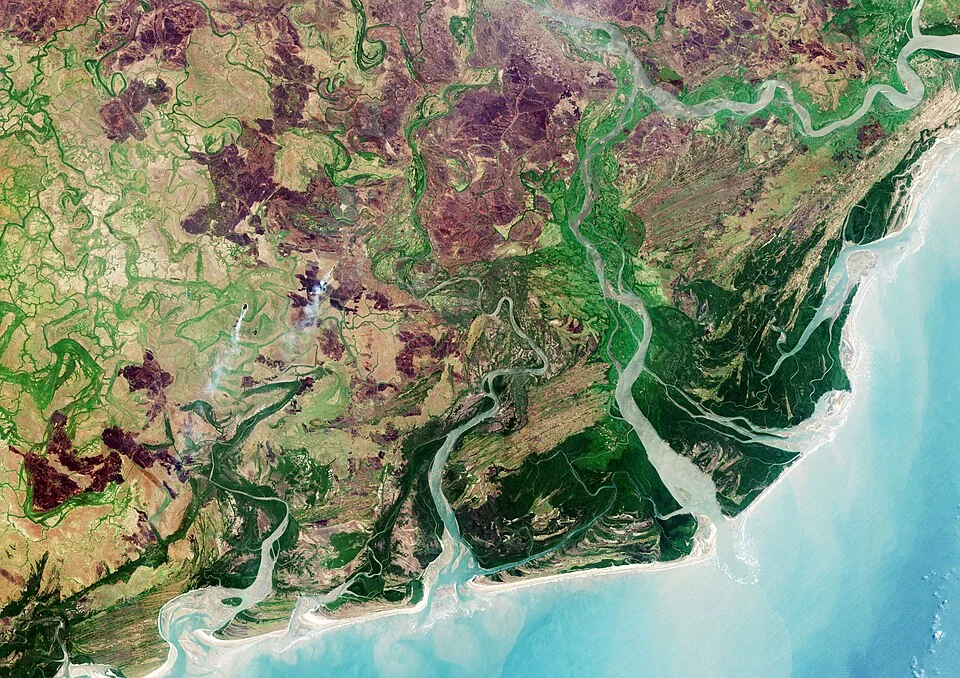
Sentinel-2A image of Mozambique’s Zambezi Delta, a comparative example of ecosystem diversity.
Credit: European Space Agency · CC BY-SA 3.0 igo · sourceResized and converted to WebP; uncropped.
Map study
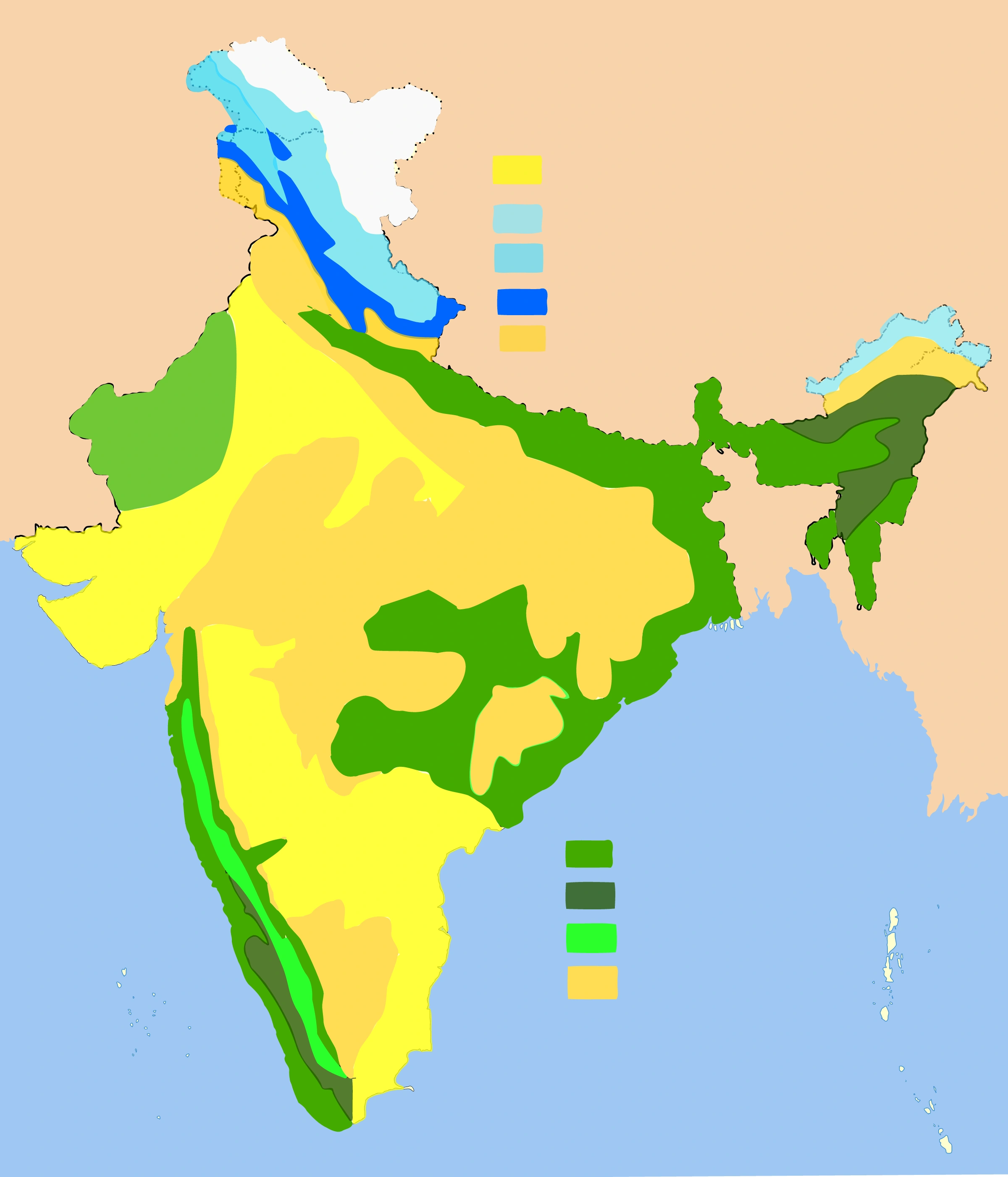
Natural vegetation zones: relate patterns to rainfall, relief and temperature. Potential natural vegetation differs from measured current forest cover.
- Read the source legend, scale and reference period before comparing regions.
- Connect spatial patterns to the processes discussed in this topic; this map is a study reference, not live operational data.
Credit: Amog · CC BY-SA 3.0 · sourceConverted to WebP on an opaque white background; proportionally resized without cropping. Original cartography and legend retained.
Map study
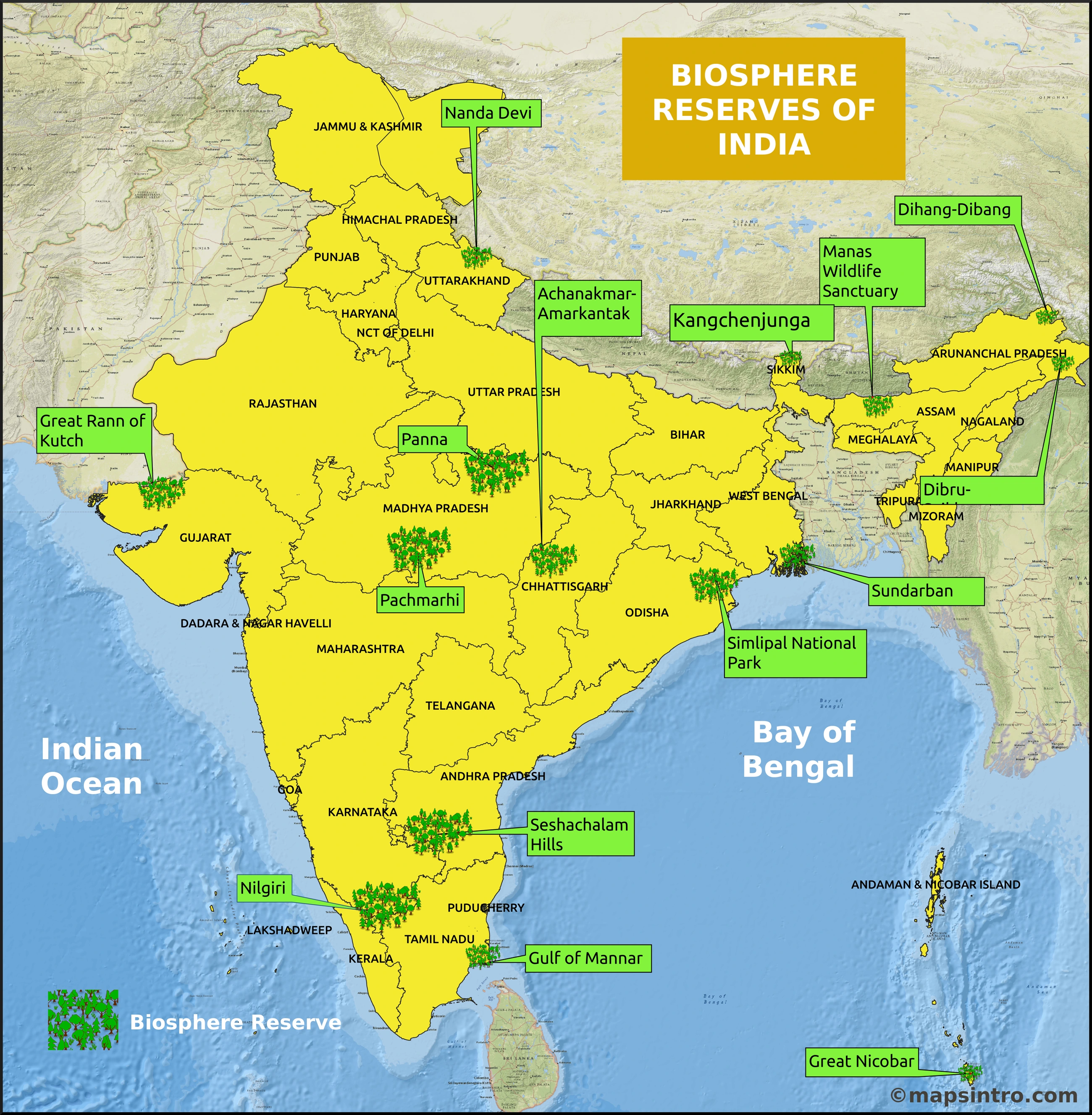
Biosphere reserves in the source reference map: locate mountain, plateau, coastal and island examples; verify the current official designation list separately.
- Read the source legend and reference date before interpreting the map.
- Use spatial patterns to support topic revision; verify current official boundaries, designations and warnings separately.
Credit: MapsIntro · CC BY-SA 4.0 · sourceConverted to WebP on an opaque white background; proportionally resized without cropping. Original cartography and legend retained.
1. Meaning and ecological foundations
Ecosystem diversity refers to the variety of ecosystems and ecological complexes within a defined area. A region containing forests, grasslands, rivers, wetlands and coastal habitats generally has greater ecosystem variety than a uniformly managed landscape. However, the number of named habitat types alone is insufficient: their extent, condition, spatial arrangement and ecological processes also matter. Ecosystems have interacting biotic components, such as producers, consumers and decomposers, and abiotic components, including water, soil, light, temperature and nutrients.
The Convention on Biological Diversity defines biodiversity to include diversity within species, between species and of ecosystems. These levels are interconnected but distinct. Different rice varieties illustrate genetic diversity; the variety of birds in a wetland illustrates species diversity; and a landscape containing marshes, open water, floodplain forests and seasonally inundated grasslands illustrates ecosystem diversity.
Ecosystem boundaries depend partly on the scale and purpose of study. A pond can be studied as an ecosystem, while the river basin containing it is a larger ecological system. A biome is a broad ecological unit associated with climate and dominant vegetation, such as tropical rainforest or tundra; each biome may contain numerous ecosystems.
- Structure: vegetation layers, food-web organisation and physical habitat features.
- Composition: the organisms and communities present.
- Function: primary production, decomposition, nutrient cycling, hydrological regulation and disturbance processes.
2. Distribution and assessment
Climate, elevation, geology, soils, water availability, salinity and disturbance regimes generate ecosystem variation. Along a Himalayan elevation gradient, subtropical forests may give way to temperate forests, subalpine vegetation and alpine meadows. Across a coastal gradient, freshwater marshes, brackish lagoons, mangroves, mudflats and marine waters support different communities. Fire, floods, grazing and storms can maintain particular ecosystems; ecological change is not automatically degradation.
India’s ecosystem diversity reflects its tropical location, monsoon climate, Himalayan relief, extensive coastline and islands. The Wildlife Institute of India framework identifies the Trans-Himalaya, Himalaya, Indian Desert, Semi-Arid, Western Ghats, Deccan Peninsula, Gangetic Plain, North-East, Coasts and Islands as ten biogeographic zones. These are large planning units rather than ten individual ecosystems. The same zone can contain several ecosystem types.
Assessment combines habitat classification, field surveys, remote sensing and indicators of ecological condition. Relevant measures include the area of each ecosystem, fragmentation, connectivity, hydrological alteration and representation within protected areas. Comparisons require consistent boundaries and classification: finer mapping will usually distinguish more ecosystem types.
Alpha diversity measures species diversity within a local site; beta diversity expresses differentiation or turnover among sites; gamma diversity describes diversity across a larger region. High turnover can reveal contrasting habitats, but does not directly measure the number of ecosystem types. An ecotone is a transition between ecosystems; edge conditions may favour some species while disadvantaging interior specialists.
Ecosystem-based conservation planning
- 1. Map ecosystem types and establish their reference condition
- 2. Assess extent, ecological integrity and major pressures
- 3. Identify representation gaps and essential connections
- 4. Select protection, sustainable-use and restoration measures
- 5. Implement with local participation and equitable governance
- 6. Monitor ecological outcomes and adapt management
3. Ecological and human significance
Different ecosystems contribute complementary services. Forests influence water movement and store carbon; wetlands retain floodwaters and process nutrients; mangroves can reduce wave energy; grasslands support grazing livelihoods; and reefs provide habitat for marine organisms. These functions depend on ecological condition and local circumstances. A degraded wetland cannot be assumed to provide the same services as an intact one of equal area.
Landscape diversity also sustains species requiring multiple habitats during their life cycles. Migratory waterbirds use networks of wetlands, while many marine fishes use mangroves or seagrass beds as juvenile habitat before occupying other coastal waters. Conserving an isolated breeding site may therefore fail if feeding grounds, migration routes or nursery habitats disappear.
Ecosystem diversity can support resilience by retaining different ecological responses and opportunities for movement under environmental change. Nevertheless, diversity does not guarantee immunity to disturbance: severe warming, pollution or altered river flows can overwhelm ecological thresholds. Maintaining functioning ecosystems also supports fisheries, pastoralism, agriculture, cultural practices and disaster-risk reduction, linking biodiversity conservation with sustainable development.
- Provisioning services: food, freshwater, fibre and biological resources.
- Regulating services: climate regulation, erosion control, flood moderation and water purification.
- Cultural services: recreation, spiritual values and place-based knowledge.
- Supporting processes: soil formation, nutrient cycling and primary production.
| Ecosystem | Indian example | Important process or feature | Conservation requirement |
|---|---|---|---|
| Alpine meadow | Valley of Flowers, Uttarakhand | Short growing season and elevation-linked communities | Manage disturbance and monitor climate-driven shifts |
| Floodplain wetland | Brahmaputra floodplain, Assam | Seasonal flooding and river–wetland exchange | Retain hydrological connectivity |
| Mangrove | Sundarbans, West Bengal | Tidal exchange and freshwater–salinity balance | Maintain sediment supply and suitable water regimes |
| Semi-arid grassland | Tal Chhapar, Rajasthan | Open habitat supporting grassland specialists | Prevent inappropriate conversion and woody encroachment |
| Coral reef | Lakshadweep | Reef-building corals and associated marine communities | Reduce local pressures and address warming risks |
4. Threats and conservation priorities
Habitat conversion reduces ecosystem extent, while fragmentation breaks continuous habitat into smaller, more isolated patches. Dams and embankments can disconnect rivers from floodplains; drainage eliminates wetlands; coastal construction alters sediment movement; and pollution changes water chemistry. Invasive alien species may simplify native communities or modify fire and water regimes. Climate change shifts suitable conditions and increases risks such as coral bleaching.
A frequent conservation error is treating all land without trees as degraded. Natural grasslands, savannas, deserts and alpine meadows are distinct ecosystems, not necessarily incomplete forests. Tree planting in such habitats can damage specialist biodiversity and alter water availability. Similarly, a monoculture plantation may increase tree cover without restoring the composition and functioning of a natural forest.
Conservation planning should ensure representation of different ecosystem types, sufficient habitat area and connectivity. Protected areas need complementary management of river basins, production landscapes and coastal zones. Ecological restoration should use an appropriate reference ecosystem rather than pursue a universal tree-cover target. Maintaining natural flows, controlling invasive species, reducing pollution and supporting community institutions are often as important as planting vegetation.
5. Institutions, laws and examination distinctions
The Convention on Biological Diversity promotes an ecosystem approach: integrated management of land, water and living resources that balances conservation, sustainable use and equity. The Kunming–Montreal Global Biodiversity Framework, adopted in 2022, calls under Target 3 for effective conservation of at least 30% of terrestrial and inland-water areas and of marine and coastal areas by 2030. It emphasises ecological representation, connectivity and equitable governance, not designation alone.
In India, the Wild Life (Protection) Act, 1972 supports protected-area categories including national parks, wildlife sanctuaries, conservation reserves and community reserves. The Biological Diversity Act, 2002, subsequently amended, provides a framework for conservation, sustainable use and benefit sharing. The Wetlands (Conservation and Management) Rules, 2017 govern specified wetlands and regulate damaging activities. These instruments are complementary; none makes all ecosystems equally represented or effectively managed.
The IUCN Red List of Ecosystems evaluates collapse risk through declining distribution, restricted distribution, abiotic degradation, disrupted biotic processes and quantitative analysis. Ecosystem collapse means loss of defining features and processes, not necessarily disappearance of every organism. For examinations, distinguish threatened ecosystems from threatened species, biodiversity hotspots from biogeographic zones, and legal protection from actual ecological integrity.
Ecosystem diversity through a delta landscape
The Zambezi Delta in Mozambique illustrates ecosystem diversity through the habitat mosaic described in its metadata: grasslands, woodlands, swamps and mangroves within a connected delta landscape. These systems differ in flooding regimes, salinity, soils and vegetation, yet exchange water, sediments, nutrients and organisms. The conceptual focus is therefore not simply the number of species present, but the variety of ecological systems and the processes linking them.
This is a comparative African example, not evidence about an Indian site. In India, the Sundarbans and other coastal deltas offer relevant contexts for studying interactions among mangroves, tidal waters, mudflats and freshwater-influenced habitats. Conservation must maintain representative habitats and their functioning, rather than protect isolated patches alone. Upstream water abstraction, altered sediment supply and coastal development can affect downstream ecosystems even when parts of a delta receive formal protection.
Satellite observations can help map habitat extent, fragmentation and changes over time. However, a single image cannot establish ecosystem health, species richness or conservation effectiveness; these require field observations and suitable time-series evidence. The metadata’s broad extinction estimate and description of a healthy ecosystem should not be treated as findings demonstrated by this image.
- Distinguish levels: genetic diversity concerns variation within species; species diversity concerns species composition; ecosystem diversity concerns ecological systems.
- Assess conservation through habitat representation, connectivity and ecological processes, not protected area alone.
- Ramsar recognition concerns wetland conservation and wise use; it does not automatically establish a formally defined biodiversity hotspot.
Real-world case studies
Chilika Lake: restoring ecological processes
Chilika, Odisha, is a brackish-water lagoon whose biodiversity depends on freshwater inflow and exchange with the Bay of Bengal. Siltation and restricted sea exchange contributed to ecological deterioration. A new sea mouth opened in 2000 as part of restoration helped improve water exchange and salinity conditions. Chilika was removed from the Ramsar Convention’s Montreux Record in 2002. The case illustrates why restoring hydrological processes can be more effective than managing individual species alone.
Western Ghats shola–grassland mosaics
High elevations of the southern Western Ghats contain mosaics of montane evergreen shola forests and natural grasslands. Conversion to commercial plantations and invasive woody spread have altered parts of this landscape. Conservation requires recognising both components as valuable habitats. Restoring native grasslands is not deforestation, and blanket afforestation can harm open-habitat biodiversity.
Previous year questions
No source-linked PYQ is available here yet. Use the practice questions below.
Practice questions
Practice MCQ 1
With reference to ecosystem diversity, consider the following statements: 1. It includes variation in ecological communities and their associated physical environments. 2. Replacing a natural grassland with a single-species tree plantation necessarily increases ecosystem diversity. 3. Conservation assessment should consider ecological condition in addition to ecosystem extent. Which of the statements given above are correct?
- A. 1 and 2 only
- B. 1 and 3 only
- C. 2 and 3 only
- D. 1, 2 and 3
Practice MCQ 2
Which one of the following best describes beta diversity?
- A. Genetic variation within a single population
- B. Species diversity within one local sampling site
- C. Differentiation in species composition among sites
- D. The total number of biomes on Earth
Practice MCQ 3
Consider the following conservation measures: 1. Maintaining seasonal river–floodplain connections. 2. Protecting both shola forests and adjoining natural grasslands. 3. Evaluating restoration success solely through the number of trees planted. Which of the above are consistent with an ecosystem approach?
- A. 1 only
- B. 2 and 3 only
- C. 1 and 2 only
- D. 1, 2 and 3
Mains practice · Conservation of ecosystem diversity requires more than increasing forest cover and expanding protected areas. Discuss with Indian examples. Answer in 250 words.
- Define ecosystem diversity and distinguish it from species richness and tree cover.
- Explain representation, ecological integrity, connectivity and natural disturbance regimes.
- Discuss neglected ecosystems such as grasslands, wetlands, mudflats and alpine meadows.
- Use Chilika to demonstrate process-based restoration and shola–grassland mosaics to critique blanket afforestation.
- Address river-basin planning, invasive species, sustainable livelihoods and community participation.
- Conclude with measurable ecological outcomes and adaptive management.
Further reading
- NCERT, Biology, Class XII: Ecosystem; Biodiversity and Conservation.
- Convention on Biological Diversity: Article 2, Ecosystem Approach and Kunming–Montreal Global Biodiversity Framework; cbd.int.
- Wildlife Institute of India: Biogeographic Classification of India; wii.gov.in.
- IUCN: Red List of Ecosystems Categories and Criteria; iucnrle.org.
- Ministry of Environment, Forest and Climate Change: Wetlands (Conservation and Management) Rules, 2017; moef.gov.in.
- Ramsar Sites Information Service: Chilika Lake site information; rsis.ramsar.org.
- https://commons.wikimedia.org/wiki/File:Zambezi_Delta_diversity_ESA394392.jpg
Preparing for UPSC Civil Services? Get classroom teaching, answer-writing evaluation and mentorship at Pragnya IAS Academy, Ashok Nagar — see why aspirants choose us for IAS coaching in Hyderabad.