
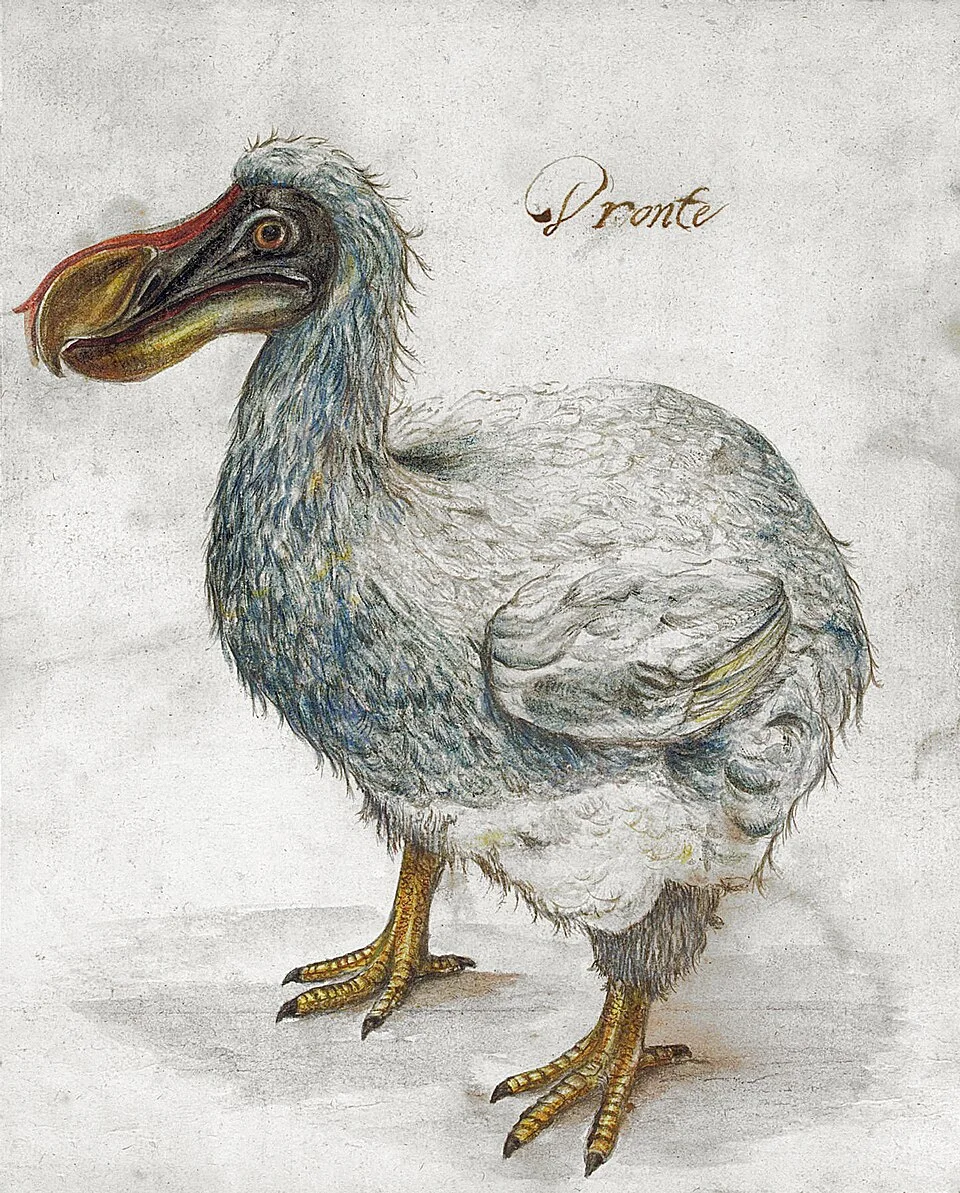
Seventeenth-century Dutch School depiction of the dodo, an extinct species endemic to Mauritius; a comparative example of island endemism.
Credit: Unknown authorUnknown author · Public domain · sourceResized and converted to WebP; uncropped.
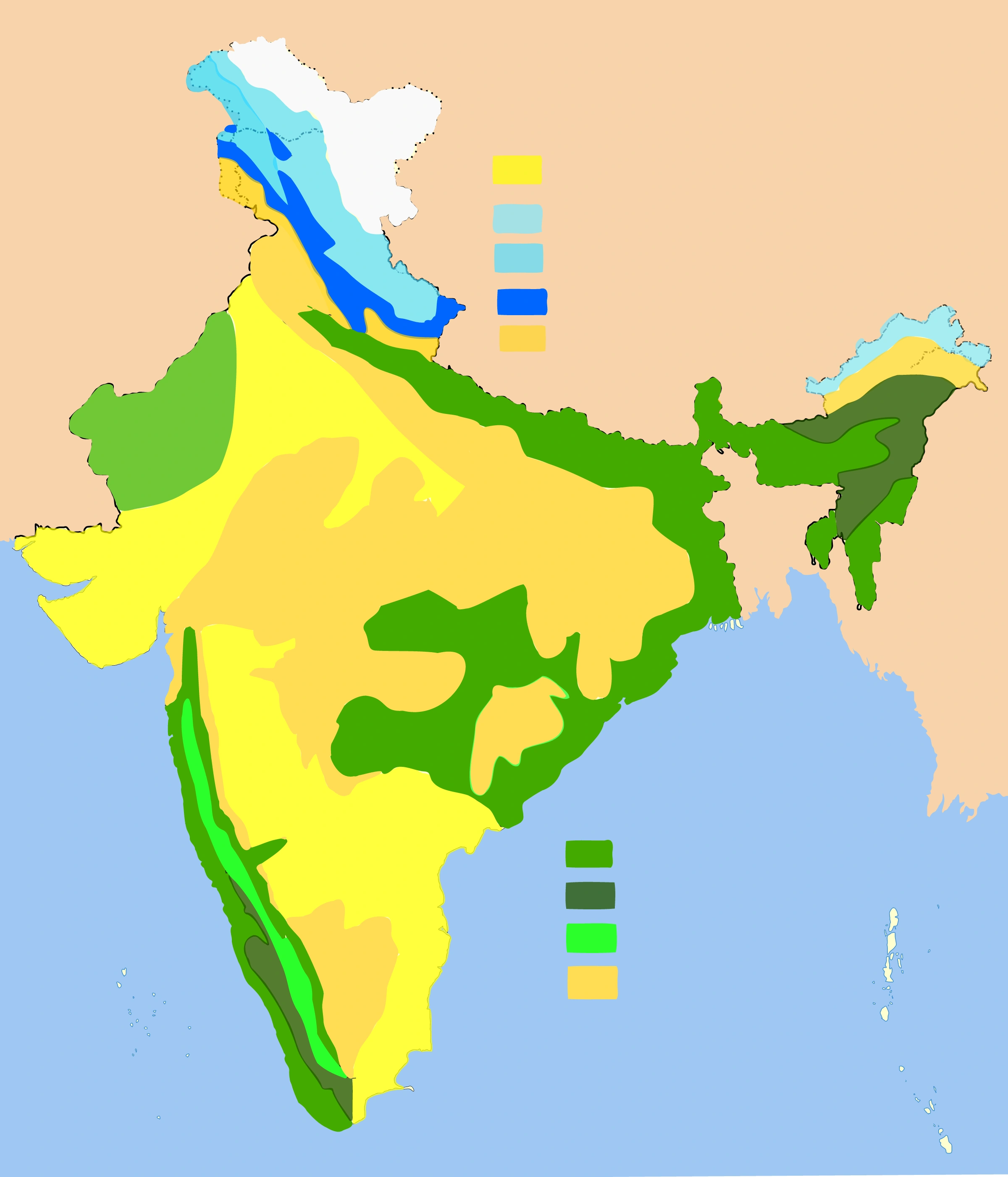
Map study
Natural vegetation zones: relate patterns to rainfall, relief and temperature. Potential natural vegetation differs from measured current forest cover.
- Read the source legend, scale and reference period before comparing regions.
- Connect spatial patterns to the processes discussed in this topic; this map is a study reference, not live operational data.
Credit: Amog · CC BY-SA 3.0 · sourceConverted to WebP on an opaque white background; proportionally resized without cropping. Original cartography and legend retained.
1. Meaning and essential distinctions
Endemism describes a biogeographical pattern: a taxon occurs naturally within a particular area and nowhere else. The area may be an island, mountain range, river basin, country or continent. Thus, every statement about endemism should identify its geographical reference. A species endemic to the Western Ghats need not be endemic to Kerala because its natural range may extend into neighbouring states.
Native and endemic are not synonyms. A native species occurs naturally in an area but may also occur naturally elsewhere. An endemic species is both native and geographically restricted. Conversely, an alien species occurs outside its natural range because of human introduction. An endemic species maintained in overseas zoos or botanical gardens does not thereby lose its endemic status, which refers to its native distribution.
Endemism also differs from rarity and threat status. A range-restricted species may be locally abundant, while a widespread species may be declining rapidly. The IUCN Red List evaluates extinction risk using population trends, geographical range and other evidence. Endemism increases conservation concern but does not automatically place a species in a threatened category.
- Range-restricted describes a limited distribution; the threshold depends on the assessment system.
- Cosmopolitan describes a very broad geographical distribution, contrasting with restricted endemism.
- A regional endemic can cross political boundaries, as in a mountain system shared by several countries.
2. How endemism develops
Geographical isolation reduces gene flow between populations. Over evolutionary time, mutation, natural selection and genetic drift can produce distinct species through allopatric speciation. Oceanic islands are classic settings, but isolation also occurs on mountain tops, in caves, within river basins and across separated forest patches. Ecological specialisation can further restrict a species to particular soils, elevations, rainfall regimes or host organisms.
Neoendemics are relatively recently evolved taxa with restricted ranges. Paleoendemics are older lineages whose formerly wider distributions have contracted. These concepts describe evolutionary history rather than conservation status. Reliable classification requires evidence from phylogeny, fossils and historical biogeography; a small present-day range alone cannot establish whether a species is a neoendemic or paleoendemic.
Climatic stability and habitat heterogeneity can allow lineages to persist and diversify. Refugia are areas where populations survive periods of adverse regional conditions. Mountain valleys and moist forest pockets may serve this role. However, isolation is not always beneficial: small populations can face inbreeding, demographic fluctuations and reduced capacity to recolonise after disturbance.
- Dispersal ability matters: frogs and freshwater fishes often show stronger local endemism than highly mobile animals.
- Edaphic endemics are restricted to particular soil or substrate conditions.
- Sea-level changes, drainage rearrangements and mountain building can create or modify barriers to movement.
From geographical restriction to conservation action
- 1. Confirm taxonomy and map the natural distribution.
- 2. Specify the geographical scale of endemism.
- 3. Assess population trends, occupied habitat and threats.
- 4. Identify irreplaceable sites and ecological requirements.
- 5. Protect and restore habitat, involving local communities.
- 6. Monitor outcomes and adapt management.
3. Endemism in India
India’s varied geology, climate and relief support important centres of endemism. The Western Ghats contain evergreen forests, streams and high-elevation shola–grassland mosaics, with many endemic flowering plants, amphibians and freshwater fishes. The lion-tailed macaque is endemic to the Western Ghats. The Nilgiri tahr is endemic to the southern Western Ghats, particularly montane grasslands and rocky slopes.
The purple frog, Nasikabatrachus sahyadrensis, exemplifies the conservation importance of specialised habitats: it is endemic to the Western Ghats, spends much of its life underground and breeds in association with seasonal rains. Red sanders, Pterocarpus santalinus, has a restricted natural distribution in the southern Eastern Ghats, particularly Andhra Pradesh. Such examples show that endemic biodiversity is not confined to humid forests.
The Andaman and Nicobar Islands support distinctive island biota shaped by isolation and different biogeographical histories. The Narcondam hornbill is naturally restricted to Narcondam Island. In global hotspot classification, the Nicobar Islands form India’s component of Sundaland, while the Andaman Islands are included in Indo-Burma. Himalayan topography and elevational gradients also support many localised taxa.
- Do not equate the combined Western Ghats–Sri Lanka hotspot with the Western Ghats alone when interpreting endemicity.
- A species recorded in India is not necessarily endemic to India; its range may extend into Nepal, Bhutan, Myanmar or elsewhere.
| Species | Natural endemic range | Conservation lesson |
|---|---|---|
| Lion-tailed macaque | Western Ghats | Rainforest fragmentation can isolate arboreal populations. |
| Nilgiri tahr | Southern Western Ghats | Natural montane grasslands require protection, not indiscriminate tree planting. |
| Purple frog | Western Ghats | Underground and seasonal life histories complicate biodiversity surveys. |
| Narcondam hornbill | Narcondam Island | A single-island distribution concentrates global extinction risk. |
| Red sanders | Southern Eastern Ghats | Restricted distribution combined with illegal extraction requires targeted protection. |
4. Conservation significance and assessment
Endemic species have high irreplaceability: protecting populations elsewhere cannot compensate for the disappearance of their entire native range. A single dam, quarry, road alignment or invasive predator may affect a large share of the world population of a narrowly distributed species. This makes fine-scale distribution information essential for environmental impact assessment and protected-area planning.
Biodiversity hotspot identification explicitly incorporates plant endemism and extensive habitat loss. The thresholds are at least 1,500 endemic vascular plant species and loss of at least 70% of original natural vegetation. These criteria do not require high animal endemism, although it often occurs. A hotspot is a global conservation-priority designation, not a statutory protected-area category under Indian law.
Conservation assessments distinguish extent of occurrence, broadly representing the geographical spread of occurrences, from area of occupancy, representing the area actually occupied within that range. Under IUCN criteria, restricted range generally requires additional evidence, such as fragmentation, continuing decline or extreme fluctuations, to establish threatened status through the geographical-range criterion.
- Species richness counts species; endemic richness counts species restricted to the chosen region.
- Weighted endemism gives greater weight to species with smaller ranges.
- Phylogenetic endemism considers geographically restricted evolutionary history, helping identify places containing distinctive lineages.
5. Threats and conservation responses
Habitat conversion and fragmentation are major threats because narrow-range species have limited alternative habitat. Mining, intensive agriculture, infrastructure and altered river flows may remove entire local populations. Island endemics are particularly exposed to introduced rats, cats, pathogens and invasive plants. Climate change can shift suitable conditions uphill; summit specialists may eventually have nowhere higher to move.
In situ conservation should protect representative habitats, breeding sites, ecological processes and, where appropriate, connectivity. For naturally isolated populations, connectivity planning must consider risks such as disease spread or disruption of local adaptation. Restoration should recover native habitat rather than simply increase tree cover: planting trees in natural montane grasslands can damage endemic grassland biodiversity.
India’s Wild Life (Protection) Act, 1972 provides for protected areas and species protection, while the Biological Diversity Act, 2002, as amended, supports biodiversity conservation and sustainable use. Biodiversity Heritage Sites, community participation and People’s Biodiversity Registers can strengthen local action. Seed banks, captive breeding and conservation translocations can provide support, but cannot replace functioning ecosystems and require scientific safeguards.
- Priorities include field surveys, taxonomic research, population monitoring and control of invasive alien species.
- Endemism alone does not create automatic legal protection; applicable laws, schedules and area notifications must be checked.
- Assess development proposals using seasonal surveys and species-level data, not only total forest area.
Island Endemism: Lessons from the Dodo
The dodo was endemic to Mauritius: its natural distribution was restricted to that island. Its extinction illustrates a central conservation principle—when a species disappears from its entire native range, local loss becomes global extinction. Geographical isolation can promote evolutionary divergence and produce endemic species, especially on islands. However, endemism describes geographical restriction, not abundance: an endemic species may be locally common within its limited range.
The dodo provides a comparative example, not evidence about Indian biodiversity. In India, the Andaman and Nicobar Islands, Western Ghats and parts of the Himalaya are important settings for studying endemism. Restricted distributions can expose species to habitat destruction, invasive alien species and other pressures affecting much of their range simultaneously. Island species may be particularly vulnerable where introduced predators encounter organisms that evolved without comparable threats. The supplied metadata identifies a historical artistic depiction; it does not establish population size, precise anatomy or the relative contribution of different extinction pressures.
- Always specify the geographical unit: a species endemic to India need not be endemic to one Indian state or ecological region.
- Endemic is not synonymous with endangered, rare or indigenous. Indigenous species occur naturally in an area but may also occur naturally elsewhere.
- Biodiversity hotspots combine high vascular-plant endemism with extensive habitat loss; endemism alone does not establish hotspot status. Conservation must assess range, threats and habitat condition together.
Real-world case studies
Eravikulam National Park and the Nilgiri tahr
Eravikulam National Park in Kerala protects an important population of the Nilgiri tahr within a high-elevation shola–grassland landscape. Seasonal visitor restrictions during the calving period illustrate species-sensitive management. The wider lesson is that conserving endemic mammals requires protecting their actual habitat, including open grasslands, rather than using tree cover as the sole indicator of ecological health.
Narcondam Island and the Narcondam hornbill
The Narcondam hornbill’s native distribution is confined to one small volcanic island in the Andaman Sea. Forest condition, nesting trees and prevention of harmful introductions therefore have global significance for the species. Its example demonstrates why a small site can possess exceptional conservation value even without very high total species richness.
Previous year questions
No source-linked PYQ is available here yet. Use the practice questions below.
Practice questions
Practice MCQ 1
Consider the following statements: 1. Every endemic species is native to its area of endemism. 2. Every native species is endemic to the area where it occurs. 3. An endemic species may be locally abundant. Which of the statements given above are correct?
- A. 1 and 2 only
- B. 1 and 3 only
- C. 2 and 3 only
- D. 1, 2 and 3
Practice MCQ 2
Which of the following combinations correctly states the global criteria for identifying a biodiversity hotspot?
- A. At least 1,500 endemic vertebrate species and loss of 50% of original forest
- B. At least 1,500 endemic vascular plant species and 30% or less of original natural vegetation remaining
- C. At least 500 endangered plant species and a legally protected area
- D. At least 1,500 native plant species and no human settlement
Practice MCQ 3
Consider the following pairs: 1. Narcondam hornbill — Narcondam Island 2. Nilgiri tahr — Southern Western Ghats 3. Red sanders — Western Himalaya. How many pairs are correctly matched?
- A. Only one
- B. Only two
- C. All three
- D. None
Mains practice · Endemism makes biodiversity conservation a question of irreplaceability, not merely species numbers. Discuss with Indian examples. Suggest measures for conserving narrowly distributed species. Answer in 250 words.
- Define endemism and distinguish it from richness, rarity and threatened status.
- Explain why loss across an endemic species’ entire native range means global extinction.
- Use the Narcondam hornbill, Nilgiri tahr and Western Ghats amphibians as examples.
- Examine habitat loss, invasive species, climate change and small-population vulnerability.
- Recommend fine-scale surveys, habitat-specific protection, invasive-species control and community participation.
- Treat ex situ conservation as a complement to, not a substitute for, in situ protection.
Further reading
- NCERT Biology, Class XII: Biodiversity and Conservation.
- IUCN: Red List Categories and Criteria, Version 3.1, and Guidelines for Using the IUCN Red List Categories and Criteria.
- Critical Ecosystem Partnership Fund: Biodiversity Hotspots and regional hotspot profiles.
- Botanical Survey of India: Endemic Vascular Plants of India.
- Zoological Survey of India: Faunal publications and endemic-species resources.
- India Code: Wild Life (Protection) Act, 1972 and Biological Diversity Act, 2002, as amended.
- https://commons.wikimedia.org/wiki/File:Dronte_17th_Century_color_corrected.jpg
Preparing for UPSC Civil Services? Get classroom teaching, answer-writing evaluation and mentorship at Pragnya IAS Academy, Ashok Nagar — see why aspirants choose us for IAS coaching in Hyderabad.