
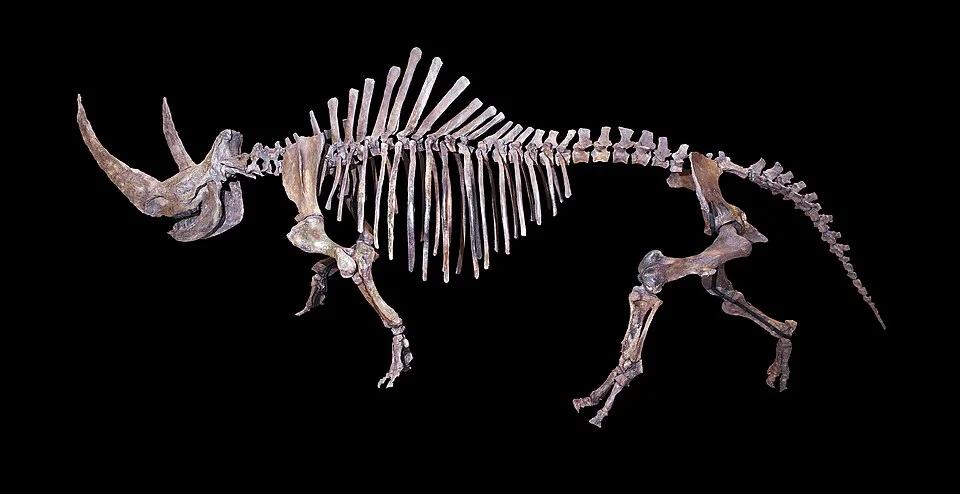
Woolly rhinoceros (Coelodonta antiquitatis), listed from Siberia at the Museum of Toulouse: a comparative example of extinction.
Credit: Didier Descouens · CC BY-SA 4.0 · sourceResized and converted to WebP; uncropped.
1. Meaning and forms of extinction
Biological extinction occurs when no living individual of a species remains anywhere. It eliminates a distinct evolutionary lineage and its future adaptive potential. Extinction differs from a temporary population decline: a declining species may recover, whereas a globally extinct species cannot be restored through ordinary conservation. Fossils reveal that extinction has continuously shaped life, but the present conservation concern is its unusually rapid, predominantly human-driven acceleration.
Local extinction, also called extirpation, means disappearance from a particular geographical area while the species survives elsewhere. A species classified as Extinct in the Wild survives only in cultivation, captivity or as naturalised populations well outside its former range. Ecological extinction describes a condition in which a species becomes too scarce to perform its former ecosystem role. Functional extinction is used in varying ways, including reproductive non-viability or loss of ecological function; neither expression is a formal IUCN Red List category.
Coextinction occurs when the disappearance of one species causes the loss of another dependent species. Highly host-specific parasites and obligate mutualists are particularly vulnerable. Losing a pollinator, seed disperser or host can also increase extinction risk without necessarily causing immediate extinction, because alternative partners may sometimes exist.
- Population loss is not automatically species extinction, but repeated local losses can culminate in global disappearance.
- Loss of genetic diversity can precede extinction and reduce a population’s capacity to adapt.
2. Natural extinction and the contemporary crisis
Background extinction is the ongoing turnover of species under ordinary evolutionary and ecological conditions. It results from changing environments, competition and other processes operating over geological time. A mass extinction is a geologically rapid, worldwide loss of a large proportion of species across many groups. A commonly used benchmark is the loss of at least three-quarters of species over a relatively short geological interval, although estimates depend on fossil evidence and the interval examined.
Five major mass extinctions are recognised in the fossil record: the end-Ordovician, Late Devonian, end-Permian, end-Triassic and end-Cretaceous events. The end-Permian event, about 252 million years ago, was the most severe. The end-Cretaceous event, about 66 million years ago, eliminated non-avian dinosaurs and many marine organisms; an asteroid impact was a principal trigger. These events should not be confused with routine background extinction.
The 2019 IPBES Global Assessment concluded that the global extinction rate is already at least tens to hundreds of times higher than the average over the past ten million years and is accelerating. Its estimate of around one million threatened species is not a count of species already extinct. The phrase sixth mass extinction highlights the present trajectory and potential magnitude; it should not imply that three-quarters of all current species have already disappeared.
- Extinction rates may be expressed as extinctions per million species-years.
- Unknown species, incomplete surveys and delayed recognition make observed extinction counts underestimates of actual losses.
A common pathway towards extinction
- 1. Habitat loss or other pressures reduce population size
- 2. Fragmentation isolates surviving populations
- 3. Genetic diversity and reproductive opportunities decline
- 4. Random disturbances and continuing threats intensify losses
- 5. Local populations disappear
- 6. The last surviving population is lost, causing global extinction
3. Drivers and mechanisms of extinction
IPBES identifies five major direct drivers of biodiversity loss: changes in land and sea use, direct exploitation of organisms, climate change, pollution and invasive alien species. Habitat conversion removes feeding, breeding and shelter sites. Fragmentation divides surviving habitat into smaller patches, increases edge effects and restricts movement. Roads, dams, fences and other infrastructure can isolate populations even where some apparently suitable habitat remains.
Overhunting, overfishing, destructive harvesting and illegal wildlife trade remove organisms faster than populations can replace them. Introduced predators, competitors and pathogens can overwhelm native species, particularly on islands where organisms evolved without comparable enemies. Pollution acts through poisoning, altered reproduction and food-web disruption. Veterinary diclofenac caused catastrophic declines in several South Asian Gyps vultures when birds consumed contaminated livestock carcasses.
Climate change shifts temperature and rainfall regimes, intensifies some extreme events and alters seasonal relationships. Mountain species may run out of cooler habitat, while marine heatwaves cause coral bleaching and mortality. Threats often reinforce one another: fragmentation may prevent climate-driven range shifts, and depleted populations may recover poorly after drought or disease.
An extinction vortex develops when small population size, inbreeding, genetic drift and random demographic or environmental fluctuations reinforce decline. Allee effects occur when individual fitness or population growth falls at low density, for example because mates become difficult to find. Extinction debt describes future losses caused by past habitat destruction: species may persist temporarily even when conditions no longer support long-term survival.
- Endemic species with tiny ranges can be eliminated by a single geographically concentrated disturbance.
- Large-bodied, slow-breeding species often recover slowly after exploitation.
| Condition | Meaning | Example or implication |
|---|---|---|
| Global extinction | No individuals survive anywhere | Dodo of Mauritius |
| Local extinction | Absent from part of its former range | Loss of India’s native cheetah population |
| Extinct in the Wild | Survives only under specified conditions outside its natural wild occurrence | Conservation breeding may enable restoration |
| Ecological extinction | Too scarce to fulfil its former ecological role | Seed-dispersal function may collapse before the disperser disappears |
| Coextinction | Loss caused by disappearance of an essential partner | A host-specific parasite may disappear with its sole host |
4. Assessing extinction risk
The IUCN Red List applies standardised criteria to assess extinction risk. Its categories include Least Concern, Near Threatened, Vulnerable, Endangered, Critically Endangered, Extinct in the Wild and Extinct, alongside Data Deficient and Not Evaluated. Only Vulnerable, Endangered and Critically Endangered collectively constitute the threatened categories. Data Deficient does not mean safe; inadequate knowledge may conceal substantial risk.
Assessment uses five criteria, labelled A to E: population reduction; restricted geographical range with specified additional conditions; small population size and decline; very small or restricted population; and quantitative analysis of extinction probability. A species may qualify through any applicable criterion. Extent of occurrence and area of occupancy are different spatial measures, not interchangeable descriptions of habitat size.
A species is classified Extinct when there is no reasonable doubt that its last individual has died, following exhaustive surveys appropriate to its biology, habitat and historical range. Failure to observe a species for a fixed number of years is not by itself a universal extinction rule. Possibly Extinct is a tag used for certain Critically Endangered species, not a separate category. Population viability analysis explores future risks under explicit assumptions; its results are conditional estimates rather than exact predictions.
- Red List status measures extinction risk; CITES appendices regulate international trade.
- Legal protection under Indian wildlife law is distinct from an IUCN assessment.
5. Preventing extinction and conserving ecological function
In situ conservation protects species within functioning habitats through protected areas, community stewardship, habitat restoration and landscape connectivity. Effective action must address the actual limiting threat: securing nesting sites will not rescue a bird if adults continue dying from poisoning or power-line collisions. Maintaining multiple viable populations reduces the chance that one disaster eliminates an entire species.
Ex situ measures include conservation breeding, botanical collections, seed banks and cryopreservation. They can preserve options when wild populations collapse, but cannot fully substitute for habitats, ecological interactions or locally adapted populations. Reintroductions require suitable habitat, removal of original threats, disease screening, appropriate genetic management and long-term monitoring. Genetic rescue may improve fitness in inbred populations, but poorly planned mixing can create biological risks.
India’s relevant framework includes the Wild Life (Protection) Act, 1972, the Biological Diversity Act, 2002, protected-area management and species recovery programmes. Globally, the Convention on Biological Diversity provides the main biodiversity framework. Target 4 of the 2022 Kunming-Montreal Global Biodiversity Framework calls for urgent action to halt human-induced extinction of known threatened species and support recovery. Conservation success means self-sustaining populations and restored ecological roles, not merely survival of a few captive individuals.
- Prioritise prevention: recovery generally becomes more difficult as populations shrink.
- Combine scientific monitoring with local participation, livelihood safeguards and control of illegal exploitation.
Extinction: Irreversible Loss and the Limits of Evidence
The woolly rhinoceros is an extinct species associated with Pleistocene Eurasia. The supplied metadata identifies a specimen from Siberia, Russia, held at the Museum of Toulouse. It provides a comparative example of global species loss, not archaeological or fossil evidence from India. Extinction differs from extirpation: an extirpated population has disappeared from a particular area, while the species survives elsewhere. The loss of the last surviving population makes extinction irreversible.
A fossil or museum specimen documents past existence but does not, by itself, establish the precise timing or cause of extinction. The youngest known fossil need not represent the last living individual because preservation and sampling are incomplete. Explanations for prehistoric losses require multiple lines of evidence, including dated remains, environmental reconstructions and evidence of human activity. Conservation biology applies this caution to living species: small, isolated populations can face interacting demographic fluctuations, inbreeding, habitat loss and environmental shocks.
- IUCN categories distinguish Extinct from Extinct in the Wild. The latter means survival only in captivity, cultivation or naturalised populations outside the former range; threatened does not mean already extinct.
- For India, the woolly rhinoceros offers conceptual comparison only. Protecting habitats, maintaining connectivity and reducing direct mortality can lower extinction risk for native species.
- For Prelims and Mains, distinguish global extinction, local disappearance and functional extinction. Functional extinction concerns lost ecological roles or reproductive viability, not necessarily the death of every individual.
Real-world case studies
South Asian vultures: identifying a reversible threat
White-rumped, Indian and Slender-billed Vultures underwent catastrophic declines after feeding on livestock carcasses containing diclofenac residues. Kidney failure and visceral gout were characteristic effects. India prohibited veterinary diclofenac in 2006. Conservation responses include safer veterinary alternatives such as meloxicam, conservation breeding, monitoring and Vulture Safe Zones. The case shows why protecting habitat alone cannot prevent extinction when mortality is caused by a toxic substance.
Mauritius kestrel: recovery from extreme rarity
The Mauritius kestrel, an island endemic, was reduced to only four known wild individuals in 1974. Captive breeding, supplementary feeding, nest management and releases supported its recovery. Its survival illustrates the value of intensive, species-specific intervention, while continuing management needs demonstrate that numerical improvement does not automatically remove long-term vulnerability.
Previous year questions
No source-linked PYQ is available here yet. Use the practice questions below.
Practice questions
Practice MCQ 1
With reference to extinction, consider the following statements: 1. Extirpation can occur while a species survives elsewhere. 2. Functional extinction is a formal IUCN Red List category. 3. Extinction debt implies that species losses may occur after the habitat disturbance responsible for them. Which statements are correct?
- A. 1 and 2 only
- B. 2 and 3 only
- C. 1 and 3 only
- D. 1, 2 and 3
Practice MCQ 2
Which of the following groups consists entirely of IUCN threatened categories?
- A. Near Threatened, Vulnerable and Endangered
- B. Vulnerable, Endangered and Critically Endangered
- C. Endangered, Extinct in the Wild and Extinct
- D. Data Deficient, Vulnerable and Critically Endangered
Practice MCQ 3
A rare plant persists for decades in small forest fragments, but its specialised pollinator has disappeared and no seedlings establish. Which interpretation is most appropriate?
- A. Survival of adult plants proves that the population is viable
- B. The plant must immediately be classified as globally extinct
- C. The population may carry an extinction debt arising from reproductive failure
- D. Pollinator loss cannot affect plant extinction risk
Mains practice · Extinction is often the final stage of a prolonged erosion of populations and ecological interactions. Explain, and suggest a conservation strategy for preventing such losses in India. Answer in 250 words.
- Distinguish population decline, extirpation, ecological extinction and global extinction.
- Explain fragmentation, extinction debt, coextinction and the extinction vortex.
- Use vulture declines to demonstrate the importance of identifying specific mortality drivers.
- Discuss habitat connectivity, community stewardship, threat removal and viable population targets.
- Assess conservation breeding, genetic management and reintroduction as complementary measures.
- Conclude with monitoring of reproduction, genetic diversity and ecological function rather than numbers alone.
Further reading
- NCERT Biology, Class XII: Biodiversity and Conservation.
- IUCN Red List Categories and Criteria, Version 3.1, and Guidelines for Using the IUCN Red List Categories and Criteria.
- IPBES: Global Assessment Report on Biodiversity and Ecosystem Services, 2019.
- Convention on Biological Diversity: Kunming-Montreal Global Biodiversity Framework, especially Target 4.
- Ministry of Environment, Forest and Climate Change: Action Plan for Vulture Conservation in India, 2020–2025.
- https://commons.wikimedia.org/wiki/File:Coelodonta_antiquitatis_.jpg
Preparing for UPSC Civil Services? Get classroom teaching, answer-writing evaluation and mentorship at Pragnya IAS Academy, Ashok Nagar — see why aspirants choose us for IAS coaching in Hyderabad.