
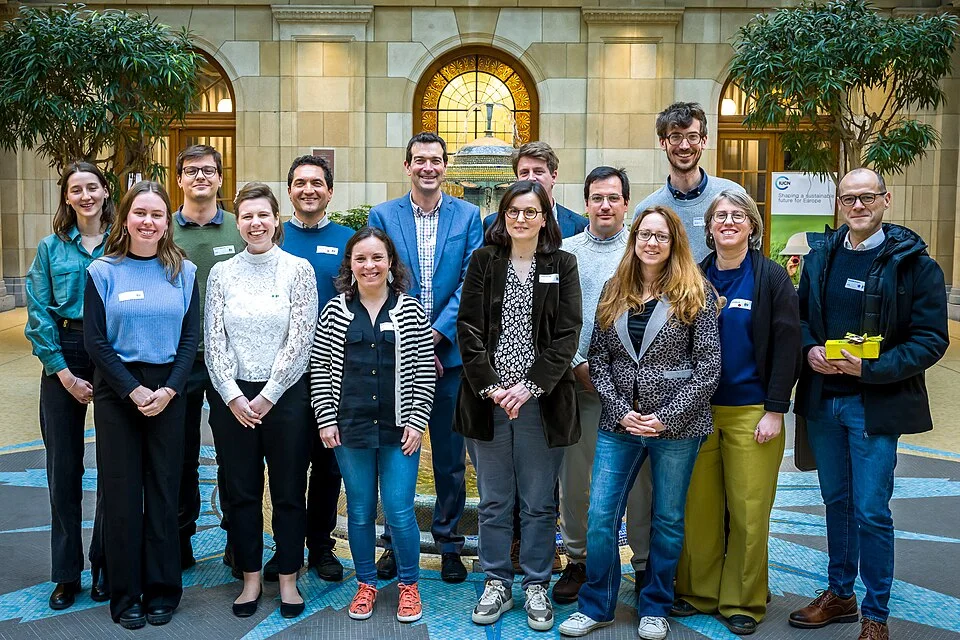
Border controls addressing invasive alien species, as identified in the image metadata.
Credit: Belgian Presidency of the Council of the EU 2024 from Belgium · CC BY 2.0 · sourceResized and converted to WebP; uncropped.
1. Meaning and ecological significance
An alien, exotic or non-native species occurs outside its natural past or present distribution because of human intervention, whether deliberate or accidental. The term includes viable seeds, eggs, spores and other propagules capable of producing organisms. An invasive alien species is an alien species whose introduction or spread threatens biological diversity. The central issue is therefore not foreign origin alone, but establishment, spread and harmful ecological consequences.
Introduction means arrival beyond the natural range. Establishment occurs when a species maintains a self-reproducing population without repeated human assistance. Naturalised species have established populations but need not be invasive. Invasion involves further spread and adverse effects. A species may remain inconspicuous for decades before expanding rapidly; this lag phase makes early risk assessment difficult.
Alien status is geographically specific. A species native to one part of a country can be alien in another ecological region. Conversely, a native species becoming locally abundant is not automatically an invasive alien species. Conservation assessment must specify the recipient ecosystem rather than simply label every troublesome organism invasive. Biological invasions are especially consequential on islands, where endemic species often evolved without particular predators, competitors or diseases.
- Alien does not mean invasive; invasive does not mean merely fast-growing.
- Introduced crops such as potato and maize illustrate why alien origin alone does not establish invasiveness.
- Translocation within national borders can also create ecological invasions.
2. Introduction pathways and drivers of spread
Deliberate introductions occur through horticulture, forestry, aquaculture, agriculture, pet keeping and biological control. Organisms introduced for useful purposes may escape cultivation or captivity and spread into natural habitats. Lantana entered India as an ornamental shrub, while several alien fishes were introduced for culture or fisheries enhancement. Risk assessment must consider both intended uses and the possibility of escape.
Unintentional introductions occur through contaminated seed or grain, soil attached to nursery plants, timber packaging, cargo, vehicles and transport equipment. Ships move aquatic organisms through ballast water and sediment; organisms attached to hulls constitute a separate pathway called biofouling. Canals and other artificial connections can enable movement across former biogeographical barriers.
Invasion success depends on propagule pressure, meaning the number of individuals introduced and the frequency of introduction, as well as suitable climate and available resources. Roads, fragmentation, overgrazing, fire and disturbed soil often create opportunities for establishment. Climate change can alter environmental suitability and open new areas to invaders, although responses differ among species. High reproduction, vegetative propagation, broad environmental tolerance and release from natural enemies can promote success, but no single trait reliably predicts every invasion.
- Transport and trade networks connect source populations with vulnerable recipient ecosystems.
- Disturbance often facilitates invasion, but relatively intact ecosystems are not universally immune.
- Repeated small introductions can create substantial cumulative invasion risk.
Invasion management sequence
- 1. Identify high-risk species and introduction pathways
- 2. Prevent entry through risk assessment and biosecurity
- 3. Detect new populations through surveillance
- 4. Respond rapidly and assess eradication feasibility
- 5. Contain or control established populations
- 6. Restore native habitats and monitor reinvasion
3. Ecological, economic and health impacts
Invasive species affect native biodiversity through competition, predation, herbivory, disease transmission and hybridisation. Introduced predators may eliminate island birds; alien plants may replace diverse grasslands with dense stands. Hybridisation can threaten the genetic integrity of native populations. The enemy-release hypothesis explains how escape from specialised predators, parasites or pathogens may help some introduced species expand.
Some invaders function as ecosystem engineers by changing habitat structure, nutrient cycling, hydrology or fire regimes. Water hyacinth forms floating mats that obstruct light and air–water exchange; decomposition of accumulated biomass can deplete dissolved oxygen. Dense Lantana thickets can suppress native regeneration and reduce access to forage. Such effects vary with habitat conditions, invasion intensity and interactions with other pressures.
Economic losses include reduced agricultural yields, blocked irrigation channels, impaired navigation, fisheries damage and management expenditure. Parthenium pollen and plant contact can cause respiratory allergy and dermatitis. Invasion impacts also have an equity dimension: pastoralists, fishers and forest-dependent communities may suffer disproportionately when access to common resources declines. However, local fuelwood or craft uses of an invasive plant can create livelihood dependence, requiring socially sensitive management.
- IPBES identifies invasive alien species as one of five major direct drivers of biodiversity loss.
- The other major direct drivers are land- and sea-use change, direct exploitation, climate change and pollution.
- A useful local application does not negate a species’ harmful ecological impacts.
| Species | Native range | Major concern |
|---|---|---|
| Lantana camara | Tropical Americas | Dense shrub invasion in forests and pastures; suppressed native regeneration |
| Water hyacinth: Pontederia crassipes, formerly Eichhornia crassipes | South America | Floating mats obstruct waterways and affect aquatic ecosystem functioning |
| Parthenium hysterophorus | Tropical and subtropical Americas | Agricultural and pasture weed; dermatitis and respiratory allergy |
| Prosopis juliflora | Tropical Americas | Encroachment into grasslands and other open habitats; context-dependent livelihood uses |
| African catfish: Clarias gariepinus | Africa and parts of West Asia | Predation and competition risks to native aquatic fauna |
4. Prevention, control and ecological restoration
Prevention is generally more cost-effective than managing a widespread invasion. Measures include pre-import risk assessment, quarantine, inspection, clean planting material, ballast-water management and regulation of high-risk trade pathways. Surveillance around ports, nurseries, wetlands and protected-area boundaries supports early detection. Rapid response is most feasible while populations remain small and geographically restricted.
Eradication means eliminating the entire population from a defined area. Containment limits spread beyond an occupied zone, while long-term control reduces abundance or impacts. Mechanical removal, carefully regulated chemical treatment and biological control may be combined according to species biology and site conditions. Repeated cutting can fail when plants resprout; careless handling can disperse seeds or viable fragments.
Biological control uses natural enemies to suppress a target organism. Classical biological control requires rigorous host-specificity testing, quarantine and post-release monitoring because an unsuitable agent may damage non-target species. Removal alone is rarely sufficient: managers must address disturbance, restore native vegetation and monitor reinvasion. For aquatic weeds, reducing excessive nutrient inputs can complement removal. Management success should be measured through native biodiversity recovery and ecosystem functioning, not merely the quantity of biomass removed.
- Prioritise high-value habitats, newly detected populations and major dispersal pathways.
- Coordinate across administrative boundaries because organisms do not follow jurisdictional limits.
- Include communities in surveillance, restoration and livelihood-transition planning.
5. International commitments and Indian governance
Article 8(h) of the Convention on Biological Diversity requires parties, as far as possible and appropriate, to prevent introductions and control or eradicate alien species threatening ecosystems, habitats or species. Target 6 of the Kunming–Montreal Global Biodiversity Framework, adopted in 2022, emphasises identifying and managing introduction pathways, reducing introductions and establishment, and eradicating or controlling invasive alien species, especially at priority sites such as islands.
The International Plant Protection Convention supports phytosanitary cooperation against plant pests. The International Maritime Organization’s Ballast Water Management Convention, which entered into force in 2017, addresses harmful aquatic organisms and pathogens transported in ballast water. It should not be confused with measures addressing hull biofouling.
In India, the Wild Life (Protection) Amendment Act, 2022 inserted Section 62A into the Wild Life (Protection) Act, 1972. It empowers the Central Government to regulate or prohibit the import, trade, possession or proliferation of invasive alien species and provides for seizure and disposal through authorised officers. Its definition refers to animal or plant species not native to India whose introduction or spread may threaten or adversely affect wildlife or habitat. This national-origin framing is narrower than the ecological concept of alien species, which can include within-country translocations.
The Plant Quarantine (Regulation of Import into India) Order, 2003 regulates imports of plants and plant materials to prevent entry of destructive pests. Effective implementation requires coordination among agriculture, environment, customs, shipping, fisheries and state agencies rather than reliance on a single institution.
Border biosecurity: preventing biological invasions
Border controls are directly relevant to invasive alien species because they target introduction pathways before organisms establish and spread. Plants, animals and microorganisms can cross borders through live-organism trade or unintentionally in cargo, packaging, soil and transport systems. Risk-based inspection, quarantine, treatment and restrictions on high-risk imports can reduce these introductions. The supplied metadata identifies border controls as the subject, but does not establish the country, organisms involved or specific procedures; it therefore supports a general biosecurity illustration rather than evidence of Indian enforcement.
For India, prevention matters because trade and travel can connect entry points with farms, forests, wetlands and other vulnerable habitats. Effective biosecurity links border measures with domestic surveillance, rapid identification and coordinated response. An alien organism is not automatically invasive: introduction must be distinguished from establishment, subsequent spread and harmful impacts. Conversely, a native species that becomes locally troublesome is not thereby an invasive alien species. Once an invader is widespread, eradication may become technically difficult or prohibitively costly, making containment, sustained control and habitat restoration more realistic objectives.
- Pathway management: assess both deliberately imported organisms and unintended hitchhikers; checking declared live imports alone leaves important introduction routes unmanaged.
- Evidence limits: interception indicates an arrival pathway, not established invasion. Establishment, spread and biodiversity impacts require separate ecological evidence.
- Prelims/Mains distinction: border quarantine is preventive, while post-entry surveillance enables early detection. For established Indian invaders such as water hyacinth, border controls alone cannot replace ecosystem-level management.
Real-world case studies
Banni grasslands, Gujarat
Prosopis juliflora, introduced in Kachchh during the twentieth century, spread extensively in the Banni landscape. Dense woody growth has affected open grassland habitats and pastoral resource use, although the plant also supports fuelwood and charcoal livelihoods. The case demonstrates why restoration must account for pastoral knowledge, livelihood trade-offs and sustained monitoring of regrowth.
Water hyacinth in Lake Victoria
Water hyacinth expanded in Lake Victoria in East Africa, affecting fishing, transport and shoreline access. Management combined mechanical measures with biological control using Neochetina weevils. Weed abundance also responded to environmental conditions. The case illustrates integrated management and cautions against attributing ecosystem-scale outcomes to one intervention alone.
Previous year questions
No source-linked PYQ is available here yet. Use the practice questions below.
Practice questions
Practice MCQ 1
Consider the following statements: 1. Every alien species established in a new region is necessarily invasive. 2. Human-assisted translocation within a country can create an ecological invasion. 3. An introduced population may remain small for years before spreading rapidly. Which statements are correct?
- A. 1 and 2 only
- B. 2 and 3 only
- C. 1 and 3 only
- D. 1, 2 and 3
Practice MCQ 2
Which option correctly distinguishes two pathways of marine biological invasion?
- A. Ballast water carries only plants, while biofouling carries only animals.
- B. Ballast water transports organisms within tanks, while biofouling involves organisms attached to submerged ship surfaces.
- C. Biofouling occurs only in freshwater ports.
- D. Ballast-water treatment necessarily eliminates all hull-associated organisms.
Practice MCQ 3
A newly detected invasive shrub occupies a small patch near a protected area. Which is the most appropriate initial management approach?
- A. Wait until its distribution becomes stable before assessing risk.
- B. Introduce an untested herbivore from the shrub’s native range.
- C. Delimit the infestation, assess risk and undertake rapid removal with follow-up monitoring.
- D. Remove above-ground biomass once and discontinue surveillance.
Mains practice · Biological invasions are both an ecological challenge and a governance problem. Discuss with Indian examples and suggest an integrated management strategy. Answer in 250 words.
- Distinguish alien, established and invasive species.
- Explain pathways linked to trade, horticulture, aquaculture and transport.
- Illustrate impacts using Lantana, water hyacinth and Prosopis.
- Discuss Section 62A, plant quarantine and the need for inter-agency coordination.
- Prioritise prevention, early detection, scientifically tested control and native-habitat restoration.
- Address livelihood dependence and long-term outcome monitoring.
Further reading
- NCERT Biology, Class XII: Biodiversity and Conservation.
- IPBES: Thematic Assessment Report on Invasive Alien Species and their Control, 2023, Summary for Policymakers.
- Convention on Biological Diversity: Article 8(h) and Kunming–Montreal Global Biodiversity Framework Target 6.
- India Code: Wild Life (Protection) Act, 1972, Section 62A.
- Directorate of Plant Protection, Quarantine and Storage: Plant Quarantine (Regulation of Import into India) Order, 2003.
- International Maritime Organization: Ballast Water Management Convention.
- https://commons.wikimedia.org/wiki/File:Border_controls_on_Invasive_Alien_Species_(53589582704).jpg
Preparing for UPSC Civil Services? Get classroom teaching, answer-writing evaluation and mentorship at Pragnya IAS Academy, Ashok Nagar — see why aspirants choose us for IAS coaching in Hyderabad.