

The National Oceanic and Atmospheric Administration's Mauna Loa Observatory on Mauna Loa in Hawaii.
Credit: NOAA Research cover image · Public domain · source

Women harvesting rice paddy in Tamil Nadu, India. Uploaded by Fowler&fowler (talk) 20:32, 9 September 2012 (UTC)
Credit: McKay Savage · CC BY 2.0 · source
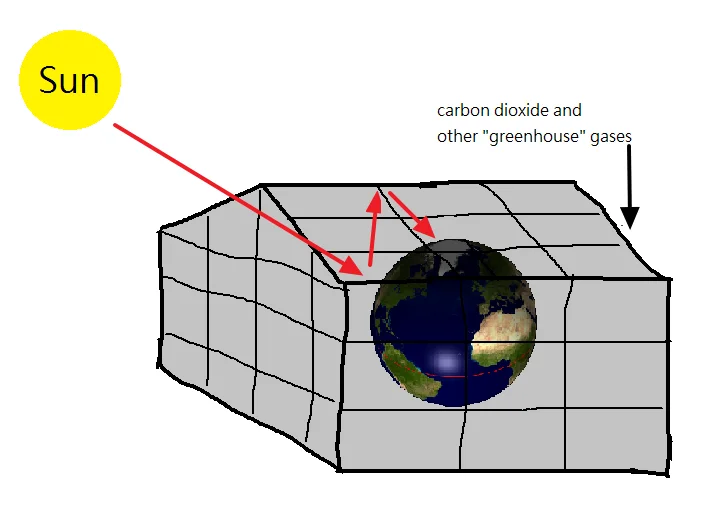
Illustrative diagram of the greenhouse effect, the warming mechanism associated with greenhouse gases.
Credit: Earth equator northern hemisphere.png Spm derivative work: Alexchris (talk) · Public domain · sourceResized and converted to WebP; uncropped.
1. Greenhouse effect and Earth’s energy balance
Earth receives energy mainly as shortwave solar radiation and releases energy as longwave infrared radiation. Some incoming sunlight is reflected by clouds, atmospheric particles and the surface. Greenhouse gases absorb outgoing infrared radiation at particular wavelengths and emit radiation in all directions, including towards the surface. This reduces the efficiency with which the surface loses energy to space. Without the natural greenhouse effect, Earth’s average surface temperature would be approximately −18°C rather than about +15°C.
The enhanced greenhouse effect arises when human activities increase greenhouse gas concentrations, disturbing the planetary energy balance. The warming continues until outgoing energy again balances incoming energy, although oceans and ice sheets respond over much longer periods. Radiative forcing, measured in watts per square metre, describes changes in Earth’s energy balance caused by drivers such as greenhouse gases and aerosols. Positive forcing tends to warm the climate; negative forcing tends to cool it.
A greenhouse gas is not defined simply by its abundance or molecular weight: its interaction with infrared radiation matters. Nitrogen and oxygen are poor absorbers of terrestrial infrared radiation. Conversely, relatively scarce gases can exert strong warming effects. The greenhouse effect is also distinct from stratospheric ozone depletion, although some chemicals contribute to both problems.
- Weather describes short-term atmospheric conditions; climate concerns their statistical patterns over longer periods.
- Greenhouse gases do not primarily warm Earth by absorbing ultraviolet radiation or by physically preventing air from escaping.
Timeline
1992
UNFCCC adopted.
1997
Kyoto Protocol adopted with an original six-gas or gas-group basket.
2012
Doha Amendment adopted, adding nitrogen trifluoride for Kyoto’s second commitment period.
2015
Paris Agreement adopted.
2016
Kigali Amendment adopted to phase down HFCs.
2. Major gases, sources and atmospheric behaviour
Carbon dioxide, or CO2, enters the atmosphere naturally through respiration, decomposition, ocean exchange and volcanic activity. Human sources include coal, oil and natural gas combustion, cement manufacture, deforestation and other land-use changes. Cement production releases CO2 both through fuel use and the calcination of limestone. Oceans and terrestrial ecosystems absorb part of anthropogenic emissions, but not all of them. CO2 has no single atmospheric lifetime: different removal processes operate over different timescales, and part of an emitted pulse persists for millennia.
Methane, or CH4, is emitted from wetlands, livestock digestion, manure, rice cultivation, landfills and fossil-fuel production and distribution. Anaerobic decomposition is central to many biological methane sources. Ruminants such as cattle and buffalo produce methane through enteric fermentation. Methane remains in the atmosphere for roughly 12 years and is removed mainly through reactions involving hydroxyl radicals. It also contributes to tropospheric ozone formation, linking climate mitigation with air-quality improvement.
Nitrous oxide, or N2O, is generated by microbial processes in soils and water. Human additions of reactive nitrogen through fertilisers and manure substantially increase emissions. Other sources include certain industrial processes and combustion. Its atmospheric lifetime is roughly a century. N2O also contributes to stratospheric ozone depletion, making it relevant to both climate and ozone science.
Fluorinated gases include hydrofluorocarbons, perfluorocarbons, sulphur hexafluoride and nitrogen trifluoride. Their applications include refrigeration, air conditioning, electrical insulation, semiconductor manufacture and aluminium production. Many have high warming potentials, and some persist for thousands of years. However, properties vary substantially between individual compounds: not every fluorinated gas has the same lifetime or climate impact.
- Water vapour is a major natural greenhouse gas, but its atmospheric abundance is largely temperature-controlled; it mainly acts as a feedback in current global warming.
- Tropospheric ozone is a greenhouse gas and air pollutant formed through photochemical reactions; stratospheric ozone protects life from harmful ultraviolet radiation.
- Black carbon warms the climate but is a particulate aerosol, not a greenhouse gas.
From greenhouse gas emissions to policy response
- 1. Identify emitting activities and gases
- 2. Estimate emissions and removals using inventory methods
- 3. Report individual gases and aggregate emissions as CO2e
- 4. Select gas-specific mitigation measures
- 5. Monitor outcomes and improve targets and implementation
3. Comparing emissions: concentration, lifetime and warming potential
Atmospheric concentration measures how much of a gas is present, usually in parts per million, billion or trillion. Emissions measure the quantity released over a period. An annual decline in emissions does not necessarily cause atmospheric concentrations to fall: concentrations can keep increasing when emissions exceed removals. This stock–flow distinction is particularly important for CO2 and explains why stabilising emissions alone does not stabilise warming.
Global Warming Potential, or GWP, compares the time-integrated radiative forcing from a pulse emission of a gas with that from an equal mass of CO2 over a specified period. CO2 therefore has a GWP of 1. The time horizon must be stated: methane’s GWP is much larger over 20 years than over 100 years because its warming influence is strong but relatively short-lived. IPCC AR6 gives methane a 100-year GWP of roughly 27–30, depending on its origin and accounting assumptions, and N2O a value of about 273.
Carbon dioxide equivalent, or CO2e, is calculated by multiplying the mass of a gas emitted by its selected GWP. It enables aggregation of different gases in inventories and targets, but it does not make their physical behaviour identical. GWP values can change between scientific assessments. For examination purposes, distinguish warming potential per kilogram from total contribution to warming: the latter also depends on emissions, concentration, persistence and atmospheric interactions.
- Radiative efficiency describes the strength of a gas’s radiative effect; atmospheric lifetime describes its persistence.
- Net-zero CO2 requires anthropogenic CO2 emissions to be balanced by anthropogenic CO2 removals; net-zero greenhouse gases involves a broader accounting balance.
| Gas | Important human sources | Key distinction |
|---|---|---|
| Carbon dioxide | Fossil fuels, cement, land-use change | GWP reference gas; no single atmospheric lifetime |
| Methane | Livestock, rice, waste, fossil-fuel leakage | Shorter-lived than CO2; stronger relative impact over a 20-year horizon |
| Nitrous oxide | Fertilised soils, manure, industry | Greenhouse gas that also contributes to ozone depletion |
| HFCs | Refrigeration, air conditioning, foams | Generally non-ozone-depleting; covered by the Kigali phase-down |
| SF6 and NF3 | Electrical equipment and electronics manufacture, respectively | High-GWP industrial gases covered by Kyoto accounting |
4. Greenhouse gases in international climate governance
The United Nations Framework Convention on Climate Change, adopted in 1992, seeks to stabilise greenhouse gas concentrations at a level that prevents dangerous anthropogenic interference with the climate system. Its principles include equity and common but differentiated responsibilities and respective capabilities. National inventories identify emissions by gas and sector and estimate removals by sinks, providing the foundation for mitigation policy and international reporting.
The Kyoto Protocol, adopted in 1997, established binding emission commitments for specified developed countries. Its original basket comprised CO2, CH4, N2O, hydrofluorocarbons, perfluorocarbons and sulphur hexafluoride. The Doha Amendment added nitrogen trifluoride for the second commitment period, 2013–2020. Water vapour and ozone were not included in this basket, despite being greenhouse gases.
The Paris Agreement, adopted in 2015, operates through nationally determined contributions and aims to hold warming well below 2°C while pursuing efforts to limit it to 1.5°C above pre-industrial levels. Its Enhanced Transparency Framework strengthens reporting and review. The Montreal Protocol primarily protects stratospheric ozone by controlling ozone-depleting substances, including CFCs and HCFCs. Its 2016 Kigali Amendment provides for an HFC phase-down. HFCs generally do not deplete ozone, but many are powerful greenhouse gases.
- The Global Methane Pledge seeks a collective reduction in anthropogenic methane emissions of at least 30% from 2020 levels by 2030 among participants; it is not a universal treaty obligation.
- India ratified the Kigali Amendment in 2021 and falls in the developing-country group scheduled to freeze HFC consumption in 2028.
5. Mitigation choices and Indian relevance
Effective mitigation is gas-specific. CO2 reduction requires cleaner electricity, energy efficiency, low-carbon transport, industrial changes and protection of carbon sinks. Methane measures include detecting fossil-fuel leaks, capturing landfill gas, improving manure management and modifying rice-water management. Alternate wetting and drying can reduce rice methane, but outcomes depend on local conditions, including water control, yields and possible changes in N2O emissions.
N2O mitigation focuses on efficient nitrogen use through appropriate fertiliser rates, timing and placement, improved manure handling and suitable inhibitors. Fluorinated-gas mitigation combines lower-impact refrigerants, leak prevention, recovery and responsible end-of-life management. The India Cooling Action Plan, released in 2019, connects cooling demand, energy efficiency and refrigerant transition. Low-GWP alternatives must also be assessed for safety, affordability and performance.
- India’s updated 2022 NDC commits to reducing GDP emissions intensity by 45% from its 2005 level by 2030; this is not an absolute emissions-reduction target.
- Forest conservation supports carbon storage, but biological sinks face risks from fire, drought and land-use change and cannot substitute indefinitely for fossil-fuel emission reductions.
Greenhouse gases: physical mechanism and governance distinctions
The metadata identifies a greenhouse-effect diagram, directly relevant to understanding greenhouse gases. Earth absorbs incoming solar energy and releases energy as infrared radiation. Greenhouse gases absorb and emit radiation at particular wavelengths, reducing outgoing heat loss for a given surface temperature. The surface and lower atmosphere consequently warm until the planetary energy balance is restored. This is not simply a layer that traps all heat, nor is it the same process as ozone-layer depletion.
Carbon dioxide, methane, nitrous oxide and fluorinated gases differ in sources, atmospheric persistence and warming influence. Water vapour is an important greenhouse gas, but its global atmospheric abundance responds strongly to temperature; it mainly amplifies warming rather than acting as the principal direct driver of current human-caused climate change. For India, relevant mitigation sectors include energy and industry for carbon dioxide, livestock and rice cultivation for methane, and agricultural soils receiving nitrogen inputs for nitrous oxide. A conceptual diagram explains the mechanism but cannot establish emission quantities, national responsibility or the effectiveness of a climate policy.
- Carbon dioxide equivalent aggregates gases using a specified metric, commonly global warming potential. The chosen time horizon matters, especially when comparing methane with carbon dioxide.
- UNFCCC and Paris Agreement reporting addresses multiple greenhouse gases, not carbon dioxide alone. HFC phase-down under the Kigali Amendment complements climate mitigation despite HFCs not depleting ozone.
- Distinguish emissions from atmospheric concentrations: annual flows add to atmospheric stocks, while removal processes and gas lifetimes influence how long warming effects persist.
Real-world case studies
India: the Indore Bio-CNG plant
The Gobar-Dhan Bio-CNG plant inaugurated in Indore in 2022 was designed to process 550 tonnes of wet organic waste daily. Anaerobic digestion converts segregated organic waste into biogas, which is upgraded for fuel use. The example links urban waste management, methane capture and fossil-fuel substitution. Climate benefits depend on preventing methane leakage and managing residual digestate safely.
European Union: controlling fluorinated gases
The European Union’s Regulation (EU) 2024/573 strengthens controls on fluorinated greenhouse gases through HFC quota reductions, restrictions on selected equipment, and recovery and servicing requirements. It illustrates how refrigerant policy must address both new products and gases already contained in existing equipment.
Previous year questions
Source-linked detailed analyses are available above.
Practice questions
Practice MCQ 1
Consider the following statements: 1. Water vapour mainly amplifies present-day global warming through a feedback. 2. Black carbon is a gaseous compound included in the original Kyoto basket. 3. Tropospheric ozone can contribute to warming. Which statements are correct?
- A. 1 and 2 only
- B. 1 and 3 only
- C. 2 and 3 only
- D. 1, 2 and 3
Practice MCQ 2
With reference to Global Warming Potential, consider the following statements: 1. It compares equal masses of a gas and carbon dioxide. 2. Its value depends on the selected time horizon. 3. It directly measures a gas’s atmospheric concentration. Which statements are correct?
- A. 1 only
- B. 2 and 3 only
- C. 1 and 2 only
- D. 1, 2 and 3
Practice MCQ 3
Which statement correctly describes the Kigali Amendment?
- A. It introduces a global phase-out of carbon dioxide emissions.
- B. It regulates HFCs because all HFCs destroy stratospheric ozone.
- C. It adds water vapour to the Kyoto Protocol’s greenhouse gas basket.
- D. It provides for an HFC phase-down under the Montreal Protocol framework.
Mains practice · Why must climate mitigation extend beyond carbon dioxide? Discuss the opportunities and implementation challenges of controlling non-CO2 greenhouse gases in India. Answer in 250 words.
- Explain differences in atmospheric lifetime, radiative effects and mitigation opportunities.
- Identify methane sources in livestock, rice cultivation, waste and energy systems.
- Discuss fertiliser-related N2O and refrigerant-related HFC emissions.
- Connect mitigation with cleaner air, resource efficiency, Bio-CNG and the India Cooling Action Plan.
- Examine food security, farmer costs, monitoring gaps, refrigerant safety and methane leakage.
- Conclude that non-CO2 mitigation complements, rather than replaces, sustained CO2 reductions.
Further reading
- NCERT, Fundamentals of Physical Geography: Solar Radiation, Heat Balance and Temperature; World Climate and Climate Change.
- IPCC, Sixth Assessment Report, Working Group I, Chapter 7 and Summary for Policymakers.
- UNFCCC: Kyoto Protocol, Doha Amendment and Paris Agreement official texts.
- UNEP Ozone Secretariat: Montreal Protocol and Kigali Amendment resources.
- Ministry of Environment, Forest and Climate Change: India Cooling Action Plan, 2019.
- UNFCCC NDC Registry: India’s Updated First Nationally Determined Contribution, 2022.
- https://commons.wikimedia.org/wiki/File:Greenhouse_effect_diagram.png
Preparing for UPSC Civil Services? Get classroom teaching, answer-writing evaluation and mentorship at Pragnya IAS Academy, Ashok Nagar — see why aspirants choose us for IAS coaching in Hyderabad.