
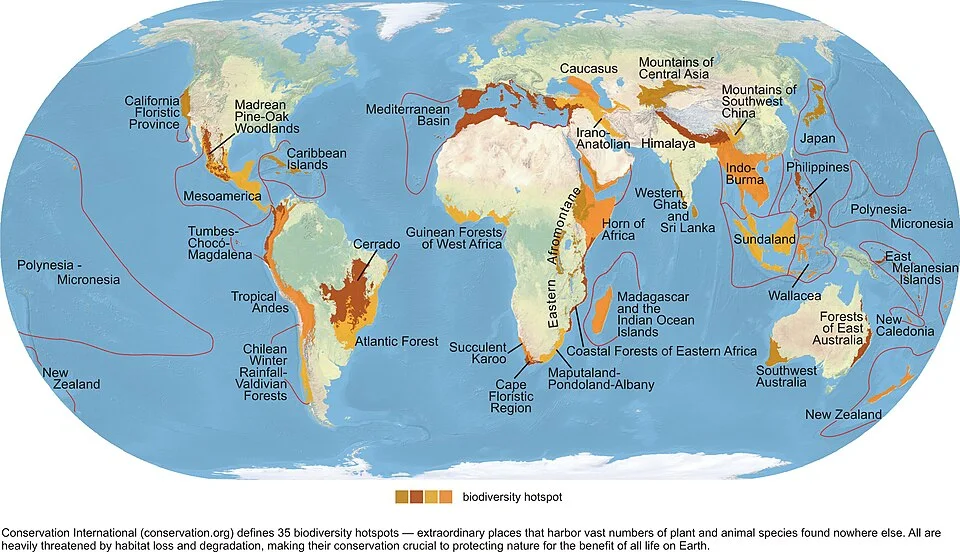
Global biodiversity hotspot map; the supplied description reflects an earlier 35-hotspot classification.
Credit: Conservation International · CC BY-SA 4.0 · sourceResized and converted to WebP; uncropped.
1. Concept, origin and qualifying criteria
Conservation biology addresses the protection of biodiversity, ecological processes and evolutionary potential. Because conservation resources are limited, scientists seek areas where intervention can prevent especially large and irreversible losses. Norman Myers proposed the biodiversity hotspot concept in 1988, initially highlighting tropical forest regions rich in endemic plants and threatened by habitat destruction. Conservation International subsequently adopted and developed the framework. A landmark global assessment published in Nature in 2000 identified 25 hotspots; later assessments expanded the recognised list to 36.
A region must satisfy two criteria simultaneously. First, it must contain at least 1,500 species of vascular plants that occur nowhere else naturally. This represents approximately 0.5% of the global vascular plant species total used when the criterion was formulated. Second, it must have lost at least 70% of its original natural vegetation, meaning that 30% or less remains. The first criterion measures irreplaceability; the second indicates severe historical habitat loss.
The thresholds concern endemic vascular plants and original natural vegetation. They do not refer to 1,500 animal species, 70% loss of species, or a specified number of threatened mammals. Vascular plants possess specialised conducting tissues and include flowering plants, conifers and ferns. Although animals and other organisms contribute greatly to a hotspot's conservation importance, animal richness is not the formal qualifying criterion.
- Both criteria are necessary: high endemism alone or severe habitat loss alone is insufficient.
- A hotspot is a broad biogeographic region, not necessarily a small local site.
- The 70% threshold measures cumulative vegetation loss, not an annual deforestation rate.
Timeline
1988
Norman Myers introduced the biodiversity hotspot concept.
2000
A landmark Nature assessment presented 25 global biodiversity hotspots.
2004
A revised global assessment recognised 34 hotspots.
2011
Forests of East Australia became the 35th recognised hotspot.
2016
The North American Coastal Plain was recognised as the 36th hotspot.
2. Ecological importance and associated terminology
Species richness is the number of species within an area, whereas endemism concerns geographical restriction. A region with many widespread species may have high richness but relatively low endemism. Conversely, an isolated mountain range or island may contain fewer species overall yet support many unique species. An endemic organism is not necessarily threatened, although a narrow distribution can increase vulnerability to habitat destruction, invasive species and extreme events.
Hotspots collectively support more than half of the world's plant species and about 43% of terrestrial vertebrate species as endemics, according to Conservation International. Their remaining natural habitats occupy only about 2.5% of Earth's land surface. These figures refer to surviving habitat, not the full original geographical extent of the hotspot regions. Loss of a habitat containing a narrowly endemic species can cause global extinction rather than merely local disappearance.
Isolation, environmental heterogeneity and evolutionary history help explain concentrations of endemism. Islands restrict dispersal, while mountain ranges generate varied climates across short distances and can isolate populations in separate valleys. Long-term persistence in suitable habitats may permit distinctive lineages to survive. Conservation of these regions also supports water regulation, pollination, soil protection and livelihoods, although ecosystem-service value is not itself a hotspot selection criterion.
- Native species occur naturally in a region; endemic species are native and geographically restricted.
- Threatened species belong to the IUCN categories Vulnerable, Endangered or Critically Endangered.
- A centre of endemism, a megadiverse country and a biodiversity hotspot are related but distinct concepts.
From hotspot identification to conservation action
- 1. Delineate a biogeographic region and assess its native vegetation.
- 2. Verify at least 1,500 endemic vascular plant species.
- 3. Verify loss of at least 70% of original natural vegetation.
- 4. Identify surviving habitats, threatened endemic species and ecological connections.
- 5. Implement legally supported protection, community-based management and suitable restoration.
- 6. Monitor biodiversity outcomes and adapt management.
3. The four hotspots overlapping India
The Himalaya hotspot extends across the Himalayan mountain system in several countries, including India, Nepal and Bhutan. In India, it encompasses Himalayan landscapes with substantial variation in altitude, rainfall and vegetation. Broadleaf forests, conifer forests and alpine vegetation support distinctive biological communities. The eastern Himalaya is particularly rich in orchids and rhododendrons. Roads, hydropower development, forest conversion and climate-driven shifts in species distributions create important conservation challenges.
Indo-Burma includes extensive parts of mainland Southeast Asia and adjoining areas of northeastern India. In standard Indian hotspot accounts, Indian areas include northeastern landscapes south of the Brahmaputra and the Andaman Islands. Northeastern India should not be treated as belonging wholly to one hotspot: different landscapes fall within Himalaya or Indo-Burma. Forest conversion, hunting, infrastructure expansion and fragmentation threaten the region's biodiversity.
The Western Ghats and Sri Lanka form one combined hotspot, despite being separated by sea. India's Western Ghats run along the western side of the peninsula and contain evergreen forests, moist deciduous forests and high-elevation shola–grassland mosaics. Notable fauna include the lion-tailed macaque and Nilgiri tahr, alongside many endemic amphibians and freshwater fishes. Sundaland includes the Malay Peninsula and major islands such as Sumatra, Borneo and Java; its Indian component is the Nicobar Islands, not the entire Andaman and Nicobar archipelago.
- Western Ghats and Sri Lanka is one hotspot, not two separate hotspots.
- India's four hotspots extend beyond Indian territory.
- Use recognised hotspot maps rather than administrative boundaries for precise location-based questions.
| Hotspot | Indian component | Important distinction |
|---|---|---|
| Himalaya | Indian Himalayan landscapes | Not restricted to the eastern Himalaya |
| Indo-Burma | Parts of northeastern India and Andaman Islands | Does not include all northeastern landscapes indiscriminately |
| Western Ghats and Sri Lanka | Western Ghats | A single transnational hotspot |
| Sundaland | Nicobar Islands | Andaman Islands are not its Indian component |
4. Conservation instruments and landscape management
Hotspot status does not automatically prohibit mining, construction or forest diversion. In India, enforceable conservation measures arise through laws and notifications, including the Wild Life (Protection) Act, 1972, the Biological Diversity Act, 2002, as amended, and the Environment (Protection) Act, 1986. National parks, wildlife sanctuaries, conservation reserves and community reserves protect particular areas. Eco-sensitive zone notifications can regulate specified activities around protected areas, but they are not synonymous with hotspot designation.
Effective conservation must extend beyond isolated protected areas. Habitat fragments may retain species temporarily but lose them later because populations become too small or disconnected, a phenomenon associated with extinction debt. Corridors and stepping-stone habitats can maintain dispersal and gene flow. However, connectivity measures must be designed around target species and local conditions; a narrow tree strip cannot replace a large, intact forest ecosystem.
Landscape planning should first avoid destruction of irreplaceable habitats, then minimise unavoidable impacts and restore degraded areas. Restoration should favour appropriate native ecosystems rather than treating all open land as degraded forest. Native montane grasslands, for example, can be harmed by tree planting. Community participation, recognition of lawful rights, sustainable livelihoods and monitoring of ecological outcomes are essential for durable conservation.
- People's Biodiversity Registers, prepared through Biodiversity Management Committees, can support local biodiversity documentation.
- Monitor habitat quality, endemic-species populations and connectivity, not merely plantation area.
- Cumulative impacts of roads, dams and settlements require landscape-level assessment.
5. Strengths, limitations and examination relevance
The hotspot framework provides a clear argument for directing resources towards places where unique biodiversity is highly threatened. It links global extinction prevention with spatial planning and helps communicate why small surviving habitat patches may have exceptional importance. However, it is a prioritisation tool rather than a complete representation of Earth's conservation needs.
Dependence on vascular plant endemism may underrepresent some animal groups, freshwater systems and poorly documented organisms. The framework is principally terrestrial and should not be applied mechanically to marine biodiversity. Large, relatively intact ecosystems may fail the habitat-loss criterion despite supporting enormous biodiversity and important ecological functions. Similarly, deserts, grasslands and wetlands outside hotspots remain conservation priorities.
For Prelims, distinguish qualifying criteria from descriptive features and legal categories. Neither species richness alone nor the presence of charismatic wildlife establishes hotspot status. UNESCO World Heritage status, biosphere reserve designation, Ramsar recognition and hotspot membership follow different systems and can overlap geographically. Also distinguish hotspot habitat loss from threatened-species assessment: IUCN Red List categories assess extinction risk, while hotspot designation identifies broad regions of endemism and extensive vegetation loss.
- Hotspot does not mean every species within the region is endemic or endangered.
- Absence from a hotspot does not imply low ecological value.
- Conservation priorities should combine hotspot information with ecosystem representation, climate resilience and local evidence.
Reading hotspot maps: priorities, boundaries and limitations
A biodiversity hotspot map illustrates conservation priorities based on both irreplaceability and threat, rather than species richness alone. Qualification requires at least 1,500 endemic vascular plant species and loss of at least 70% of original natural vegetation. Endemic species have restricted geographical distributions; losing their remaining habitat can therefore cause global extinction, not merely local disappearance. Plant endemism is the formal selection criterion, although hotspot conservation also benefits animals and ecological processes.
The supplied metadata describes 35 hotspots, whereas the currently recognised framework contains 36. This makes the image relevant as a conceptual illustration but requires a historical-count caveat; its precise boundaries cannot be verified from metadata alone. Four hotspots overlap India: Himalaya, Indo-Burma, Western Ghats and Sri Lanka, and Sundaland. These are biogeographic regions crossing political boundaries, not exclusively Indian units or statutory protected areas. Hotspot status supports prioritisation, but effective conservation still requires local evidence on habitat condition, connectivity, species distributions and community needs.
- For Prelims, distinguish endemism from richness: many species alone do not qualify a region; both the endemic-plant and habitat-loss thresholds must be met.
- For Indian geography, Sundaland includes the Nicobar Islands, not the Andaman Islands; avoid treating the entire island territory as one hotspot component.
- For Mains, hotspot targeting is not a complete conservation strategy: ecosystems outside hotspots also need protection for ecological functions, threatened species and representative habitat coverage.
Real-world case studies
Silent Valley, Kerala
A proposed hydroelectric project on the Kunthipuzha River threatened tropical evergreen forest within the Western Ghats hotspot. Scientific assessment and public mobilisation highlighted the ecological importance of the landscape, including habitat for the lion-tailed macaque. The project was abandoned, and Silent Valley was declared a national park in 1984. The episode illustrates the value of avoiding irreversible habitat loss rather than relying solely on compensatory measures.
Great Nicobar, Sundaland
Great Nicobar contains tropical forests, coastal ecosystems and habitats important for endemic wildlife. Galathea Bay is a major leatherback turtle nesting area. Proposed port and associated infrastructure development has generated debate over forest loss, coastal impacts and Indigenous communities' interests. The case demonstrates why hotspot-scale significance must inform project-level and cumulative environmental assessment; hotspot recognition alone does not determine legal permission.
Previous year questions
No source-linked PYQ is available here yet. Use the practice questions below.
Practice questions
Practice MCQ 1
Which of the following are necessary conditions for recognition as a biodiversity hotspot? 1. At least 1,500 endemic vascular plant species. 2. Loss of at least 70% of original natural vegetation. 3. At least 100 globally threatened mammal species. Select the correct answer.
- A. 1 and 2 only
- B. 2 and 3 only
- C. 1 and 3 only
- D. 1, 2 and 3
Practice MCQ 2
Consider the following pairs: 1. Nicobar Islands — Sundaland. 2. Western Ghats — Western Ghats and Sri Lanka. 3. Andaman Islands — Himalaya. How many pairs are correctly matched?
- A. Only one
- B. Only two
- C. All three
- D. None
Practice MCQ 3
With reference to biodiversity hotspots, consider the following statements: 1. Every endemic species is necessarily endangered. 2. Hotspot recognition automatically creates a national park under Indian law. 3. A highly diverse region may fail to qualify if it has retained most of its original natural vegetation. Which statements are correct?
- A. 1 only
- B. 1 and 2 only
- C. 3 only
- D. 2 and 3 only
Mains practice · Explain the scientific basis of biodiversity hotspot identification. Discuss its relevance and limitations for conservation planning in India. Answer in 250 words.
- Define hotspots using both qualifying thresholds.
- Explain irreplaceability, endemism and historical habitat loss.
- Locate the four hotspots overlapping India, distinguishing Andaman from Nicobar.
- Discuss prioritisation of threatened habitats, connectivity and extinction prevention.
- Clarify that hotspot status does not itself confer legal protection.
- Examine taxonomic bias and the exclusion of many intact or non-hotspot ecosystems.
- Conclude with landscape-level, community-inclusive and ecosystem-representative conservation.
Further reading
- NCERT Biology, Class XII: Biodiversity and Conservation.
- Conservation International: Biodiversity Hotspots, conservation.org.
- Critical Ecosystem Partnership Fund: hotspot profiles and ecosystem profiles, cepf.net.
- Myers and colleagues, Biodiversity hotspots for conservation priorities, Nature, 2000.
- Ministry of Environment, Forest and Climate Change: biodiversity publications and India's reports to the Convention on Biological Diversity, moef.gov.in.
- National Biodiversity Authority: Biological Diversity Act and biodiversity governance resources, nbaindia.org.
- https://commons.wikimedia.org/wiki/File:Biodiversity_Hotspots_Map.jpg
Preparing for UPSC Civil Services? Get classroom teaching, answer-writing evaluation and mentorship at Pragnya IAS Academy, Ashok Nagar — see why aspirants choose us for IAS coaching in Hyderabad.