
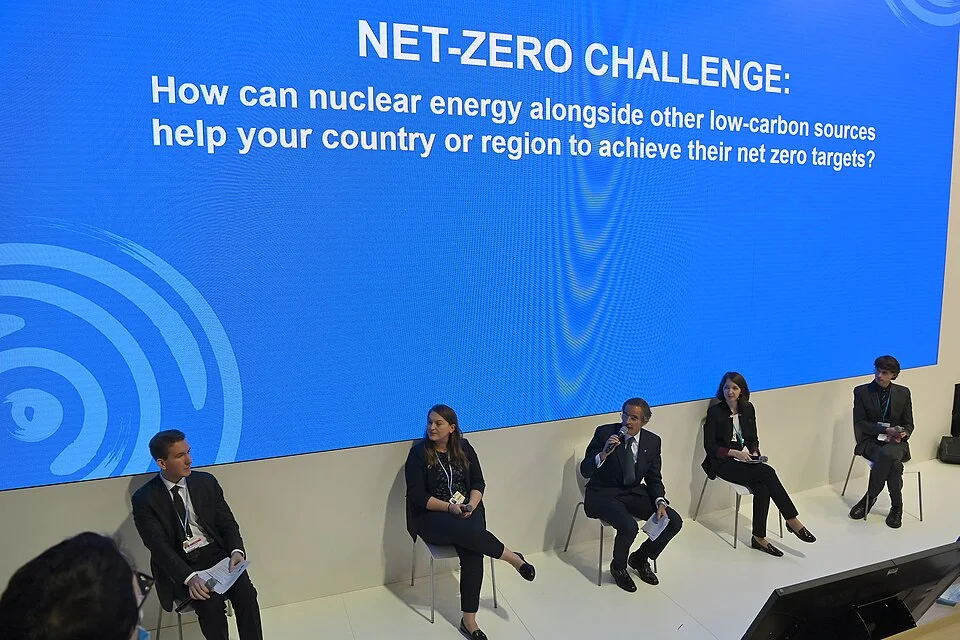
COP26 event on nuclear energy, youth and net zero, Glasgow, 2021. Credit: Dean Calma / IAEA, CC BY 2.0.
Credit: IAEA Imagebank · CC BY 2.0 · sourceResized and converted to WebP; uncropped.
1. Meaning and scientific basis
Net zero describes a balance between human-caused emissions and human-caused removals within a defined boundary and period. The boundary may be a country, company or the global economy. Net-zero carbon dioxide means balancing CO2 alone; net-zero greenhouse gases includes gases such as methane, nitrous oxide and fluorinated gases, aggregated using an emissions metric. The chosen metric matters because these gases differ in atmospheric lifetime and warming effects.
Cumulative CO2 emissions are the principal determinant of CO2-induced warming. Consequently, reducing annual emissions without eventually reaching net-zero CO2 does not stop their cumulative contribution to warming. Sustained global net-zero CO2, together with strong reductions in non-CO2 greenhouse gases, is necessary to limit human-induced warming. Net zero should therefore be understood as a physical endpoint supported by immediate action, not simply a distant policy slogan.
Carbon neutrality is often used for net-zero CO2, but corporate usage can also refer to balancing a limited footprint through purchased credits. It is therefore not automatically equivalent to an economy-wide net-zero greenhouse gas target. Net-negative emissions occur when anthropogenic removals exceed emissions. Even after net zero, sea-level rise and some other impacts can continue, so adaptation remains indispensable.
- Gross zero means no emissions within the defined boundary; net zero permits residual emissions balanced by removals.
- Emissions intensity measures emissions per unit of output or GDP; falling intensity can coexist with rising absolute emissions.
Timeline
2015
Paris Agreement adopted, including the long-term emissions–removals balance objective.
2018
IPCC Special Report on Global Warming of 1.5°C highlighted the need for global net-zero CO2 around mid-century in 1.5°C pathways.
2021
India announced its 2070 net-zero goal at COP26.
2022
India submitted its updated NDC and Long-Term Low-Carbon Development Strategy.
2023
The first Global Stocktake concluded at COP28.
2. Net zero in international climate governance
The Paris Agreement seeks to hold warming well below 2°C above pre-industrial levels and pursue efforts to limit it to 1.5°C. Article 4 calls for global peaking of emissions as soon as possible, recognising that peaking will take longer for developing countries, followed by rapid reductions. It envisages a balance between anthropogenic emissions by sources and removals by sinks in the second half of this century, on the basis of equity and sustainable development.
Paris does not impose one identical net-zero year on every country. Nationally Determined Contributions, or NDCs, specify successive national climate efforts and are communicated every five years. Parties must prepare, communicate and maintain NDCs and pursue domestic mitigation measures, but the agreement does not guarantee achievement of each nationally chosen numerical outcome. Long-term low greenhouse gas emission development strategies provide a longer planning horizon.
The Enhanced Transparency Framework supports reporting and review, while the Global Stocktake assesses collective progress every five years. The first stocktake concluded at COP28 in 2023 and called for transitioning away from fossil fuels in energy systems in a just, orderly and equitable manner. Equity remains central: historical responsibility, per-capita emissions, development needs, finance and technology access affect how the global transition burden should be shared.
- Common but differentiated responsibilities and respective capabilities remains a foundational principle.
- A target announced politically, included in a strategy or enacted in domestic law has different accountability implications.
Building a credible net-zero strategy
- 1. Define scope and establish a verified emissions inventory.
- 2. Set a long-term target and measurable interim milestones.
- 3. Prioritise absolute emissions reductions and align investment.
- 4. Identify unavoidable residual emissions.
- 5. Secure credible removals with environmental and social safeguards.
- 6. Monitor, disclose and strengthen implementation.
3. India’s net-zero pathway
India announced a 2070 net-zero goal through the Panchamrit commitments at COP26. Its updated NDC, submitted in August 2022, commits to reducing the emissions intensity of GDP by 45% by 2030 from the 2005 level. It also targets about 50% cumulative electric power installed capacity from non-fossil fuel-based energy resources by 2030, with support through technology transfer and low-cost international finance, including the Green Climate Fund.
These targets require careful interpretation. Installed capacity is not electricity generation, because technologies have different capacity-utilisation patterns. Non-fossil energy includes nuclear power as well as renewable sources. India’s intensity target does not mean an absolute 45% reduction in national emissions. The NDC also retains the objective of creating an additional carbon sink of 2.5–3 billion tonnes of CO2 equivalent through additional forest and tree cover by 2030.
India submitted its Long-Term Low-Carbon Development Strategy at COP27 in November 2022. Important policy instruments include renewable energy expansion, transmission and storage, energy efficiency, railway electrification, public transport and the National Green Hydrogen Mission. The Energy Conservation (Amendment) Act, 2022 enabled a carbon credit trading framework; the Carbon Credit Trading Scheme followed in 2023. These instruments must be assessed through actual emissions outcomes, not announcements alone.
A just transition is particularly important for coal-dependent districts, workers and state revenues. India must reconcile reliable and affordable energy, industrialisation and poverty reduction with decarbonisation. Domestic institutional capacity and predictable international finance will influence the speed and distributional fairness of this transition.
| Concept | Meaning | Exam caution |
|---|---|---|
| Net-zero CO2 | Anthropogenic CO2 emissions equal anthropogenic CO2 removals. | Does not necessarily cover other greenhouse gases. |
| Net-zero greenhouse gases | Aggregated greenhouse gas emissions balance removals using a specified metric. | Not interchangeable with net-zero CO2. |
| Emissions intensity reduction | Lower emissions per unit of GDP or output. | Absolute emissions may still increase. |
| Avoided emissions | Emissions reduced relative to a counterfactual baseline. | Not the same as withdrawing CO2 from the atmosphere. |
| Carbon dioxide removal | Anthropogenic extraction of atmospheric CO2 with storage. | Durability and lifecycle emissions must be assessed. |
4. How net zero can be achieved
The first priority is rapid, sustained emissions reduction. Power-sector decarbonisation supports electrification of transport, buildings and parts of industry. Efficiency, compact urban planning, public transport, circular material use and reduced energy demand can lower the scale of clean-energy investment required. Methane abatement from fossil fuel systems, waste and agriculture can reduce near-term warming, although agricultural mitigation must protect food security and livelihoods.
Some emissions are harder to eliminate, including those from cement chemistry, aviation and certain agricultural activities. Credible pathways reserve removals for genuinely residual emissions rather than using them to postpone feasible reductions. Biological options include ecosystem restoration and improved land management. Engineered options include direct air carbon capture and storage and bioenergy with carbon capture and storage, subject to energy, land, water, cost and sustainability constraints.
Carbon capture and storage at a fossil-fuel facility generally avoids part of an emission; it is not automatically atmospheric carbon removal. Removal requires extracting CO2 from the atmosphere and storing it. Natural background uptake by oceans and land should not simply be counted as a country’s additional mitigation effort.
5. Credibility, accounting and environmental safeguards
A credible target specifies its gases, sectors, geographical boundary, baseline, target year and treatment of international aviation and shipping. For companies, coverage of direct emissions, purchased-energy emissions and value-chain emissions is critical. Interim targets, investment plans and transparent monitoring, reporting and verification make a distant pledge assessable today.
Offsets require scrutiny. Additionality asks whether mitigation would have happened without the intervention; permanence concerns the durability of storage; leakage occurs when emissions shift elsewhere. Forest carbon can be reversed through fires, logging or drought. Double counting arises when the same mitigation outcome is claimed more than once. Under relevant Paris Article 6 arrangements, corresponding adjustments help address double counting between national accounts.
Avoided-emission credits are not equivalent to removals for balancing residual emissions at net zero. Large-scale monoculture plantations can also damage biodiversity, water availability and community rights. Strong governance therefore combines deep domestic reductions, conservative accounting, durable removals and social safeguards. Success should be measured against cumulative emissions and near-term progress, not merely the number of entities announcing targets.
Net zero: energy choices and credible governance
The metadata identifies a COP26 discussion linking nuclear energy and youth participation to the net-zero transition. It illustrates a climate-governance debate, not evidence that a particular technology or country has achieved net zero. Net zero requires balancing anthropogenic emissions with anthropogenic removals over a specified period. Credible pathways prioritise deep emissions cuts, reserving removals for residual emissions rather than treating offsets as an unlimited substitute for mitigation.
Nuclear power can contribute low-carbon electricity, but it is not a carbon-removal technology and its lifecycle emissions are not zero. Its role depends on costs, construction timelines, safety, waste management and electricity-system needs. India's announced net-zero target is 2070; evaluating progress requires attention to interim commitments, sectoral policies, finance and equitable access to energy. Youth participation highlights intergenerational equity, while a just transition also requires protection for affected workers and communities. The event description establishes its stated subject, but cannot demonstrate policy effectiveness or agreement among participants.
- Distinguish net-zero CO2 from net-zero greenhouse gases: gas coverage and the metric used to aggregate gases matter; net zero does not mean zero gross emissions.
- Separate reductions, avoided emissions and removals: replacing fossil generation lowers emissions, whereas removals extract greenhouse gases from the atmosphere and require durable storage.
- Assess pledges through coverage, interim milestones, transparent accounting and implementation. A conference discussion is neither a negotiated COP decision nor proof of a legally enforceable national obligation.
Real-world case studies
United Kingdom: legislating the target
In 2019, the United Kingdom amended its Climate Change Act framework to require at least a 100% reduction in the net UK carbon account by 2050 relative to 1990. Five-year carbon budgets and the independent Climate Change Committee support accountability. The case illustrates how legislation and interim budgets can strengthen a pledge, while delivery still depends on sectoral policies.
Sweden: separating reductions from supplementary measures
Sweden targets net-zero greenhouse gas emissions by 2045 and negative emissions thereafter. Its framework requires emissions from Swedish territory to be at least 85% below 1990 levels by 2045, with supplementary measures addressing the remainder. This illustrates the importance of specifying how much a target relies on direct reductions rather than balancing mechanisms.
Previous year questions
No source-linked PYQ is available here yet. Use the practice questions below.
Practice questions
Practice MCQ 1
Consider the following statements: 1. Net-zero CO2 necessarily means that emissions of every greenhouse gas are zero. 2. Reducing emissions intensity can coexist with rising absolute emissions. 3. Net-negative CO2 emissions occur when anthropogenic CO2 removals exceed anthropogenic CO2 emissions. Which statements are correct?
- A. 1 and 2 only
- B. 2 and 3 only
- C. 1 and 3 only
- D. 1, 2 and 3
Practice MCQ 2
With reference to India’s climate commitments, consider the following statements: 1. India has announced a net-zero target for 2070. 2. Its updated NDC requires a 45% absolute reduction in greenhouse gas emissions by 2030 from 2005 levels. 3. Its non-fossil electricity target is expressed in terms of installed capacity. Which statements are correct?
- A. 1 and 2 only
- B. 1 and 3 only
- C. 2 and 3 only
- D. 1, 2 and 3
Practice MCQ 3
Which intervention most directly constitutes carbon dioxide removal, provided that its lifecycle accounting confirms net removal?
- A. Replacing a coal power plant with a solar power plant
- B. Capturing fossil CO2 from a cement plant before release
- C. Capturing CO2 from ambient air and storing it permanently underground
- D. Improving the fuel efficiency of diesel trucks
Mains practice · A net-zero pledge is only as credible as its near-term implementation and accounting framework. Discuss with reference to India’s development priorities. (250 words)
- Define net zero and distinguish CO2 from all-greenhouse-gas coverage.
- Explain interim targets, cumulative emissions and transparent inventories.
- Link India’s 2070 goal with its 2030 NDC and long-term strategy.
- Discuss energy access, industrial growth and coal-region just transitions.
- Evaluate offsets, removals, permanence and double-counting risks.
- Conclude with finance, technology, institutional accountability and equity.
Further reading
- IPCC, Climate Change 2023: AR6 Synthesis Report, Summary for Policymakers.
- UNFCCC, Paris Agreement, especially Articles 4, 6, 13 and 14.
- Government of India, Updated First Nationally Determined Contribution, 2022.
- Government of India, Long-Term Low-Carbon Development Strategy, 2022.
- Bureau of Energy Efficiency, Indian Carbon Market and Carbon Credit Trading Scheme resources.
- United Nations High-Level Expert Group, Integrity Matters: Net Zero Commitments by Businesses, Financial Institutions, Cities and Regions, 2022.
- https://commons.wikimedia.org/wiki/File:Net_Zero_World_(cop26_2164)_(51657431225).jpg
Preparing for UPSC Civil Services? Get classroom teaching, answer-writing evaluation and mentorship at Pragnya IAS Academy, Ashok Nagar — see why aspirants choose us for IAS coaching in Hyderabad.