

Sundarbans National Park is a major national park, tiger reserve, and biosphere reserve located in West Bengal, India. It forms the core part of the vast Sundarbans on the Ganges Delta and is adjacent
Credit: Kingshuk Mondal · CC BY 4.0 · source
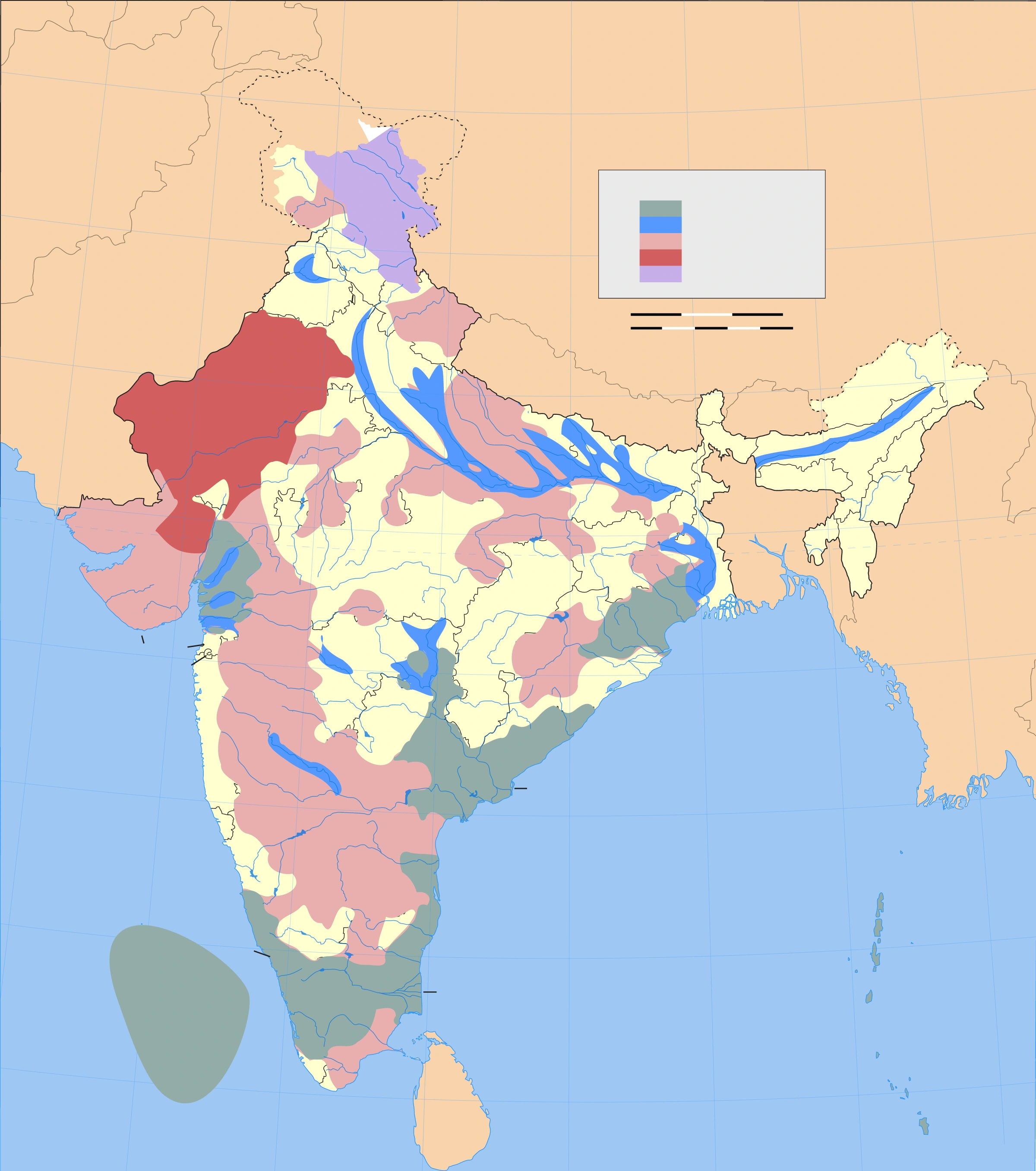
Map study
Broad climatic disaster-risk regions: compare flood, drought and cyclone patterns. Historical conceptual reference, not a real-time warning or site-specific assessment.
- Read the source legend and reference date before interpreting the map.
- Use spatial patterns to support topic revision; verify current official boundaries, designations and warnings separately.
Credit: Saravask; Planemad; Nichalp · CC BY-SA 3.0 · sourceConverted to WebP on an opaque white background; proportionally resized without cropping. Original cartography and legend retained.
1. Meaning, risk and adaptive capacity
The Intergovernmental Panel on Climate Change defines adaptation in human systems as adjustment to actual or expected climate and its effects, to moderate harm or exploit beneficial opportunities. In natural systems, it refers to adjustment to actual climate and its effects; human intervention may facilitate adjustment to expected climate. Examples include heat-action plans, drought-resilient crops, flood-resilient infrastructure and ecosystem restoration.
Climate risk arises from interactions among climatic hazards, exposure and vulnerability. A cyclone is a hazard; people and assets located along an affected coast constitute exposure. Unsafe housing, poverty, ecosystem degradation and inadequate public services increase vulnerability. Adaptation can reduce exposure through risk-sensitive land-use planning and reduce vulnerability through stronger buildings, social protection and accessible health services.
Adaptive capacity is the ability of people, institutions and ecosystems to adjust, respond and cope. It depends on finance, information, technology, institutions, education and ecosystem health. Vulnerability is therefore socially differentiated: women, small farmers, informal workers, persons with disabilities and marginalised communities may face disproportionate risks. Effective adaptation requires locally appropriate measures rather than a uniform technological solution.
- Resilience concerns the capacity to cope with disturbances while maintaining essential functions and the capacity to adapt, learn and transform.
- Disaster risk reduction overlaps with adaptation, but also covers non-climatic hazards such as earthquakes.
Timeline
1992
UNFCCC adopted, recognising cooperation and assistance for adaptation.
2008
India launches the National Action Plan on Climate Change.
2010
COP16 adopts the Cancun Adaptation Framework and establishes the National Adaptation Plan process.
2015
Paris Agreement establishes the Global Goal on Adaptation under Article 7.
2023
COP28 adopts the UAE Framework for Global Climate Resilience.
2. Approaches and sectoral applications
Anticipatory adaptation occurs before impacts materialise, such as designing drains for projected rainfall extremes. Reactive adaptation follows experienced impacts. Autonomous adaptation arises from responses by households, firms or ecosystems without a deliberate public adaptation policy; planned adaptation follows a conscious policy decision. Incremental adaptation preserves the basic character of a system, whereas transformational adaptation changes its fundamental attributes, such as shifting livelihood systems where existing activities become unviable.
Adaptation measures may be structural, ecosystem-based, institutional or behavioural. Seawalls and cyclone shelters are structural measures; wetland restoration is ecosystem-based; zoning and building codes are institutional; changing outdoor work schedules during heatwaves is behavioural. Ecosystem-based adaptation uses biodiversity and ecosystem services to help people adapt. Mangroves can reduce coastal wave energy, while urban trees provide shade and cooling. Their performance remains dependent on ecological conditions and hazard intensity.
Agricultural adaptation includes crop diversification, adjusted sowing dates, soil-moisture conservation and climate information services. Water-sector measures include demand management, rainwater harvesting and watershed restoration. Cities require heat-action plans, permeable surfaces, drainage maintenance and climate-resilient housing. Health systems need heat surveillance, disease monitoring and resilient facilities. No-regret measures provide benefits even if projected climate impacts differ from expectations, although their costs and distributional effects still require assessment.
- Insurance and contingency finance can support recovery but do not physically prevent climatic hazards.
- Diversification usually reduces dependence on a single climate-sensitive crop, livelihood or water source.
An iterative adaptation planning cycle
- 1. Assess current and projected hazards, exposure and vulnerability
- 2. Identify locally appropriate options with affected communities
- 3. Appraise costs, equity, ecosystem impacts and maladaptation risks
- 4. Integrate priorities into budgets and development plans
- 5. Implement measures with clear institutional responsibilities
- 6. Monitor outcomes and revise as risks and evidence change
3. International adaptation governance and finance
The United Nations Framework Convention on Climate Change recognises adaptation alongside mitigation. Its provisions include cooperation on adaptation and assistance to particularly vulnerable developing countries. The Cancun Adaptation Framework, adopted at COP16 in 2010, strengthened adaptation institutions and initiated the National Adaptation Plan process. National Adaptation Plans identify medium- and long-term needs and integrate adaptation into development planning. They differ from National Adaptation Programmes of Action, which focused on urgent and immediate needs of least developed countries.
Article 7 of the Paris Agreement establishes the Global Goal on Adaptation: enhancing adaptive capacity, strengthening resilience and reducing vulnerability to climate change. It recognises adaptation as a global challenge with local through international dimensions. Countries should, as appropriate, submit and periodically update adaptation communications describing priorities, implementation needs, plans and actions. COP28 in 2023 adopted the UAE Framework for Global Climate Resilience, providing thematic and adaptation-cycle targets to guide progress towards this goal.
The Green Climate Fund supports both mitigation and adaptation. The Adaptation Fund finances concrete adaptation projects and programmes in developing countries and permits direct access through accredited national implementing entities. The Least Developed Countries Fund and Special Climate Change Fund are administered by the Global Environment Facility. UNEP’s Adaptation Gap Report 2024 estimated the developing-country adaptation finance gap at US$187–359 billion annually, underscoring the difference between available international public finance and estimated needs.
- The Adaptation Committee promotes coherent implementation of enhanced adaptation action under the UNFCCC.
- Adaptation communications are not identical to Nationally Determined Contributions, although they may be submitted as a component of, or alongside, them.
| Concept | Primary focus | Example |
|---|---|---|
| Mitigation | Reducing emissions or enhancing sinks | Replacing coal-generated electricity with renewable power |
| Adaptation | Adjusting to climatic impacts | Preparing heat-action plans |
| Disaster risk reduction | Preventing and reducing disaster risk | Cyclone shelters and earthquake-resistant construction |
| Loss and damage | Addressing adverse climate impacts, including those not avoided | Responding to loss of land and livelihoods from sea-level rise |
| Maladaptation | An intervention increases or redistributes risk adversely | Flood protection that worsens downstream flooding |
4. Adaptation governance in India
India’s National Action Plan on Climate Change, launched in 2008, contains eight national missions. Adaptation-relevant missions include the National Water Mission, National Mission for Sustainable Agriculture, National Mission for Sustaining the Himalayan Ecosystem and Green India Mission. State Action Plans on Climate Change translate national priorities into state-specific interventions, reflecting differences among coastal, Himalayan, arid and urban environments.
The National Adaptation Fund for Climate Change supports adaptation activities in states and Union territories particularly vulnerable to climate impacts. Established in 2015–16, it is administered by the Ministry of Environment, Forest and Climate Change, with NABARD as National Implementing Entity. It is a domestic fund and should not be confused with the international Adaptation Fund. India’s updated NDC of 2022 also retains adaptation priorities concerning agriculture, water resources, the Himalayan region, coastal regions, health and disaster management.
Adaptation is implemented through multiple sectors rather than one programme alone. Watershed development, MGNREGA-supported water conservation, resilient agriculture research, cyclone preparedness and municipal heat-action plans can contribute. ICAR’s National Innovations in Climate Resilient Agriculture supports research and demonstrations. Effective delivery requires coordination among ministries, state departments, district administrations and local bodies, supported by climate information and public participation.
- IMD forecasts and warnings support anticipatory action; their effectiveness depends on accessible communication and timely local response.
- Climate-proofing infrastructure requires attention to future climatic conditions, not only historical design standards.
5. Maladaptation, limits and evaluation
Maladaptation means actions that may increase climate-related risks, vulnerability or inequity, now or in the future. A seawall may protect one settlement while worsening erosion elsewhere. Unregulated groundwater extraction may cushion short-term drought impacts but deplete aquifers. Cooling based solely on inefficient air-conditioning can increase electricity demand, emissions and outdoor waste heat while excluding households unable to afford it.
Soft adaptation limits occur when options exist but are not currently available because of constraints such as finance or institutions. Hard limits occur when no adaptive action can avoid intolerable risks. With rising warming, some ecosystems and livelihoods face increasingly severe limits. Loss and damage concerns adverse impacts associated with climate change, including impacts that are not avoided through mitigation or adaptation; it is not simply another name for adaptation.
Assessment should measure outcomes, not merely expenditure or infrastructure built. Useful indicators include reduced heat illness, reliable water access, livelihood stability and ecosystem condition. Monitoring must also test whether benefits reach vulnerable groups and whether risks are transferred elsewhere. Flexible planning, periodic review and community knowledge help avoid locking societies into unsuitable long-lived investments.
- An adaptation gap is the difference between implemented adaptation and the level needed to meet a specified objective.
- Climate-resilient development integrates adaptation and mitigation with sustainable development.
Real-world case studies
Ahmedabad Heat Action Plan
Following the severe 2010 heatwave, Ahmedabad launched a Heat Action Plan in 2013. It combines forecast-based warnings, public communication, health-worker training and coordinated response. Subsequent cool-roof initiatives illustrate how built-environment measures can complement emergency preparedness. The case demonstrates the importance of early action and protecting outdoor workers and vulnerable residents.
Odisha’s cyclone preparedness
After the 1999 super cyclone, Odisha strengthened disaster-management institutions, cyclone shelters, evacuation arrangements and community preparedness. Large-scale evacuations during Cyclone Phailin in 2013 helped limit deaths compared with the 1999 disaster. Such systems support climate adaptation, although mortality comparisons also depend on cyclone characteristics, exposure and other conditions.
Previous year questions
No source-linked PYQ is available here yet. Use the practice questions below.
Practice questions
Practice MCQ 1
Consider the following statements: 1. The Global Goal on Adaptation is established under Article 7 of the Paris Agreement. 2. National Adaptation Plans are intended exclusively for immediate emergency relief. 3. Adaptation communications may be submitted alongside an NDC. Which statements are correct?
- A. 1 and 2 only
- B. 1 and 3 only
- C. 2 and 3 only
- D. 1, 2 and 3
Practice MCQ 2
Which intervention most clearly illustrates maladaptation?
- A. Restoring wetlands after assessing local hydrology
- B. Diversifying crops using locally suitable varieties
- C. Subsidising unrestricted groundwater pumping in an already overexploited aquifer
- D. Issuing heat warnings linked to public-health responses
Practice MCQ 3
Consider the following statements: 1. NABARD is the National Implementing Entity for India’s National Adaptation Fund for Climate Change. 2. The Green Climate Fund finances only mitigation. 3. The Adaptation Fund permits direct access through accredited national implementing entities. Which statements are correct?
- A. 1 only
- B. 2 and 3 only
- C. 1 and 3 only
- D. 1, 2 and 3
Mains practice · Adaptation is essential for climate-resilient development, but poorly designed adaptation can deepen vulnerability. Discuss with Indian examples. Suggest safeguards against maladaptation. Answer in 250 words.
- Define adaptation and distinguish it from mitigation.
- Explain differentiated vulnerability across communities and regions.
- Use heat-action plans, cyclone preparedness and watershed management as examples.
- Discuss groundwater depletion, risk-shifting coastal defences and unequal access to cooling.
- Recommend participatory risk assessment, ecosystem safeguards, climate-informed planning and equity-sensitive monitoring.
- Conclude that adaptation requires finance and institutions but cannot replace ambitious mitigation.
Further reading
- IPCC Sixth Assessment Report, Working Group II: Impacts, Adaptation and Vulnerability, Summary for Policymakers and Annex II Glossary.
- UNFCCC: Paris Agreement Article 7, National Adaptation Plans and UAE Framework for Global Climate Resilience.
- UNEP: Adaptation Gap Report 2024.
- MoEFCC: National Action Plan on Climate Change and India’s Updated First NDC, 2022.
- NABARD: National Adaptation Fund for Climate Change.
- NDMA: Guidelines for Preparation of Action Plan—Prevention and Management of Heat Wave.
Preparing for UPSC Civil Services? Get classroom teaching, answer-writing evaluation and mentorship at Pragnya IAS Academy, Ashok Nagar — see why aspirants choose us for IAS coaching in Hyderabad.